physical environment
 Call Kai
 Learn
Learn Practice Test
 Spaced Repetition
 Match
Match Flashcards
 Knowt Play
1/46

There's no tags or description
Looks like no tags are added yet.
Name | Mastery | Learn | Test | Matching | Spaced | Call with Kai | Chat |
|---|
No analytics yet
Send a link to your students to track their progress
47 Terms
what is climate
long term description of weather at a given location, based on averages and variation measured over decades.
or the long term trends in temperature, wind, and precipitation
what drives the climate system
radiation from the sun ultimately drives the climate system as well as biological energy production
what are the aspects of the physical environment
climate and chemical composition of air and water (salinity, acidity, and concentrations of gases in the atmosphere and dissolved in water)
what is weather
the current temperature, humidity, precipitation, wind, and cloud cover
what is climate variation
it includes the daily and seasonal cycles associated with changes in solar radiation as earth rotates on its axis and orbits the sun. it also includes changes over years or decades, such as large-scale cyclic weather patterns (El nino southern oscillation)
how does climate determine where organisms live
temperature determines rates of biochemical reactions and physiological activity for all organisms. ocean organisms depend on current, temperature, and water chemistry.
rain water is important. its an essential resource for land organisms and it maintains the quality of freshwater organisms
how can you characterize climate - or any aspect of the physical environment
by a given location by the average conditions and by its variability over time.
how does climate influence abiotic processes
climate affects the rate at which rocks and soil are broken down to supply nutrients to plants and microorganisms.
describe the process for solar radiation to reach earth
of the total solar radiation that earth receives a third of it is reflected back out by clouds, aerosols, and the earth’s surface. a fifth of the incoming radiation is absorbed by ozone, clouds, and water vapor in the atmosphere. the remaining half is absorbed by land and water at the surface.
what are aerosols
fine atmospheric particles
what happens when solar radiation is absorbed by earth’s surface
the solar radiaion absorbed by earth’s surface is emitted to the atmosphere as infrared radiation
how can earth’s surface cool
earth’s surface can lose energy and cool when water evaporates, because the phase change from liquid to water vapor absorbs energy
what is latent heat flux
the heat loss due to evaporation
what is conduction
the transfer of energy through the exchange of kinetic energy by molecules in direct contact with one another
what is convection
the transfer of energy by the movement of currents of air (wind) and water
what is sensible heat flux
the energy transfer from the warm air immediately above earth’s surface to the cooler atmosphere by convection and conduction is known as sensible heat flux
what are greenhouse gases
gases in the atmosphere that absorb and reradiate infrared radiation
what are the greenhouse gases
water vapor (H2O)
carbon dioxide (CO2)
methane (CH4)
nitrous oxide (N2O)
why is it hotter at the equator and colder at the poles
near the equator, the sun’s rays strike earth’s surface perpendicularly. toward the north and south poles, the angle of the sun’s rays becomes steeper, so the same amount of energy is spread over a progressively larger area of earth’s surface.
because of the angle the sun hits earth
because of how long the radiation has to travel through the atmosphere
why does uplift happen
the heating of earth’s surface varies with latitude and topography. such differential warming creates pockets of warm air surrounded by cooler air. when the warm, less dense air is surrounded by cooler denser air it will rise.
what is atmospheric pressure
its the force exerted by molecules of air on the air and surface below it
what happens to atmospheric pressure with altitude
atmospheric pressure decreases with increasing altitude
what happens when atmospheric pressure decreases
as the pocket of warm air rises it will expand. this expansion will cool the rising air because cool air cannot hold as much water vapor as warm air. so as the air continues to air continues to rise and cool water vapor will condense into droplets and form clouds
why dont clouds form past the stratosphere
cloud rise when warm air is surrounded by cool air. The air in the troposphere is cool, but the air in the stratosphere is warm. this creates a boundary where the air pocket stops rising
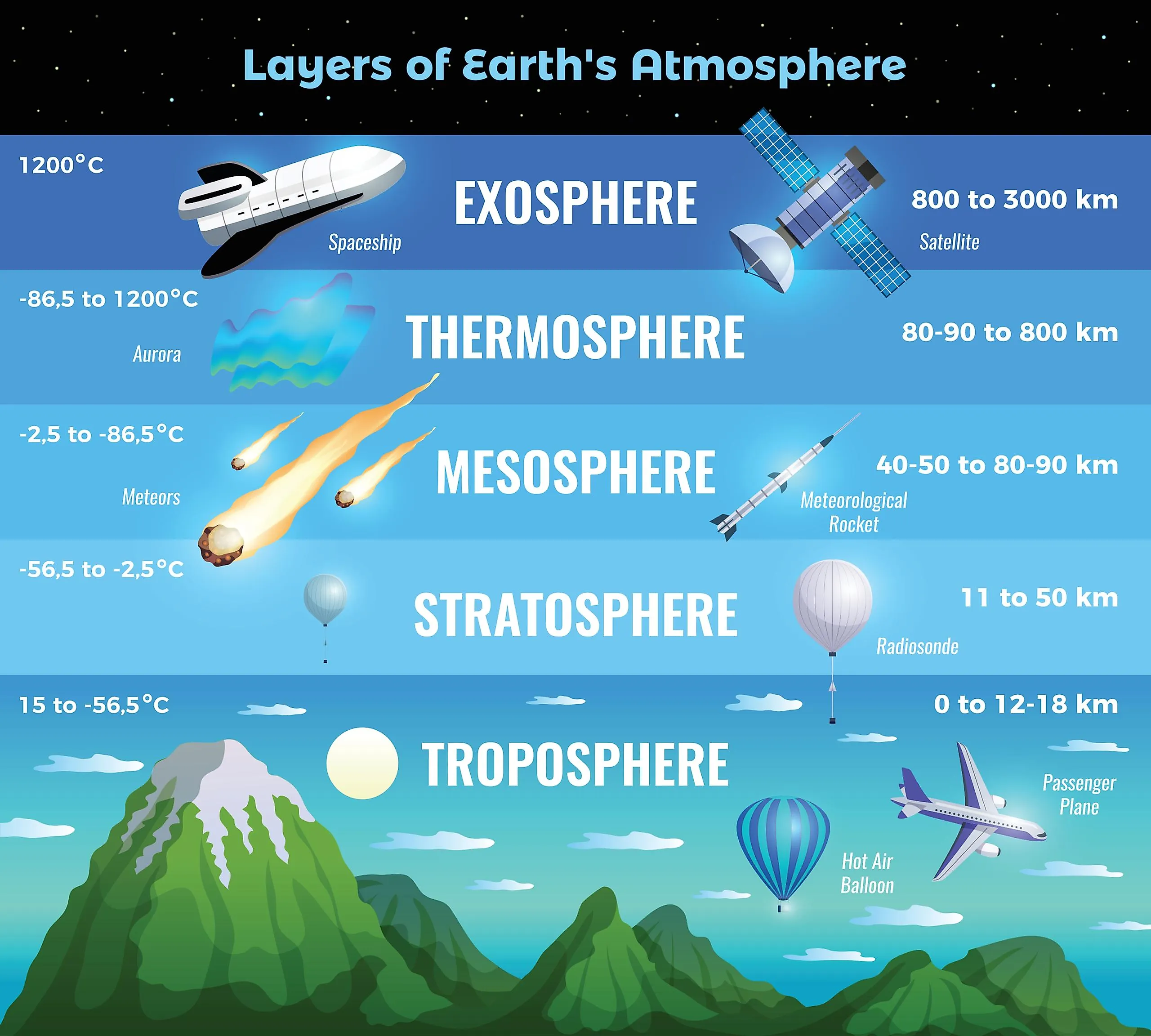
explain the circulation of air in a hadley cell
the warm air of the tropics cause the air to rise. it will rise until it reaches the boundary between troposphere and stratosphere where it will move towards the poles. here the air will cool down and once the air temperature and atmosphere temperature are the same the air falls back to the surface.
what is subsidence
its the process for air to descend back towards earth’s surface in a circulation cell
what does subsidence result in
subsidence creates areas of high atmospheric pressure around latitude 30N 30S, which prevent cloud formation and cause these areas to be very dry.
what is a hadley cell
its the circulation cell that is formed by the uplife of war air at the equator

what is a polar cell
circulation cell that occurs at the north and south pole
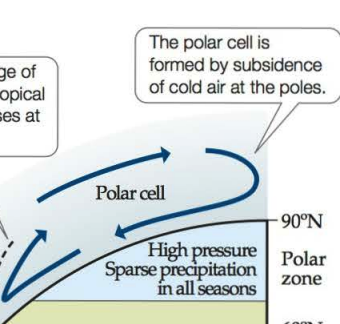
how does a polar cell work
cold, dense air subsides at the poles and moves toward the equator when it reaches the surface.

what is a ferrell cell
its the intermediate circulation cell between the hadley and polar cell
what drives the ferrell cell
the ferrell cell is driven by the movement of the hadley and polar cells and by exchange of energy between tropical and polar air masses at the polar front

how do prevailing winds occur
winds flow from high pressure areas to low so because of atmospheric circulation cells these areas of high and low pressures are constant which creates these constant patterns of wind
explain the coriolis effect
to an observer on earth’s surface rotating around the planetary axis, the path of the wind appears curved.
or
the apparent deflection of moving air and water currents caused by earth's rotation. because earth rotates faster at the equator than at higher latitudes, moving air or water retains its rotational momentum, causing it to deflect to the right in the northern hemisphere and to the left in the southern hemisphere relative to an observer on earth's surface.
why are seasonal air temperature changes less extreme over oceans than on land
because water has a higher heat capacity than land, so it can absorb more energy without its temperature rising. So ocean waters will remain cooler than land in summer, but warmer than land in the winter. and air temperatures near the ocean will follow this trend
why are ocean currents similar to prevailing winds
because of the coriolis effect. from an observer on earth, the water is deflected to the right in northern hemisphere and to the left in southern hemisphere.wh
why don’t the surface and deep layers of ocean water mix
because of differences in their temperature and salinity.
the surface waters are warmer and less saline, and therefore less dense, than the deeper, cooler ocean waters.
how does downwelling occur
when warm tropical surface currents reach polar regions, the water loses heat to the surrounding environment and becomes cooler and denser. when the water cools enough to form ice, the remaining water will increase in salinity which will then sink to deeper layers.
how does upwelling occur
when prevailing winds blow nearly parallel to a coastline. the force of the wind, in combination with the coriolis effect, causes surface waters to flow away from the coast and deeper, colder waters rise to replace them.
how can the coriolis effect create zones of upwelling
as a result of the coriolis effect, water just to the north and south of the equator is deflected slightly away from the equator, causing divergence of surface water and a zone of upwelling
why are upwelling zones among the most productive open ocean ecosystems
when organisms in the surface water dies, their body and all the nutrients they contain, sink and accumulate in deep water. upwelling brings these nutrients back
what is the great ocean conveyor belt
a large system of interconnected surface and deep ocean currents that links the pacific, Indian, and Atlantic oceans. it is an important means of transferring heat to the polar regions.
what 3 influences alter the global pattern of temperature
ocean currents, the distribution of land and water, and elevation
how does the ocean current influence temperature
ocean currents contribute to a warm climate in northern Europe than at North American locations of the same latitude

why are colder climates found at higher elevations
there are less air molecules to hold onto the infrared energy reflecting off the earth
air exchanges more effectively with cooler air in the surrounding atmosphere
why is the air cooler at higher altitudes
the atmosphere is warmed by infrared radiation emitted by earth’s surface, so the temperature of the atmosphere decreases with increasing distance from the ground
what is lapse rate
the decrease in temperature with increasing height above the surface