BKE3 4 Energy Sources and Energy Consumption
 Call Kai
 Learn
 Practice Test
 Spaced Repetition
 Match
 Flashcards
 Knowt Play
1/15

There's no tags or description
Looks like no tags are added yet.
16 Terms
Binding Energy (Eb) of a nucleus
The minimum energy required to completely separate a nucleus into its constituent individual nucleons.
[TRAP: It is NOT the energy a nucleus "possesses".]
Formulas for Binding Energy and Mass Defect
Eb (in MeV) = mass defect (in u) * 931.
Alternatively, Eb (in J) = mass defect (in kg) * c^2.
[NOT IN DSE FORMULA SHEET - MUST MEMORIZE/DERIVE]

Binding Energy Curve & Nuclear Stability
A larger binding energy per nucleon (Eb/A) means the nucleus is more stable. Iron-56 (Fe-56) is at the peak and is the most stable nuclide.
[TRAP: Candidates often confuse total binding energy with Eb/A. A higher total Eb does NOT mean the nucleus is more stable!]

Energy Release in Nuclear Fission & Fusion
The products formed have a higher binding energy per nucleon (more stable) than the reactants. This results in a mass defect (total mass of products is less than mass of reactants), and this lost mass is converted into energy.
Function of the Moderator in a Fission Reactor
To slow down fast-moving neutrons produced by fission, which increases the probability of them being captured by other U-235 nuclei to maintain the chain reaction.
[TRAP: Do NOT write that the moderator "absorbs" neutrons or "controls the rate of fission"—that is strictly the control rod's function!]
Function of Control Rods in a Fission Reactor
To absorb neutrons to control the rate of the fission chain reaction. They can be fully inserted into the core to completely stop the chain reaction in an emergency.
Function of the Coolant in a Fission Reactor
To absorb the thermal energy released from nuclear fission in the reactor core and transfer it to the steam generator. [TRAP: In a Pressurized Water Reactor (PWR), the pressurized water acts as BOTH the moderator and the coolant.]
Safety Feature: Primary and Secondary Circuits
Water in the primary circuit (containing radioactive substances) does not mix with water in the secondary circuit to prevent radioactive contamination of the environment.
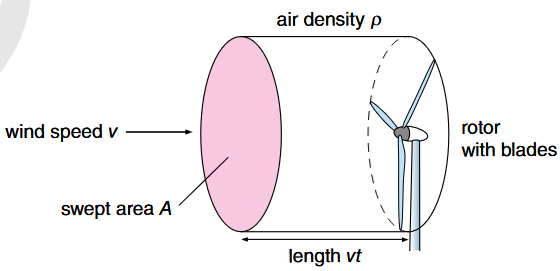
Maximum Electrical Power Output of a Wind Turbine
P = 1/2 * efficiency * air density * swept area * v^3.
[TRAP: Always remember to cube the wind speed (v^3)! If wind speed increases by 50%, power becomes (1.5)^3 = 3.375 times larger.]
[NOT IN DSE FORMULA SHEET - MUST MEMORIZE/DERIVE]

Power Output of a Hydroelectric Power Station
P = (m/t) * g * h * efficiency. Where m/t is the mass flow rate (kg/s) and h is the vertical height difference between the upper and lower reservoirs.
[TRAP: 'h' is the difference between the two water levels, NOT the distance from the turbine to the upper reservoir!]
[NOT IN DSE FORMULA SHEET - MUST MEMORIZE/DERIVE]

Pumped Hydroelectric Storage System Principle
During off-peak hours (low demand), excess electricity is used to pump water to the upper reservoir, converting electrical energy into gravitational potential energy. During peak hours, water flows down to drive the turbine and generate electricity.
Solar Constant Definition
The total electromagnetic radiation energy radiated at normal incidence by the Sun per unit time per unit area, measured OUTSIDE the Earth's atmosphere at the mean Earth-Sun distance.

Solar Power Received by a Tilted Surface
Total power received = Solar Constant * Area * cos(theta).
[TRAP: 'theta' MUST be the angle between the incident sunlight and the NORMAL to the surface, NOT the angle to the surface itself!] [NOT IN DSE FORMULA SHEET - MUST MEMORIZE/DERIVE]
Solar Cell (Photovoltaic Cell) Working Principle
Electrons at the p-n junction absorb sunlight to become free electrons, leaving holes behind. The built-in electric field pushes free electrons to the n-type side and holes to the p-type side. If connected to a load, a direct current (DC) flows from the p-side to the n-side through the external circuit.

Solar Cell Output vs Light Intensity
Under higher light intensity, a larger current is driven because more electron-hole pairs are created per second. However, the output voltage remains fairly constant as it depends on the p-n junction material.
[TRAP: A common MC distractor claims that voltage increases proportionally with light intensity.]
Enhanced Greenhouse Effect Mechanism
Burning fossil fuels increases greenhouse gases (e.g., CO2) in the atmosphere. These gases absorb and re-emit infra-red radiation radiated from the Earth's surface, preventing heat from escaping into space and causing global warming.