A&P Bones
 Call Kai
 Learn
Learn Practice Test
 Spaced Repetition
 Match
Match Flashcards
 Knowt Play
1/77

There's no tags or description
Looks like no tags are added yet.
Name | Mastery | Learn | Test | Matching | Spaced | Call with Kai | Chat |
|---|
No analytics yet
Send a link to your students to track their progress
78 Terms
Anatomy
The study of structure (morphology)
Physiology
The study of function at many levels
Integumentary System
(skin, hair, nails, sweat glands, sebaceous glands) Forms the external body covering, and protects deeper tissues from injury. Synthesizes Vitamin D, and houses cutaneous (pain pressure etc) receptors and sweat and oil glands.

Skeletal System
(Bones, ligaments, cartilage) Protects and supports body organs, and provides a framework the muscles use to cause movement. blood cells are formed within bones. Bones store minerals.

Muscular System
(Muscles) Allows manipulation of the environment locomotion, and facial expression. Maintains posture, and produces heat.

Nervous System
(Brain, spinal cord, nerves, sense organs) As the fast-acting control system of the body, it responds to internal and external changes by activating appropriate muscles and glands.

Endocrine System
Glands secrete hormones that regulate processes such as growth, reproduction, and nutrient use (metabolism) by body cells.

Cardiovascular System
(Heart, arteries, veins, capillaries, blood) Blood vessels transport blood, which carries oxygen, carbon dioxide, nutrients, wastes, etc. the heart pumps blood.

Lymphatic System
(Lymph vessels, fluid, nodes, thymus, spleen) Picks up fluid leaked from blood vessels and returns it to blood. Disposes of debris in the lymphatic stream. Houses white blood cells (lymphocytes) involved in immunity. The immune response mounts the attack against foreign substances within the body.

Respiratory System
(Nasal cavity, pharynx, larynx, trachea, bronchi, lungs) Keeps blood constantly supplied with oxygen and removes carbon dioxide. The gaseous exchanges occur through the walls of the air sacs of the lungs.

Digestive System
(Mouth, tongue, teeth, salivary glands, pharynx, esophagus, stomach, liver, gallbladder, pancreas, small intestine, large intestine) Breaks down food into absorbable units that enter the blood for distribution to body cells. Indigestible foodstuffs are eliminated as feces.

Urinary System
(Kidneys, ureters, urinary bladder, urethra) Eliminates nitrogenous wastes from the body. Regulates water, electrolyte and acid-base balance of the blood.

Male Reproductive System
Overall function is production off offspring. Testes produce sperm and male sex hormone, and male ducts and glands aid in delivery of sperm to the female reproductive tract.
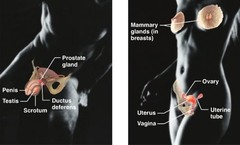
Female Reproductive System
Overall function is production of offspring. Ovaries produce eggs and female sex hormones. The remaining female structures serve as sites for fertilization and development of the fetus. Mammary glands of the female breasts produce milk to nourish the newborn.

Homeostasis
- Maintenance of a relatively stable, livable, internal environment despite continuous outside changes.
- A dynamic state of equilibrium
- involve continuous monitoring and regulation of many factors (variables)
Movement (Contractility)
- of body parts (skeletal muscle)
- of substances (cardiac and smooth muscle)
Responsiveness: the ability to sense and respond to stimuli
- Control of breathing rate
Digestion (Metabolism obtaining nutrients)
- Breakdown of ingested foodstuff
- Absorption of simple molecules into blood
Metabolism
All the chemical reactions that occur in body cells
Excretion: The removal of wastes from metabolism and digestion
Urea, carbon dioxide, feces
Reproduction
- Cellular division for growth or repair
- Production of offspring
Growth & Repair
increase in size of a body part or of organism or replacement of tissues
Nutrients
- Chemicals for energy and cell building
- Carbohydrates, fats, proteins, minerals, vitamins
Oxygen
Essential for energy release (ATP production)
Water
- Most abundant chemical in the body
- Site of chemical reactions
Normal Body Temperature
Affects rate of chemical reactions
Pressure
- Atmospheric pressure: For adequate breathing and gas exchange in the lungs
- Hydrostatic: Heart action produces blood pressure, forcing blood through blood vessels
Receptors
- Monitors the environment
Control center
-Determines the set point (expected value) at which the variable is maintained
- Receives input from receptor
- Determines appropriate response
Effectors
- Receives output from control center
- Provides the means to respond
- Response acts to reduce or enhance the stimulus (feedback)
Negative Feedback
- Receptors sense decreases blood volume
- control center in hypothalamus stimulates pituitary gland to release antidiuretic hormone (ADH)
- ADH causes the kidneys (effectors) to return more water to the blood
Positive Feedback
- The response. or exaggerates the original stimulus
- May exhibit a cascade or amplifying effect
Anatomical Position
- Body erect
- Feet slightly apart
- Palms facing forward

Superior
Toward the head end or upper part of a structure or the body; above

Inferior
Away from the head end or toward the lower part of a structure or the body; below

Anterior (ventral)
Toward or at the front of the body; in front of

Posterior (dorsal)
Toward or at the back of the body; behind

Medial
Toward or at the midline of the body; on the inner side of

Lateral
Away from the midline of the body; on the outer side of

Proximal
Closer to the organ of the body part or at the point of attachment of a limb to the body trunk

Distal
Farther from the organ of a body part or the point of attachment of a limb to the body trunk

Superficial
toward or at the body surface

Deep
Away from the body surface: more internal

Axial
Head, Neck and Trunk

Appendicular
Limbs

Sagittal Plane
- Divides body vertically into right and left parts
- produces a sagittal section
Midsagittal plane
Lies on a midline with left and right parts

Coronal plane
divides body vertically into anterior and posterior parts

Transverse plane
- Divides body horizontally into superior and inferior parts
- produces a cross section

oblique section
Cuts made diagonally
Cranial Cavity
Encases brain

Vertebral Cavity
Encases spinal cord

Thoracic Cavity
Contains Heart and Lungs

Abdominopelvic cavity
Contains stomach, intestines, spleen, liver, urinary bladder, reproductive organs, and rectum

Mediastinum
- Contains pericardial & pleural cavities
- Surronds thoracic organs

Pleural Cavities
Each houses a lung

Pericardial Cavity
Encloses Heart

Abdominal Cavity
Contains stomach, intestines, spleen, and liver

Pelvic Cavity
Contains urinary bladder, reproductive organs, and rectum

2,500 years ago
The belief that natural processes were caused by forces that could be understood, as opposed to superstitions
vital signs
observable body functions that reflect essential metabolic activities - temperature, blood pressure, pulse rate - signals living
diaphragm
separates thoracic and abdominopelvic cavities
visceral pericardium
membrane touching the heart
parietal pericardium
membrane surrounding the heart cavity
visceral pleura
membrane touching the lungs
parietal pleura
membrane surrounding the thoracic cavity
visceral peritoneum
membranes touching the abdominal organs
parietal peritoneum
membranes surrounding the abdomen
Positive Feedback Loop Example
Blood clotting, lactation, labor contractions
early ancestor study of A&P
curious about illness and injury; superstition, magic, and herbs
level of organization
atoms, molecules, organelles, cells, tissues, organs, organ systems, organisms
viscera
organs found deep within a body cavity
Respiration
obtaining oxygen, removing carbon dioxide, and releasing energy from foods
Absorption
passage of substances through membranes and into body fluids
Circulation
movement of substances in body fluids
Assimilation
changing absorbed substances into chemically different forms
Heat
product of metabolic reactions, and determines rate of reactions
Longitudinal section
lengthwise cut