Acute Kidney Injury
 Call Kai
 Learn
 Practice Test
 Spaced Repetition
 Match
 Flashcards
 Knowt Play
1/71

There's no tags or description
Looks like no tags are added yet.
72 Terms
what is GLOMERULAR HYDROSTATIC PRESSURe
the driving force behind glomerular filtration
how long does it take for kidney function to be reduced in acute kidney injury>
Abrupt (generally within 48 hrs
what effect does the dmg lead to?
1. Loss of excretory function of the kidneys (H2O and
waste)
2. Accumulation of metabolic waste products (e.g. K+,
PO4), and a rapid rise in creatinine and urea
3. A decline in urine output may occur
4. Reduced ability to maintain fluid, electrolyte and acid-
base balance
what is Creatinine and how is it excreted
Creatinine is a by-product of muscle metabolism and is steadily released into the blood
skeletal muscles —> blood creatinine 60 – 100 umol/L —> kidneys filter —→ excreted in urine
how is urea produced
Urea is produced when the body breaks down proteins.
Proteins are broken down into amino acids.
Amino acid metabolism produces ammonia (NH₃), which is toxic.
The liver converts ammonia into urea, which is much less toxic.
Urea enters the bloodstream.
The kidneys remove urea through urine.
what is the blood urea lvl when liver creates urea as a biproduct>
2–7 mmol/L.
what has been used as a gold standard for kidney filtration health?
Historically the retention of creatinine in the blood has been the gold standard for assessing the degree of glomerular filtration
impairment in patients with kidney damage
why is Creatinine a gold standard
Muscles continuously produce creatinine.
Creatinine enters the bloodstream.
The kidneys filter creatinine through the glomeruli.
Creatinine is eliminated through urine.
not reabsorbed at nephron so it can only leave
is creatinine clearange relatively equal to gfr?
to express the underlying degree of glomerular
filtration (GFR). We assume in medicine that creatinine clearance around or equal to GFR !
- However, creatinine undergoes some degree of tubular secretion, as well as GFR; and thus, this marker may overestimate GFR a little (but often ignored in clinical practice)
How we assess the degree of renal damage in patients?
Method for estimating GFR as a CrCl = creatinine clearance
this is called The Cockcroft & Gault Equation - for adultsadults

How we assess the degree of renal damage in pediatrics?
Method for estimating GFR
(Schwartz equation)

what are Limitations of using creatinine to estimate GFR
only for adult patients (> 18 years of age)
Assumes a steady-state serum creatinine value! During AKI the actual creatinine may be rising dramatically ever day
Patients with muscle wasting medical conditions (e.g. muscular dystrophy (MD), multiple sclerosis (MS), amyotrophic lateral sclerosis (ALS) may have an underproduction of creatinine; and thus, the formula will give you erroneous results
few drugs may compete with creatinine for tubular secretion and thus may ‘falsely’ elevate serum creatinine in patients (e.g. trimethoprim/ sulfamethoxazole)
what is a better way to assess GFR?
The future is Cystatin-C, a protein that cells in your body produce at a constant rate and is filtered by GFR. Not influenced by patient muscle mass!
what is the Glomerular Filtration Rate in adults?
FR averages 120 -140 mL/min/72kg in young healthy adults 18 - 22 years of age
FR gradually declines with age to ~ 50 - 60 mL/min/72kg at age 65 years of age
what do you expect gfr to be in a healthy 80 year old
We expect a GFR in an otherwise healthy, normal 80 y.o. to be
~ 30 - 40 mL/min/72kg
what formate for GFR should you use?
Note: always use a Normalization of ‘mL/min/72kg’ , or
≡ ‘mL/min/1.73m2 BSA’
what are the stages of kidney damage (4)
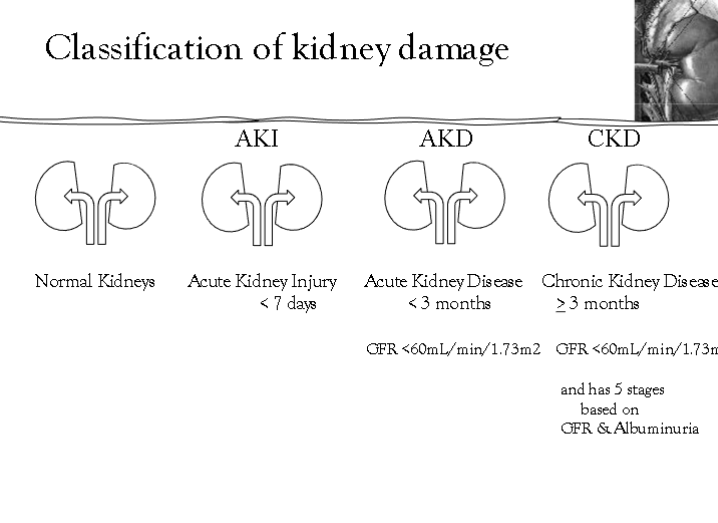

what type of kidney injury is this?
Evidence of Acute Kidney Injury
because creatinine starts at around baseline
then injury occurs which diminishes gfr rate and creatinine goes high
THen it comes back down to normal lvl within 7 days

what does this graph show
This one shows that the same dmg is lasting longer and creatinine lvls are still high less than 3 months
evidence of acute kidney disease

what does this graph show
if that creatinine stays elevates for longer than 3 months that it is classified as chronic kidney disease
Definition of acute kidney injury (AKI)
a rise in creatinine and decline in urine output that has
developed within hours to days
what lvls of creatinine and urine output is classified as acute kidney injury
Criteria | What it means |
|---|---|
1. Creatinine increases ≥27 µmol/L within 48 hours | A relatively rapid increase in blood creatinine |
2. Creatinine increases ≥1.5 times baseline within 7 days | Creatinine rises to at least 150% of its original value |
3. Urine output <0.5 mL/kg/hour for ≥6 hours | Kidneys produce abnormally little urine |
How common is AKI in hospitals?
occurs in about 20 to 34% * recent increase
how common is it in community
bout 1% of hospital admissions from the
community involve an AKI
how common is it in adult ICU
rises in 40 – 77% of cases
what about pediatric ICU
rises in 26% of cases
what two factors is aki often associated with
increased risk of morbidity and mortality
Morbidity: Illness and complications.
Mortality: Risk of death.
Risk Factors for AKI

what factor determines long- term prognosis of kidney function
he number of irreversibly lost nephrons in AKI
what is recovery rate and mortality of AKI?
• High mortality of 35 - 90% depending on underlying illness
• 90% recover enough renal function to live normal lives, but 50% of them may have ongoing defects in kidney function
how many of the AKI patients will develope CKD or go onto need Dialysis
• ~ 25% will go on to develop CKD
• ~12.5% will go on to require life-long dialysis
how is urine output affected by kidney dmg
o Anuric, i.e. < 100 mL/day
o Oliguric, i.e. < 500 mL/day (< 0.5 mL/kg/h of urine output)
o Non-oliguric, i.e. > 500 mL/day
what do those 3 terms mean
Anuria: Almost no urine is produced.
Oliguria: Abnormally low urine output.
Non-oliguric AKI: The patient still produces a relatively normal amount of urine despite impaired kidney function.
what are 4 factors that are Manifestations of kidney disease
1. Evidence of reduce renal function, i.e. elevated creatinine & urea, edema, hyperkalemia (K+), & hyperphosphatemia (PO43-)
2. Evidence of kidney damage (e.g., gross hematuria, proteinuria)
3. Abnormal radiological findings on kidney imaging
4. Requirement for some form of dialysis
Three major causes of AKI - three categories based on where the problem occurs.
prerenal
instrinsic
postrenal
are used to group common pathophysiologic features. All
forms of AKI can be classified into one of these 3.
what is Prerenal AKI and how is it caused
Problem: Not enough blood reaches the kidneys.
The kidneys need adequate blood flow to filter waste.
If blood flow decreases, GFR decreases.
Common causes:
Dehydration from vomiting or diarrhea.
Severe hypotension.
Heart failure (reduced cardiac output).
Severe blood loss.
what is Intrinsic renal AKI and what are causes
Problem: There is damage to the kidney tissue itself.
This damage can affect the glomeruli, tubules, or interstitial tissue.
ex of cause could be Glomerulonephritis, Drugs,
what is Postrenal AKI and how is it caused
Urine cannot flow out normally because of an obstruction.
Urine backs up, increasing pressure in the urinary system and reducing GFR.
Common causes:
Kidney or ureteral stones, prostatic hypertrophy, tumor
is it true that not all elevation in creatinine are from aki?
Caveat –NOT all elevations in creatinine are from AKI.
Watch for false elevations in creatinine when specific drugs
are added that compete for tubular secretion!
what is Urinary sediment
particles found in urine when examined under a microscope.
These include red blood cells, white blood cells, and structures called casts.
what are What are casts?
Casts are tube-shaped structures that form inside the kidney tubules.
They can contain proteins, red blood cells, white blood cells, or epithelial cells.
Different types of casts can suggest different kidney problems.
what are 6 types of cast
Finding | What it suggests |
|---|---|
Hyaline casts | Dehydration, exercise, diuretic use; nonspecific |
Epithelial cell casts | Tubular injury, such as acute tubular necrosis (ATN) |
RBC casts | Bleeding originating within the nephron, especially glomerulonephritis |
WBC casts | Kidney inflammation, such as pyelonephritis or interstitial nephritis |
Nitrite positive | Presence of nitrate-reducing bacteria |
Leukocyte esterase positive | White blood cells in urine, suggesting inflammation or infection |
why does prerenal aki make concentrated urine?
Because the kidneys are receiving less blood, they try to conserve sodium and water.
Urinary Na⁺ <10 mmol/L: Very little sodium is lost in urine.
Urine osmolality >500 mOsm/kg: Urine is concentrated.
Specific gravity >1.020: Urine is relatively concentrated.
what is Fractional excretion of sodium (FeNa)
FeNa measures the ratio of sodium excreted in the urine compared to the sodium available for filtration by the kidney (GFR
why does FeNa work?
Normally, the kidneys filter sodium and then reabsorb most of it back into the bloodstream.
For example, if the kidneys filter 100 units of sodium:
99 units are reabsorbed.
1 unit is excreted in urine.
FeNa = 1%.
So:
Low FeNa: Kidneys are conserving sodium.
High FeNa: Kidneys are excreting more sodium.
what does FeNa < 1% mean?
FeNa < 1% in oliguric/anuric patients = pre-renal AKI, as an
increased reabsorption of Na is the appropriate response of
functioning nephrons to the state of decreased renal perfusion
what does FeNa > 3% mean?
may be consistent with an Intrinsic form of AKI*, due
to inappropriate Na excretion in the setting of tubular damage (i.e. losing Na). Inability to concentrate their urine
. Why does urea increase more in prerenal AKI?
Urea increases disproportionately in the serum
compared with creatinine due to enhanced proximal tubular
reabsorption of urea that follows transport of Na+ & H2O
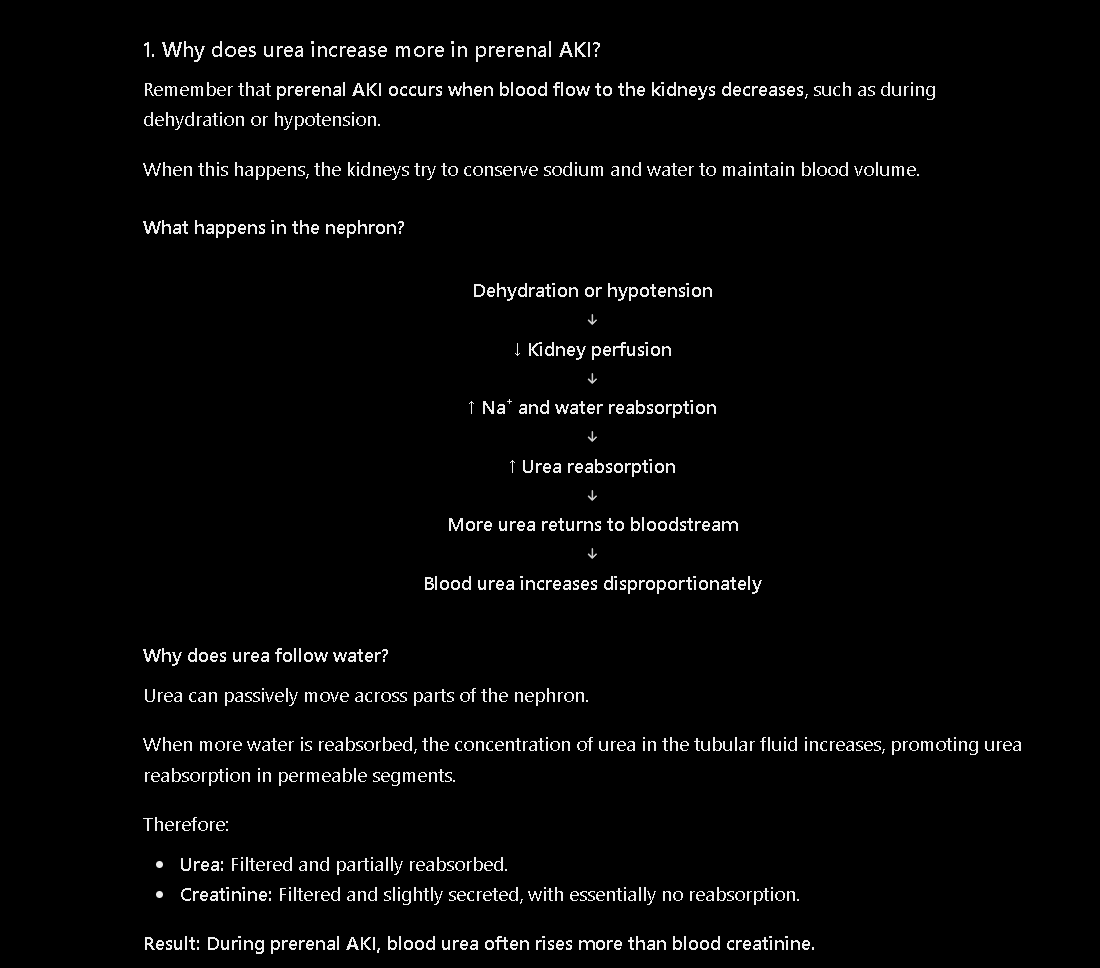
Prerenal AKI vs Intrinsic AKI:
Prerenal AKI: Urea increases more than creatinine because the kidneys reabsorb more urea.
Intrinsic AKI: Creatinine and urea may both increase, but urea does not necessarily rise disproportionately.
urea-to-creatinine ratio
In prerenal AKI, both waste products can accumulate because GFR decreases.
However, urea increases disproportionately because more is reabsorbed back into the blood.
what is a limitation for urea to creatinine ratio
ONLY interpret in the absence of gastrointestinal bleeding, since urea gets reabsorbed from blood in the Gut

what does the flat line mean
A flat Urea/Creatinine ratio is suggestive
of an Intrinsic profile of AKI (or possibly Post-renal
what is Prerenal AKI
Prerenal AKI occurs when blood flow to the kidneys decreases, causing GFR to decrease.
Remember that the kidneys need adequate blood flow to filter waste products.
what are Causes of prerenal AKI
Decreased blood volume (hypovolemia) due to Severe dehydration
Vomiting or diarrhea
Hemorrhage (blood loss)
Reduced effective circulating blood volume - but with low effective circulating blood volume to the kidney, e.g. severe heart failure, or liver failure precipitating kidney failure! i.e. Cardiorenal syndrome or Hepatorenal syndrome
medications can cause too
Laboratory findings of prerenal AKI
Essentially a normal urinalysis, no cells, no proteinuria, u-Na+ <10, u-
specific gravity > 1.020, FeNa+ <1%, Urea/Creatinine ratio > 100/1
what happens to urine output in pre-renal aki
Decreasing urine output is always the case, either:
o Oliguria < 500 mL/day or < 0.5 mL/kg/h, or
o Anuria < 100 mL/day
what is Postrenal AKI
Postrenal AKI occurs when urine flow becomes obstructed somewhere along the urinary tract.
The obstruction causes urine to back up, increasing pressure within the kidney and reducing GFR.
what are causes of postrenal aki
Stone disease, stricture, tumors, thrombosis, fibrosis, prostatic
hypertrophy
o Obstruction may be unilateral, or bilateral
Unilateral obstruction: Only one kidney's urinary drainage is blocked.
Bilateral obstruction: Both kidneys' urinary drainage is blocked.
what does bilateral (obstructive) disease result in?
Only bilateral (obstructive) disease results in oliguria and severely
elevated urea & creatinines
Laboratory findings of postrenal AKI
Abrupt parallel rise in creatinine & urea (urea/creatinine ratio is flat), and an abrupt decline in urine volume
Essentially a normal urinalysis with no/few RBC’s or WBC’s cells, no casts, and no/minimal proteinuria; but may have crystals in the urine suggestive of the mechanism of the obstruction (urate, calcium phosphate, etc)
what is Nephrotic syndrome
Nephrotic syndrome occurs when the glomerular filtration barrier becomes damaged, allowing excessive protein to leak into the urine.
Remember that the glomeruli filter blood while normally preventing most proteins from entering the urine.
what are effects of nephrotic syndrome
excessive amount of protein released into the urine;
from increased glomerular permeabilityAs a result, severe systemic hypoalbuminemia develop
Loss of protein occurs because of changes to the capillary endothelial cells, the glomerular basement membrane (GBM), or the podocyte
Diseases that progress to nephrotic syndrome are grouped into three major
categories:
antibody-mediated diseases - (e.g., lupus, membranoproliferativ
metabolic disorders - (e.g., diabetes, amyloidosis, and Fabry disease
podocytopathies - (e.g., minimal change disease, and focal segmental
glomerulosclerosis)
Where does protein leakage occur?
Structure | Normal function |
|---|---|
Capillary endothelium | Allows filtration while helping restrict blood cells |
Glomerular basement membrane (GBM) | Provides structural support and filtration selectivity |
Podocytes | Form filtration slits that help prevent protein loss |
What are podocytes?
Podocytes are specialized cells that wrap around glomerular capillaries.
They have projections called foot processes, which form filtration slits.
When podocytes become damaged, proteins such as albumin can pass into the urine more easily.
what is . Acute tubular necrosis (ATN)
ATN means injury and death of kidney tubular epithelial cells, causing impaired kidney function.
ATN is one of the major causes of intrinsic AKI.
how does acute tuburlar necrosis happen
50% are a result of renal ischemia
35% are the result of exposure to direct tubular toxins
Renal tubular epithelial cell injury is the hallmark of an initiation phase that leads to a reduction in GFR
Tubular ‘toxin’ damage can be the result of:
Endogenous causes (e.g. hemolysis, rhabdomyolysis, uric acid)
Exogenous causes (e.g. contrast dye, aminoglycosides)
What is glomerulonephritis?
In glomerulonephritis, inflammation damages this filtration barrier.
how does glomerulonephritis happen
Glomerular disease can result from many inherited or acquired disorders and can manifest in a variety of ways, ranging in severity from asymptomatic urinary abnormalities to AKI and end-stage kidney disease (ESRD)
Important findings in glomerulonephritis
Finding | Meaning |
|---|---|
Hematuria | Red blood cells (blood) in urine |
Proteinuria | Excess protein in urine |
Glomerular disease should be suspected when hematuria and/or proteinuria are seen on urinalysis
With GMN what does it give passage too?
inflammation within the glomerulus leads not only to the
passage of inflammatory cells, such as leukocytes and RBCs, but also of protein into the renal tubule