INBDE High-Yield Head and Neck Anatomy
 Call Kai
 Learn
 Practice Test
 Spaced Repetition
 Match
 Flashcards
 Knowt Play
1/145

There's no tags or description
Looks like no tags are added yet.
146 Terms
List the muscles of mastication
-masseter
-temporalis
-lateral pterygoid
-medial pterygoid
The muscles of mastication are all innervated by what nerve?
Trigeminal, V3
The muscles of mastication are all supplied by what artery?
maxillary artery
Origin of Masseter
-zygomatic arch
Insertion of Masseter
-lateral surface of the ramus and angle of the mandible
Action of Masseter
-elevation, retraction, and protrusion
-ipsilateral excursion
Origin of Temporalis
temporal fossa of temporal bone
Insertion of Temporalis
coronoid process
Action of Temporalis
-elevation and retraction
-ipsilateral excursion
Origin of Lateral Pterygoid
-infratemporal fossa of sphenoid bone
-lateral surface of lateral pterygoid plate
Insertion of Lateral Pterygoid
-articular disc and capsule of TMJ
-neck of mandibular condyle
Action of Lateral Pterygoid
-depression and protrusion
-contralateral excursion
Origin of Medial Pterygoid
-maxillary tuberosity
-medial surface of lateral pterygoid plate
Insertion of Medial Pterygoid
-medial surface of the ramus
-angle of the mandible
Action of the Medial Pterygoid
-elevation and protrusion
-contralateral excursion
Extrinsic muscles of the tongue are defined as those that:
connect the tongue to other structures
Intrinsic muscles of the tongue are defined as those that:
lie entirely within the tongue
List the extrinsic muscles of the tongue
-hyoglossus
-genioglossus
-styloglossus
-palatoglossus
Action of Hyoglossus
-retrudes the tongue
-depresses the lateral margins of the tongue
Action of Genioglossus
-protrudes the tongue
Action of Styloglossus
-retrudes the tongue
-elevates the lateral margins of the tongue
Action of Palatoglossus
-elevates posterior tongue
-draws soft palate to tongue
Three extrinsic tongue muscles are innervated by the same cranial nerve. What are those three extrinsic muscles, and what nerve is it?
The fourth extrinsic muscle is which, and innervated by what cranial nerve?
hyoglossus, genioglossus, styloglossus
CN XII
palatoglossus
CN X
List the soft palate muscles
-palatopharyngeus
-musculus uvulae
-levator veli palatini
-salpingopharyngeus
-tensor veli palatini
Action of palatopharyngeus
pulls pharynx and larynx upward
Action of musculus uvulae
shortens/broadens uvula to help close nasopharynx during swallowing
action of levator veli palatini
elevates the soft palate to close off nasopharynx during swallowing
action of salpingopharyngeus
equalizes air pressure
action of tensor veli palatini
-tenses the soft palate and opens the auditory tube
What's important to know about the anatomy of the tensor veli palatini?
tendon hooks around pterygoid hamulus to form palatine aponeurosis
Four soft palate muscles are innervated by the same cranial nerve. What are those four soft palate muscles, and what nerve is it?
The fifth soft palate muscle is which, and innervated by what cranial nerve?
palatopharyngeus, musculus uvulae, levator veli palatini, and salpingopharyngeus
CN X
tensor veli palatini
CNV3
*tensor and trigeminal both begin with T
List the facial expression muscles.
-buccinator
-orbicularis oris
-zygomaticus major
-levator labii superioris
-occipitofrontalis
-platysma
Buccinator Action
compresses cheeks against teeth
Orbicularis Oris Action
puckers lips and compresses lips against teeth
Zygomaticus Major Action
retracts and elevates corner of mouth
Levator Labii Superioris Action
elevates upper lip, aids in smiling
Occipitofrontalis Action
elevates eyebrows, wrinkles skin of forehead, retracts scalp
Platysma Action
depresses mandible, tenses skin of lower face and anterior neck
Innervation of Buccinator
buccal branches of CN VII
Innervation of Orbicularis Oris
buccal and mandibular branches of CN VII
Zygomaticus Major, Levator Labii Superioris, Occipitofrontalis, and Platysma are all innervated by what nerve?
CN VII
Mylohyoid Action
forms floor of cavity, elevates hyoid bone and floor of mouth, depresses mandible
Mylohyoid Innervation
CN V3
What are the effects of the mylohyoid on mandibular dentures?
limits extension of lingual flange
What wraps around the posterior edge of the mylohyoid muscle?
submandibular gland
Give the Name, Sensory/Motor/Both, and Major Function of CN I
Olfactory
Sensory
Sense of Smell
Give the Name, Sensory/Motor/Both, and Major Function of CN II
Optic
Sensory
Vision
Give the Name, Sensory/Motor/Both, and Major Function of CN III
Oculomotor
Motor
Certain eye movements
Give the Name, Sensory/Motor/Both, and Major Function of CN IV
Trochlear
Motor
Certain eye movements
Give the Name, Sensory/Motor/Both, and Major Function of CN V
Trigeminal
Both
Somatic sensation to face, mouth, cornea
Motor innervation to muscles of mastication
The trigeminal ganglion emerges from what anatomic structure?
pons
List the three divisions of the trigeminal nerve.
V1 - ophthalmic
V2 - maxillary
V3 - mandibular
Ophthalmic Division V1 is sensory/motor/both
sensory
Maxillary Division V2 is sensory/motor/both
sensory
Mandibular Division V3 is sensory/motor/both
both
What structure does the ophthalmic division V1 exit?
cranium via superior orbital fissure
What structure does the maxillary division V2 exit?
cranium via foramen rotundum
What nerves does the maxillary division V2 give rise to?
branches into greater palatine, PSA, and infraorbital (gives off MSA and ASA) nerves
What nerves does the mandibular division V3 give rise to?
branches into lingual nerve (sensory for anterior 2/3 of ipsilateral tongue) and inferior alveolar nerve
What structure does the mandibular division V3 exit?
cranium via foramen ovale
Give the Name, Sensory/Motor/Both, and Major Function of CN VI
Abducens
Motor
Eye movements: lateral rectus muscle
Give the Name, Sensory/Motor/Both, and Major Function of CN VII
Facial
Both
Controls muscles of facial expression, taste from anterior 2/3 of the tongue (via chorda tympani), lacrimal and salivary glands
What are the five branches of the Facial Nerve CN VII?
Temporal
Zygomatic
Buccal
Mandibular
Cervical
What nerve is affected in Bell's Palsy?
Facial Nerve (CN VII)
Give the Name, Sensory/Motor/Both, and Major Function of CN VIII
Vestibulocochlear (technically 2 nerves)
Sensory
Proprioception and balance (via vestibular nerve)
Hearing (via cochlear nerve)
Give the Name, Sensory/Motor/Both, and Major Function of CN IX
Glossopharyngeal
Both
Sensation from posterior 1/3 of tongue and pharynx, taste from posterior 1/3 of tongue, carotid baroreceptors and chemoreceptors, salivary gland
Give the Name, Sensory/Motor/Both, and Major Function of CN X
Vagus
Both
Autonomic functions of gut, cardiac parasympathetic innervation, sensation from larynx and pharynx, muscles of vocal cords, swallowing
What controls the gag reflex and can cause a hoarse voice if the recurrent laryngeal nerve is damaged?
Vagus
Give the Name, Sensory/Motor/Both, and Major Function of CN XI
Accessory
Motor
Trapezius and sternocleidomastoid muscles: shoulder shrugging and turning head
Give the Name, Sensory/Motor/Both, and Major Function of CN XII
Hypoglossal
Motor
Movement of the extrinsic muscles of the tongue
Upon tongue protrusion, if there is a lesion, which way will the tongue deviate? (towards/away from lesion)
towards
Infraorbital Nerve (CN V2)

ASA Nerve (CN V2)

MSA Nerve (CN V2)

PSA Nerve (CN V2)
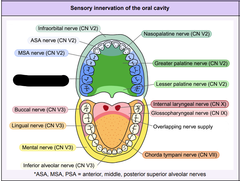
Buccal Nerve (CN V3)
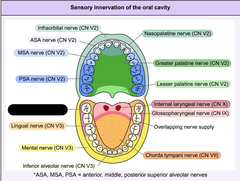
Lingual Nerve (CN V3)
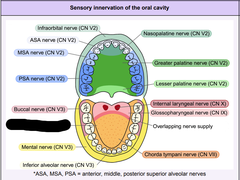
Mental Nerve (CN V3)

Inferior Alveolar Nerve (CN V3)

Nasopalatine Nerve (CN V2)

Greater Palatine Nerve (CN V2)

Lesser Palatine Nerve (CN V2)

Internal Laryngeal Nerve (CN X)

Glossopharyngeal Nerve (CN IX)

Overlapping nerve supply

Chorda tympani nerve (CN VII)

Infraorbital Block

Nasopalatine Block
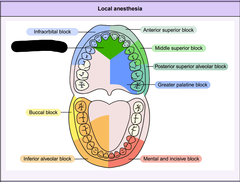
Anterior Superior Block
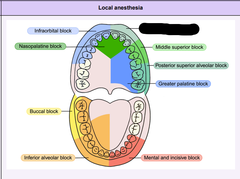
Middle Superior Block

Greater Palatine Block
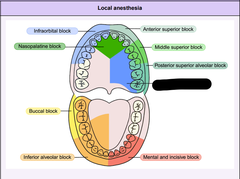
Posterior Superior Alveolar Block

Buccal Block

Inferior Alveolar Block

Mental and Incisive Block

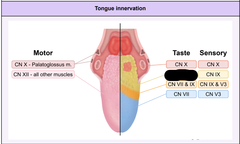
CN X - Palatoglossus muscle

CN XII - all other muscles

CN X

CN X

CN IX