CHEm 130 Exam 3
 Call Kai
 Learn
 Practice Test
 Spaced Repetition
 Match
 Flashcards
 Knowt Play
1/69

There's no tags or description
Looks like no tags are added yet.
70 Terms
Chemical properties versus physical properties
______ properties can be observed or measured without changing the chemical identity of the substance, whereas _____ properties can only be established by changing a substance’s chemical structure through a reaction.
______ ____, such as density, melting point, boiling point, color, and solubility, conductivity, and phase changes describe the state of matter itself; as measuring them leaves the core identity intact (e.g., melting ice still leaves you with H2O molecules).
In contrast, chemical properties, such as flammability, toxicity, acidity, and heat of combustion, all describes a substance’s potential to undergo a chemical change.
To measure a chemical property you must react the substance, breaking and forming chemical bonds to create entirely new substances with different atomic arrangements (e.g., burning magnesium ribbon yields magnesium Oxide)

Chemical and physical change
A ______ change modifies the physical properties of a material, such as its shape, size, or state of matter, without chaining it chemical composition (for example, when ice melts into water or a piece of paper is torn, the molecules themselves remain exactly the same, making these changes typically easy to reverse)
In contrast, a chemical change occurs at the molecular level, where chemical bonds break and reform to create entirely new substances with distinct properties. (for example process like wood burning, iron rusting, or food digestion are chemical changes because the orignal material are permanently transformed, usually accompanies by indicators like color shifts, temperature changes, gas production, or light emission)

The different states of matter
Matter commonly exists in four fundament states —- solid, liquid, gas, and plasma — each defined by the kinetic energy and structural arrangement of its particles.
in a solid particles are tightly packet in a fixed lattice, giving it a definite shape and volume. As thermal energy increases, it transition into a liquid, where particles remain close but can fluidly slide past one another, maintaining a fixe volume but adapting to its container’s shape. Further heating turns the substance into a gas, where particles move rapidly with negligible attractions, expanding to fill any container completely.
At extreme temperatures, gases ionize into plasma (this means that a neutral gas is supplied with enough energy, such as high heat, electric current, or radiation, to strip electrons away from its atoms or molecules), which is a highly energetic state of charged ion and free electrons found in starts.
The different phase labels
In chemical equations and scientific notation, the states of matter are tracked using lowercase ____ _____, enclosed in parentheses directly following a chemical formula:
(s) for solid
(l) for liquid
(g) for gas
(aq) for aqueous solution (which denotes a substance completely dissolved in water, such as saltwater)
Introduction to chemical equations
A _______ ______ is a shorthand recipe that demonstrates how atoms rearrange to form new substances during a chemical reaction
how to write it is:
Reactants (these are the starting materials) go on the left side
Products (these are the new substances) and these go on the right side
State symbols (you must always include the physical states in parentheses) and they mut follow the substances molecular formula
Remember in a chemical reaction that based upon the law of conservation of mass, matter cannot be created or destroyed, so you must always end up with the exact same number and type of atoms you started with, therefore
Subscripts (e.g., the 2 in H2O) tell you the ratio of atoms inside a molecule. Never change the subscripts to balance an equation, or else you will change the chemical identity
Coefficients (e.g., the 2 in H2O) are the big number our front, and you change only these to be able to balance your equation

Polyatomic elements
These are pure chemical substance consisting of two or more atoms of the same element covalently bonded together to form a distinct, natural molecule.
Unlike monatomic elements (like Helium) or diatomic element (Like O2) true polyatomic elements typically refer to stable elemental structures containing three or more identical atoms,, though the term broadly encompasses any element requiring multiple atoms to exist in its natural stable state.
some examples would be:
Ozone (O3)
Phosphorus (P4)
Sulfur (S8)
Selenium (Se8)
Stoichiometric coefficients and how we can use them in calculations
These are the absolute or relative numbers placed in front of chemical formulas in a balance chemical equation to established the molar ratios between reactants and products.
Rooted deeply in the Law of conservation of mass, these dimensionless integers reprised the specific number of moles (or individual molecules) of each substance that mut react or be produced for a chemical system to remain perfect balanced
These coefficients are also used to execute dimensional analysis and solve quantitive problems. They serve as the definite “mole bridge” allowing you to construct conversion factors, to translate a known mass, molarity, or volume of one chemical species into the theoretical yield or required quantity of an entirely different species.
Balancing chemical reactions
This means ensuring that the number of atoms of each element is identical on both the reactant and produce side. This fundamental process directly satisfies the Law of Conservation of mass, which dictates that matter cannot be created or destroyed during a chemical reaction, only rearranged.
To achieve this, we use the “Method of Inspection” adhering to a strict rule which is you can only later the stoichiometric coefficients and never the subscripts
How we do this is:
Count how many atoms of each element are initially present on both sides
Start with the Complex: Balance elements that appear in only one reactant and one product first, leaving simple single elements for the end
Keep polyatomic ions together; if a polyatomic ion remains unchanged on both sides of the arrow, treat it as a single unit rather than splitting it into individual elements
Save Hydrogen and Oxygen for las: Balance H and O at the very end, as they are typically scattered across multiple molecules (especially in combustion reactions)
Reduce to Lowest whole Rations; ensure that all coefficients are in their simples, lowest, whole-number integer ratio.
(Remember it is often easier to balance In the order C then H then O)
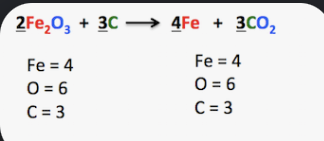
Limiting Reagents and Theoretical / Actual yield
The ______ _____ is the reactant that is completely consumed first during a chemical reaction, which ultimately determines and limits the maximum amount of product that can be formed.
Once this substance runs out, the reaction stops, leaving any other reactants behind as “excess reagents.”
The _______ ______ is the maximum amount of product that could possibly be created based on perfect calculations from this limiting reagent, acting as the ideal, best-case scenario.
However, in a real lab you will actually measure the _____ ____, which is the real about of product you successfully collect, and this number is almost always lower than the theoretical calculation due to spills, incomplete reactions or side processes.
To measure the efficiency of your experiment, you calculate the percent yield, which divided the ____ yield by the ___________ yield and multiples it by 100 to show how close you came to that perfect theoretical maximum
Percent Yield
This measures the efficiency of a chemical reaction by comparing the amount of product you actually created in the lab to the amount that was mathematically predicted.
You calculate this by taking your experimental result, called the actual yield and dividing it by the maximum possible result calculated from your limiting reactant, knowing as the theoretical yield and multiplying by 100.
This percentage serves as a critical diagnostic tool; a 100% yield is rarely achieved in practice due to real-work factors like incomplete reactions, side reactions that form unwanted byproducts, or physical loss of material during filming and transferring between glassware.
Conversely a percent yield over 100% usually signals an experimental error.
What is a solution
This is a homogenous mixture composed of two or more substances that has a completely uniform composition at the molecular or ionic level. On a microscopic scale, the minority component, know as a ____ is throughly broken down and evenly dispersed throughout the majority component, kwnohng as the _____.
Because the individual ____ and _____ particles do not chemically react to form new covalent or ionic compounds, they maintain their separate chemical identities but are physical bound by intermolecular fifers like dipole-dipole or ion-dipole attractions.
While we frequently observe liquid solutions, such as salt dissolved in water, solutions can actually exact in any phase of matter, including gaseous states (like the air we breathe) and solid states (like brass or other metal alloys)
Concentration; molarity (M)
This refers to the quantity measure of how much solute is dissolved in a given volume of solution or solvent.
it essentially tells you how “crowded” the solute particles are witching the mixture, which directly influences how the solution behaves, reacts, and conducts electricity.
To describe this density of parties, chemical rely on several distinct mathematical expression depending on the laboratory context. The most foundation unit you will encounter is ________ (M), defined as the moles of solute per liter of solution (M/L) which is heavily used for stoichiometry calculations involving liquid volumes.
For more specialized applications, you will also use molarity (m), which measures moles of solute per kilogram of solvent, and remains table during temperature changes, as well as parts per million (ppm) for extremely dilute environmental samples, and mass or volume percentages for general commercial mixtures.
Master
How do we make solutions
How to make a solution, you must accurately calculate, weight, and dissolve a specific mass of solute into a precise volume of solvent using a volumetric flask.
First, use the molarity formula (M = moles / L) to determine the required grams of your solid chemical based on the desired concentration and final volume.
Weight this mass on an analytical balance using a weigh boat, than quantitatively transfer it to a beaker to dissolve it completely using a weigh boat, than quantitatively transfer it to a beaker to dissolve it completely in a small amount of deionized water.
New, pour this mixture into a clean volumetric flaks, rinsing the beaker multiple times with deionized water to ensure every particle of solute is transferred.
Carefully add solvent to the flask until the bottom of the fluid meniscus rests exactly on the etched calibration line, cap it securely with a stopper, and inverted the flask multiple times to throughly mix the solution.
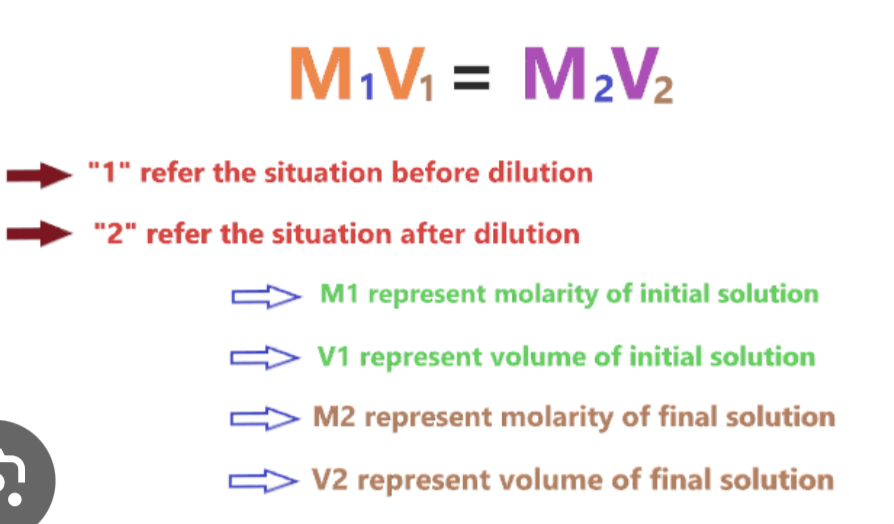
Solution Dilutions (M1V1 = M2V2)
This is the process of reducing the concentration of a solution by adding more solvent (such as water) without altering the total amount of solute present.
This relationship is mathematically governed by the algebraic conservation formula M1V1 = M2V2, where M represented the molarity (moles of solute per liter of solution) and V represents volume.
Because multiplying molarity by volume yields total models of solute (M * V = moles) the equation explicitly proves that the initially moles of solute in the concentrated stock solution, must equal the final moles of solute in the diluted solution.
How solids dissolve
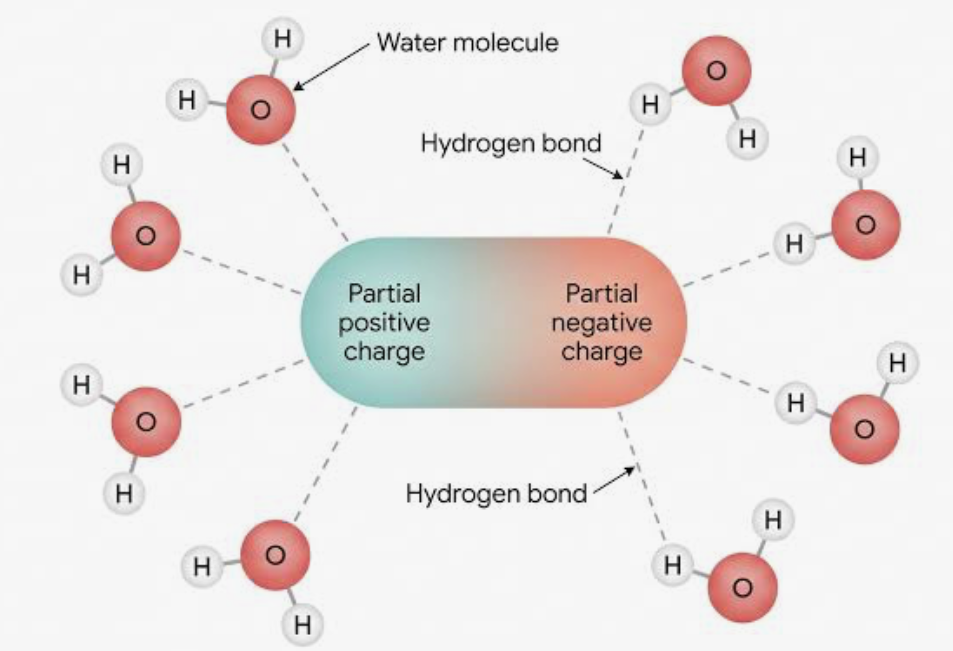
Solids dissolve through a process called salvation (or hydration in water), where the attraction between a solute particles is overcome by stronger solute-solvent interactions.
Specifically, when a solid enters a liquid, solvent molecules collide with its surface, aligning themselves to maximie intermolecular forces (such as ion-dipole interactions for ionic salts or hydrogen bonding for polar molecule solids). If these new attractions are energetically favorable enough to disrupt both the solids cohesive lattice energy and the solvents own internal bonds, the solvent molecules cage individual solute particles, pulling them away from the crystal matrix.
This thermodynamic interplay between enthalpy (health exchange) and the natural increase in entropy (system disorder) drives the particle dispersion until the solid is completely broken down into a homogenous solution.

Electrolytes and Nonelectrolytes
_________ are substances that produce ions when dissolved in water or melted, allowing the solution to conduct electricity. Electrical conductivity occurs because ions are charged particles that can move freely and carry electric charger through the solution.
For example, when sodium chloride (NaCl) dissolved in water, it dissociates into Na^+ and Cl^- ions. When an electric potential is appleid, the positive Na^+ ions move toward the negative electrode, while the negative Cl^- ions move toward the positive electrode. This moment of ions creates an electric current.
__________ are substances that dissolve in water without producing ions, meaning their particles remain as neutral molecules. Because these molecules do not carry an electrical charge, they cannot transport charger through the solution, so non electrolyte solutions do not conduct electricity.
For example, sugar dissolves in water as intact, neutral molecules rather than separation into ions. Therefore, even though sugar dissolved readily in water, its solution does not conduct electricity.
The key distinction is that electrical conductivity is an aqueous solution depends on the present and movement of ions, not simply on whether a substance dissolves in water (also remember that when non-electrolytes dissolve in water, the individual molecules separate from each other, but that atoms within those molecules do not break apart)

Strong versus weak electrolytes
Strong ____________ are substances that produce ion almost completely when dissolved in water, allowing the solution to conduct electricity very effectively. To understand why this happens, consider NaCl I the solid state, Na+ and Cl- ions are held together in a crystals lattice by electrostatic attraction. When NaCl is placed in water the partially negative oxygen atoms of the water molecules attract Na+ ions, while the partially positive hydrogen atoms attract Cl- ions. Water molecules surround these ions through ion-dipole interactions, a process called hydration. These interactions stabilizing the separates ions, meaning the ions are energetically more comfortable being surrounded by water than remaining in the solid crystal under these conditions. Consequently, NaCl separates into mobile Na+ and Cl- ions. These ions carry electric charger through the solution when an electric potential is applies. Strong acids such as Hal also produce ions almost completely because transferring H+ tp water forms H3O+ which is strongly stabilizing by interactions with surrounding water molecules. Therefore, strong electrolytes produce a large concentration of mobile ions and conduct electricity effectively
_______ ______ only partially produce ions in water because the formation of ions does not overwhelmingly favor the ionized state over the neutral molecular state. For example acetic acid (CH3COOH) reacts with water to produce H3O+ and CH3OO-. However, most acetic acid molecules remain intact because the balance between ion formation and recombination results in only partial ionization (in other words, some acetic acid molecules transfer H+ to water, while other ions recombine to form natural acetic molecules) This creates a dynamic equilibrium in which both ionized and nonionized parties exist simultaneously. because fewer mobile ions are present, _____ _______ conduct electricity less effectively than _______ _______ at comparable concentrations.
The key concept is that strong _______ form ions essentially complete, whereas weak electrolytes only partially form ions because the balance of interactions in water does not favor complete ionization. importantly, favorable does not mean that a substance wants to react; it means that resulting states has lower Gibbs free energy under the given conditions.

How non-ionic compounds dissolve in H2O
When a non-ionic polar compound (like sugar or ethanol) dissolves in water, it undergoes solvation without dissociation, meaning the individual molecules separate from each other but their internal covalent bonds remain fully intact.
Because water is highly polar, featuring a partial negative charge on the oxygen and a partial positive charge on the hydrogen atom, it can form strong intermolecular forces with the solute.
if the non-ionic compound contains polar functional groups (such as -OH groups) the partial positive hydrogens of water molecules attract the partially negative regions of the solute molecule, while the partially charged negative oxygen of the water attract the partially positive regions of the solute
Thermodynamically, this process is driven by the “like dissolves like” principle, which states that the energy released when new water solute hydrogen bonds and dipole-dipole interactions from is strong enough to overcome both the solute-solute IMF holding the crystal or liquid together and the water-water IMFs that are disrupted to create the cavity for the solute.
Consequently, water molecules completely surround individual intact molecules in a hydration shell, dispersing them evenly throughout the solution as individual molecules rather than breaking them into isolated ions.
Precipitation Reactions
This occurs when two clear aqueous solutions of soluble ionic compounds are mixed together and undergo a double-displacement reaction to form an insoluble solid product called a _______;
At the molecular level, the dissolved reactant compounds exist completely dissociated into their constituent cations and anions, randomly colliding in water. When specific pairs of oppositely charged ions like collide, their metal electrostatic attraction is strong enough to overcome the hydrating forces of the water molecules, causing them to snap together an form organized insoluble ionic crystal lattice that drops out of solution.
The key to mastering this concept is producing production by swapping their ionic partners (cations from one reactant with the anion of the other ) and applying solubility rules to determine which new combination is insoluble.
You will than translate this process from a molecular equation into a net ionic equations that strips away the (spectator ions, so the ions that remain dissolved and unchanged on both sides) to show only the specific chemical species actively crashing out of solution to drive the reaction forward.

Solubility
This dictates whether an ionic compound will break apart into free-floating aqueous ions in water, making it ______, or tightly bind together to form a solid predicate, making it _______.
This behavior is a direct tug of war between two forces, the ion-dipole attractions pulling the ions into the water versus the lattice energy holding the crystal grid together.
One the periodic table, you can map these rules perfectly by looking at the extremes. One the far left, Group 1 Alkali metals (Li +, Na+, K+, etc ) have a +1 charger and large ionic radii, resulting in a weak lattice energy what water easily tears apart, making them always soluble with absolutely no exceptions.
Conversely, as you move toward the middle and bottom of the table into the transition metals and heavy post-transition metals like Silver, lead, Mercury, the ions become highly polarizable and form bonds with high covalent character rather than purely ionic interactions/

Solubility rules on the periodic table and how you interpret them
These predict whether an ionic compound will dissolve in water to become aqueous (aq) or fail to dissolve and form a solid predicate (s), a behavior that directly reflects periodic table groups and column trends.
these rules include:
Group 1 Alkali metal cations, alongside ammonium ion, are universally soluble with absolutely no exceptions
Moving across to the halogens in Group 7A, these elements are highly soluble unless they are paired with a few heavy metals found lower down in the d-block and p-block (specifically silver, lead, and mercury)
The most distinct periodic table trend involves Group 2A alkaline earth metals moving down their column; as atomic size increases from magnesium to barium, their sulfates (SO4) become increasingly insoluble, making Ca2+, Sr2+, and Ba2+ prominent insoluble exceptions, conversely this exact downward column trends makes Group 2A hydroxides (OH-) and sulfides (S2^-) increasingly soluble, breaking away from the default rule that most other transition metals hydroxides, sulfides, and highly-charged anions stay completely locked up as insoluble solids.

How to write precipitate reactions
To write these reactions you follow a structured three-step process:
in the molecular equation swap the partner ions of your reactants to predict the products, balance their chargers to write the correct chemical formulas and use solubility rules to label them as aqueous (aq) or solid (s)
Break apart all soluble, aqueous strong electrolytes into their individual, floating ions while keeping the solid precipitate completely intact as a single formula
Cross out the spectator ions (the ions that appear identical on both sides because they did not participate in the reaction) to reveal the pure chemical change that actually formed the solid.

Ionic equations and how to write them
These are chemical equations that explicitly show the electrolytes in aqueous solution as separate, dissociated ions rather than combined neutral molecules.
In a typical Chem aqueous reaction, you start with a molecule equation, than break all strong electrolytes, specifically strong acids, strong bases, and soluble starts (determined using you solubility rules) into their respective cations and anions to write the complete ionic equation.
Weak electrolytes, insoluble solids, liquids, and gases do not dissociate and are kept complete intact.
To find the net ionic equation, you cancel out the spectator ions, which are the identical ions that appear on both the reactant and product sides because they do not actively participate in the chemical change. The final net ionic equation isolates only the specific chemical species that undergone a bond-breaking or bond-forming event, perfectly illustrating the underlying chemistry of precipitation, acid-based neutralization, or redox reactions.

Oxidation
This is the process in which an atom, ion, or molecule loses electrons, causing its oxidation number to increase.
When a substance undergoes _________, it loses negatively charged electrons, which changes its charge or the way its electrons are distributed (for example, when sodium becomes a sodium ion, the reaction Na - Na+ - e-. A neutral sodium atom originally has 11 protons and 11 electrons, but when it loses one electrons, it has 11 protons and 10 electrons, giving it a +1 charger. This is oxidation because sodium loses an electron and its oxidation number increases from 0 to +1)
________ does not always mean that an atom becomes positively charged; it can also occur when an atom in a covalent compound loses electron density to another atom that attracts electrons more strongly (for example when carbon forms a covalent bond with a more electronegative atom like oxygen, the shared electrons spend more time pulled toward the oxygen atom and away from the carbon atom. Carbon does not become a full positive ion or cation, because the electrons are still shared with a covalent bond rather than completely transferred. However carbon, loses electron density to oxygen. This shift increases Carbon’s oxidation number, as it becomes more oxidized, even though the molecule as a whole or the carbon atom itself does not carry a formal positive charge)
Remember that _________ and ________ always occur together because electrons lost by one substance must be gained by another. A useful way to recognize _______ is to remember that oxidation involves electron loss, an increase in oxidation number, and potentially a more positive charge (the mnemonic OIl helps stand for this)
Reduction
This is the process in which an atom, ion, or molecule gains electrons, causing its oxidation number to decreases.
Because electrons carry a negative charger, gaining electrons makes a substance more negative or decreases it positive charge. (For example, when chlorine becomes a chloride ion, the reaction Cl + e- turns into Cl-. A neutral chlorine atom originally has 17 protons and 17 electrons, but when it gains one electron, it has 17 protons and 18 electrons, giving it a -1 charge. This is a _______ because chlorine gains an electron and its oxidation number decreases from 0 to -1)
_________ can also occur within covalent compounds when an atom gains electron density from another atom that attraction electrons less strongly (For example hydrogen being less electronegative than carbon. When carbon bonds to hydrogen, the shared electron pair shits closer to the carbon. Carbon does not become a full negative ion, nor does it gain a discrete free electron. Instead, it gains electron density because hydrogen pulls strongly on the shared electrons. Its oxidation states decreases, meaning carbon has been ______ via unequal sharing in a covalent bond)
Remember that _______ and ________ must occur tougher in a redox reaction because electrons cannot simply disappear, the electrons lost by the oxidized substance are transferred to the reduced substance. (a helpful mnemonic is RIG)
Oxidizing agent versus reducing agent
An _______ ______ is a substance that causes another substance to undergo oxidation by accepting electrons from it. Because the _____ _____ gains electrons, it is itself reduced, meanings its oxidation number decreases.
For example, Mg + Cl2 - MgCl2, chlorine acts as the oxidizing agent because it accepts electrons from magnesium, causing magnesium to become oxidized. Chlorine’s oxidation number decreases from 0 to -1 as it gains electrons.
The import concept is that an oxidizing agent makes another substance lose electrons, but it actually gains those electrons itself.
A _______ _______ Is a substance that causes another substance to undergo reduction by donating electrons to it. Because the reducing agent loses electrons, it is itself oxidized, meanings its oxidation number increases. For example in Mg + Cl2 - MgCl2, magnesium acts as the reducing agent because it donates electrons to chlorine, allowing charring to become reduced. Magnesium oxidation number increases from 0 to +2 as it loses electrons. The important concept is that a reducing agent makes another substance gain electrons, but it actually loses those electrons itself.
Oxidation number
An ________ ____ is a blue assigned to an atom that represents that represents that about of electron loss or gain it would have if the bonds in a compound were treated as completely ionic.
It helps us track how electrons are transferred or how electrons density shifts between atoms during a chemical reaction. (for example in NaCl, sodium has an oxidation number of +1 because it loses an electron to chlorine, while chlorine has an oxidation number of -1 because it gains an electron)
_______ _____ are especially important in redox reactions because they allow us to determine which atoms are oxidized or reduced; if an oxidation number increases, the atom is oxidized; If it decreases, the atom is reduced.
Remember though that an ______ _____ are not always the same as an atom’s actual charge, especially in covalent compounds, where electrons are shared. They are a bookkeeping system used to track electron distribution.
The essential rules for assigning oxidation number:
An element in its pure form (Na, O2, Cl2) always has an oxidation number of 0
A monatomic ion (Mg²+ or Cl-) always has an oxidation number that is equal to its ion charge
Group 1 metals have an oxidation number of +1
Group 2 metals have an oxidation number of +2
Fluorine in compounds has an oxidation number of -1
Oxygen in most compounds has an oxidation number of -2
Hydrogen in most compounds has on oxidation number of +1
Sum in a neutral compound of the oxidation number would be 0
Sum in a polyatomic ion oxidation number would be equal to the ion’s charge
Oxidation-Reduction Reactions (Redox)
An _______-_________ reaction is a chemical reaction in which electrons are transferred from one substance to another, causing one substance to be oxidized and another to be reduced.
Oxidation occurs when a substance loses electrons and its oxidation number increases. while reduction occurs when a substance gains electrons and its oxidation number decreases.
These process must happen simultaneously because the electrons lost by one substance are gained by another, meaning electrons are conserved.
For example, in the reaction Mg(s) + Cl2 (g) - MgCl2 (s), magnesium transfer two electrons to chlorine. Magnesium is oxidized from an oxidation number of 0 to +2, while chlorine is reduced from 0 to -1. Magnesium acts as a reducing agent because it donates electrons, while chlorine acts as the oxidizing agent because it accepts electrons. Redox reaction are important because electron transfer changes the chemical properties of substances and can release or absorb energy. To identify a redox reaction, compare the oxidation numbers of the elements before and after the reaction; if at least one oxidation number increases and another decreases, the reaction is a redox reaction.

Thermochemistry
This is the study of the heat energy transferred between a system and its surroundings during a chemical reaction or physical change.
Energy; kinetic energy; potential energy
This is the capacity to do work or transfer heat, and it is a fundamental property of matter that allows physical and chemical changes to occur.
In chemistry, energy is important because atoms, molecules, and ions possess energy due to their motion, positions, and interactions with one another.

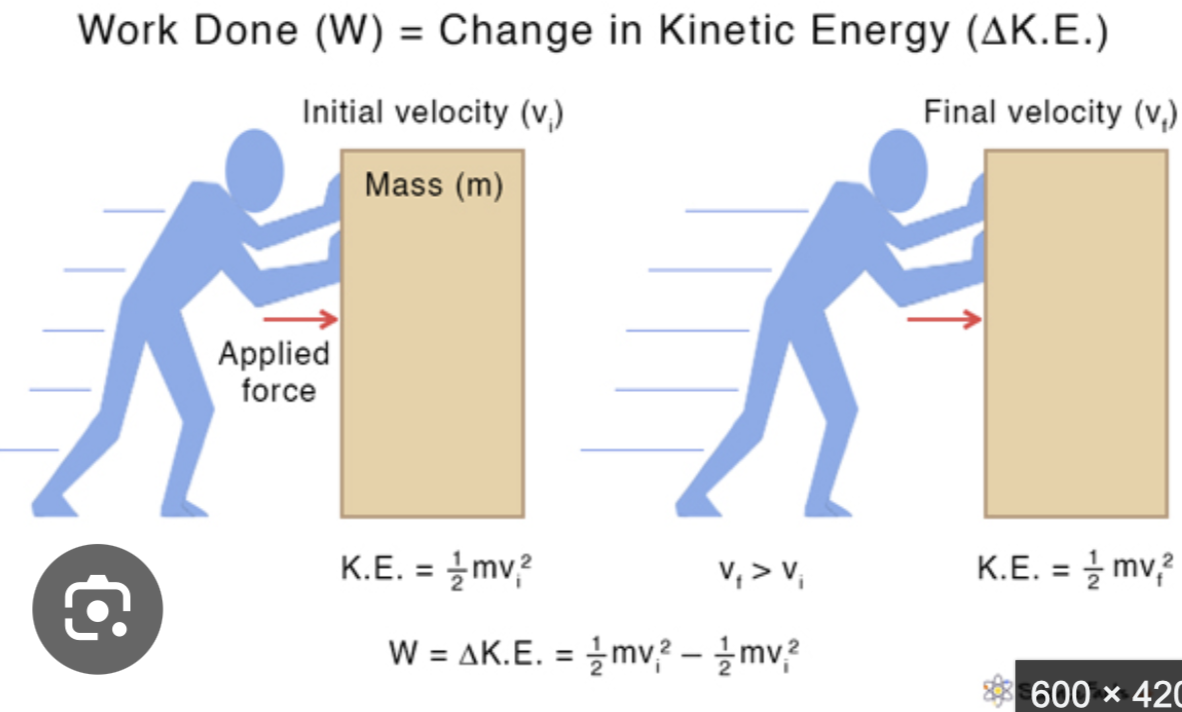
Work
This is the transfer of energy that occurs when a force causes an object or substance to move through a distance.
In thermochemistry, _____ represent energy transferred between a system and its surroundings through a physical process rather than through heat. For example, when a gas expands inside a container and pushes against a piston, the gas does ____ on its surroundings because it uses energy to move the piston.
Conversely, when the surroundings compress a grass, the ____ is done on the system because energy is transferred into the gas.
(so overall this is result of force acting through distance)
Heat
This is the transfer of energy between a system and its surroundings caused by a difference in temperature.
Heat naturally flows from a higher-temperature object to a lower-temperature object until they reach thermal equilibrium, meaning they have the same temperature. In thermochemistry, _____ describes energy moving into or out of a system during a chemical reaction or physical change.
When a system absorbs heat from it surroundings, q is positive because energy enter the system, this is called an endothermic process.
When a system releases heat into its surroundings, q is negative because energy leaves the system; this is called a exothermic process.
(for example, when ice melts, it absorbs heat from its surroundings to overcome the intermolecular attractions holding the water molecules in the solid structure. Conversely, when water freezes, it release heat as the molecules form a more organized solid structure)
_____ is different from temperature, as temperatures measures the average kinetic energy of particles, whereat ____ is the energy being transferred because of a temperature difference.

Kinetic energy
This is the energy an object or particle posses because of its motion. In chemistry, atoms, molecules, and ions are constantly moving, and their motion gives them kinetic energy.
The faster a particle moves, the greater its kinetic energy because kinetic energy increases with the square of its velocity. This means that doubling an objects speed increases its kinetic energy by a factor of four. Kinetic energy also depends on mass, so a heavier object moving at the same speed as a lighter object possess more kinetic energy.
In Chem, the kinetic energy of a particles is closely related to temperature, as the temp of a substance increases, its particles generally move faster, resulting in a higher average kinetic energy (for example heating water causes its molecules to move more rapidly, increasing their average kinetic energy. However, during a phase change, such as melting or boiling temperature remains constant while energy is used to overcome intermolecular attractions rather than increases the particles average kinetic energy.

Thermal energy
This is the energy associated with the random motion and interactions of the particles within a substance.
Atoms, molecules, and ions constantly move and interact with one another, and the energy associated with these motions and interactions contributed to a substances _____ _____.
_____ _______ is related to temperatures because increasing a substance’s temperature generally increases the average kinetic energy of its particles. However, thermal energy also depends on the amount of substance present, meaning a larger sample can have more total thermal energy than a smaller sample at the same temp (for example, a large pot of hot water generally contains more thermal energy than a small cup of hot water at the same temperature because the pot contains more water molecules)
_____ _____ can be transferred between substances as heat when they have diff temperatures, During heating, particles generally move faster, while during cooling, their average motion decreases.

Potential energy
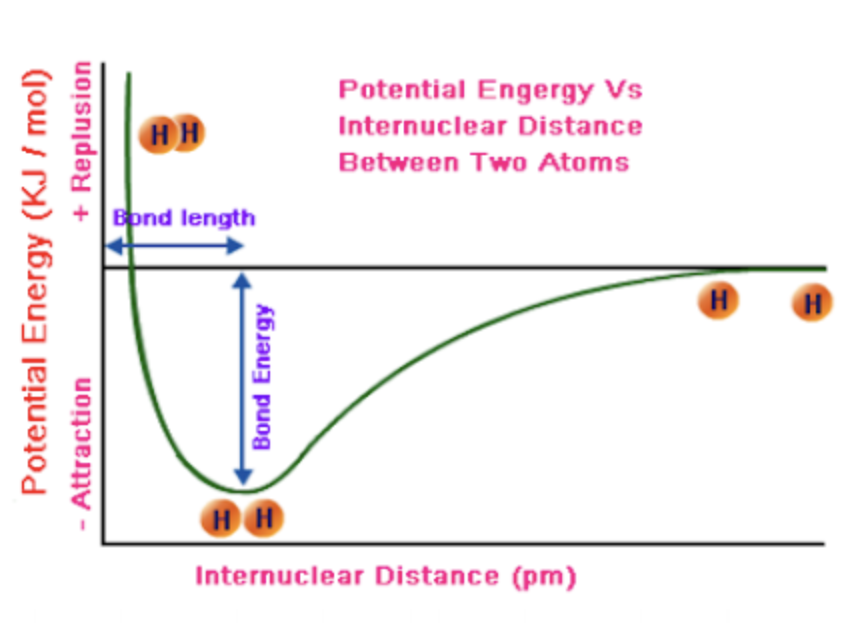
This is the stored energy associated wit the position, arrangement, or interactions of object or particles. In chem, potential energy is especially important because atoms, molecules, and ions posses energy due to the attractive and repulsive forces between them. (For example, oppositely charged ions, such as Na+ and Cl- attract one another through electrostatic forces, when these ions come together to form an ionic solid, their potential energy decreases, and energy is released because the resulting arrangement is more energetically favorable.
Similarly, chemical bonds involve potential energy associated with the interactions between atoms. Breaking a chemical bonds requires energy to overcomes the attraction between atoms, whereas forming a bond generally releases energy as the atoms move into a lower-energy arrangement.
Potential energy is also affected by particle separation, for oppositely charged particles, brining them closer together generally lowers their electrostatic potential energy.
In thermochemistry, changes in potential energy help explain why chemical reactions absorb or release energy.
Chemical energy
Is a form of potential energy associated with the arrangement of atoms, electrons, and chemical bonds within a substance.
Atoms and molecules posses chemical energy because the attractive and repulsive forces between their particles, particularly the interactions between electrons and nuclei. During a chemical reaction, atoms rearrange as existing bonds are broken and new bonds are formed, changing the system’s chemical potential energy.
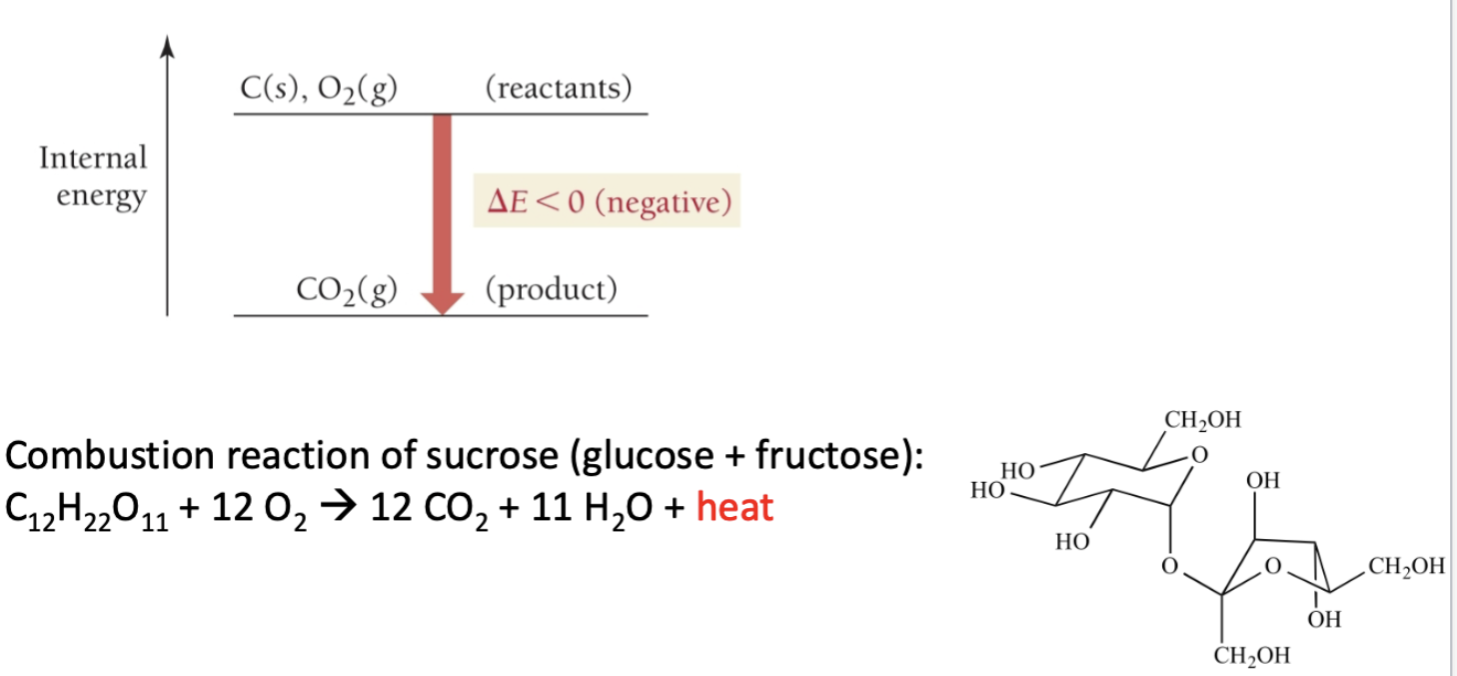
Breaking bonds requires energy because energy must be supplied to overcome the attractive forces holding atoms together, whereat forming bonds generally releases energy because the atoms move into a more energetically favorable arrangement. Whether a reaction releases or absorb energy depends on the overall energy balance between the bonds broke and the bonds formed (For example, combustion releases energy because forming bonds in the products releases more energy than is required to break bonds in the reactants)
______ ______ is therefore important in thermochemistry because changes in chemical potential energy explain why chemical reactions can transfer energy to or from their surroundings as heat.
System versus surroundings
In thermochemistry, the system is the specific substance or chemical reaction being studies, while the surroundings are everything outside the system that can exchange energy with it.
For example, if a chemical reaction occurs inside a beaker, the resting chemicals are the system, while the beaker, surrounding air, and nearby object are the surroundings.
energy can transfer between the system and surroundings as heat or work, but the total energy is conserved. If the system releases heat during an exothermic reaction, its energy transfers into the surroundings, causing the surroundings to warm up; therefore the system has a negative q, while the surroundings has a positive q.
Conversely, during an endothermic reaction, the system absorbs heat from the surroundings, causing the surroundings to cool down, the system has a positive q, while the surroundings have a negative q.
Understanding the distinction is important because thermochemistry focuses on tracking where energy goes; energy leaving the system enters the surroundings, and energy entire the system comes from the surroundings.

1st law of thermodynamics
This states that energy cannot be creates or destroyed; it can only be transferred between a system and its surroundings or converted from one form into another.
This means that the title energy of the universe remains constant, even when a chemical reaction causes energy to change forms. In thermochemistry, a systems internal energy (E) changes when heat is transferred or work is performed. (for example, if a chemical reaction releases heat into its surroundings, the system loses energy; if the surroundings compress a gas, the system gains energy through work)
The change in internal energy depends on both heat (q) and work (w), so the First law is expressed as (Change one energy = q + w)
Using the chemistry sign convention, heat entering the system is positive, heat leaving is negative, work down on the system is positive, and work done by the system is negative.
The first law allows chemists to track energy changes during reactions and understand that energy transferred out of a system must be transferred somewhere else rather than disappearing.

Seconds law of thermodynamics
The ______ law of thermodynamics states that the total entropy of the universe increases during a spontaneous process.
Entropy (S) describes how many microscopic arrangements are available to particles and how energy is distributed among those arrangements (think of entropy as a measure of how many different ways particles can arrange themselves and how energy can be distribute among them). When energy becomes more spread out among particles, there are generally more possible microscopic arrangements, and entropy increases.
For example imagines placing an ice cube in a warm room. Thermal energy naturally transfers from the warmer air into the colder ice, causing the ice to melt. This happens because energy becomes more disperses throughout the ice and surroundings. The reverse process, where a melted ice cube spontaneously gather heat from the room and freezes while the room becomes warmer doesn’t happen because it would decrease the total entropy of the universe, even if the system itself becomes more organized. Therefore entropy can decreases within a system as long as the entropy of its surroundings increases by a greater amount.

The third law of thermodynamics
This states that the entropy of a perfect crystal at absolute zero (0K) is zero. To understand this, entropy describes the number of possible microscopic arrangements available to particles. At absolute zero, a perfect crystal has its particles arranged in one unique, completely ordered configuration, meaning there is only one possible arrangement and no thermal motion.
Because there is only one possible arrangement, its entropy is zero. As the temp increases, particles gain thermal energy and can occupy more microscopic arrangements, causing entropy to increases (For example, as a crystal is heated its atoms vibrate more, and as it eventually melts its particles gain even more freedom of movement and possible arrangements)

Internal energy
This is the total microscopic kinetic and potential energy of all the particles within a system.
It includes the kinetic energy associated with the movement of atoms, molecules, and ions as well as the potential energy assailed with their interactions, such as electrostatic attractions, repulsions, and chemical bonding.
_____ _____ is not the energy of the system’s overall motion or position, rather, it represents the energy contained within the system at the microscopic level (For example, when a substance is heated its particles generally move faster, increasing their kinetic energy and therefore its internal energy. During a chemical reaction, internal energy can also change because atoms rearrange and chemical interactions change, altering the system’s potential energy.)
____ _____ is important in thermochemistry because it tells us how much the system’s energy changes when heat is transferred or work is performed (according to the first law of Thermodynamics, a system’s internal energy changes when energy enters or leaves through heat or work)
Internal energy being a state function
This means that the value of internal energy depends only on the system’s current state, not on the specific process or pathway used to reach that state.
A system’s state is determined by its properties, such as temperatures, pressure, volume, and composition. For example, imagine a gas that starts with an internal energy of 100 J and ends up with an internal energy of 300 J. Regardless of whether that gas is heated directly, compressed, or undergoes several different steps, its change in internal energy is always +200 J, because the initial and final state are the same (this means that that we are comparing different pathways that all start at the same condition and end up the same condition). However, the amounts of heat (q) and work (w) transferred can differ depending on the pathway. This is why _____ _____ is a state function, whereat heat and work are not, as ____ _____ describes a property of the system’s state, while heat and work describe how energy is transferred during a process.
Remember that means that:
______ _____ is a state function (E)
Enthalpy (H) is a state function
Entropy (S) is a state function
heat (q) is not a state function
Work (w) is not a state function

What enthalpy actually represents
__________ (H) is a thermodynamic state function defined as the internal energy of a system plus the pressure-volume term.
It is defined by H = E + PV (where E is internal energy, P is pressure and V is volume, and the PV terms accounts for energy associated with the system occupying volume under pressure)
What does this actually represent though: imagine a chemical reaction happening inside an open beaker, and the reacting chemicals are the system, the system has internal energy from the motions and interactions of its particles. The system also occupies space while surrounded by atmospheric pressure. ________ combines internal energy with the pressure-volume term. this makes it useful for tracking heat changes in reaction that happen at a constant pressure. You do not need to think of ______- as a separate kind of energy being stored in a substance, it is a defined thermodynamic quantity, that helps us calculate heat transfer)
What is enthalpy change; This tells us how much the enthalpy of a system changes as it goes from reactants to products. For example reactants have an enthalpy of 200 kJ and products have an enthalpy of 150 KJ, the products are 50 kJ lower in enthalpy. The reaction release 50 KJ of heat at constant pressure. This is an exothermic reaction
Why does enthalpy change equal heat at constant pressure: At constant pressure, heat transfer can account for changes in internal energy as well as energy assailed with expansion or compression abasing the external pressure. This is why _____ is useful because it captures the heat transfer at constant pressure in one quantity
Enthalpy
This is a thermodynamic state function defined as the internal energy of a system plus the pressure-volume term. It is defined by H = E + PV, where E is internal energy, P is pressure, and V is volume. The PV term accounts for energy assailed with a system occupying volume under pressure.
______ is particular useful because most chemists experiments occur at constant pressure, such as reactions in an open beaker exposed to atmospheric pressure. Under constant-pressure conditions, the change in _______ (Triangle H) equals the heat transferred to or form the system, provided the only work involved is pressure-volume work.
This means _______ change lest chemists determine how much heat a reaction absorbs or releases without having to separately calculate all the energy transfers involved.
This means enthalpy changes lets chemist determine how much eat a when a reaction releases heat, the products have lower ______ than the reactants, so _____ is negative and the reaction is exothermic. When a reaction absorbs heat, the products have higher ______ than the reactants, so the ______ is positive and the reaction is endothermic.
________ is a state function because its change depends only on the initial and final states, not the pathway used to reach them.
Exothermic Reactions
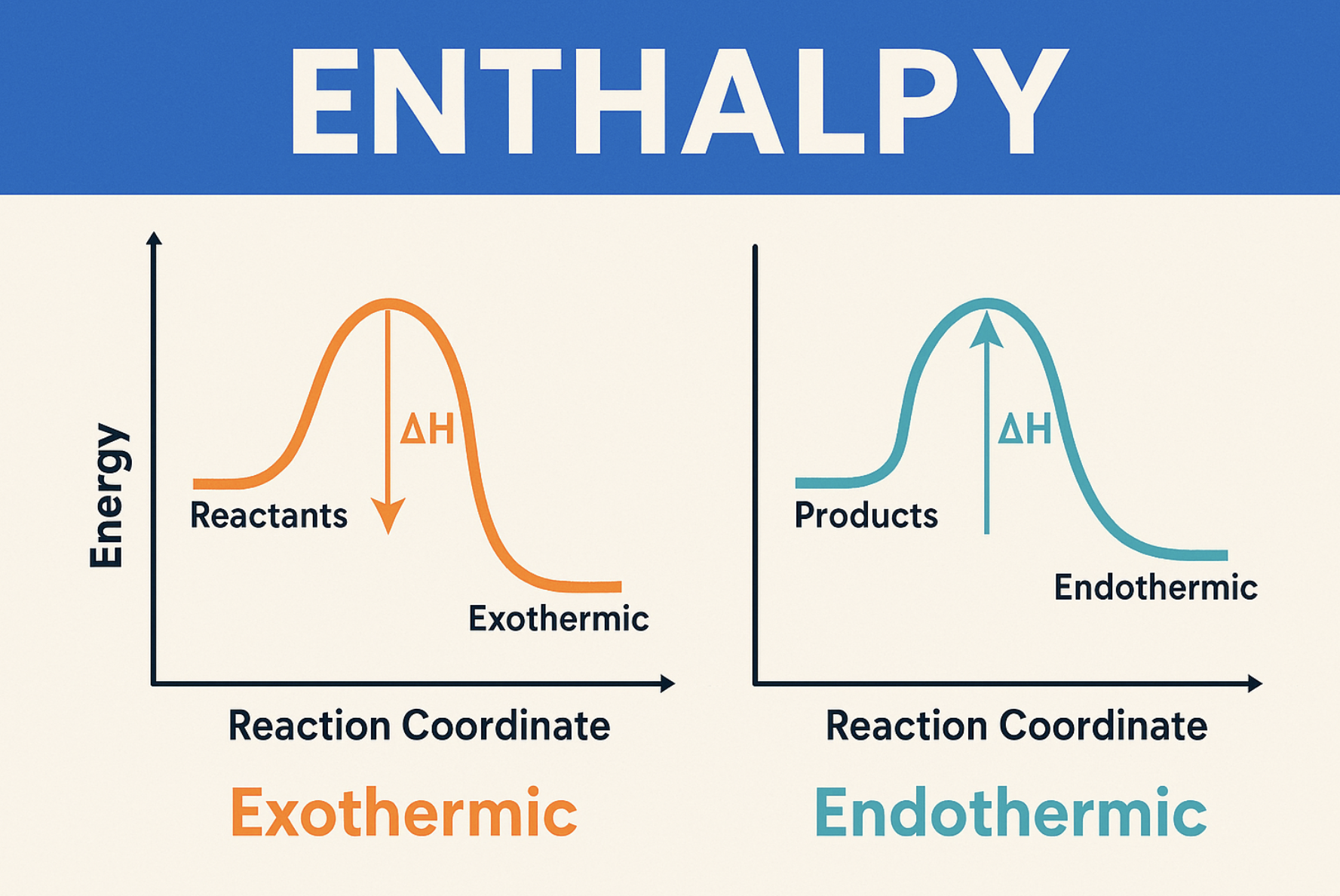
An __________ ______ is a chemical process that releases net energy to tis surroundings, usually in the form of heat or light. This means that the change in enthalpy is always negative, because the system is going heat.
On a potential energy diagram, the reactants start at a higher energy level than the final products, while it takes energy to break the initial chemical bonds, significantly more energy is released when the new bonds form, resulting in a net surplus of energy exit.
Because this excess thermal energy is dumped directly into the environment, you will physically observe a rise in temperature of the surroundings (making a test tube feel hot to the touch) Everyday examples include combustion, and acid-based neutralizations.
Endothermic Reactions
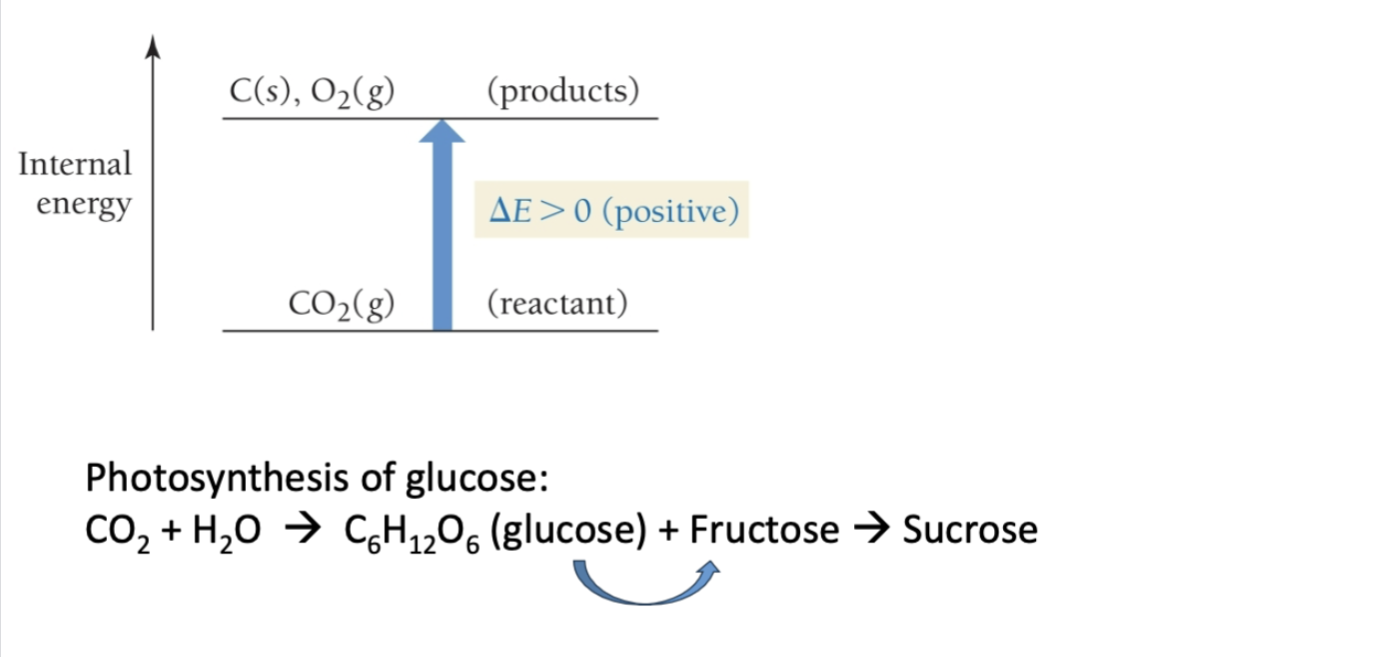
An ________ _____ is a chemical process that absorbs thermal energy from its surroundings to break chemical bonds in the reactants. In these reactions, the energy required to break the existing bonds is greater than the energy released when new bonds form, resulting in a net intake of heat.
As a result, the enthalpy change is always positive, and because heat is drawn away from the environment the temperature of the immediate surroundings drops.
A classical everyday example would be a chemical cold pack, where the reaction absorbs your body heat, making it feel cold to the touch (as dissolving ammonium nitrate in water absorbs heat rapidly making the pack fell cold
Change in internal being related to heat and work
The ______- in internal energy (Triangle E) of a system is the total change in its kinetic and potential energy, dilated by the first law of thermodynamics as the sum of heat (q) added to or lost by the system and work (w) done on or by the system
To calculate it, you must follow strict sign conventions based on the system’s perspective; heat absorbed by the system is positive (+q), while heat released by the system is negative (-q), and work done on the system (like compression a gas) is positive (+w) while work down by the system (like an expanding gas) is negative (-w).
In chem, expansion work is often called using the formal (w = -p * change in volume) which can be substitute directly into the main equation to yield (change one energy equal = heat - work done by or on the system)
Heat Capacity; Specific Heat Capacity and Molar Heat capacity
This is a measure of how much heat energy an object or substance must absorb to raise its temperature by one degree Celsius (or Kelvin). Think of it was a substances thermal sponge capacity as some materials, like water, have a high ____ ______ and can absorb a massive amount of heat before they actually start feeling hotter, while other, like metals, have a low _____ ______ and experience a rapid temperature spike from just a little bit of heat.
While ______ _____ ______ is the heat required to raise the temperature of exactly one gram of a substance by 1 degree Celsius and its units are J / G C or J/ (g K). The core formula is q = m x C x Change in temp (where m is mass in grams)
While _____ _____ _______ is the heat required to raise the temp of exactly one mole of a substance by 1 degree Celsius, and its units are J / (Mol x C) or J / (Mol x K) in which the core formula is 1 = n x Cm x Change in temp (where n is the number of moles)
Remember that the C’s stand for:
Uppercase C stands for Heath Capacity for the whole object measured in J / C
lowercase C (or s) stands for specific heat capacity (per gram)
Uppercase Cm (or C molar) stands for molar heath capacity
The q stands for heat energy (that is measured in Joules or kilojoules)
The Triangle T stands for change in temp (it is calculated as Temp final subtract Temp initial)

Thermal energy Transfer ; The Calorimetry law
This is often called heat (q) is the movement of kinetic energy from a warmer object to a cooler object due to a temp difference.
it is not somethings that an object “has” but rather the energy currently in transit until the two object reach the same temp (thermal equilibrium(
In Chem we calculate thermal energy transfer by tracking how a substances temperature changes, using the heat transfer equation:
q = m x c x Change in temp
Q = Thermal energy transferred (measured in Joules or Kilojoules)
m = mass of the substance (measured in grams)
c = specific heat capacity (measures in J/ (g x C)
Triangle T = Change in temp (T finial - T initial in C or k)
Remember though when thermal energy transfers between two isolated objects (like dropping a hot metal waster into cool water) energy is conserved, therefore the heat lost by the hot object must equal the heat gained by the cold object, this products the equation:
qlost = -qgained
Which is :
m (metal) x c (metal) x temp change (metal) = -( m water x c water x Temp change water)

Pressure-Volume work
This occurs when a system exchanges energy with its surroundings by changes it volumes against an external pressure.
In chem, this concept is most easily pictured as a gas trapped inside a cylinder with a movable piston, when the gas expands, it pushed the piston upward against the atmospheric pressure of the surroundings; because the system is expanding and expending energy to move that physical boundary, it is doing work on the surroundings, which results in a negative sing conversion (in which is work is negative). Conversely if the surroundings compress the gas into a smaller volume, energy is fired into the system , meaning work is done on the system (cause the work to positive)
We calculate this work by doing:
Originally physics defined work (w) as pushing an object with a force (F) over a certain distance
W = F x D
Inside a cylinder, a force comes from gas pressure (P) pushing against the surface Area of a potion. Since Pressure = Force / Area, we can rewrite force as
F = P X A
If we swap this into our first formal, work becomes
W = P x A x D
In a cylinder, the distance the piston moves up or down Is just its change in height, we call this triangle H
W = P x A x Triangle H
If you multiply the flat surface area (A) of a cylinder by its height (Triangle H) you get its volume. Therefore, the change in area times height is the change in volume
W = P Change in Volume V
The negative sign means that when gas expands if pushes the piston out, during work on the surroundings and losing energy. We give this a negative sign to work
When gas compresses, the surroundings push down on it, adding energy into the gas, we give the work a positive sign.

Calorimetry
This is the experimental measurement of heat transferred during a physical or chemical process.
The fundamental idea behind _______ is that when a reaction releases or absorbs heat, that energy can be measured by observing the temperature change of the surroundings, usually water. Heat is energy transferred because of a temperature difference; it flows from a warmer substance to a cooler substance. For example, if a chemical reaction releases heat into water, the water’s temperature increases because its particles gain energy. If the reaction absorbs heat from the water, the water’s temperature decreases because the water loses energy.
A ________ is an insulated device design to minimize heat exchange wit the outside environment, allowing use to measure this energy transfer. The important distinct is that the temperature change you measure in the water tells you about the heat transferred by the reaction, not necessary the reaction’s own temperature change.
The mathematical relationship in calorimetry:
The amount of heat transferred is calculated using:
Q = mcTriangle T, where
Q = is the heat transferred in joules (J)
m = the mass of the substance in grams (g)
c = the specific heat capacity in J / (g * C) (this is from the substance who’s temperature you are measuring)
Triangle T = The final temperature versus the initial temperature (representing temperature change)
The reason mass and specific heat matter is that different substance require different amount of energy to change temperature. For example, water has a specific heat of 4.184 J / (g * C) meaning it requires 4.184 J to raise 1 gram of water by 1 degree C. Therefore a larger mass or a greater temperature change means more heat was transferred.
The other important fact is the that calorimeter follows the law of conservation of energy; (energy cannot be created or destroyed, only transferred).
Therefore that means that the:
q reaction = -q solution (exothermic reaction; that means the reaction relates heat, so the solution gains heat and its temperature increases that mean the q reaction would be negative. If it is an endothermic reaction where the reaction absorbs heat, so the solution loses heat and its temperature decreases, that means the q reaction is positive)

Constant-Volume Calorimetry: How do We measure Change in Enthalpy for chemical reactions
______-_________ __________ is a method used to measure the change in internal energy, defined as triangle E, of a chemical reaction by measuring the heat transferred while the reactor occur in a rigid, sealed container.
To understand this, we need to distingue between the system and the surroundings; the system is the chemical reaction itself, while the surroundings are the calorimeter and the water around it. When a reaction releases heat, the energy transfers from the system to the surroundings, causing their temperature to increases. We calculate the heat absorbed by the surroundings using q = mcs and change in T (where m is the mass of the surroundings, Cs is their specific heat capacity, and change in T is their temperature change).
The reaction’s heat is equal in magnitude but opposite in sign to the heat absorbed by the surroundings. The reason ______ - ________ ________ allows us to determine internal energy is that the container cannot expand or contract, so its volume change is zero. Since pressure-volume work is calculated using w = - P times Change in V, and the change in V is zero, the reaction does not pressure-volume work. And according to the first law of thermodynamics, the change in E (so the change in internal energy) is equal to heat transferred and work done, the work term becomes zero and the reaction’ change in internal energy is equal to the heat transferred at a constant volume.

The bomb Calorimeter
A _______ ________ is a device used to measure the heat released or absorbed by a chemical reaction occurring at constant volume. The reaction, which is the system, takes place inside a tightly sealed metal container called the bomb, which is filled with oxygen to allow the sample to react. This sealed container is surrounded by water, which acts as part of the surroundings. When the reaction releases heat, that energy transfers from the reaction to the surrounding water and calorimeter, causing their temperature to increases.
A thermometer measures this temperature change, and a stirrer ensures that the heat is distributed evenly throughout the water. Because the calorimeter has a know heat capacity, Ccal, we can calculate how much heat is absorbed using qcal = Ccal times change in temperature (remember that you a bomb calorimeter, you usually don’t need the mass In the equation because the calorimeters heat capacity already accounts for how much heat the tier calorimeter absorbs)
The heat releases or absorbed by the reaction is than equal in magnitude but opposite in sign to the heat absorbed or lost by the calorimeter.

Enthalpy (H)
This is a thermodynamic property that helps us understand how energy is transferred as heat during a chemical reaction, particularly when the reaction occurs at constant pressure.
To really understand enthalpy, it is important to recognize that matter contains energy in many different forms. Atoms and molecules are constantly moving, and they also have energy associated with their interactions, chemical bonds, and arrangements. When a chemical reaction occurs, the reactant molecules are rearrange into products, and the energy of the system changes because the original arrangement of atoms and interactions is replaced by a new arrangement.
________, represented by H, is a property that accounts for the system’s internal energy as well as a pressure-volume contribution. Its mathematical definition is H = U + PV (where U represents the internal energy of the system, P represents its pressure, and V represents its volume) the important thing to understand is that ______ is not simply the amount of heat stored inside a substance, nor it is a substances temp. Instead ______ is a thermodynamic property that allows chemist to determine the heat transferred during a process that takes place a constant pressure.
For example, when you conduct a reaction in an open laboratory container, the pressure is approximately constant because the reaction is exposed to atmospheric pressure. under these conditions, the _____ change of the reaction tell you how much heat the system transfers to or receives from its surroundings.
What the equation H = U + PV actually means
The equation H = U + PV acts to combine internal energy, pressure, and volume which appear to represent different things. However, the purpose of this equation I to account for two important aspects of a system’s energy.
The first is its internal energy, U, which represents the microscopic energy associated with the particles inside the system, including their motion and interactions.
The second is the pressure-volume term, PV, which accounts for the energy-related contribution associated with the system occupying volume under pressure. imagine a chemical reaction that produces a gas. The gas molecules spread out, causing the system to expand against the surroundings atmospheric pressure. When the system expands, it must transfer energy to its surroundings by doing pressure-volume work. Therefore, _____ is useful because it incorporates this pressure-volume contribution alongside internal energy.
This means that when we calculate the change in _______, we account for the energy change of the system in a way that is particularly useful for reactions occurring at constant pressure. One important distinction is that PV is not necessarily energy that is stored in a separate physical object; it is a mathematic contribution to a thermodynamic property.
______ is therefore a defined property that helps chemist understand energy change, rather than a literal substances or a separate type of energy that molecules contain.
Stoichiometry involving change in Enthalpy
_________ _________ tells you how much heat is released or absorbed when a certain amount of a substance reacts.
An important distinction is the enthalpy change given in a balance chemical equation tells you how much heat is released or absorbed when the reaction occurring in the exact proportions specific by its coefficients
For example in the photo, this means that when 2 moles of hydrogen react with 1 mole of oxygen to produce 2 moles of water, 571.6 KJ of heat is released. If you want to know how much is related per mol of hydrogen you divide the enthalpy by the coefficient of hydrogen, and you get a value that displaying things like for example that for every 1 model of hydrogen that reacts, 285.8 KJ of heat is released.
Therefore you can use this process of saluting the amount of heat released or absorbed during a chemical reaction using the balanced chemical equation and its enthalpy change.

Coffee-cup calorimetry; Constant-Pressure Calorimetry
This is an experimental method use to measure the heat released or absorbed during a chemical reaction that occurs at approximately constant pressure.
The concept is based on measure how the temperature of a solution changes when a chemical reaction takes place inside an insulated container, such as a coffee up. The reaction is considered the system, meaning it is the chemical process being studied, while the surrounding solution act as the surroundings, meaning it absorbs or release heat from the reaction.
When an exothermic reaction occurs, the reaction releases heat into the solution, causing the solution’s temperature to increases. When an endothermic reaction occurs, the reaction absorbs heat from the solution, causing the solutions temperature to decreases. By measuring the solutions temperature change, its mass, and its specific heat capacity, chemist can calculate how much heat the solution absorbed or released.
Because the calorimeter is open to the atmosphere, the reaction occur at approximately constant atmospheric pressure. This is important because under constant-pressure conditions, the heat transfer by the reaction corresponds to enthalpy change. Therefore, the _____-______ _______ allows chemist to experimentally determine the enthalpy change of a chemical reaction by measuring the temperature change of the solution rathe than directly measuring the heat of the reaction itself.

Relationships involving enthalpy change
The relationships involving enthalpy change (Triangle H rxn) describe how chemist can calculate the heat released or absorbed by a chemical reaction even when they cannot directly measure that reaction’s enthalpy using calorimetry.
Although calorimetry is useful for measuring the enthalpy change of many reactions, some reactions cannot be isolated to produce only one specific product. For example, when carbon reacts with oxygen, it can product carbon dioxide, or carbon monoxide, depending on the reaction conditions. (carbon dioxide forms when carbon reacts with sufficient oxygen, while carbon monoxide can form when oxygen is limited) if we want to determine the enthalpy changes for producing carbon monoxide, we cannot simply measure the heat released from burning carbon because the reaction may also product carbon dioxide.
Instead, chemist use experimentally measured enthalpy changes to called the enthalpy change of the reaction they cannot directly measure. This works because enthalpy is a state function, meaning its change depends only on the initial and final state of the system, not on the pathways taken between them. Therefore, even if a reaction cannot be directly measures, its enthalpy change can be called by combing other reactions wheels enthalpy changes are already know. This principle is called Hess’s Law.
Three relationships between chemical equations on Change in Hrxn
The relationships between chemical equations and enthalpy change explain how changing a chemical equation affects the amount of heat released or absorbed by the reaction. Because enthalpy change depends on the quantity of reactions and products involved, whenever you manipulate a balance chemical equation, you must also manipulate its enthalpy change value accordingly.
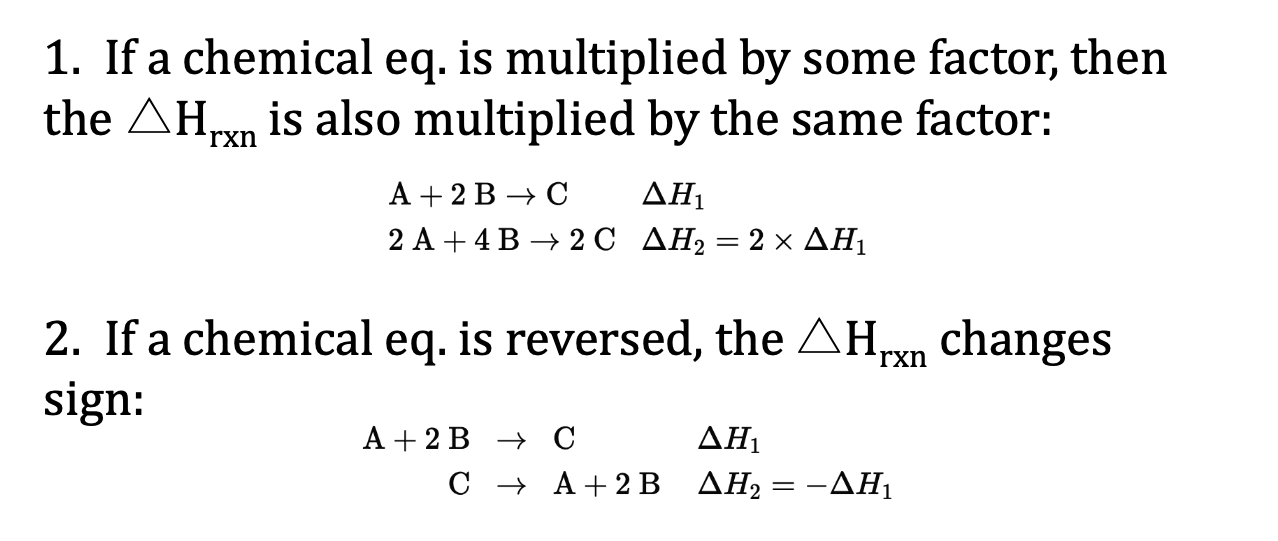
The first relationship state that if you multiply a chemical equation by a certain factor, you must multiply its enthalpy change by the same factor. this is because multiplying the equation increases or decreases that amount of reaction occurring. for example, If a reaction releases 100 KJ of heat when it occurs as written, doubling all of its coefficient means twice as much of each substance reacts, so the reaction releases 200kj of heat.
The second relationship states that if you reverse a chemical equation, you must reverse the sign of its enthalpy change. This happens because reversing a reaction switches the direction of heat transfer. If the forward reaction releases heat and it exothermic, so (Change in heat is negative) the reaver reaction absorbed that same amount of heat and is endothermic. (change in heat is positive).
These relationship are important for Hess’s Law because they allow you to manipulate know chemical equations and their enthalpy values to called the enthalpy change of a reaction that cannot be directly measured.
Hess’s Law relationship
This law states that if a chemical reaction can be expressed as the sum of multiple smaller reactions, the enthalpy change (Triangle Hrxn) of the overall reaction equals the sum of the enthalpy changes of those individual steps.
This principle works because enthalpy is a state function, meaning that the total enthalpy change depends only on the initial reactants and final products, not on how many steps the reaction takes to get form one to the other. For example, imagine that a reaction begins when substances A and B and ultimately products substances D, but it cannot occur directly in a way that allows its enthalpy change to be measured. instead, the reaction can occur through an intermediate substance C. The first reaction transforms A and B into C and has an enthalpy change of Triangle H1, while the second reaction transforms C into D and has an enthalpy change of Triangle H2. Because the intermediate substance is produced in the first reaction and consumed in the second reaction, it cancels out when the equations are aded together.
This resulting equation repressed the overall reaction from A and B to D.
Hess’s law tells us that the enthalpy change of this overall reaction equal to Triangle H1 + Triangle H2. This means that even if we cannot directly measure the heat transferred during the overall reaction, we can calculate it by adding the enthalpy cages of the individual steps.
The important concept is that energy changes of the entire reaction is the same whether the reaction occur in one step or through several intermediate steps.

Enthalpy Change from bond energies
Bond energy calculations allow you to estimate the enthalpy change of a chemical reaction by determine how much energy is required to break the bonds in the reactants, and how much energy is relearned hone new bonds form in the products.
To understand this concept, remember that chemical reactions involving rearrange atoms, not creating or destroying the. The atoms in the reactant are conned by certain chemical bonds, and during the reaction, those bonds are broken and new bonds are formed to create the products. Breaking a chemical bonds requires energy because you must overcome the attractive forces holding the atoms together, so bond breaking is an endothermic process with a positive energy contribution. Forming a chemical bonds releases energy because the atoms become more stable when they bond, so bond formation is an exothermic process s with a negative energy contribution.
The enthalpy change of the overall reaction depends on the balance between these two energy changes. if more energy is released from forming new bonds than is required to break the original bond, the reaction releases heat and is exothermic.
If more energy is required to break the original ends and then is releases form firing new bond, the reaction absorb heat and is endothermic. This is why you cannot determine whether a reaction is exothermic or endothermic simply by looking at the number of bonds broken or formed; you must consider the energy associated with each specific bond.
The bond energy equation would be:
change in enthalpy = added bond energies of the bond broken - added bond energies of the bonds formed.
(Remember that is is important for you to know the Lewis structure of all reactants and products for bond energies calculations, this means you need to be able to draw the molecules and identify which atoms are connect by which chemical bonds)

Standard Enthalpy of Formation / Standard Heat of formation
The standard enthalpy of formation is the enthalpy change that occurs when exactly 1 mole of a compound is formed from its constituent elements, in their standard states.
It tells you how much heat is released or absorbed when a compound is crated from elements that make it up. (for example, when hydrogen gas and oxygen gas react to form liquid water, the standard enthalpy of formations tell you the heat transferred when exactly 1 mole of water is produced. The symbols Triangle H f with a zero indicates that the formation occurs under standard-state conditions.
Standard states are the defined conditions for each substance; gases are pure gases at 1 atm, liquids and solids are pure substance in their most stable forms at 1 atm, and dissolved substance have a standard concentration of 1 M. The temp is commonly 25 degrees Celsius in a lot of these problems. These conditions matter because a substance enthalpy can change depending on its physical state, pressure, and concentration (for example, liquid water and water vapor have different enthalpies because the molecules have different intermoelcuels interactions and energy) By specificying standard states, chemist can constitnelty report and compare enthalpy values. (Remember that for pure elements in their standard states, the standard enthalpy of formation of defined as zero. This doesn’t mean that these elements contain no energy; it means that forming the from themselves in their standard forms produces no enthalpy change)
Compounds, however, generally have nonzero formations enthalpies because forming them from their constituent elements involves a chemical change that transfer energy (for example, the formation of liquid water has a stand enthalpy of formation of approximately - 285.8 kj / mol, meaning that the forming 1 mold of liquid water form hydrogen and oxygen releases 285.8 kJ of heat)
These values are especially useful in chem because they allow you to calculate the enthalpy change of an entire reactor by comparing the formation of enthalpies of its products and reactants.

Calculating the Standard Enthalpy Change for a Reaction
To calculate the Standard enthalpy of change of a reaction, you use the principle that a chemical reaction can be conceptually broke down into two steps. Decomposing the reactants into their constituent pure elements and then reassembling those elements into the final products.
Because standard enthalpy of formation values represent the energy change when a compound is built from its elements, breaking a compound down into elements requires reversing the sign, Summing these pathways together gives use Hess’s laws formula:
To solve in depth:
Look up each substance standard enthalpy of change formation value from the table and multiply it by its stoichiometric coefficient from the balance equation, as enthalpy is an extensive property (dependent on about)
Sum the values for the products
Some the values for the reactants (note that pure elements in the standard states always have a standard enthalpy of change of 0 kj/mol because it takes no energy to form an element form itself)
Subtract the reactant total from the product total to find the final net energy change.

Properties of states of matter
The three primary states of matter, solids, liquids, and gases are fundamentally defined by the balance between the kinetic energy of their particles and the strength of their intermolecular forces.
Solids feature particles locked into highly organized, fixed position with minimal kinetic energy, vibrating in place because the strong attractive IMFs completely dominate thermal motion (this macroscopic rigdity results in a fixed shape and an incompressible, definite volume). (therefore the density is high, the shape is definite, and the volume is definite and the strength of the intermolecular force relative to thermal energy is strong)
As thermal energy increases and overcomes these rigid constraints, matter transition into a liquid, where particles posses enough kinetic energy to continuously slides and flow past one another while remaining in close, constnat macroscopic contact (this state yields a fixed, incompressible volume but an indefinte shape that naturally conforms to its container) (therefore its density is high, its shape is indefinite, its volume is definite, and its strength of the intermolecular force relative to thermal energy is moderate)
Finally, when kinetic energy overwhelmingly surpasses all IMFs, the substance becomes a gas, characterized by widely separated particles moving rapidly and randomly. (because gas molecules interact almost exclusively through brief, random collisions, they lack both a fixed shape, and a definite volume, expanding completely to fill any vessel while remaining highly compressible due to the vast amounts of empty space between the molecules) (therefore its density is low, its shape is indefinte, its volume is indefinite, and its strength of intermolecular force relative to thermal energy is weak)

Intermolecular Forces / Supramolecular interactions (SI) / Van der Waals Forces
___________ ______ are the electrostatic attraction that occur between neighboring molecules. (these are distinct from much strong intramolecular covalent or ionic bonds that hold individual atoms together)
These are derived fundamentally from Coulomb’s law, these forces arise because opposite electrical chargers attract; therefore variations in electron density create areas of permanent or temporaty positive and negative charge.
These interactions are grouped into three primary categories based on how those chargers originate, these are typically ranked by their relative strength, assuming similar molecular sizes, starting with London dispersion forces, next dipole-dipole interactions, then hydrogen bonding, and then ion-dipole forces.

Bonds
The core of chemical bonding lies in Coulomb’s law, which states that the potential energy of two interacting charges depends on their types and the distance between them.
When a positively charged nucleus and a negatively charge electron approach one another, the product of their opposite signs yields a negative potential energy value.
In physicals and chem a lower, more negative energy state signifies greater stability. As these opposite charges move closer together (r decreases) the value becomes increasingly negative, releasing energy and creating a strong attractive force that holds the particles together.
This thermodynamic drive to achieve the lowest possible energy states is what creates all chemical bonds. The specify way these particles arrange themselves to maxine this stabilization determines the bond type, for example atoms share electrons equally in non-polar covalent bonds, share then unequally due to electronegativity in polar covalent bonds, or completely transfer electrons to form oppositely charged ions that cling together through pure electrostatic attraction ionic bonds
London Dispersion Force
These are temporary intermolecular attractions that occur between all atoms and molecules, even if they are completely nonpolar.
Because electrons are constantly moving in their probably clouds, they don’t always stay perfectly balances; at any given split-second, more electron might randomly bund up on one side of a molecular then the other. This momentary imbalance caveats an instantaneous dipole, giving one side a partial negative charge and the other a partial positive change. This fleeting charge then shifts the electron cloud of a neighboring molecule, inducing a second dipole. The opposite partial chart of these two adjectives temporary dipoles attract each other momentarily before the electron move again.
The critical take is how these forces Cale. LDFs scale dreiclty with polarziabilty, which is how easily an electron cloud can be distorted, Large moelcuels with higher molar mass have large more loosely held electron cloud , making them highly polarizable and resulting in much strong lDFS (which is why iodine isa solid at room temp, and while flurry is a gas) (done is very far dow the halogen group, it has a massive heavy electron cloud contain 106 electron per 12 moel3s, because that cloud is so large and far fro the uncle, it is incredibly easy to distort. This high polarczaiblty treats strong, frequent temporal dipoles. The resulting LDFs are strong enough at room temp to tightly lock the iodine meolces into a ridge strcure solid lattice. However Flurie is at the very top of the group it is a tiny mobceus with only 18 total electron telhgly held to the uncles. This small electron cloud is ridge and very diffuse to disotre, because its tmepaory dippers are incredible weak nd fleeting , the LDFS between F2 mooches are virtually non-existent at room tmp, thermal energy easily overcomes theee weak attractions, allowing the moelces to flay apart freely as a gas)
How we identify these, in terms of which ones are stronger (cause every atom / molecules has it) is:
Identify molar mass (polarizaibilty) look at the periodic table, large atoms and moelces have more electron. that are farther from the nucleus .Tese large electron cloud are loosely and easily distorted meaning, they are highly polarized
Identify shape: For molecules with simiarmases, long and linear chains have more surface are to interact with neighbor, creaint stronger LDFS than compare spherical molecules

Polarizability and shape and surface area impact on London Dispersion forces
Polarizabilty is the “of the electron cloud. When a molecules has a larger surface area or a large volume. its other electrons are spread out and less tightly held by the nuclei. This make the cloud highly _______, meaning it is very easy for the elections to suddenly slosh to one side and care a powerful temparoy dipole.
Shape directly determines the available surface area for contact. Long, line shapes allow tow molecules to fie flat again each other, maximin their coat area, Sperhical or branches hares kappa the moelces apart, mining contact. More surface are means more operates for electron cloud on an ajdece mooches to touch and infleucneo ne another.
Therefore high surface area + high polarity means a strong LDf, while a low surface are + low polarization = weak LDFs
So thing about:
Polarizaiblty (size of the electron cloud)
Shape (remember that the molecules shape determines its surface area)
Surface area (remember that particles with greater molar mass have greater surface area)

Dipole-Dipoles Forces
These are intermolecular attractions that occur between polar molecules, while are moleusl with a permanet uneven distribution of electron density.
In a polar bond, a more electroengiatve atom pulls shared electrons closer to itself, creating a partial negative charge on one end of the moelce and leaving a particle positive charge on other other.
Think of these molecules as tiny molecular magnets; the partial positive end of one polar moelces aligns with an electros tail attracts the partial negative ned of an adjance moelce . These force are strong than long dispersion force (which rely on tempura blinking dipoles) but weaker than ionic or covalent bondsbecuas they only involve particle charge.
In the context of this course the strength of these dipoe=diple interaction directly dialects microscope physical prospers, as strong dipole-diple forces mean the moelces cling to each other more tightly, resulting in a higher boiling options, higher meting poitns, and Lowe vapor pressure comped to nonpolar substance of similar size
How we check if a molecule is this:
Check for polar bonds
Look at the electronegative diffnece between bonded atoms
if two nonmetals are bonded (like C-Cl , H-O, or C-O) the bond is polar
if atoms are identical (like O2) or it is a C-h bond the bond is nonpolar
Determine the 3d Molecules geometry (VSEPR)
Draw the Lewis strict and count the elected domain around the cnetlra atoms
determine the 3d shape (liner, bent, et )
This tells you exalcyt which way the polar bond arrows (dipole vetoers) are point in 3d space
Check for Assyemtr