Nervous and Endocrine System WOT - Science T2 2026
 Call Kai
 Learn
 Practice Test
 Spaced Repetition
 Match
 Flashcards
 Knowt Play
1/57

There's no tags or description
Looks like no tags are added yet.
58 Terms
Describe the stimulus response
Stimulus -> Receptor -> CNS (brain and spinal cord) -> Effector (via the interneuron and motor neuron) -> Response
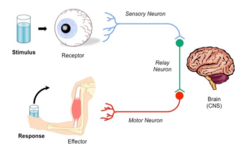
Types of neurons
Sensory, motor and interneurons
Sensory neuron
Carries incoming information from the sensory receptors to the brain and spinal cord

Interneuron
Connects sensory and motor neurons
Motor neuron
Sends an impulse to a muscle or gland, causing the muscle or gland to react
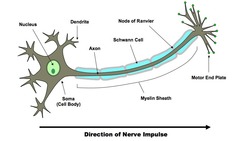
What are the main parts of the neuron?
Dendrites, cell body (soma), axon, myelin sheath and axon terminals
Role of dendrites in nerve transmission
Receive incoming signals from other nerve cells
Role of the cell body in nerve transmission
Acts as the metabolic and integration center of a neuron
Role of the axon in nerve transmission
Conducts electrical impulses away from the cell body (soma)
Role of the myelin sheath in nerve transmission
increases the speed and efficiency of nerve impulse transmission
Role of axon terminals in nerve transmission
Carries impulses to other neurons
What is a synapse?
The gap between 2 nerve cells or neurons
What are neurotransmitters?
Chemicals that send messages across a synapse from one nerve cell to another
Describe synaptic transmission between neurons
1. Neurotransmitters are released from vesicles
2. The vesicles fuse with the cell membrane
3. The neurotransmitter travels across the synapse
4. The neurotransmitter binds to the receptor on the nearest dendrite
What are the 3 main parts of the brain?
The forebrain, midbrain and hindbrain
What are the 2 main parts of the hindbrain?
The brain stem (medulla) and cerebellum
What is the main part of the forebrain?
The cerebrum
Brain stem (medulla)
Regulates critical, involuntary survival functions
Cerebellum
Controls posture, coordination, balance and movement
Cerebrum
Controls conscious, voluntary activities such as thinking, memory, senses and voluntary movement
What are the 4 lobes of the brain?
Frontal lobe, parietal lobe, occipital lobe, temporal lobe (FPOT)
Functions of the frontal lobe
Controls decision-making, planning, personality, speech and voluntary movement
Functions of the parietal lobe
Processes touch, temperature and pain
Functions of the occipital lobe
Processes visual information and Interprets colour, shape, and movement
Functions of the temporal lobe
Where hearing is processed and where our memories are stored
What are reflex actions?
Automatic and rapid actions that travel through the spinal cord instead of the brain to ensure survival and protect the body from harm
Why are reflex actions important?
They protect the body from harm
What are the differences between reflex arcs and conscious thoughts?
Reflex arcs are automatic, quick responses that travel through the spinal cord to help you survive by protecting the body from harm whereas conscious thoughts are slow, deliberate and controlled by the cerebrum
What are some differences between the nervous and endocrine system?
Endocrine effects last longer, the nervous system is faster and shorter and the nervous system involves chemical and electrical messages whereas the endocrine only involves chemical messages
What are similarities between the nervous and endocrine systems?
They coordinate and control body functions, help maintain homeostasis, use chemical signals to communicate and both respond to stimuli
What are similarities between neurons and endocrine glands?
Both are specialised cells that produce chemical signals to communicate with other parts of the body and help coordinate body functions.
What are differences between neurons and endocrine glands?
Neurons transmit rapid electrical and chemical signals through the nervous system, while endocrine glands release hormones into the bloodstream
What are the major glands involved in the endocrine system?
Hypothalamus, adrenal glands, ovaries, pancreas, parathyroid glands, pineal gland, pituitary gland, testes and thyroid gland
What hormones does the pituitary gland produce?
Growth hormones, thyroid-stimulating hormone, adrenocorticotropic hormone, follicle-stimulating hormone, luteinising hormone and prolactin
What hormones does the thyroid gland produce?
T4 (thyroxine), T3 and calcitonin
What hormones does the hypothalamus produce?
ADH and oxytocin
What hormones does the adrenal gland produce?
Adrenaline, cortisol and aldosterone
What hormones does the ovaries produce?
Estrogen and progesterone
What hormones does the pancreas produce?
Insulin and glucagon
What hormones does the parathyroid produce?
Parathyroid hormone
What hormones does the pineal gland produce?
Melatonin and serotonin
What hormones does your testes produce?
Testosterone
Thyroxine
Controls your body's metabolism, heart rate, brain development, and bone maintenance
Testosterone
Drives male puberty, regulates sex drive, builds bone and muscle mass, and promotes red blood cell production.
Estrogen
Essential for reproductive development, bone strength, and brain health
Adrenaline
Triggers your "fight-or-flight" response and instantly prepares you for fast action by pumping your heart faster, opening up your breathing and giving you a sudden burst of energy
Insulin
Regulates blood sugar (glucose) levels by decreasing blood sugar
Glucagon
Prevents blood sugar from dropping too low by increasing blood sugar
Growth hormone
Fuels childhood growth, controls body composition, and regulates metabolism
What happens to the neurotransmitter after it crosses the synapse?
It breaks down or is reabsorbed
Why is there a synapse between neurons?
To allow control and flexibility in signalling
Describe the order of events at a synapse
Electrical -> Chemical -> Electrical
Where is the hindbrain located?
At the back and base of the brain
Which part of the forebrain helps relay messages between the body and the cerebrum?
Thalamus
Which part of the forebrain controls hunger, thirst, body temperature and emotions?
Hypothalamus
What does the parietal lobe help the brain do?
Understand space and body position
What are hormones?
Chemical messengers carried in the blood
What happens if the body doesn't produce enough insulin?
Diabetes