Exam 3 TA Review Video
 Call Kai
 Learn
 Practice Test
 Spaced Repetition
 Match
 Flashcards
 Knowt Play
1/69

There's no tags or description
Looks like no tags are added yet.
70 Terms
oxidoreductases
class of enzyme that transfers electrons
transferases
class of enzyme that catalyzes group transfer reactions
hydrolases
class of enzyme that catalyzes hydrolysis reactions
lyases
class of enzyme that catalyzes the addition of groups to double bonds, or formation of double bonds by removal of groups
isomerases
class of enzymes that catalyzes the transfer of groups within molecules to yield isomeric forms
ligases
class of enzymes that catalyzes the formation of C-C, C-S, C-O, and C-N bonds by condensation reactions coupled to ATP cleavage
EX double dagger
Which must be bound more tightly for catalysis to occur? : EX double dagger or ES?
catalyzed rate / uncatalyzed rate
What is the equation for catalytic power?
lock and key model
model that’s a bit older that says the enzyme already has the exact shape for a substrate to fit.
induced fit model
more accurate model for enzyme catalysis that says an enzyme’s active site may not be perfect for the substrate before binding, but the active site shape kinda changes a little bit once the substrate binds
cofactors
non-protein chemical components required for enzyme activity
coenzymes
organic, non-protein molecules that assist enzymes by carrying chemical groups or electrons (often derived from vitamins)
Are all coenzymes cofactors, or are all cofactors coenzymse?
All coenzymes are cofactors
apoenzyme
the protein portion of an enzyme, typically inactive (without its cofactor / coenzyme)
holoenzyme
the complete, catalytically active enzyme (with its cofactor / coenzyme)

k-1 could also be written as k3 and k-2 could also be written as k4
Label the following

Km (Michaelis constant)
term in Michaelis-Menten equation that represents the [S] where V is half of Vmax
no
Does Km depend on enzyme concentration?
steady state assumption
assumption that states the concentration of the ES complex stays constant over time bc rate of ES breakdown = rate of ES formation
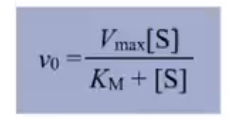
Write out the Michaelis-Menten equation

Write out the equation for a Lineweaver-Burk plot in y = mx + b form
first order reaction
What order reaction does the first half of a Michaelis-Menten graph resemble?
zero order reaction
What order reaction does the final half of the Michaelis-Menten graph resemble?
M/s (concentration over time)
What are the units of V0?
turnover frequency (kcat)
the number of conversions of S to P over time - allows for the comparison of rate limiting steps and provides information on max catalytic rate
catalytic efficiency
measures how effectively an enzyme converts substrate to product - combines speed with binding affinity (higher ratio = more efficient)

What is the equation for turnover frequency (kcat)?

What is the equation for catalytic efficiency?
enzyme activity
moles of substrate converted over time - measure of the quantity of active enzyme present under defined conditions
specific activity

irreversible inhibition
when an inhibitor binds to an enzyme permanently disrupting its activity, often by forming a covalent bond; potent inhibitors will mimic the transition state
False; they can be organic or inorganic compounds
True or false: inhibitors are always organic compounds
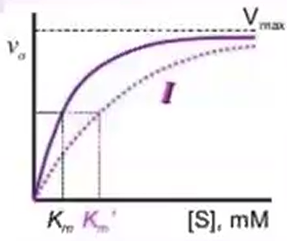
competitive
Is this competitive, noncompetitive, or uncompetitive?
noncompetitive
Is this competitive, noncompetitive, or uncompetitive?

uncompetitive
Is this competitive, noncompetitive, or uncompetitive?
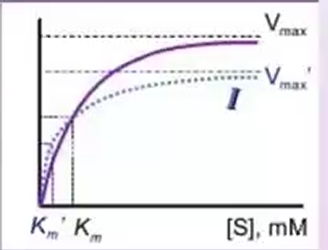
False; noncompetitive inhibitors can bind to the allosteric site of either the free enzyme or the ES complex
True or False: noncompetitive inhibitors can only bind to the free enzyme
allosteric regulation
What type of enzyme regulation yields sigmoid-shaped kinetics
Ser, Thr, and Tyr
On what three amino acid residues can reversible phosphorylation occur on?
isoenzymes
a type of enzyme regulation where different molecular forms of the same enzyme that catalyze the same reaction but vary in amino acid sequence, allowing precise regulation of enzymea activity
zymogen
inactive precursor forms of enzymes that require biochemical activation, usually by proteolytic cleavage
chymotrypsinogen
example of a zymogen that is converted into the active enzyme form in the small intestine by cleavage at Arg, where it helps digest proteins
chymotrypsin
the active form of chymotrypsinogen
compartmentation
a type of enzyme regulation where enzymes, substrates, and regulatory molecules can be physically separated or located close together
trypsin
What is the enzyme that turns chymotrypsinogen into chymotrypsin?
cooperativity
refers to the interaction between different subunits of an enzyme or protein in response to ligand binding, which affects the binding affinity of other subunits
positive cooperativity
amplifies enzyme activity by increasing the affinity of S to E once the first molecule binds, making it easier for additional molecules to bind
negative cooperativity
lower enzyme activity by reducing affinity of S to E, decreasing the likelihood of further binding after the first molecule attaches
hyperbolic curve
What type of curve does negative cooperativity display?
sigmoidal curve
What type of curve does positive cooperativity display?
MWC Model
explains allosteric proteins existing in relaxed (R) or taut/tense (T) states - all subunits must be in the same state
KNF model
explains how ligand-induced conformation changes could cause subunits to adopt conformations with decreased/increased affinity for the ligand - negative / positive cooperativity
heterotropic effectors
molecule that influence the binding of something other than themselves
homotropic effectors
molecules that influence the binding of themselves
left
an allosteric activator (in cooperativity) shifts the curve to the right or left?
right
an allosteric inhibitor (in cooperativity) shifts the curve to the right or left?
covalent catalysis
mechanism of enzyme catalysis where the enzyme forms a temporary covalent bond with the substrate, creating a more reactive intermediate that facilitates the reaction
Chymotrypsin cleaves carboxyl side of large hydrophobic or aromatic amino acids like Phe, Met, Tyr, and Trp
What is an example of covalent catalysis?
Histidine bc it’s pKa is near 7
What amino acid is often used for acid-base catalysis, and why?
low-barrier H-bond
Special type of H-bond where the proton is more equally shared between the donor and acceptor atoms, rather than being strongly associated with one
60 kJ / mol
What is the approximate energy of a low barrier hydrogen bond?
metal ion catalysis
mechanism of enzyme catalysis where metal ions in an enzyme’s cofactors interact with the substrate, stabilizing the transition state and orienting the substrate for reaction
less than 0.26 nm
What distance do atoms have to be apart for low barrier h bonds to exist
Thermolysin
What is an example of metal ion catalysis?
serine and aspartic acid proteases
What are examples of acid-base catalysis?
acylation
What is an example of covalent catalysis?
formation of glucosyl enzyme intermediate
What is an example of nucleophilic attack catalysis?
hydrolase
What class of enzyme does chymotrypsin belong to?
covalent and acid/base catalysis
What two mechanisms of enzyme catalysis does chymotrypsin use?
serine
What amino acid does chymotrypsin use as a nucleophile?
LEFT OFF AT 39:24