ECON ANALYSIS CHAP 5

0.0(0)
Studied by 0 people
call kaiCall Kai
learnLearn
examPractice Test
spaced repetitionSpaced Repetition
heart puzzleMatch
flashcardsFlashcards
GameKnowt Play
Card Sorting

1/10

encourage image

There's no tags or description

Looks like no tags are added yet.

Last updated 2:51 PM on 10/14/26
Name
Mastery
Learn
Test
Matching
Spaced
Call with Kai
Chat

No analytics yet

Send a link to your students to track their progress

11 Terms

1
New cards

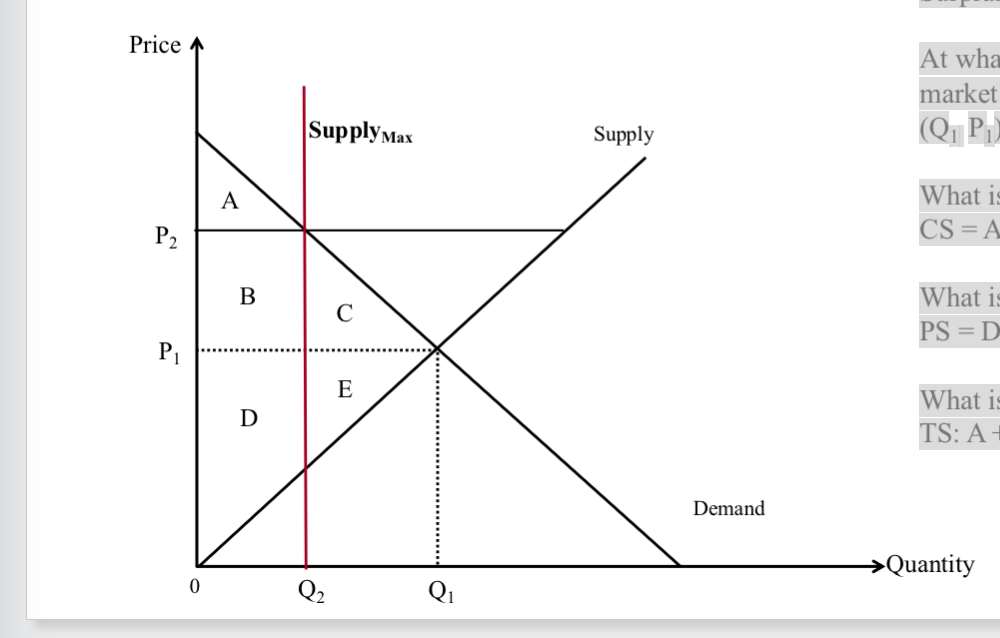
Quantity Regulation: Production v Import Quotas

Production quotas: limits on the quantity of a good that can be produced
• A maximum legal quantity above which a good cannot be produced
• Sometimes by decree, sometimes through incentive programs
• To be binding, must be less than equilibrium quantity.
• Examples: taxicab medallions (licenses required to operate taxicabs; maximum quantity),
liquor licenses


• Import quotas: limits on the quantity of a good that can be imported
2
New cards
<p>Production Quotas and surplus</p><p><span style="font-size: calc(var(--scale-factor)*20.18px);"><strong>Surplus before production quotas:</strong></span><span><br></span><span style="font-size: calc(var(--scale-factor)*20.18px);">At what price and quantity will the</span><span><br></span><span style="font-size: calc(var(--scale-factor)*20.18px);">market transaction occur?</span><span><br><br></span><span style="font-size: calc(var(--scale-factor)*20.18px);">What is consumer surplus (CS)?</span><span><br><br></span><span style="font-size: calc(var(--scale-factor)*20.18px);">What is producer surplus (PS)?</span><span><br><br></span><span style="font-size: calc(var(--scale-factor)*20.21px);">What is total surplus (TS)?</span><span><br></span></p>

Production Quotas and surplus

Surplus before production quotas:
At what price and quantity will the
market transaction occur?

What is consumer surplus (CS)?

What is producer surplus (PS)?

What is total surplus (TS)?

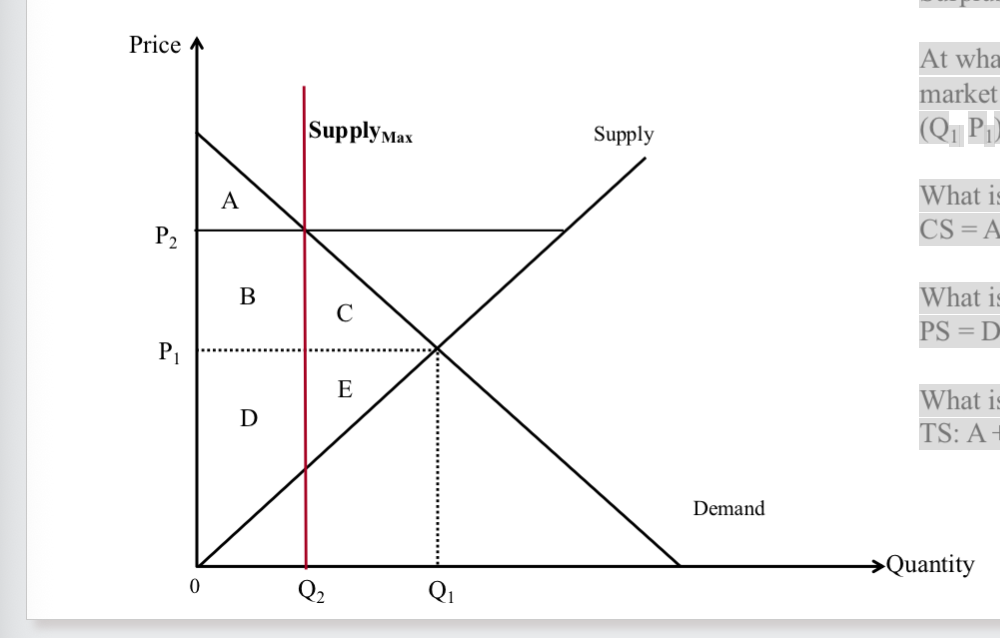
Surplus before production quotas:
At what price and quantity will the
market transaction occur?
(Q1 P1)
What is consumer surplus (CS)?
CS = A + B + C
What is producer surplus (PS)?
PS = D + E
What is total surplus (TS)?
TS: A + B + C + D + E
<p><span style="font-size: calc(var(--scale-factor)*20.18px);">Surplus before production quotas:</span><span><br></span><span style="font-size: calc(var(--scale-factor)*20.18px);">At what price and quantity will the</span><span><br></span><span style="font-size: calc(var(--scale-factor)*20.18px);">market transaction occur?</span><span><br></span><span style="font-size: calc(var(--scale-factor)*20.18px);">(Q</span><span style="font-size: calc(var(--scale-factor)*13.71px);">1 </span><span style="font-size: calc(var(--scale-factor)*20.18px);">P</span><span style="font-size: calc(var(--scale-factor)*13.71px);">1</span><span style="font-size: calc(var(--scale-factor)*20.18px);">)</span><span><br></span><span style="font-size: calc(var(--scale-factor)*20.18px);">What is consumer surplus (CS)?</span><span><br></span><span style="font-size: calc(var(--scale-factor)*20.18px);">CS = A + B + C</span><span><br></span><span style="font-size: calc(var(--scale-factor)*20.18px);">What is producer surplus (PS)?</span><span><br></span><span style="font-size: calc(var(--scale-factor)*20.21px);">PS = D + E</span><span><br></span><span style="font-size: calc(var(--scale-factor)*20.21px);">What is total surplus (TS)?</span><span><br></span><span style="font-size: calc(var(--scale-factor)*20.18px);">TS: A + B + C + D + E</span></p>
3
New cards
<p>Production Quotas and surplus</p><p><span style="font-size: calc(var(--scale-factor)*20.18px);"><strong>Surplus AFTER production quotas:</strong></span><br><span style="font-size: calc(var(--scale-factor)*20.18px);">At what price and quantity will the</span><br><span style="font-size: calc(var(--scale-factor)*20.18px);">market transaction occur?</span><br><br><span style="font-size: calc(var(--scale-factor)*20.18px);">What is consumer surplus (CS)?</span><br><br><span style="font-size: calc(var(--scale-factor)*20.18px);">What is producer surplus (PS)?</span><br><br><span style="font-size: calc(var(--scale-factor)*20.21px);">What is total surplus (TS)?</span><br></p>

Production Quotas and surplus

Surplus AFTER production quotas:
At what price and quantity will the
market transaction occur?

What is consumer surplus (CS)?

What is producer surplus (PS)?

What is total surplus (TS)?

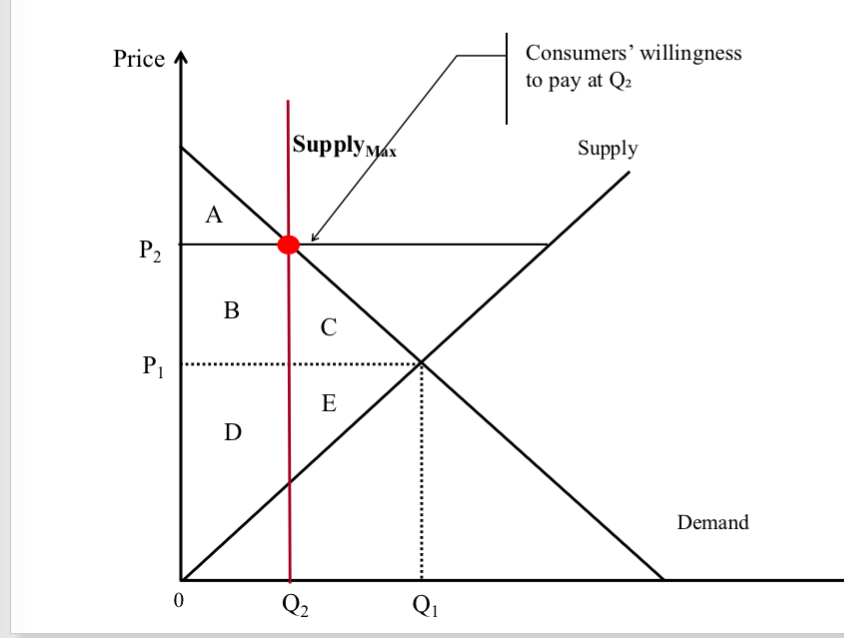
Surplus after production quotas:
At what price and quantity will the
market transaction occur?
(Q2 P2)
What is consumer surplus (CS)?
CS = A
What is producer surplus (PS)?
PS = B+D
What is total surplus (TS)?
TS: A + B + D
DWL: C + E
<p><span style="font-size: calc(var(--scale-factor)*20.18px);"><strong>Surplus after production quotas:</strong></span><span><br></span><span style="font-size: calc(var(--scale-factor)*20.18px);">At what price and quantity will the</span><span><br></span><span style="font-size: calc(var(--scale-factor)*20.18px);">market transaction occur?</span><span><br></span><span style="font-size: calc(var(--scale-factor)*20.18px);">(Q</span><span style="font-size: calc(var(--scale-factor)*13.71px);">2 </span><span style="font-size: calc(var(--scale-factor)*20.18px);">P</span><span style="font-size: calc(var(--scale-factor)*13.71px);">2</span><span style="font-size: calc(var(--scale-factor)*20.18px);">)</span><span><br></span><span style="font-size: calc(var(--scale-factor)*20.18px);">What is consumer surplus (CS)?</span><span><br></span><span style="font-size: calc(var(--scale-factor)*20.18px);">CS = A</span><span><br></span><span style="font-size: calc(var(--scale-factor)*20.18px);">What is producer surplus (PS)?</span><span><br></span><span style="font-size: calc(var(--scale-factor)*20.21px);">PS = B+D</span><span><br></span><span style="font-size: calc(var(--scale-factor)*20.21px);">What is total surplus (TS)?</span><span><br></span><span style="font-size: calc(var(--scale-factor)*20.18px);">TS: A + B + D</span><span><br></span><span style="font-size: calc(var(--scale-factor)*20.18px);">DWL: C + E</span></p>
4
New cards

Welfare Effects on Government Intervention

Government interventions change how resources are allocated in the
market, and these changes may result in less efficient outcomes.
- Price and quantity controls often result in deadweight loss.


• While these interventions reduce efficiency in the broader market, they
may redistribute some economic surplus from one group to another
and thereby improve well-being for specific groups.
- Milk price floor: from milk consumers to dairy farmers
- Rent ceiling: from Mansfield landlords to UConn student renters

5
New cards

The efficiency of competitive markets: height of the demand curve, height of supply curve, in a perfectly competitive market; which is MC which is MB; for quantities less than the EQ Quant value to ___ is ___ than cost to producers.; for quantities greater than the EQ Quant value to ___ is ___ than cost to producers/ — which side of the graph

The height of the demand curve represents:
- Consumers’ willingness to pay
- Values to consumers
- Marginal benefit (MB) to consumers
- Demand curve is also MB curve


The height of the supply curve represents
- Producers’ costs (marginal costs; MC)
- Producers’ willingness to accept (the minimum
price they are willing to accept)
- Supply curve is also MC curve


In a perfectly competitive market:
Profit-maximizing firms adjust production until P = MC
Consumers purchase up to the point where P = MB

<p><span style="font-size: calc(var(--scale-factor)*20.18px);"><strong>The height of the demand curve represents:</strong></span><span><br></span><span style="font-size: calc(var(--scale-factor)*18.02px);">- Consumers’ willingness to pay</span><span><br></span><span style="font-size: calc(var(--scale-factor)*18.05px);">- Values to consumers</span><span><br></span><span style="font-size: calc(var(--scale-factor)*18.02px);">- Marginal benefit (MB) to consumers</span><span><br></span><span style="font-size: calc(var(--scale-factor)*18.02px);">- Demand curve is also MB curve</span></p><p><span><br></span><span style="font-size: calc(var(--scale-factor)*20.18px);"><strong>The height of the supply curve represents</strong></span><span><br></span><span style="font-size: calc(var(--scale-factor)*18.02px);">- Producers’ costs (marginal costs; MC)</span><span><br></span><span style="font-size: calc(var(--scale-factor)*18.05px);">- Producers’ willingness to accept (the minimum</span><span><br></span><span style="font-size: calc(var(--scale-factor)*18.02px);">price they are willing to accept)</span><span><br></span><span style="font-size: calc(var(--scale-factor)*18.02px);">- Supply curve is also MC curve</span></p><p></p><p><span style="font-size: calc(var(--scale-factor)*18.02px);"><strong>In a perfectly competitive market:</strong></span><span><br></span><span style="font-size: calc(var(--scale-factor)*18.02px);">Profit-maximizing firms adjust production until P = MC</span><span><br></span><span style="font-size: calc(var(--scale-factor)*18.02px);">Consumers purchase up to the point where P = MB</span></p>
6
New cards

Diminishing marginal benefit

As a consumer, do you think your willingness to pay (marginal benefit)
would be the same for your first, second, and third string cheese?

If you skipped lunch, the benefit you would get from eating your first
string cheese would be much greater than the benefit you would get
from eating your tenth string cheese

7
New cards

Diminishing Marginal benefit: law of diminishing marginal benefit

Law of Diminishing Marginal Benefit: As more units of a good (here,
string cheese) are consumed, the marginal benefit (willingness to pay)
from consuming each additional unit decreases.
8
New cards
<p><span>Consumers in a Competitive Market</span></p><p><span style="font-size: calc(var(--scale-factor)*22.37px);">When the market price is $4, is it rational for consumers</span><br><span style="font-size: calc(var(--scale-factor)*22.34px);">to buy only up to the 3rd string cheese</span><span style="font-size: calc(var(--scale-factor)*23.79px);">?</span></p>

Consumers in a Competitive Market

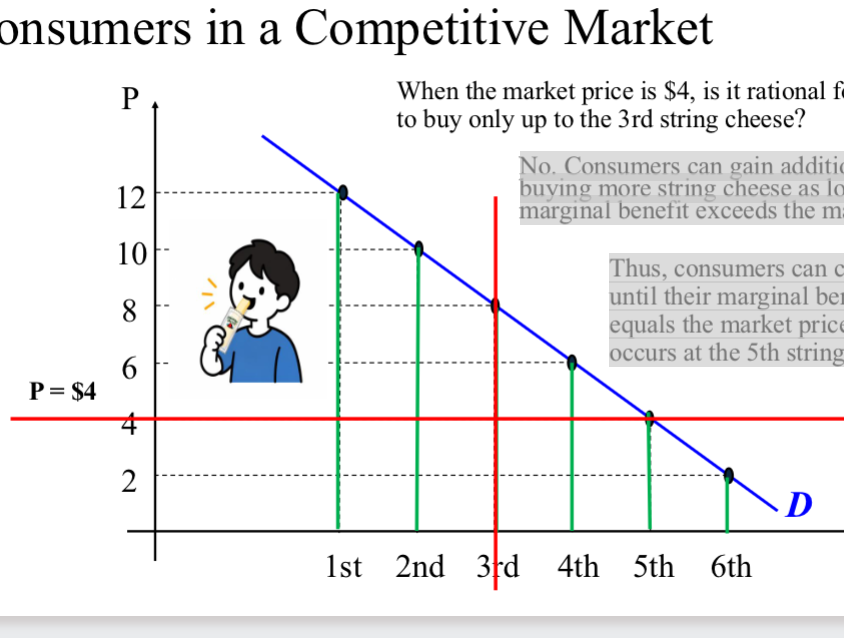
When the market price is $4, is it rational for consumers
to buy only up to the 3rd string cheese?

No. Consumers can gain additional surplus by
buying more string cheese as long as their
marginal benefit exceeds the market price.


Thus, consumers can continue buying
until their marginal benefit (MB)
equals the market price (P), which
occurs at the 5th string cheese.

<p><span style="font-size: calc(var(--scale-factor)*22.34px);">No. Consumers can gain additional surplus by</span><span><br></span><span style="font-size: calc(var(--scale-factor)*22.34px);">buying more string cheese as long as their</span><span><br></span><span style="font-size: calc(var(--scale-factor)*22.34px);">marginal benefit exceeds the market price.</span></p><p><span><br></span><span style="font-size: calc(var(--scale-factor)*22.37px);">Thus, consumers can continue buying</span><span><br></span><span style="font-size: calc(var(--scale-factor)*22.34px);">until their marginal benefit </span><span style="font-size: calc(var(--scale-factor)*20.18px);">(MB)</span><span><br></span><span style="font-size: calc(var(--scale-factor)*22.37px);">equals the market price </span><span style="font-size: calc(var(--scale-factor)*20.21px);">(P)</span><span style="font-size: calc(var(--scale-factor)*22.37px);">, which</span><span><br></span><span style="font-size: calc(var(--scale-factor)*22.34px);">occurs at the 5th string cheese.</span></p>
9
New cards

Diminishing Marginal Returns and Increasing
Marginal Cost
• As a producer (e.g., a dairy company like Organic Valley), do you think
your willingness to accept (marginal cost) would be the same for your
first, second, and third string cheese?

Imagine producing string cheese with only one machine.
• To produce more string cheese, if you keep adding more workers to
operate the same machine, eventually too many workers will have to
share the same machine, making each additional worker less productive.
• As a result, producing one more string cheese requires more labor,
increasing the marginal cost of production.

10
New cards
<p><span style="font-size: calc(var(--scale-factor)*43.99px);">Producers in a Competitive Market</span><span><br></span><span style="font-size: calc(var(--scale-factor)*22.34px);">P = $10</span><span><br></span><span style="font-size: calc(var(--scale-factor)*22.34px);">When the market price is $10, is it rational for</span><span><br></span><span style="font-size: calc(var(--scale-factor)*22.37px);">producers to produce only up to the 3rd string cheese</span><span style="font-size: calc(var(--scale-factor)*23.81px);">?</span></p>

Producers in a Competitive Market
P = $10
When the market price is $10, is it rational for
producers to produce only up to the 3rd string cheese?

No. Producers can gain additional surplus by producing more string cheese
as long as their marginal cost is below the market price.
Thus, producers can continue producing until their marginal cost (MC) equals the market
price (P), which occurs at the 5th string cheese.

<p><span style="font-size: calc(var(--scale-factor)*22.37px);">No. Producers can gain </span><span style="font-size: calc(var(--scale-factor)*22.34px);">additional surplus by </span><span style="font-size: calc(var(--scale-factor)*22.37px);">producing more string cheese</span><span><br></span><span style="font-size: calc(var(--scale-factor)*22.34px);">as long as their marginal cost </span><span style="font-size: calc(var(--scale-factor)*22.37px);">is below the market price.</span><span><br></span><span style="font-size: calc(var(--scale-factor)*22.37px);">Thus, producers can continue </span><span style="font-size: calc(var(--scale-factor)*22.34px);">producing until their marginal </span><span style="font-size: calc(var(--scale-factor)*22.37px);">cost (MC) equals the market</span><span><br></span><span style="font-size: calc(var(--scale-factor)*22.34px);">price (P), which occurs at the </span><span style="font-size: calc(var(--scale-factor)*22.37px);">5th string cheese.</span></p>
11
New cards
<p><span>Why is a competitive market Pareto efficient at the equilibrium?</span></p>

Why is a competitive market Pareto efficient at the equilibrium?

A market is said to be pareto efficient if it is not possible to make one person better off
without making someone else worse off.

Then, why is the market not Pareto efficient if it is not at equilibrium, for example, at Q = 2?

At Q = 2, it is possible to make consumers better off without making producers worse
off (more precisely, while also making producers better off) by increasing production to Q = 3.

<p><span style="font-size: calc(var(--scale-factor)*22.34px);">A market is said to be pareto efficient if it is </span><span style="font-size: calc(var(--scale-factor)*22.37px);">not possible to make one person better off</span><span><br></span><span style="font-size: calc(var(--scale-factor)*22.34px);">without making someone else worse off.</span><span><br></span></p><p><span style="font-size: calc(var(--scale-factor)*22.37px);">Then, why is the market not Pareto efficient if it </span><span style="font-size: calc(var(--scale-factor)*22.34px);">is not at equilibrium, for example, at Q = 2?</span><span><br></span></p><p><span style="font-size: calc(var(--scale-factor)*22.34px);">At Q = 2, it is possible to make consumers </span><span style="font-size: calc(var(--scale-factor)*22.37px);">better off without making producers worse</span><span><br></span><span style="font-size: calc(var(--scale-factor)*22.34px);">off (more precisely, while also making </span><span style="font-size: calc(var(--scale-factor)*22.37px);">producers better off) by increasing </span><span style="font-size: calc(var(--scale-factor)*22.34px);">production to Q = 3.</span></p>



