Part 1 of nervous tissue
 Call Kai
 Learn
 Practice Test
 Spaced Repetition
 Match
 Flashcards
 Knowt Play
1/30

Earn XP
Description and Tags
about 30 questions
31 Terms
Sensory input
receptors detect changes inside or outside the body and send information toward the CNS.
Integration
the CNS processes and interprets the information, then decides what it means or what to do.
Motor output:
the nervous system sends commands to effectors—muscles or glands—to create a response.

Central nervous system (CNS):
brain and spinal cord. It is the main processing and control center.
Peripheral nervous system (PNS)
nerves and ganglia outside the brain and spinal cord. It carries information to and from the CNS.
Afferent
sensory information traveling toward the CNS. Efferent = motor commands traveling away from the CNS.
ensory (afferent) neurons:
carry information from receptors to the CNS. Most are unipolar; their cell bodies are in PNS ganglia.
Motor (efferent) neurons:
carry commands from the CNS to muscles or glands. Usually multipolar.
Interneurons (association neurons):
connect and process information within the CNS. They make up the vast majority of neurons.
what are Neurons
are specialized cells that receive and transmit electrical signals.
Most neurons have a cell body plus extensions called processes:
dendrites and an axon.

Cell body (soma/perikaryon):
contains the nucleus and most organelles; makes proteins and other materials needed by the neuron.

Nissl bodies:
rough endoplasmic reticulum in the cell body; helps make proteins.

Dendrites:
usually short, branched input structures. They receive messages and carry graded potentials toward the cell body.

Axon hillock:
cone-shaped area where the axon begins; often the point where an action potential is initiated.
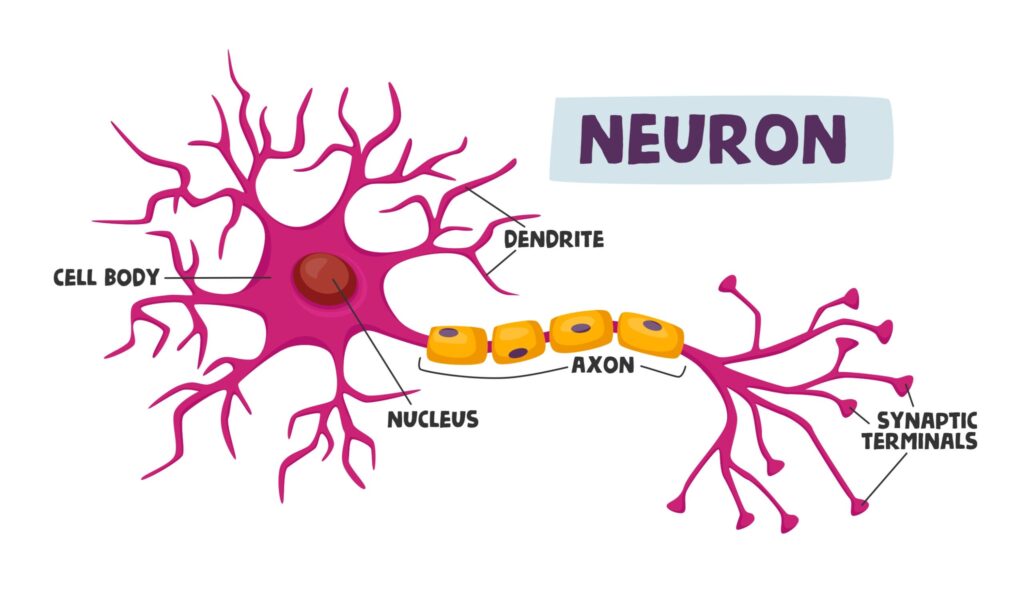
Axon:
the conducting region. It carries action potentials away from the cell body toward its terminals.

Axon terminals (terminal boutons):
endings that release neurotransmitters to communicate with another cell.

Axon collaterals:
branches coming off an axon.
Tract:
a bundle of axons in the CNS
a Nerve:
a bundle of axons in the PNS.
Nucleus:
a cluster of neuron cell bodies in the CNS.
Ganglion:
a cluster of neuron cell bodies in the PNS
Anterograde transport
moves materials away from the cell body toward the axon terminal.
Retrograde transport
moves materials back toward the cell body. Some pathogens and toxins can exploit this route.
Neuroglia (Glial Cells)
Glia support, protect, nourish, and help maintain the environment around neurons. They are not the main signal-conducting cells.
Astrocytes:
most abundant; support neurons, help regulate the chemical environment, and help manage exchanges between blood capillaries and nervous tissue.
Microglia:
immune-defense cells; remove microbes, damaged cells, and debris by phagocytosis.
Ependymal cells:
line brain and spinal-cord cavities; some have cilia that help circulate cerebrospinal fluid (CSF).
Oligodendrocytes:
form myelin around axons in the CNS. One oligodendrocyte can myelinate portions of multiple axons.
Schwann cells (neurolemmocytes):
surround PNS axons and form myelin around many of them; help support repair of damaged peripheral axons.
Satellite cells:
surround neuron cell bodies in PNS ganglia and regulate their local environment.