Cell Theory, Cell Types, and Microscopy
 Call Kai
 Learn
Learn Practice Test
 Spaced Repetition
 Match
Match Flashcards
 Knowt Play
1/22

Earn XP
Description and Tags
Vocabulary flashcards covering the cell theory history, cell classification, cell structures, and electron microscopy.
Name | Mastery | Learn | Test | Matching | Spaced | Call with Kai | Chat |
|---|
No analytics yet
Send a link to your students to track their progress
23 Terms
Cell Theory
A fundamental biological theory stating three concepts: all living things are composed of one or more cells, cells are the basic unit of structure for all organisms, and cells arise only from other living cells.
Unicellular Organism
An organism composed of only one single cell that must carry out all functions of life, such as Paramecium, Amoeba, Bacteria, or Yeast.
Multicellular Organism
An organism made up of two or more cells, such as humans, mushrooms, trees, or butterflies, where cells have specialized jobs that allow the organism to survive.
Zacharias Janssen
A Dutch maker of glasses associated with the invention of the first optical telescope and/or compound microscope between 1590 and 1618.
Robert Hooke
An English scientist and architect who in 1665 used a microscope to observe cork, identified small structures as 'cells' because they looked like living quarters for monks, and established them as building blocks for organisms.
Antonie van Leeuwenhoek
A Dutch microscopist who observed pond water in 1683, becoming the first to observe bacteria and protozoa and refuting the doctrine of spontaneous generation.
Matthias Jakob Schleiden
A scientist who put forth the idea in 1838 that every structure of plants is composed of cells, though he incorrectly believed in cell crystallization.
Theodor Schwann
A scientist who declared in 1839 that animal tissues are composed of cells with nuclei and stated that 'All living things are composed of cells and cell products.'
Rudolf Virchow
A German pathologist and statesman who proposed the third tenant of cell theory in 1850: 'Omnis cellula e cellula' (Every living cell comes from another living cell).
Spontaneous Generation
An obsolete scientific theory asserting that living organisms can develop directly from nonliving matter.
Prokaryotic Cells
Smaller and simpler cells that lack a nucleus (such as Archaea and Bacteria) and contain a single main strand of chromosomal DNA located in a nucleoid region.
Eukaryotic Cells
Cells that contain a distinct nucleus, unlike prokaryotic cells.

Nucleoid
The specific region within a eukaryotic cell where its chromosomal DNA is located, which is not a membrane-bound nucleus.

Plasmid
Small, circular, extra pieces of DNA found in some prokaryotic cells that are non-essential for survival.
Cell Wall (Prokaryotic)
A cellular structure that provides structure and support for the prokaryotic cell.
Cell Membrane
A barrier made of proteins and lipids that controls what enters and leaves the cell.
Cytoplasm
The liquid that fills the inside of the cell ('cyto' = cell, 'plasm' = liquid).

Flagellum
A structure used by prokaryotic cells for movement.
Ribosome
A cellular structure that uses information from DNA to synthesize proteins required for cell functions.
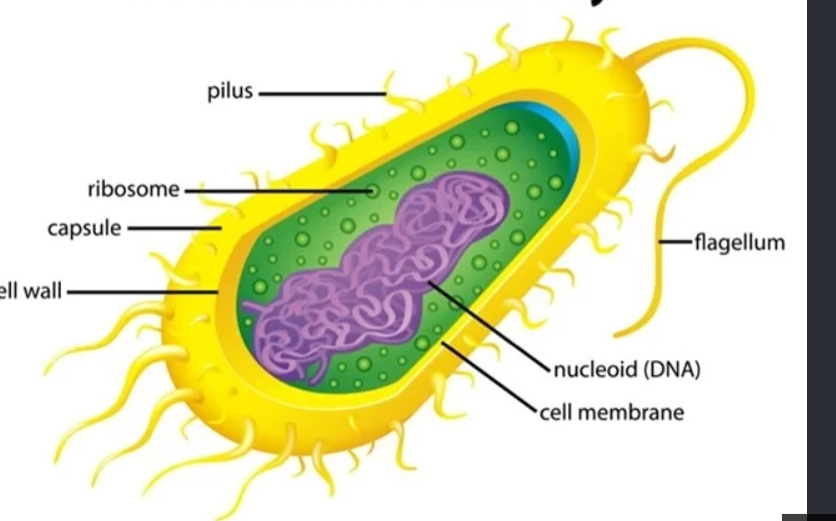
Chromosomal DNA
A single main strand molecule in prokaryotic cells that contains all the information needed to make cell parts and carry out cell functions.
Electron Microscope (EM)
A microscope that illuminates a specimen using a beam of electrons, providing magnification up to 1,000,000× due to shorter electron wavelengths.
Scanning Electron Microscope (SEM)
An electron microscope that directs an electron beam over the surface of a dehydrated, metal-coated specimen in a vacuum to produce a 3D image magnified up to 500,000×.
Transmission Electron Microscope (TEM)
An electron microscope that sends an electron beam through a thin slice of a sample and projects the image onto a fluorescent screen, achieving magnifications up to 50,000,000×.