Signalling
 Call Kai
 Learn
 Practice Test
 Spaced Repetition
 Match
 Flashcards
 Knowt Play
1/58

Earn XP
Description and Tags
Lectures 13-16
59 Terms
Why is signalling important for multicellularity?
Multicellular organisms are a highly coordinated heap of cells and signalling allows cells to coordinate within the organisms.
What forms can a signal take?
Proteins (insulin, fibrobalst growth factors)
Small hydrophobic molecules (animal steroid hormones)
Small hydrophilic molecules (plant auxins)
Gas (ehylene, nitric oxide)
Electrical (nerve impulses)
How far is a long, intermediate and short signalling range?
Long - 1000mm
Intermediate - 1mm
Short - 0mm
Long range signalling
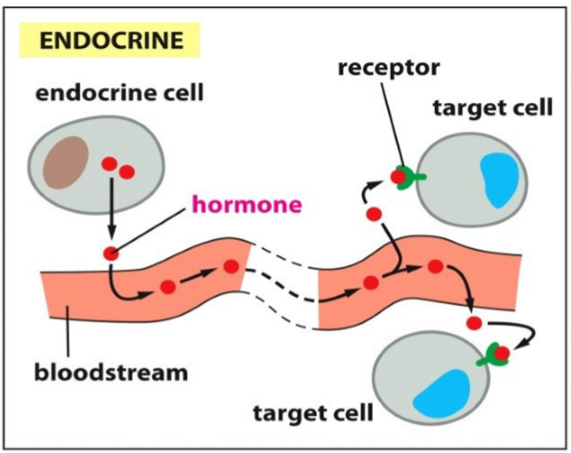
Endocrine:
Endocrine cells release hormones into the bloodstream, travelling in the blood to reach receptors on target cells.
Intermediate range signalling
Paracrine:
Signalling cell excretes local mediators into the extracellular fluid which then binds to receptors on target cells.

Short range signalling
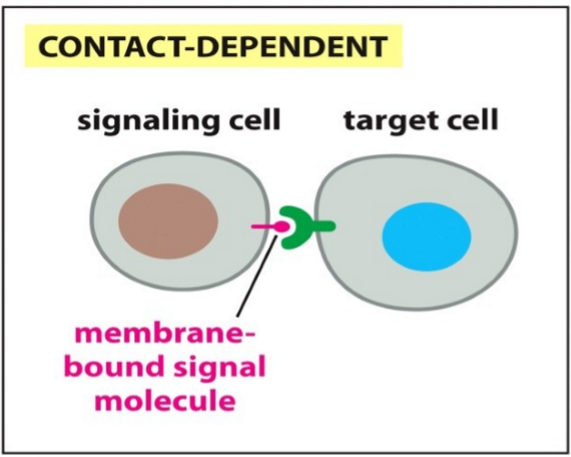
Contact-dependent (juxtacrine):
Signalling cell has a membrane bound signal molecule which binds to the receptor on a target cell.
What does long range signalling enable plants to do?
Allows some plants to time their flowering according to daylength which allows plants of the same species to synchronise their flowering which is important for cross pollination.
How is flowering time regulated by daylength?
CO protein is found in the leaf and is a sensor for sunlight. It regulates gene expression and the levels of CO are sensitive to daylight so accumulates when the days are long.
High CO protein levels promote synthesis of FT protein
FT protein levels are high in the leaf when the day is long
FT protein moves through sap from leaf to shoot.
Flower forms at the shoot
Competence
The ability of a cell or tissue to respond to a signal.
In plants only the shoot is competent to respond to FT protein by flowering - other cells are incompetent.
Signalling in the brain/nervous system
It allows signalling both within the brain and over long distances from the brain to the periphery. The development of these nerve fibre connections is achieved through shorter range signalling.
Axon navigation
As the growth cone navigates trhough the brain, it is guided by guidance molecules secreted by cells along it’s route.
In some cases each step of the growth cone is guided by a different ’guidepost’ cell that secretes a guidance cue. Removal of a quidepost cell causes axon to become misrouted. It interacts with axon guidance molecules via paracrine or juxtacrine mechanisms.

Signalling along nerve cells
Electrical signal propagates from the cell body of the presynaptic cell along it’s axon
The two cells contact each other at the synapse where the axon of once cell touches the cell body of another
Electrical signal then propagates along the post-synaptic cell
What happens at the synapse?
Action potential is propagated along axon of the presynaptic neurone and depolarisation occurs
Ca2+ VCG’s are stimulated to open and Ca diffuses into synaptic knob
This causes the synaptic vesicles containing acetylcholine to fuse with the presynaptic membrane
Acetylcholine released into synaptic cleft by exocytosis
Acetylcholine diffuses across
It binds with its specific receptor molecules on the postsynpatic neurone
Na channels open and Na enters postsynaptic neurone
This causes depolarisation and action potential is generated
Acetylcholinesterase breaks down acetylcholine
How does sex development occur?
There is sex neutral development of the fertlised egg until there is a signal from the Y chromosome (if there is one) resulting in sex specific development.

Sry gene
Sry = sex determining region Y chromosome
It is a transcription factor only expressed from the Y chromosome leading to testes differentiation.
Pre sex development structures
During sex neutral development, the mammalian XX or XY embryo have male (wolffian duct) and female (mullerian duct) structures.
Male determination
The Sry signal from the Y chromosome causes the gonads to become testes and the wolffian duct to persist and mullerian duct to deteriorate.
Testes secrete Mullerian-inhibiting substance which inhibits the mullerian duct.
Testosterone signals to the wolffian duct to develop into the vas deferens which carries sperm
Testosterone
Hyrdophobic steroid hormone released into the blodd which can cross the plasma membrane and bind to receptor proteins to regulate gene expression in target cells.
Female determination
In the absence of the Sry signal, the gonads become ovaries.
No mullerian inhibiting substance so oviduct can develop
No testosterone made so vas deferans does not develop
Ovaries secrete female homrone which signal to instruct female phenotype
In mammals, the development of the female phenotype is the default.
Complete andorgen insensitivity syndrome (CAIS)
When XY people (genetically male) lack functional receptors for androgens
Have internal testis but develop as females at puberty
Sex determination in chickens
ZZ = male, ZW = female
Like mammals male and female embyros are initially sexually indifferent
Gynandromorphs
Chickens that have a female and male form (half and half). They are a mixture of ZZ and ZW cells.
Can arise from mosaic or chimera.

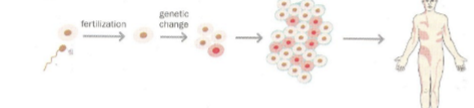
Mosiac mechanism for gynandromorphic chickens
A genetic change in cell lineage derived from a single zygote
Chimera mechanisms for gynandromorphic chickens
The fusion of genetically distinct embryos

What does the gynandromorph chicken show?
That endocrine signalling cannot be sufficient to determine secondary sex characteristics in chickens as the female and male sides are exposed to the same hormones in the bloodstream. Male and female cells must have an intrinsic sex identity - the intepretation of the signal by target cells is critical - Cell autonomous sex determination
Why do we not have human gynandromorphs?
Secondary sex characteristics are not determined cell automonously. Each cell is competent to develop male or female secondary sex characteristics in response to endocrine signals whatever their genotype.
How do alligators determine sex?
Egg incubation temperature determines sex phenotype.
Warm >33 → males
Cool <31 → females
Structures in an embryo
Most structures have formed when the embryo is very small and grow during subsequent development.
In an 8 week old human embyro structures have already formed.
How far can paracrine signalling operate?
Over 1-100 cell diameters
100 cells ~ 1mm
Pendactly limb
Has provided a useful model system to study paracrine signalling during development as many animals have a variations from the same theme.

Limb formation in chicks
Starts around 3 days after fertilisation
The developing limb is very small
Signalling over <1mm range can access the whole limb
Proximal
Close to the body
Distal
Distant from the body
Anterior
Points up e.g. thumb (finger 1) - shows that limbs grow out of the sides of our body, in the embryo the thumb points up.
Posterior
Points down e.g. pinky (finger 5)
How does the vertebrate limb develop along proximal-distal axis?
The apical ectodermal ridge (AER) is the structure at the tip of the limb bud. The AER secretes a protein called FGF4 which supports this growth -
FGF4 can rescue limb truncation caused by AER removal. FGF4 soaked beads can replace function of surgically removed AER.

AER removal experiment
The AER was surgically removed from the wing bud at different stages over the developmental period 3-4 days
Development was then allowed to proceed.
It was found that the later the AER was removed, the more distal limb structures formed.

Morphogen
A substance active in pattern formation whose spatial concentration varies and to which cells respond differently at different threshold concentrations.
The French Flag Model
It describes how morphogen concentration gradient can be translated into a pattern.

What is the hypothesis for anterior-posterior axis?
The differentiation of each digit is like the formation of different colours in the french flag model. For this to work:
A source of morphogen on one edge of the developing limb anterior-posterior axis
A resulting anterior-posterior concentration gradient
A specific range of morphogen concentration would specify each digit along the axis
What would be the mechanism if the french flag hypothesis was true?
Morphogen molecules secreted on one side of the limb-bud
Posterior (high) and anterior (low) concentration gradient
Digits instructed by different concentrations

Zone of polarising activity (ZPA)
A region at the posterior edge of the limb bud. Hypothesis suggests that ZPA secretes the morphogen molecules
ZPA signal secretes Shh (sonic hedgehog) which could be the polarising activity
Testing the french flag hypothesis
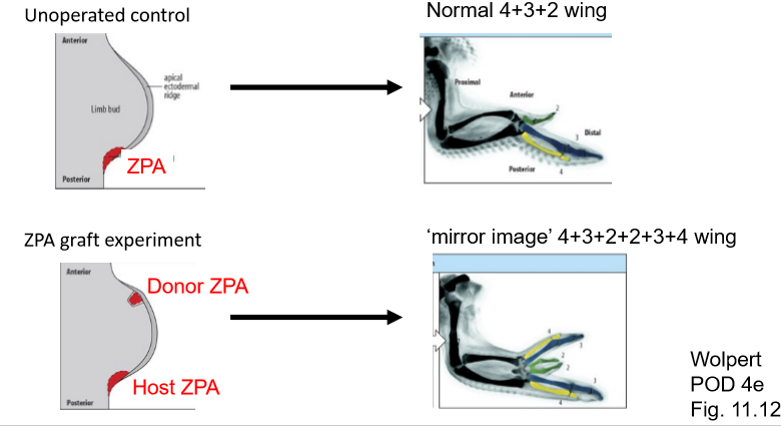
Experiment: The ZPA from a donor embryo is grafted onto the anterior edge of the limb bud of host embryo.
The result is that a mirror image 4+3+2+2+3+4 limb forms which supports the hypothesis.
The experiment is repeated using Shh expressing cells instead of the ZPA graph and the result is the same.
This shows that Shh protein is sufficient to provide the ZPA morphogen activity.
Organiser
A signalling centre that directs the development of the whole embryo or part of the embryo .e.g. the ZPA
Lateral inhibition
Organising cell structures by inhibitory signalling at a very close range.
Trichomes
Hairs on plant stems or leaves.
Evolution has adapted them to many forms and functions:
Stinging hairs on nettles
Insect trapping hairs on sundew plant
Seed dispersal structures on cotton plant.
They differentiate from an epidermal precursor cell
What trichome properties must be regulated in order for them to function
Trichome spacing (patterning of the plant surface)
Trichome anatomy (differentiation of individual trichomes)
Hypothesis 1 of how trichome spacing is regulated
Each epidermal cell has a probability of developing into a trichome - each probability is independent of each other
Cells do not need to signal to one another
Result of hypothesis 1 of trichome spacing
Would give a random pattern of trichomes
Having a higher density would increase the probability of cells independently forming a trichome, increasing the number of trichomes, decreasing spacing and vice versa.
Hypothesis 2 of how trichome spacing is regulated
Each epidermal cell decides whether or not to develop into a trichome depending on signalling between it and other cells in the epidermis.
Whether one cell develops into a trichome is dependent on cells (non cell autonomous)
Result of hypothesis 2 of trichome spacing
Might not generate a random pattern
Higher or lower density trichome could be achieved by varying the signal
Evidence for trichome spacing regulation
Trichomes on the leaf surface of Thale Cress never touch arguing against hypothesis 1
Mutation triptychon
Broke no touching rule so suggested that the mutation disrupted cell-cell signalling that normally prevent adjacent cells developing into trichomes - suggests lateral inhibition
Hairs on insects
Sensory bristles on the insect body surce
Each bristle is connected to a sensory neurone sending touch sensation to fly brain
Arranged in a very regular pattern
The sensory neurone + bristle normally form at the centre of an easily identifiable group of cells on the surface of a grasshopper embryo
Bristle neurones never normally form next to each other
Contact repulsion + juxtacrine signalling
Organising cell structures by repulsive signalling at very close range
Signalling by cell:cell contact in the gut
Villi help digestion in the gut by increasing the surface area for absorption of digested food
Villi are constantly being eroded and have to be replaced
How are villi regenerated?
Cells are constantly being shed from the tip of the villus
Lost cells are replaced by division of stem cells in the crypt
These new cells are displaced out of the crypt and replace the villus from the bottom as its is eroded from it’s tip
How does signalling by cell:cell contact help the development of the crypt
Repulsive signalling between EphB and ephrin B transmembrane proteins
Cells expressing EphB contacting a cell expressing EphrinB tiggers a repulsive response causing them to segregate
How to crypts form?
Proliferating stem cells in the crypt express EphB
Flanking cells express Ephrin B
As stem cells proliferate their numbers increase but they cannot escape from the crypt as this would involve mixing with the flanking EphinB expressing cells
The pressure is resolved by the EphB cells buckling downwards to form the crypt
