Chapter 5 Lesson 2: How to Use a Microscope
 Call Kai
 Learn
 Practice Test
 Spaced Repetition
 Match
 Flashcards
 Knowt Play
1/11

Earn XP
Description and Tags
Comprehensive vocabulary flashcards covering the components of a microscope, slide preparation steps, magnification properties, and operating principles.
12 Terms

Microscope
A tool used to see very small (tiny) things that are not clearly visible to the eye.

Eyepiece lens
The lens on the microscope through which we look at the object we want to observe.

Tube
A cylinder that holds the eyepiece lens and connects it to the objective lenses.

Arm
A curved part used to carry the microscope.
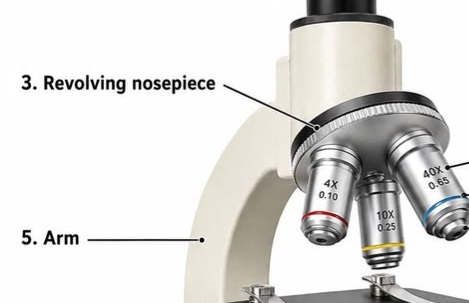
Revolving nosepiece
The circular structure of the microscope on which the objective lenses are fixed.

Objective lenses
Lenses that magnify the image, each having a different magnification power than the other.

Stage
The platform where the prepared slide containing the object to be observed is placed.

Clips
Parts used to hold the prepared slide containing the object to be observed (the sample) securely on the stage.

Adjustment knob
The knob used to move the stage up and down to clarify the view of the sample.

Reflector
A mirror that directs light towards the stage to make the view complete and bright.

Cover glass
The short, thin piece of glass that is lowered slowly from one side over the sample on a slide to prevent air bubbles from getting in.

Prepared slide
An assembly consisting of two pieces of glass—one long and thick slide and one short and thin cover glass—holding the sample to be examined.