SOC305 Test 1
 Call Kai
 Learn
 Practice Test
 Spaced Repetition
 Match
 Flashcards
 Knowt Play
1/81

There's no tags or description
Looks like no tags are added yet.
82 Terms
What is a profession?
A socially recognized occupation claiming specialized knowledge, autonomy, service and status.
boundary between professions + other occupations is socially contested.
Trait theory (+ limitation)
A checklist of professional characteristics that separate professions from other occupations (specialized expertise, lengthy training, autonomy, self-regulation, service, ethics and professional community).
Limitation: Other occupations may share these traits, so a list cannot clearly identify professions from non-professions.
What do power theories argue about professional status?
Status and economic rewards arise partly from controlling work, markets and access —not only from possessing useful knowledge.
Social closure
Restricting entry/access to power through licensing, credentials, training standards and other boundaries.
What is technical autonomy?
If members of a given profession have recognized control over a body of knowledge, then no one outside the profession can legitimately dictate what those professionals do or how they do it
What is self-regulation?
A professional body establishes and enforces standards governing its own members, often with legal authority delegated by the state.
What is a professional project?
A collective effort to secure recognized authority, status, autonomy and control over a market or task area.
Social status vs legal status.
Social status = prestige and respect; legal status = formal rights such as licensing/titles. One does not guarantee the other.
What is a folk concept of profession (Eliot Freidson)?
Freidson argues that profession = everyday socially valued label, its boundaries depend on historical context & social claims.
What are the three lenses of Anteby et al.?
Becoming: how occupational members learn to be part of the collective (shared cultural values, norms, worldviews)
Doing: what + how activities they perform → consequences for indiv., occupational, organizational (eg: shifts in juristiction, status, power, resource allocation)
Relating: how they relate to others outside their group to collectively expand their social influence
What are the three becoming filters?
“Becoming socialized”: emphasizes uniqueness of a given occupational group + how newcomers learn to belong to that group (ie: learning to fit in; belonging)
“Becoming controlled”: focuses on how org. + mgt shape workers’ identities + behaviours (power dynamics betw ER + EEs, how mgt controls workers) (ie: learning to follow authority; power)
“Becoming unequal”: focuses on how professions reinforce social inequalities; professional training + culture can give certain grps more opportunities, status, power (ie: learning your place in society; inequality)
What are the three doing filters?
Doing tasks: focuses on how workers perform tasks + effects on individual/group in profession (ie: doing work)
Doing jurisdictions: focuses on how diff professions compete for right to perform certain tasks; eg: doctors + nurse practitioners compete over who should have authority to diagnose illnesses & prescribe medications (central problem w doing lens!) (ie: fighting over who gets to do the work)
Doing emergence: how grps work tgt to establish new occupations (ie: creating new types of work)
What are the three relating filters?
Relating as collaborating: focuses on how ppl within same profession/across diff professions cooperate + what helps this? (eg: Doctors, nurses, and pharmacists work tgt to provide best patient care) (contrast to doing lens which examines conflict & competition)
Coproducing: focuses on how professionals work w/ diff grps to develop knowledge + expertise → how these partnerships expands profession’s influence in society
Relating as brokering: focuses on middlemen (professions) betw. diff grps → who help coordinate tasks, manage disagreements, keep everything running smoothly (eg: project manager connecting engineers, designers, and business executives to ensure project succeeds)
What are Gorman and Sandefur’s (2011) four recurring attributes of professional work?
Expert knowledge
technical autonomy
orientation toward the service of others
status, income and other rewards
What is Gorman and Sandefur’s golden age?
Professions in the Golden Age
professions’ knowledge was certified by the state as qualifying to provide services within certain defined areas of need (expert knowledge)
(esp medicine + law) practitioners worked in solo/small group private practice → control over content & economic circumstances of their work (technical autonomy)
local professional practices supported growth + persistence of strong local professional communities, which used informal methods of socialization and social control to uphold & enforce norms of professional ethics.
before recent increases in corporate compensation, professionals’ levels of income + social status ranked higher than almost all other occupations. (status + rewards)
Codified knowledge + how can it threaten professional power?
Codified knowledge: info that is written down in formal language so it can be easily stored, shared, and reused
If expert techniques become standardized + easily transferable, organizations/other occupational groups may apply them, reducing professional discretion.
Define jurisdiction (Abbott).
Legitimate control an occupational group claims over a task or problem, including diagnosing and treating it.
What is abstract knowledge (Abbott)?
General principles and categories that allow professions to redefine problems, generate techniques and claim new tasks.
How does a profession differ from a craft in Abbott’s explanation?
A craft chiefly controls techniques; a profession controls the abstract knowledge from which techniques are derived and can delegate techniques while retaining authority.
What is reduction (Abbott)?
Reinterpreting a problem in terms of the professional knowledge one already controls. (eg: reframing behavior as a medical condition)
What is a jurisdictional vacancy?
A new, abandoned or weakly governed task area that occupations may try to claim.
What are Abbott’s three components of professional work?
Diagnosis → inference → treatment.
What is a defensive professional project?
An established occupation protects its existing work and privileges from another group seeking autonomy
What is Abbott’s escalator critique?
NO escalator! all exist on one level; licensing doesn’t protect occupation when knowledge transforms work OR other occupations take parts of work away. what DOES MATTER abt an occupation is its relation to work it does
Difference betw profession + other occupations is the kind of knowledge it controls → give professions power to adapt, expand responsibilities, compete w/ other occupations
What does Paul Starr explain in The Social Transformation of American Medicine?
Doctors in America were not always the powerful and authoritative profession that they are today. A century ago they had much less influence, income, and prestige
Early 1800s: Weak Profession
doctor ≠ prestiege + security + wealth
if someone who went to university chose to be a doctor, it was said that they ‘threw their life away’
1830s–1850s: Sectarian Competition
Early 19th-c. doctors divided, poorly paid, low prestige.
competing healers (midwives, homeopaths, herbalists) contested authority
no social closure! no standardized licensing → anyone could claim to be a doctor; med schools numerous + poor quality → boundary to profession fragile (pp. 99-100)
Abbott connection: Jurisdiction is contested — multiple groups claimed authority over the same tasks, illustrating that no jurisdiction is ever natural or inevitable.
1847: Founding of the AMA
American Medical Association founded in Philadelphia by abt 250 urban, regular physicians
excluded sectarians + wanted to represent elite, orthodox doctors
adopted Code of Ethics, pushed for licensing + education reforms, sought to unite regular physicians around shared standards of ethics + practice
Early Failures: small membership, no permanent org., bare treasury, authority questioned
1850s–1870s: AMA consolidating authority
by 1855, AMA req. state + local societies to bar ‘exclusive dogmas’ → excluded homeopaths → formalized separation betw ‘regulars’ & sectarians + gave AMA an institutional tool for policing boundaries (p.99)
Abbott connection: Jurisdiction emerges through battles over legitimacy (who is a legit doctor?).
Why did they fail at first?
missing incentives for participation
being a member helped certify practitioner’s social status BUT diploma frm medical college could do the same
no leverage over indiv. doctors
medical practitioners could get by on their own: didn’t need access to hospital facilities (little care took place there), advertised themselves
competitive profession!
Late 1800s: Rise of Science
labs, germ theory, pathology → legitimacy for physicians (supported AMA claim to jurisdiction)! sectarians struggled to adapt
scientific model justified reforms in med edu.
‘scientific medicine’ req. labs, hospitals, universities → sectarians can’t keep up
AMA used this to argue that only ‘scientific physicians’ deserved recognition
Science & Social Closure
in 19th century, US med schools were small, private, run by handful of doctors → accepted large no. of students, low entrance standards, charged tuition directly → attractive to poor students
AMA wanted to raise status of medicine + align w/ science & unis → advocated for incorporation of med schools into uni system
criticized proprietary schools as money-driven, not science-driven
example of social closure: sealing the profession’s boundaries through law, education, and ethics, now reinforced by the legitimacy of science
Early 20th Century: Professional Sovereignty
physicians had control over licensure, education, and hospitals; gained monopoly over defining medical knowledge + practice
end of 19th c, every state had medical licensing law
1910: medical schools integrated in uni, raised admissions standards (req. prior college degree), eliminated most proprietary schools
doctors determined who had hospital privileges + controlled admissions → hospitals were charitable refuges; not professional strongholds where physicians supervised other staff
state licensing laws = legal force for jurisdiction
beyond legal and institutional control, medicine gained cultural authority: the public deferred to physicians’ expertise.
bargain betw. state + profession: state granted physicians monopoly authority through licensing, AMA framed medicine as serving the public interest (better health, fewer quacks, more effective training) in return
1920s-1930s–Closure Against Immigrants
US lots of immigrant at this time (mostly Jews + Eastern Europeans fleeing persecution); they entered med professions thro proprietary schools before they were shut down → barring them
tightened standards for foreign-trained doctors → exams more difficult, recognition of foreign degrees restricted
Consequences: In 1930, only 5.7% of foreign-trained physicians failed state licensing exams. By 1940, the failure rate was 20.7%
What was Katherine Kellogg’s central research puzzle (Doctors vs Lawyers)?
Medical-legal Partnership (MLP) Reform: program designed to improve health outcomes of traditionally disadvantaged grps by changing everyday practices of medical doctors + lawyers
to impliment: D + L need to change how they screen clients, determine eligibility for treatment, treat them
doctors learn frm lawyers to screen + refer patients w/ unmet social + economic needs (income, housing, utilities, education, immigration, personal/family stability) to lawyers
lawyers learn frm doctors how to resolve issues during consultations, advise other doctors abt other legal + social services, schedule patients for intakes + treatment @ legal clinic
Reform succeeded at Central hospital, but failed at Main hospital
doctors/lawyers @ main didnt attempt to win juristiction of new tasks created by reform bc doing these new tasks threatened their professional expertise, identity, interests
Doctors NOT willing to acquire legal expertise
“if i wanted to be a lawyer, i would’ve gone to law school”
didnt want to allocate time + mental energy for tasks that didn’t reward them w same high material + status as their core tasks
Lawyers NOT willing to help w/ low-status social problems emerging frm process
eg: when doctors requested lawyers to book an appointment for any patient w/ a potential legal need, one lawyer responded: “If we did that, what would happen is that the lawyers would show up to do an intake and it would turn out to be a social problem rather than a legal problem!”
Why was reform successfully implemented at Central? (example of relating as brokering)
community health workers (CHWs) present @ central → doctors + lawyers interracted thru 3rd party CHWs
@ main, doctors contacted lawyers directly
doctors + lawyers acted similarly @ two sites → CHWs caused diff outcomes
CHW took on new work tasks frm failure of collaboration betw. doctors + lawyers; managed workload by prioritizing MLP tasks over other tasks → these new tasks were not of lower value/status than their other tasks, so they were interested in doing the work
What does the Ontario paramedic case reveal about professionalization?
Ontario Paramedic Professionalization Project (a failed professional project)
paramedics want more independence + control over their work (self-regulating College of Paramedics) → aim to create a more equal relationship with physicians
want to move beyond the "ambulance driver" identity; seek recognition as legit healthcare professionals w/ expertise; believe self-regulation would increase their professional status & credibility
CONFLICT: some paramedics believe existing regulatory system works well; self-regulation unnecessary bc paramedics already professionals → changing system could create unnecessary risks
Current regulations provide: Patient safety and protection, professional standards and title protection, opportunities for advancement in paramedic practice.
Dentists vs Dental Hygienists (example of Claiming Jurisdiction)
professions claiming jurisdiction ≠ total dominance, sometimes split control of an area betw them
subordination: when a junior profession accepts the authority of a senior one in exchange for control over a smaller, specific area of work
eg: dentists (senior) hv greater authority + control over dental care (diagnosing problems + planning treatments); dental hygienists gained little control — cleaning teeth + work under dentists
Abbott connection: A subordinate occupation gains recognition and expands task control while the dominant profession defends higher-status jurisdiction.
How are Starr and the dental hygienist case similar?
Both show professional authority is built through organization, rules and state recognition, though hygienists’ gains remained partial within dentistry’s broader scope.
What case challenges the assumption that professions always seek more jurisdiction?
Kellogg: doctors and lawyers rejected new tasks when those tasks threatened identity or status.
Why does licensing not automatically create equal professional prestige?
Legal recognition can coexist with narrower scope, lower market power or social subordination, as illustrated by dental hygiene.
What is boundary work?
Defining the boundaries between legitimate and illegitimate practitioners or knowledge, including what counts as scientific expertise.
What is a knowledge claim?
An assertion that a group possesses authoritative knowledge warranting trust, autonomy or jurisdiction.
What is the difference between internal and external battles (Welsh et al.; reading on CAM)?
Internal: which members qualify as experts within a field.
External: who is worthy of state regulation
Gil Eyal on Autism (Reading: “For a sociology of expertise: The social origins of the autism epidemic.” — Eyal, G. (2013))
Distinguish experts and expertise (Eyal).
Gil Eyal – The Rise of Autism Diagnoses from 1980s onwards
Naturalist explanation: one set of explanations treats the rise as a real epidemic caused by environmental toxins, vaccines, or even television exposure
Social constructionist explanation: the rise due to diagnostic practices: broader DSM criteria, greater awareness, lobbying, and
service accessEyal's argument: Both explanations incomplete. We must ask why autism was so rarely diagnosed in the past.
Main cause identified by Eyal: as long as very young children were institutionalized in large residential institutions for the retarded there was hardly any way to distinguish between autism and retardation.
Deinstitutionalization created new environments where autism could be recognized and diagnosed.
How Autism Expertise Developed
1943 – Leo Kanner: Identified autism as distinct from intellectual disability and childhood schizophrenia.
1940s–1960s: Children with developmental disabilities were often institutionalized, making autism difficult to distinguish.
1970s – Deinstitutionalization: Children entered schools, community clinics, and special education programs, making autism more visible.
1960s–1980s – Parental activism: Parents became important contributors to diagnosis, research, and therapy.
1987/1994 – DSM broadened autism criteria → more children eligible for an autism-related diagnosis.
Key idea: Autism diagnoses expanded through changing institutions, categories, tools, and relationships (diagnostic substitution: child given new diagnostic label (eg: autism); older system might’ve assigned diff diagnosis) —not simply because more professionals identified cases.
Experts: ppl claiming credentials/authority
Expertise: capacity to accomplish tasks thru assembled networks, tools, institutions and categories.
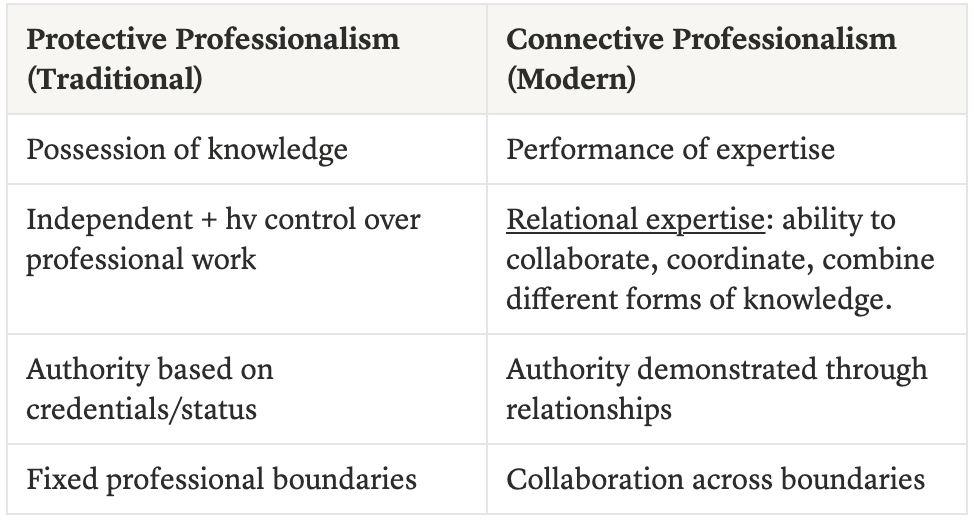
Noordegraaf – Protective vs. Connective Professionalism
Relational Expertise
Technical knowledge remains important but no longer sufficient on its own.
eg: Doctors must combine medical knowledge with input from nurses, specialists, patients, families, and technology.
Key idea: Managing relationships becomes part of professional expertise itself.
Reading: “Moving forward? Complementary and Alternative practitioners seeking self-regulation” — Sandy Welsh et al.
background
4 strategies that the leaders of the CAM groups said they were pursuing to help them reach their goal of state-sanctioned self-regulation
Background: 3 grps (Naturopathy, TCM/Acupuncture, Homeopathy in the province of Ontario) — who is considered a credible CAM practitioner w/ a valid knowledge base?
4 strategies that the leaders of the CAM groups said they were pursuing to help them reach their goal of state-sanctioned self-regulation:
improving educational standards
improving practice standards
engaging in peer-reviewed research
increasing group cohesion
these strategies separates who is qualified to practice + signal to ‘outsiders’ (eg: medicine + gov.) that practitioners are qualified + legit
Across the 3 groups, the leaders referred to inclusion of medical science as a basis for distinguishing between ‘science’ and ‘non-science’ and who should/should not practice
CTCMPAO requires that every practitioner be a registered member of the College.
members must pass exams + meet rigorous educational requirements determined by the College, meet registration requirements laid out in Ontario’s Traditional Chinese Medicine Act, 2006, in order to legally use the titles of “traditional Chinese medicine practitioner” and/or “acupuncturist”
Improving the quality of education (expertise based on education)
for TCM: Some leaders convinced that the inclusion of anatomy, physiology and other medical sciences in curriculum was necessary to ensure modern education.
internal battles bc this is strategy for social closure; also who is the true acupuncturists? Chinese medicine or western science?
What is a high standard of practice? High standards seen as important for protecting the public BUT each group believed it was their standards + knowledge that were best
Naturopaths try to gain professional legitimacy and government recognition by adopting scientific standards from Western medicine, but disagree internally about whether scientific evidence is necessary. (conflict over expertise, identity, authority)
For an occupation to become a recognized profession, its members must unite, establish shared standards, and develop a collective professional identity → BUT diff practitioners hv conflicting opinions abt professional standards + regulations, resist change, some practitioners with higher qualifications support stricter regulations, which could exclude less-qualified practitioners.
What is Timmermans’s main argument about expertise? (Reading: "Suicide Determination and the Professional Authority of Medical Examiners” — Stefan Timmermans)
Death classification depends on situated judgment, evidence and interaction with other parties; professional authority is enacted relationally, not merely possessed.
Background: Underreporting of Suicide (not all deaths that are suicides are reported as such)
Why are suicides consistently underreported? expertise & authority
allegation of suicide inaccuracy challenges authority of professional grp (suggests scientific incompetence, inconsistency, preoccupation w/ private rather than public needs; criticizes that they are unfit to do their jobs)
For suicide investigators, professional authority = ability to present death investigations as accurate + valid and shape cultural understanding of suicide
How do you determine suicide?
Death investigator needs to establish that the death is 1) self-inflicted, 2) intentional.
To determine whether suicide was the intended outcome, the death investigator needs to establish suicidal intent from secondary evidence (7 diff sources)
“Doing” suicide determinations
Medical examiners work ‘inductively’ (building a case for suicide from diverse pieces of evidence), NOT ‘deductively’ (determining a suicide based on a checklist of evidence)
Suicide determinations = probabilistic decision-making process where evidence of the entire investigation needs to meet a suicide threshold.
‘51 percent rule’ of a medicolegal suicide decision-making underscores how medical examiners' scientific expertise is in dual areas of medicine & criminal justice.
suicide classification is socially situated: investigators may weigh family statements, scene evidence, notes and professional interpretations differently in ambiguous cases.
What did John Carson examine in Army Alpha, Army Brass? (Case study: Jurisdiction)
Main idea: Psychologists expanded their professional authority by convincing the U.S. military that intelligence testing was necessary → psychologists adapted their expertise to military needs while also changing how the military evaluated soldiers.
Creating Demand for Expertise
Before WWI, the military evaluated soldiers based on leadership, discipline, character, and judgment.
In 1917, psychologists convinced the military that intelligence testing could improve recruitment.
Rapid military expansion (200,000 → 3.5 million soldiers) created a need for efficient evaluation.
Expanding Professional Jurisdiction
Psychologists claimed authority over measuring soldiers' intelligence; introduced standardized tests:
Army Alpha: Literate recruits.
Army Beta: Recruits unable to complete the written English test.
Connection to Abbott: Psychologists used abstract knowledge to claim a new area of professional work.
Adapting Expertise to Military Needs
Developed multiple-choice tests for efficient mass testing.
from interpreting individual behaviour → analyzing standardized test results.
Adapted testing to military culture using commands like "Attention!" and "Stop!"
Psychologists took military commissions and underwent training.
Key idea: Professionals adapt their expertise to gain acceptance from new audiences.
Resistance and Acceptance
Some military leaders questioned standardized testing bc it challenged traditional personal evaluations.
Testing continued bc it was efficient + appeared consistent with officers' assessments.
Psychologists gained legitimacy by demonstrating practical value.
Changing Military Culture
Intelligence became an important factor in evaluating soldiers.
"Passing cull": Commanders kept soldiers with high intelligence scores and transferred those with lower scores.
Key idea: Psychologists changed how the military understood and evaluated soldiers.
Connections to Course Concepts
Abbott (Jurisdiction): Psychologists expanded authority thru abstract knowledge.
Cultural Work: Redefined intelligence as a measurable military concern.
Audience Matters: Psychologists adapted their expertise to military expectations.
Demand Creation: Professionals can create a market for their services by identifying new problems.
Relational Expertise: Psychologists and military institutions shaped each other's practices.
What is Gil Eyal’s critique of Abbott?
Abbott asks who controls a task; Eyal asks what networks of people, devices, concepts, institutions and spaces make the task possible.
Why were single-vehicle deaths relevant to Timmermans?
They may contain hidden suicides, but intent is hard to establish using available evidence, making classification uncertain.
Abbott versus Eyal: what is each author’s central analytical question?
Abbott: who legitimately controls work? Eyal: what social/material arrangements enable work to be done?
How do Welsh et al. and Starr connect?
Both show knowledge standards and state recognition can strengthen claims to authority while drawing exclusionary boundaries.
How do Carson and Eyal connect?
In both cases, expertise depends on tools, organizational demand and institutional arrangements—not simply an individual expert.
How are Eyal and Noordegraaf different?
Eyal analyzes the networks that produce expertise; Noordegraaf describes an organizational model of professionalism grounded in connection and coordination.
What is a cultural schema?
A socially learned framework that shapes how people interpret situations, judge what matters and decide how to act.
What is the passion principle?
Cech’s morally charged schema encouraging people to prioritize meaningful, self-expressive career work over money, status or security.
What is meant by a reflexive project of the self?
An ongoing effort to construct and revise a coherent personal identity, often through educational and career choices.
What is work devotion?
An expectation of intense loyalty and time commitment to work, sometimes even when employers offer little reciprocal security.
Define career funneling. (+ initial naivete)
Binder et al.’s process by which campus culture and recruitment make a narrow range of elite careers appear desirable and appropriate.
Ambitious first-year students have limited labor-market knowledge and are therefore receptive to campus signals about prestigious careers.
What is cultural matching?
Rivera’s concept: hiring evaluators treat shared personal tastes, leisure interests and social style as evidence of candidate fit.
What is predictive validity in testing?
How well a test predicts later outcomes, such as first-year college grades.
What is the distinction between aptitude and achievement testing?
Aptitude tests aim to measure future learning capacity; achievement tests measure material and skills already learned.
What is Erin Cech’s core argument in The Passion Principle? (reading)
Believing work should fulfill personal passion is culturally powerful + socially patterned → can reproduce inequality and overwork.
Passion principle: cultural schema advising people to prioritize meaningful, self-expressive work + personal connection to an occupational field over income/security.
3 dimensions of passion: Intellectual interest, emotional enjoyment and a personal/identity connection to an occupation.
Evidence: Cech combines interviews with students + career advisers, worker surveys and an experiment.
eg: Steve Jobs urging graduates to love their work; Claire, who hesitates to abandon her social-science interests for supposedly safer fields; Will, who rejects an engineering path he would dislike; and Xavier, who describes mathematics as engaging puzzles central to his sense of self.
Findings: Passion is socially patterned, not just innate or purely personal.
Privileged people can afford low-paid explorations + convert passion into rewarding work.
Less-privileged aspirants face stronger trade-offs and precarious outcomes. Employers may exploit passion to demand long hours or accept low pay.
What did Binder, Davis and Bloom find? (Binder, Davis & Bloom (2016) — career funneling)
Question: Why do students at highly selective universities concentrate in prestigious consulting, finance and technology careers?
Four linked mechanisms — sequence is important:
students have ambition but little concrete knowledge of careers → peers, clubs, career events become influential.
heavily funded campus recruiting makes a few sectors more noticeable; seeing accomplished peers apply makes those jobs attractive.
Istudents fear failing to live up to elite-education expectations; consulting/finance offer validation, training, optionality and a way to postpone choosing a lifelong passion.
visible recruiting firms become the benchmark of a “real” prestigious career, and students devalue unadvertised/less elite choices.
Finding: Campuses are active cultural environments producing the desire for certain jobs, not merely pipelines distributing preexisting preferences. Contrast with Cech: passion versus prestige are different schemas of a good career; both are socially shaped.
What is Malcolm Gladwell’s central SAT argument? (Malcolm Gladwell (2001) — “Examined Life” / Stanley Kaplan and the SAT)
Scores reflect practice, instruction and test-taking knowledge more than a fixed measure of innate intelligence; ideas of merit can justify exclusion.
Evidence: SAT makers once insisted the test was essentially uncoachable. Gladwell also reviews evidence that achievement tests and school grades predicted college results better in a University of California study, and that sustained music practice and engaged parental support predicted young musicians' results.
Historical inequality: admissions tests and other criteria could be used in exclusionary ways, eg: restricting Eastern European Jewish entrants who excelled through hard study.
Finding: The seemingly natural distinction between “brilliant naturals” and “grinds” is fragile. How institutions measure merit creates winners and losers; opportunity, practice and family support influence achievement.
Comparison: Gladwell's SAT ↔ Starr's medical-school barriers ↔ Rivera's school filters all show how apparently legitimate selection systems can enforce boundaries, although the specific organizations and mechanisms differ.
What is Lauren Rivera’s (2011/2012) central argument about elite hiring?
Stage 1 — structured exclusion: “target” schools receive recruiting attention, interview slots and employer-sponsored events. Factors influencing hiring chance:
A school's geography
perceived cultural orientation and relationships
elite school names, grades, exceptional extracurriculars (candidate from a non-target school won’t be reviewed, even if qualified)
A powerful credential signals generalized intelligence and future social ties as much as job-specific knowledge.
Stage 2 — cultural matching: candidates passing the credential screen are assessed for personal and cultural fit.
three processes: organizational rules explicitly prioritize fit; cognitive similarity raises evaluators' understanding/valuation of qualifications; affective similarity makes evaluators excited and willing to advocate for a candidate.
interviewers ask whether they would enjoy spending very long nights with the applicant; shared sports, hobbies, experiences and self-presentation = evidence of belonging.
Finding: Hiring is neither a pure test of human capital nor only a matter of demographic prejudice: cultural similarity itself can become a criterion of perceived merit and reproduce privilege.
Cech versus Binder: what shapes desirable careers?
Cech: moral valuation of passion. Binder: elite campus culture channels desire toward prestigious occupations. Both show that career preferences are social.
Binder versus Rivera: where does sorting occur?
Binder studies how universities shape students’ aspirations; Rivera studies how employers assess and admit applicants.
How do Starr, Gladwell and Rivera connect?
All show educational credentials or admissions/screening standards can produce social closure, although the organizational mechanisms differ.
Define professional socialization.
Learning the formal and informal practices, values, identities and standards required to be recognized as a professional.
What is lay idealism?
Becker and Geer’s term for medical entrants’ early belief in medicine as an immediately meaningful humanitarian calling.
What is situational cynicism?
Medical students’ pragmatic, sometimes disillusioned adaptation to examinations and routines that seem remote from ideal medical practice.
What is professional idealism?
A later, more realistic commitment to medical ideals tied to how students expect to practise once they have greater autonomy.
What does being “test-wise” mean for medical students?
Learning through student culture which material faculty emphasize, how exams work and how to survive a demanding curriculum.
What is organizational socialization?
Learning workplace-specific norms and hierarchies, such as acceptable dress, use of time and signals of commitment.
What is regulation of the professional self?
Internalizing workplace rules so workers monitor their own time, conduct, availability and identity.
What does “writing off time” mean in the accounting study?
Working hours are not always recorded as billable because workers balance pressures to appear committed with budgets/client billing norms.
What are provisional selves (Ibarra)?
Trial versions of a new professional identity that people test, assess and revise while shifting into senior roles.
What is an identity paradox?
A persistent contradiction between the occupation’s idealized self-image and practices actually needed to perform contemporary work.
What does “being” versus “doing” mean in Ahuja et al.?
Being is the architect’s cherished identity as creative master-designer; doing involves collaborative, managerial and persuasive project work.
What is Becker and Geer’s main finding? (Medical School Reading)
Students starting med school: doesn’t live up to expectations; not near patients, lots of med. knowledge, learning content disconnected from what they think actual practice of medicine will be
What happens to their idealism as they learn what medical school — and medicine — are actually like?
students realise that they cannot learn everything they are expected to know → start distinguishing what is important to pass exams + what they believe will matter in medical practice → develops ‘student culture’ (cynicism directed towards med school requirements, rather than medicing itself) → change in outlook = ‘real medicine’ pushed to the future
eg: Cadaver Dissection — seems like smth a doctor needs to do → unpleasant experience, but students interpret as needed for professional preparation → reinforces idealism → cynicism selective: reject what seems irrelevant to medicine, not medicine itself
eg: Clinical Years — when student sees a cancerous organ removed, instead of responding w/ sympathy for patient, they are more concerned that they were not allowed to close the incision/frustrated by spending hours searching for the lymph node tissue → learning what is ‘rlly important’ frm the physicians position → professional socialization changes what they notice + interpret same event
Professional Idealism
Students now know that few doctors live up to all of the standards they have been taught, but they intend to do so themselves → intend to examine patients thoroughly and give treatment based on firm diagnosis rather than merely relieving symptoms
Lay idealism → situational cynicism → professional idealism
ideals are not abandoned; they are transformed + postponed until students believe they will have enough control to practise medicine
Becoming a professional is not simply acquiring expert knowledge; also means learning what really counts, how to navigate the institution, and how to reconcile professional ideals w/ realities of professional work.
What does Karen Ho argue in Liquidated? (Karen Ho. 2009. Liquidated: An Ethnography of Wall Street)
Wall Street remakes elite recruits to treat extreme labor, rank and “smartness” as natural markers of professional success.
Orientation
1 month financial training course for non-financial majors to get used to intensity of financial calculations
analysts are reinterviewed + retested → placed
oriented into culture of instability + competition frm the beginning!
after month training → 3-4 day off site conference + team building to inititate new hires to firm ‘culture’ new hires are officially hired + given royal treatment
Spatial Segregation: ‘Global Financial Management Training Program’’ (gfmtp; ‘second tier’’ private schools; eg: Lehigh University, suny Binghamton) vs ‘‘Global Corporate Finance Training Program’’ (gcftp; Wharton, Princeton, Harvard, Duke, Stanford, MIT)
everyone in gmftp group → back-office worker (though in management positions) → hope and excitement let down
everyone in the ‘‘elite’’ Corporate Finance group → front office investment banker (fancier food, better supplies, professional ‘‘facebook’’ which detailed their pedigrees and biographies, excellent head-shots)
Every investment bank in NYC organised elevators this way; low floors = less prestigious departments, upper floors = elite workers
“Front-office’’ workers (aka ‘officers’ of the bank): most valued EEs because they generate revenue for the company; extravagantly recruited, req. to participate in the various training + orientation events; invited to various off-site retreats, conferences, and social events
‘middle office’’: (not as lucratively compensated or as highly valued as front office workers as they do not actively generate revenue) BUT are still considered ‘‘officers’’ of the bank (recruited from the same elite universities as front-office)
Almost everyone else in the bank considered ‘‘back-office’’ support staff
Opportunities to enter front-office work = highly exclusionary + open only to particular class & educational backgrounds
mostly white, upper middle class men
front + back office workers do not socialize w/ each other
Analyst (lowest EEs): college graduate hired from a few elite universities in the United States; former colleagues refer to program as ‘2 years in boot camp’
if analysts work 110+ hours a week (with 4-5 all nighters a month), then a typical analyst’s salary of $50,000 amounts to little more than minimum wage.
Only variable bonus of $20,000 - $50,000 (for first-year analysts) pulls analysts significantly above a living wage in New York CityWhen investment bankers reach vice president, they are expected to take on more hours and commitment (to demonstrate both up-to-date product expertise and a desire for the much-coveted position of managing director (md).)
‘Perks’ — if investment bankers stay after 7pm, they can order dinner on the firm (so every analyst + associate partakes in this); if they stay after 9pm, they can call company car to drive them home; having a ‘BlackBerry’ keeps them constantly ‘on call’ + chained to office
incentives to get them to work for longer!
v high pressure job + everything has to be perfect → stay office till morning hours
Forging Superior Workers
hard work + becoming part of business elite → belief that corporate America has become inefficient bc ppl move so ‘slowly’ (said w superiority; they interpret their experience of overwork = sign that they know how to ‘get things done’ as proof of their smartness’)
Wall Street mentality + claims: "We don't care who you are, as long as you make us money."
Greed presented as smth preventing discrimination (desire for profit outweighs racism, sexism, other biases)
hires ppl w/ exceptional abilities (eg: math talented ppl, skilled problem solvers/chess players); talent over social status
claims to be meritocracy BUT unconscious biases + unequal opportunities can still influence hiring + promotions
Clothing hierarchy
junior people don’t wear suspenders; managing directors do (it looks like you spent too much time on your appearance; supposed to just work hard. You shouldn’t be wasting time putting on suspenders in the morning!)
for women: Hair: Neat, and pulled back or at least out of your eyes. No crazy 'dos.; Nails: Manicured red, pink, or nude. Trimmed short and round.; Make-up: Smooth, even-toned, fresh-looking skin. Mascara. No heavy eye-liner, ideally none. Light lipstick
women wear sneakers in commute → change into heels @ office. sneakers over pantyhose = indictor of lower class (worn by assistants) → female investment bankers must constantly guard against class slippage: being mistaken for assistants or ‘‘admins.’’ → must police themselves for such class infractions as wearing socks over hose
Goldman Sachs offer many perks (gyms, massage, medical care, wellbeing support) BUT also demands long hours + avaliablilty at all times → no time for personal life
Image is EVERYTHING! the way you talk, respond to situations, approach a problem
even the way you eat (shouldn’t eat in the lunchroom too often, everybody brought their food back to their desk)
What do Anderson-Gough, Grey and Robson argue? (accountant trainees)
Central idea: Professionalism is the regulation of the self through time and everyday conduct. Trainees learn unwritten rules about how long to work, when to leave, when lunch is acceptable, how available to be, and what part of private life must yield to firm demands.
Two useful details: (1) Long hours become an informal proxy for organizational commitment and the ideal “high-energy” accountant. (2) Writing off time creates a contradiction: managers want workers to put in many hours, but partners may discourage recording all that time because of client fees or budgets. Trainees must learn how time is actually evaluated, not merely follow written policy.
Finding: Acquiring accounting qualifications is insufficient for becoming a professional; organizational discipline and self-surveillance → appropriate identity.
Compare: Ho's bankers internalize hard work as prestige; accountants internalize time management as responsible professional conduct.
What does Masashi Goto (2021) examine? (auditors and AI)
How auditors collectively reconstruct professional roles and identity when AI threatens established technical tasks.
Six reconstructed professional identities (learn what each means):
Productivity maximizer — automation improves efficiency.
Collaboration facilitator — coordinate auditors with data, IT and other specialists
Data-empowered advisor — use analytics for deeper advice + judgment.
Analytics user — IT, AI and statistical knowledge become part of professional expertise
Continuous self-disruptor — learn + adapt as technology changes.
Guardian of capitalism — human judgement, responsibility and auditor's role in sustaining trust remain
Finding: AI can be narrated as enhancing rather than abolishing professionalism; role identity changes while enduring commitments remain.
Comparison: Goto's auditors actively reconstruct who they are; Ahuja's architects struggle to accept a redefinition of their work.
What is Ibarra’s main finding about identity transitions?
Promotion requires experimenting with who to be, using role models, feedback and trial identities—not simply accumulating technical management skills.
Question: How do experienced consultants and bankers adjust when promoted beyond the technical individual-contributor role?
Process: Observe successful seniors as potential role models → experiment with provisional selves → assess external feedback (credibility/results) and internal feedback (authenticity/fit with self) → modify, combine or abandon styles → form a more stable senior professional identity.
Three strategies:
wholesale imitation (copy one senior model; may feel artificial)
selective imitation (combine aspects of several models)
true-to-self (rely on established style; may limit adaptation). Example: a consultant rejects mimicking an effective senior colleague because she experiences his interpersonal style as manipulative. Another looks for a quieter, analytical senior style he could authentically inhabit.
Finding: Becoming a senior professional is not merely learning management techniques; it means experimenting with who to be. Unlike Becker's entering students, Ibarra's participants are already professionals shifting roles.
What is Ahuja, Nikolova and Clegg’s (2017) main finding? (archetects)
Question: What happens when architects' professional identity as independent creative designers diverges from the work performed in large complex projects?
Method: year-long ethnography in 2 large architecture firms; observations, shadowing, conversations with architects working on complex “city-building” projects.
3 evidence clusters:
Ambiguous design authorship/control: design emerges thru numerous consultants, specialists and construction teams. designs change to fit budgets, or can just be changed by team developing it
Management versus design: senior architects spend time on fees, budgets, contractors, staffing, meetings, clients and projects. One senior architect says she has not drawn for over 10 years. Keeping business control reduces time for designing; delegating it risks subordination to managerial staff.
Persuasion replaces automatic authority: architects need to persuade clients to protect design goals because they lack budgetary control. They feel under-valued/marginalized when their design image doesn’t match final product anymore
Finding — identity paradox: idea of “master designer” → professional pride BUT prevents architects from managerial, relational and collaborative skills already essential to their practice. A professional identity can therefore undermine adaptation and status when it no longer matches actual work.
Nuance: The study focuses on large, multi-organization projects; not every architect experiences the same identity conflict!
Becker/Geer versus Ibarra: who is becoming a professional?
Becker and Geer study novices entering medicine; Ibarra studies established workers experimenting with identities as they move into senior roles.
How do Karen Ho and Anderson-Gough et al. connect?
Both show that time, availability and informal conduct become moral signals of professionalism and organizational loyalty.
How do Goto and Ahuja et al. differ?
Goto’s auditors actively reconstruct roles to incorporate AI; Ahuja’s architects struggle to revise the entrenched identity of the autonomous designer.
How can Anteby’s lenses explain architects in Ahuja et al.?
Becoming: learning designer identity. Doing: managerial/design tasks. Relating: collaboration with consultants and clients; their mismatch creates a paradox.
What common thread links Noordegraaf and Ahuja et al.?
Interdependent work challenges ideals of autonomous expertise; connective capacities must be recognized as legitimate professional skills.