Political Science 3 Midterm 1 - UC Berkeley
 Call Kai
 Learn
 Practice Test
 Spaced Repetition
 Match
 Flashcards
 Knowt Play
1/34

There's no tags or description
Looks like no tags are added yet.
35 Terms
What are the steps to acquiring scientific knowledge?
1. Pose a research question
2. Develop a causal theory
3. Generate a hypothesis
4. Test and evaluate the hypothesis
5. Evaluate the theory
What are the core components of a Theory
A tentative conjecture (an unproven opinion) and a causal statement (x causes y)
What is an Independent Variable
variable that is manipulated and results in the dependent variable (X)
What is the Dependent Variable
variable that is measured (y) (the outcome)
Steps to make a theory into a hypothesis
1. Restate relationship into one or more causal and effect relationships/hypothesis that can be tested
2. Operationalize variables into something that can be measured
Type 1 Errors
False Positive - occurs when you incorrectly reject the null hypothesis - Saying it is true when in reality it is not
Type 2 Errors
False Negative - when you wrongly accept the null hypothesis - Saying something is not true when it is.
Inductive Theory Building
start with observation; then develop theory explaining what was observed - explaining observed patterns and regularities through theories
AKA: bottom up approach -- collect observations to reach conclusion
Deductive Theory Building
1. Develop a theory
2. Generate a hypothesis
3. Get data
4. Test the theory on data
- Uses logic to develop premises of theory
AKA: top down approach - state general idea and verify it to reach conclusion
Down's Spatial Model Assumptions
1. One dimension
2. Two mobile parties
3. No entry of more parties
4. Office-seeking behavior
Spatial Model Mechanics
Parties pick a location along the dimension and battle in Condorcet tournaments. After each tournament, they pick a new location on the spectrum to capture more votes. Keep repeating.
Spatial Model Outcomes
They will end up at the middle of all voters or the so called equilibrium.
Condorcet Tournament
A head-to-head competition between two parties uses players' preferences to determine who would win in each situation. This is one way of aggregating votes to find a consensus
Condorcet Paradox
a situation in which a series of pair-wise majority votes over more than two options leads to a cycling of winners. When a Condorcet tournament has no clear winner. Only can occur if there are non-single peak preferences however does not always occur with non-single peak preferences.
Cylcing
An implication of the Condorcet paradox where with each change in outcome forms a new majority that will thus favor a new outcome and will change it.
Arrow's Theorem
The idea is that elections cannot be the perfect means of making decisions when there are more than 2 candidates because the method by which the votes are tallied can significantly alter the outcome. There is no way of vote aggression that consistently produces the best outcome.
Median voter theorem
Assumptions: All players are rational and candidates move freely along the spectrum
Candidates will locate themselves in the middle of voters to get the most votes or split the vote 50/50.
This concept came from the Spatial model.
Single-peaked preferences
Preferences with only a single local maximum, or peak, so that utility falls as choices move away in any direction from that peak. Single lines or upside-down V
Non-single-peaked preferences
Preferences that have multiple local maximum, or peaks. V shape and more.
Game Theory Concepts
1. Players make mores (simultaneously or sequentially)
2. 2+ players
3. Are not pure chance or games where there are no strategic interaction.
4. Players are rational - want to maximize payoffs
Simultaneous Game
a game in which participants choose their actions simultaneously without knowing their opponents' strategies
Sequential Game
Game in which players move in turn, responding to each other's actions and reactions
Prisoner's Dilemma Concept
A situation in which two (or more) actors cannot agree to cooperate for fear that the other will find its interest best served by reneging on an agreement.
Pursuing self interest leads to socially sub-optimal results.
Prisoner's Dilemma Criteria/Concept
1. 2 Dominate Strategies for each player. Where they do the same thing.
2. Outcome does not change between the sequential and simultaneous versions of the game

Prisoner's Dilemma Generic
Confess, Confess: 2,2 - Confess, Deny: 4,1 - Deny, Confess: 1,4 - Deny, Deny: 3,3
Battle of Sexes/Friends Concept
1. 2 equilibrium however each player has a preferred equilibrium over each other
2. No dominate strategies

Battle of Sexes/Friends Generic
Option 1, Option 1: 2,1 - Option 1, Option 2: 0,0 - Option 2, Option 1: 0,0 - Option 2, Option 2: 1,2
Chicken Game Concept
1. 2 Equilibrium
2. Opposing strategies
3. No dominant Strategies
4. Highest payoffs is when there are a different selection or strategy from both players
5. One payoff will be bad for one player and good for another

Chicken Game Generic
C = Cooperate and D = Defect
C, C: 1,1 - C,D: 4,2 - D,C: 2,4 - D,D: 3,3
Assurance Game Concept
1. 2 equilibrium
2. No dominant Strategy
3. One outcome is better than other for both players
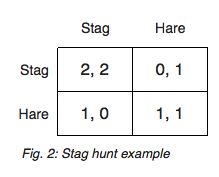
Assurance Game Generic
C = Cooperate and D = Defect - C,C: 4,4, - C,D: 1,3 - D,C: 3,1 - D,D: 2,2
Finding a Meeting Place/Focal Point - A type of Coordination Game Concept
1. There are 2 equilibrium where both are equal. Neither one is better than the others.
2. No dominate Strategy
Finding a Meeting Place/Focal Point Generic
A,A: 1,1 - AB: 0,0 - B,A: 0,0 - B,B: 1,1
Coordination Games
- EX: assurance, where to meet, battle of sexesAll players can benefit form making the same or compatible choices
- There may be multiple ways to coordinate and one may be more beneficial
- Assurance games: benefit from mutual cooperation but require assurance that the other player will also cooperate to achieve a positive outcome (ex battle of the sexes, meet at a place)
- Move better sequentially
Conflict Games
- EX: Prisoners dilemma and Chicken
- players have opposing interests
- It illustrates the tension between individual rationality and collective benefit
- Even though mutual cooperation renders a higher pay off for both players, defecting is a dominant strategy
- This suboptimal outcome does not depend on whether the players make decisions simultaneously or sequentially
- However, game repetition, communication, social norms, and external enforcement can encourage cooperation