ansc314 - carbohydrates pt 1
 Call Kai
 Learn
 Practice Test
 Spaced Repetition
 Match
 Flashcards
 Knowt Play
1/44

There's no tags or description
Looks like no tags are added yet.
45 Terms
carbohydrates
hydrates of carbon formed from carbon dioxide & water (CH2O)n
C:H:O = 1:2:1
plants makes glucose & O2 w/ water as by product
energy from sun transferred to chemical bond of glucose
some carbohydrates contain P, N, & S
major component in omnivore diets
simple carbs
complex carbs

simple carbohydrates
found in foods like fruits, milk, & vegetables
complex carbohydrates
provide vitamins, minerals, & fiber
in foods like breads, legmumes, rice, pasta, & starchy
blood glucose level

plants v animals
plants
store carbohyd. (CHO) — sugars & starch
cell walls: structural CHO — cellulose & hemicellulose
animals
energy source & store (glycogen in liver/muscle)
component of tissues & other compounds
humans can make carbohydrates (from glucose) & store it for SHORT periods of time
instant energy
sugar
monosaccharides
disaccharides
monosaccharides
single CHO unit
pentoses - (C5H10O5) - Xylose, Xylulose, Ribose, Ribulose
hexoses - (C6H12O6) - Glucose, Galactose, Mannose, Fructose
disaccharides
2 CHO units
sucrose
lactose
maltose
cellobiose
alpha bonds can be broke down by human enzymes but not beta bonds
ruminants can b/c more extensive microbial gut biome
non-sugars
polysaccharides
homoglycans
heteroglycans
complex carbohydrates
glycolipids
glycoproteins
homoglycans
polysaccharide - 1 type of CHO
Xylans
Glucans…….starch, dextrins, glycogen, cellulose
Fructans
Galactans
Mannans
Glucosamines (chitin, shell of crustacea/insects)
heteroglycans
more than 2 types of CHO
Pectic substances (oranges)
Hemicelluloses (plant cell wall)
Hyaluronic acid (libricant for connective tissue)
Chondroitin (cartilage)
monosaccharide
one CHO unit
hexose - C6H12O6
aldoses (aldehyde)
glucose, galactose, mannose
ketose (ketone)
fructose
reactive b/c functional groups
ALL sugars are REDUCING in nature (reduce sugars)

sugars
all monosaccharides are reducing sugars
open ring of glucose → reducing sugar
reducing sugars react w/ amino acids in the Maillard reaction
aldehyde → oxidized → carbox. acid (by donating e-)
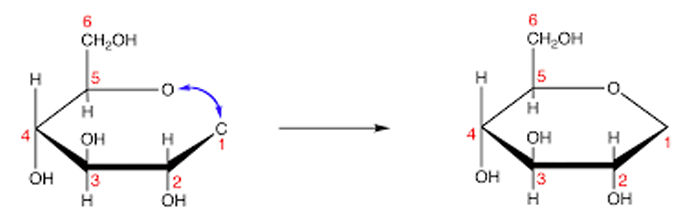
sugar forms
D-form
L-form
D-sugar
-OH group on RIGHT side of last chiral carbon
only D sugars can be metabolized by animals

L-sugar
-OH group on LEFT side of last chiral carbon
not occur naturally in higher living organisms
cannot be used for energy
can’t be phosphorylated by hexokinase (1st enzyme in glycolysis pathway)

alpha carbon
first carbon which attaches to a functional group
2nd C is a beta carbon
different projections

glucose
aldo-sugar
most important SUGAR in nutrition
major end product of CHO digestion in non-ruminants
primary form of sugar in blood for energy
free (fruits, plants, honey) & polymerized (starched, dextrin) forms
body can make glucose in liver (90%) & kidney (extreme cases)

galactose
aldo-sugar
C-4 Epimer of glucose
not found in nature
component of lactose
gums
mucilages

epimer
one of a pair of steroisomers
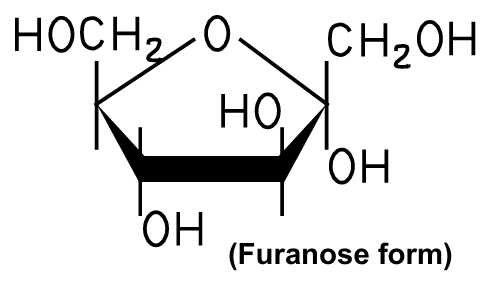
fructose
keto-sugar
only important ketose in nature
free sugar in leaves, fruits, honey
major sugar in corn syrup
component of sucrose (table sugar)
sweetest of CHO
mannose
aldo-sugar
C-2 epimer of glucose
not found in nature
component of glycoproteins
found in yeasts, molds, & bacteria

pentoses
C5H10O5
d-ribose
d-xylose, d-arabinose

d-ribose
pentose
part of nucleotides (ATP, GTP, etc.)
vitamin B
RNA → D-ribose (protein synth. template)
DNA → D-deoxyribose (genetic coding)
modified sugar, locking 1 O atom
d-xylose
only as intermediate in Pentose phosphate cycle

disaccharides
has 2 monosaccharides linked by glycosidic bond
most nutritionally important sugar
sucrose
lactose
know which 2 monosacc are linked together
sucrose
disaccharide - table sugar
α-D-GLUCOSE + β-D-FRUCTOS
most abundant in plants (sugar cane, beets, maple syrup)
broken down by sucrase in monogastric intestines, but not ruminants
lactose
disaccharide - milk sugar
α-D-Galactose+ α/β-D-Glucose
found in milk
promotes acidity in intestines (desirable bacteria)
lactase in small intestine breaks bond
↓ w/ age
enhances absorption of Mg, Ca, & P
homopolysaccharides
starch
amylose
amylopectin
glycogen
dextrin
cellulose
starch
α-D-glucose linked w/ α-1,4 linkages
only in plants
maltose is basic disaccharide unit
glucose + glucose = maltose unit
maltose + maltose = starch
monogastric: digested by amylase (saliva & s. intestine)
cereal sugar
made up of
amylose
amylopectin
amylose
straight line of glucose
α-1,4 glycosidic bonds, straight chains of D-glucose
iodine stains blue
15-30% total starch in most plants
α-amylase degrades amylose in s. intestine
soluble in hot water

amylopectin
branching glucose along straight line
α-1,4 bonds with α-1, 6 bonds at branch points every 25 residues
has branches b/c
enzymes have more opportunities to bind
STORAGE (allows it to be more consolidated)
iodine stains purple/red
70-85% total starch in plants
broken down by amylase at α-1,4 bonds, needs de-branching enzyme for α-1,6 bonds
less soluble in hot water

amylose vs amylopectin
most plant starch is amylopectin

glycogen
animal version of starch
α-D-glycose linked & branched as amylopectin
small amts
liver (8-10%), muscle (2-3%)
liver DENSE in glycogen storage
muscle more important in ability to store glycogen
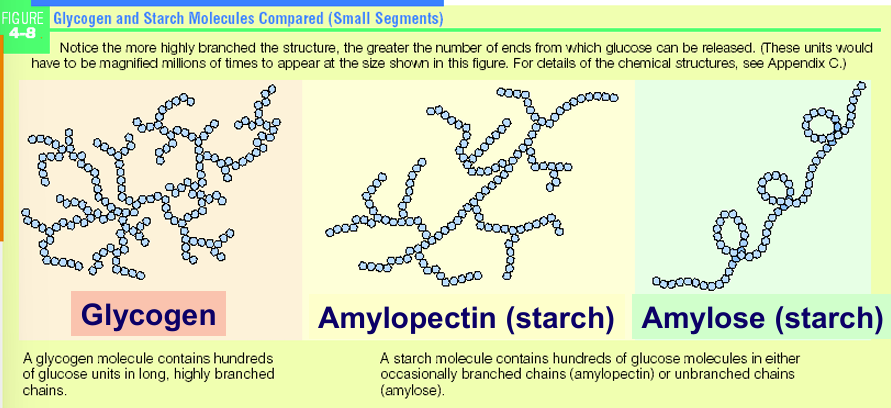
glycogen vs amylopectin
glycogen
higher # of branch points
allows more glucose to be released at once
smaller molecule
very compact & soluble - lots of OH groups to form hydrogen bonds w/ water
glycogen vs starch
dextrin
intermediate product of STARCH + GLYCOGEN digestion
low MW, small, highly branched intermediate
plant fiber
cellulose, hemicellulose, & pectin
alpha vs beta (cellulose)
undigestible for humans
only ruminants & hindgut fermenters

cellulose
β D-glucose w/ β-1,4 linkage straight chain
disaccharide: cellobiose
highly stable: no animal enzyme degrates it
microbial cellulase breaks bond
cotton is one of purest forms
most abundant CHO on planet (trees)

alpha vs beta
alpha (α)
animal enzymes can break α-α linked D-sugars
starch & glycogen
beta (β)
microbial enzymes can break β-β linked D-glucose bond
cellulose
heteropolysaccharides
pectin
hemicellulose
pectin
heteropolysaccharide
linear chain of galacturonic acid interrupted by rhamnose w/ side chains of galactose, arabinose, & xylose
abundant in soft tissue of citrus fruit peels
soluble fiber
exhibits gelling properties

hemicellulose
β-linages of D-glucose, D-galactose, D-mannose, D-xylose, & L-arabinose
digested by rumen bacterial enzymes
easier to digest than cellulose
grasses made of xylan chain in β-1, 4 linkages
found in fruits, plant stems, & grain hulls

lignin
indigestible for several enzymes & just goes out (animals)
can use as a marker (how much in/out?) in research
how digestible fiber & other components are