ME115 - Week 10
 Call Kai
 Learn
 Practice Test
 Spaced Repetition
 Match
 Flashcards
 Knowt Play
1/17

Earn XP
Description and Tags
Fatigue 2, Ceramics, Glasses
18 Terms
Fatigue Life
# of cycles a component survives at a particular stress. Depends on crack initiation and propagation which should be delayed as long as possible
Fatigue Strength
Maximum stress for which fatigue will not occur for a set number of cycles.
How to improve fatigue life
Choose materials that are not sensitive to defects
Avoid/reduce surface flaws by improving design (no sharp corners) and manufacturing (polish)
Avoid sharp changes in direction in your design, they are stress raisers
Reduce tensile stress levels
Create compressive residual stress on the surface

Compressive Residual Stresses
If a metal’s surface carries a residual compressive stress, applied tensile loads must first cancel it out before a crack can open — raising the fatigue threshold and slowing crack growth.
e.g. shot peening or rivets
Fatigue Testing Machine
Rotating-bending machine: not common
Tensile test: expensive
Crack Growth Rate (Paris’ Law)
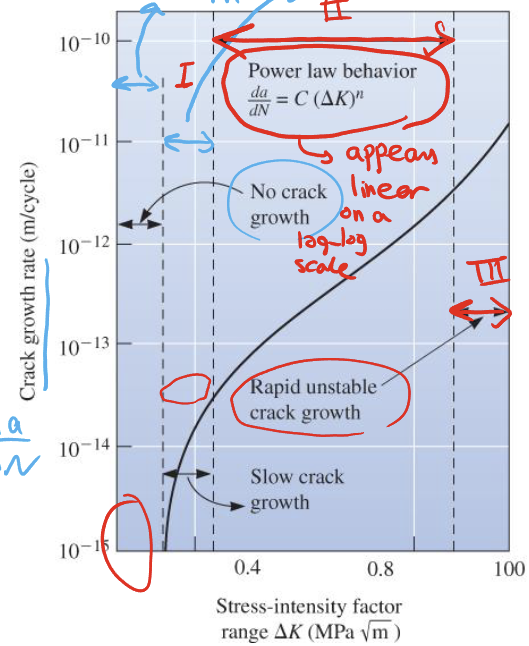
da/dN (crack length per cycle), dependent on a range of crack intensity factors (ΔK) since there is a range of stress being applied to the material and it is bent and unbent and the equation for K depends on σ (stress)
Cracks propagate at Kc

Crack Growth Stages
Pre-Stage: K<Kth (intensity threshold), no crack growth
Stage 1: Slow growth
Stage 2: Growth is linear on a log-log scale
Stage 3: Rapidly unstable crack growth until rupture
Ceramic
Solid compounds with elements bonded together in a fixed atomic ratio (determined by chemical formula) by ionic &/or covalent bonds that comprise:
at least one metal and one non-metal (e.g. Al2O3, MgO)
at least two non-metals (e.g. SiC, Si3, N4)
These are solid compounds that are formed by applying heat or a combination of heat and pressure (sintering)
General Characteristics of Ceramics
High melting temps
High compressive strength, low tensile strength (due to low fracture toughness - also causes them to be brittle)
Hard and wear-resistant (strong bonding)
Prone to thermal shock i.e. damage or cracking caused by a sudden, extreme change in temperature
Generally electrically and thermally insulating - not a lot of freely moving electrons
Generally non-magnetic
Chemically stable and oxidation-resistant (many are already made out of oxidized metals)
Crystalline Ceramics
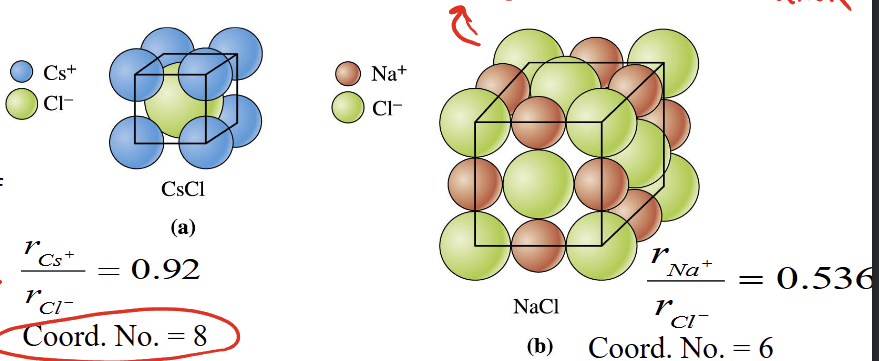
Ceramics that are comprised of crystal lattices. A larger cation (+) usually allows for a higher concentration #, as is seen in the photo
Types of Crystalline Ceramics
Oxides: Al2O3, Si2O (silica), FeO, Fe2O3
Carbides: SiC, WC, Fe3C (cementite - strengthens steel), Al4C3
Nitrides (high hardness): BN, Si3N4, TiN
Processing of Ceramics
Due to high melting temp, they can’t be melted and then molded, thus the process is:
Powder prep → shaping → sintering (applying heat and pressure) → finishing

Glasses
This is a type of ceramic, non-crystalline (short-ranged order only), usually made from silica (Si2O).
Metastable
Glass is stuck in a higher-energy, amorphous state — kinetically trapped rather than thermodynamically stable. Given enough time or heat, glass can slowly crystallize, a process called devitrification.
Glass Vs. Other Ceramics
Most properties are similar to ceramics (brittle, non-conductive, etc.). The difference is that glass is metastable and so it’s not usually crystalline at room temperature, the fact that it is amorphous makes it have a gradual melting temperature, compared to other ceramics that have a very distinct melting temp
Glass Transition Temp (Tg)
Other ceramics do not have this, this is not a fixed value for glass, meaning that over a range of temperatures glass begins to transition into a liquid.
Melting Temp (Tm)
This is a fixed value for other ceramics. However, for glasses it is not, meaning that there is no one temperature where glass stops being solid, it is solid and then it is viscous and then it is liquid, but this happens over a range of temperatures.
This is because glass is amorphous, so there is no need to break strong crystal lattices which means that not a lot of energy is required to turn it into a liquid.
Processing Sheet and Plate Glass
