8.1 Monosaccharides & Disaccharides
 Call Kai
 Learn
 Practice Test
 Spaced Repetition
 Match
 Flashcards
 Knowt Play
1/7

There's no tags or description
Looks like no tags are added yet.
8 Terms
Carbohydrates
Carbohydrates = polyhydroxyl aldehydes or ketones
general formula: (CH2O)n
linear chain of carbons for in monosaccharides, not in polysaccharides
1 carbon is associated with a carbonyl
roles of carbs:
fuel source/storage: glucose, glycogen (poly), starch (poly
structural compounds: cells walls, cellulose, chitin in insects
recognition/regulation of extracellular proteins
structural component in nucleic acids: ribose, dexoyribose
Classes of Carbohydrates
Monosaccharides, disaccharides, oligosaccharides
generally soluble in water
monosaccharides (ex. glucose): very soluble
disaccharides (ex, sucrose, lactose): very soluble
oligosaccharides: relatively soluble → less soluble w increased size
classified by size
Homopolysaccharides & Heteropolysaccharides (mixed)
= polymers of 1+ carbohydrate unit
generally INSOLUBLE in water (get wet but don’t dissolve)
large molecules ( 1000 -1million)
ex. starch isn’t soluble
Glycoconjugates = carbohydrates joined to other molecule classes
joined to proteins/peptides: proteoglycans, glycoproteins, peptidoglycans
covalent assemblies
joined to lipid: glycolipid (ex. gangliosides)
Monosaccharides
monosaccharide = aldehyde or ketones with 2+ hydroxyl groups
unbranched carbon chain connected by single bonds
multiple chiral centres
one carbon is attached to oxygen via a carbonyl
Aldose = aldehyde at C1
ketose = ketone at C2
naming: by the # of carbon atoms
hexoses are the most common
start numbering from end closest to carbonyl
sugar type: combines type & length
ex. glucose: aldohexose bc it has 6C & C1 is an aldehyde
ex. fructose: ketohexose

Monosaccharides: Multiple Chiral Centres
→ all monosaccharides (except for dihydroxyacetone) have 1+ chiral centres
for every n chiral centre, theres 2^n stereoisomers
Stereoisomers
Epimers = stereoisomers that differ in configuration at ONLY ONE chiral carbon (have 2+ chiral centres)
Enantiomers = mirror reflection stereoisomers (inverts ALL chiral centres)
classed as D or L based on configuration of chiral c furthest from carbonyl
D isomer = hydroxyl on RIGHT
L isomer = hydroxyl on LEFT
ex. L-glucose & D-glucose are enantiomers
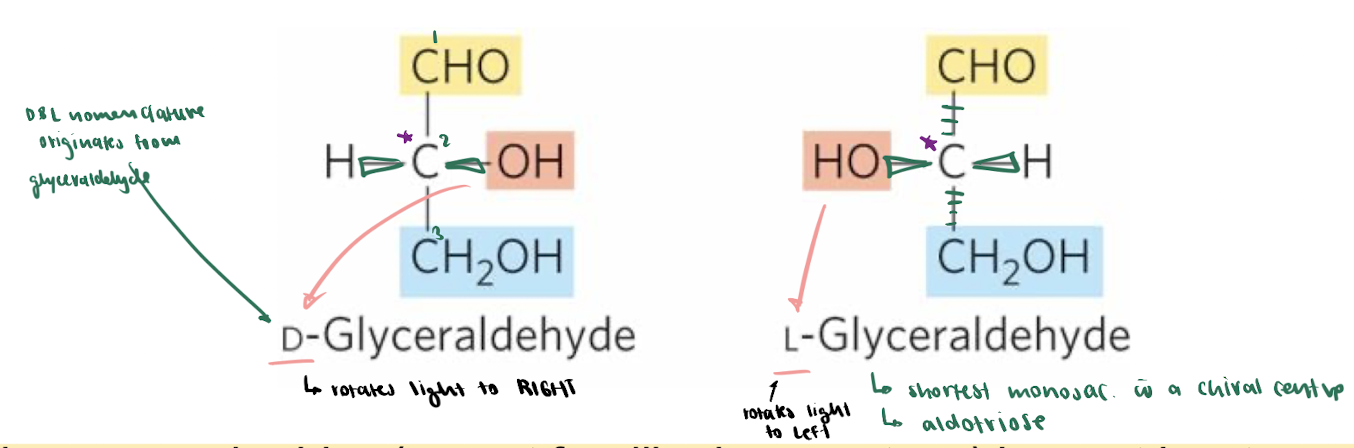
note: Fischer projections allow us to represent chiral centres stereochemistry reliably & UNambiguously
note: D & L nomenclature originates from glyceraldehyde
Monosaccharides: Aldohexose examples
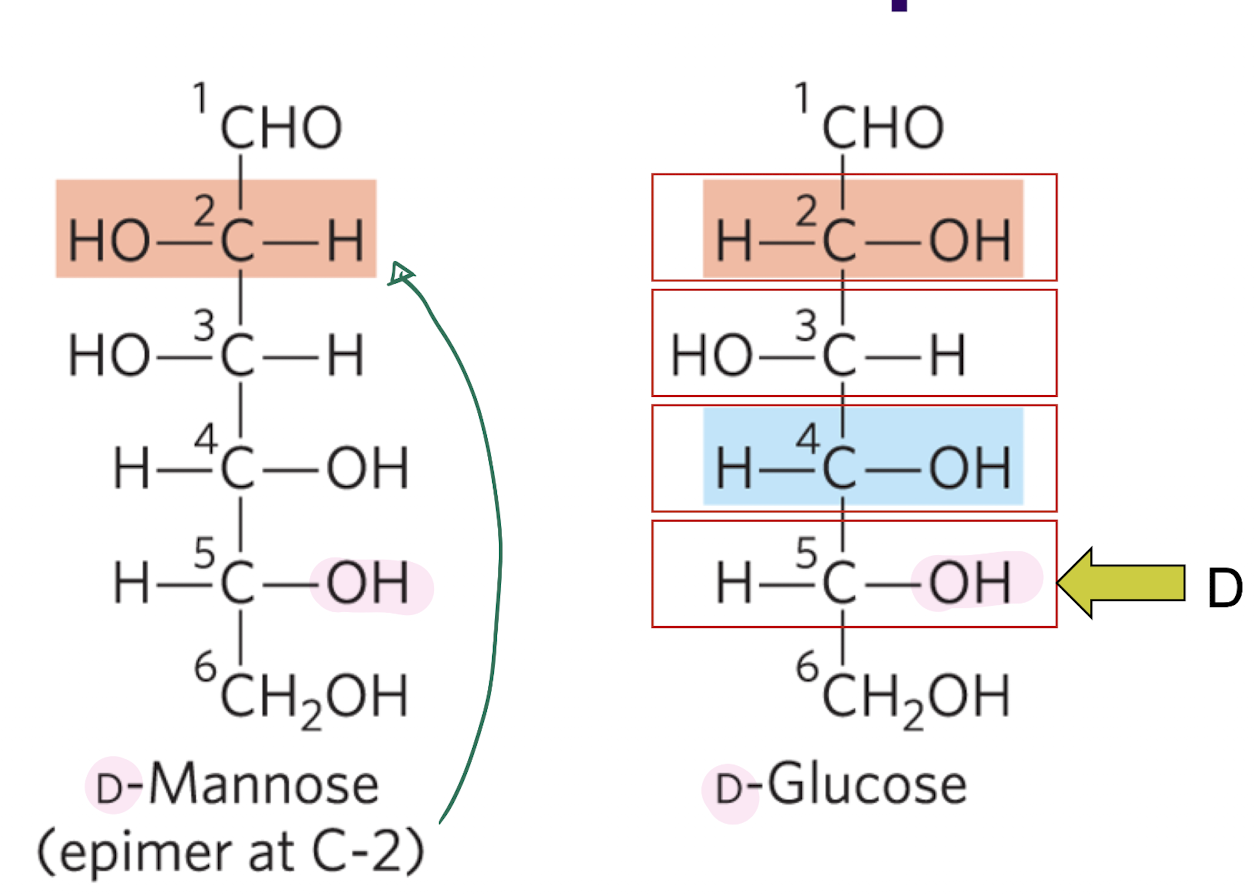
Aldohexose = 6 carbons with aldehyde at C1
4 chiral centres → 16 possible stereoisomers (2^4)
c5 is identified as D or L
ex. D-mannose is the C-2 epimer of D-glucose: invert c2 of D-glucose
ex. D-galactose is the C-4 epimer of D-glucose: invert C4 of D-glucose
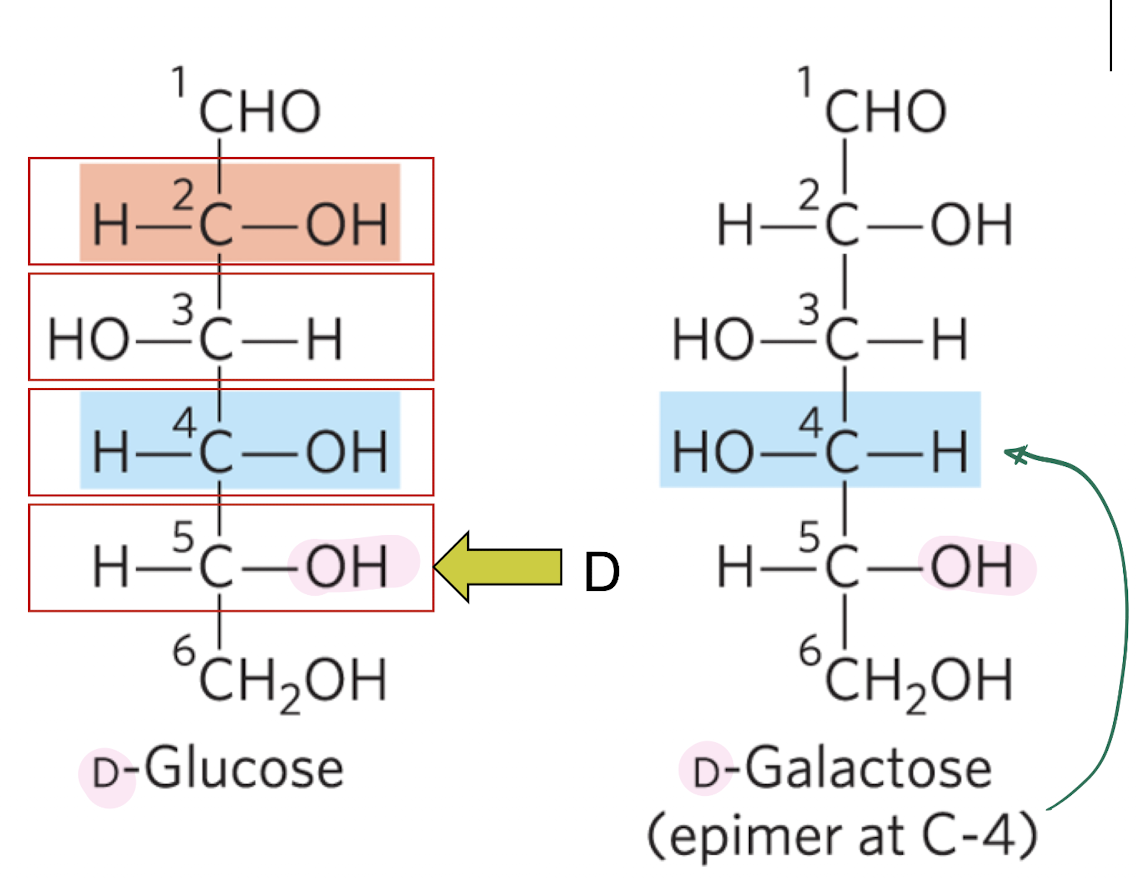
note: D-mannose & D-galactose are diastereomers (NOT epimers or enantiomers)
Monosaccharide Examples: D-Aldoses
→ aldoses have more chiral centres than ketoses because their carbonyl is at c1 (carbons between c1 and last c are usually chiral)
Adotriose (3C) : 1 chiral centres
2^1 = 2 stereoisomers (1 is D- 1 is L- )
Aldotetroses (4C) : 2 chiral centres
2² = 4 stereoisomers ( 2 are D-, 2 are L- )
Aldopentoses (5C) : 3 chiral centres
2³ = 8 stereoisomers ( 4 D-, 4 L- )
Aldohexoses (6C) : 4 chiral centres
2^4 = 16 stereoisomers ( 8 D-, 8 L- )

Monosaccharide Examples: D-Ketoses
→ have fewer ketoses bc they have less chiral centres, thus less stereoisomers
ketotriose / Dihydroxyacetone (3C): NO chiral centres
NO stereoisomers
achiral
ketotetrose (4C) : 1 chiral centre
2^1 = 2 stereoisomers (1 D-, 1 L- )
Ketopentoses (5C) : 2 chiral centres
2² = 4 stereoisomers (2 D-. 2 L- )
ketohexoses (6C) : 3 chiral centres
2³ = 8 stereoisomers ( 4 D-, 4 L- )

Q. L-erythrulose is a ketotetrose. Draw the structure of this monosaccharide ( in the linear/ Fischer projection)
→ ketotetrose thus 4C with C2 as a carbonyl
