PM - Rehabilitation of the Patient With Stroke – Intro and Assessment
 Call Kai
 Learn
 Practice Test
 Spaced Repetition
 Match
 Flashcards
 Knowt Play
1/116

There's no tags or description
Looks like no tags are added yet.
117 Terms
Ischemic stroke is due to?
Thrombus or embolus
**Ischemic stroke is more common
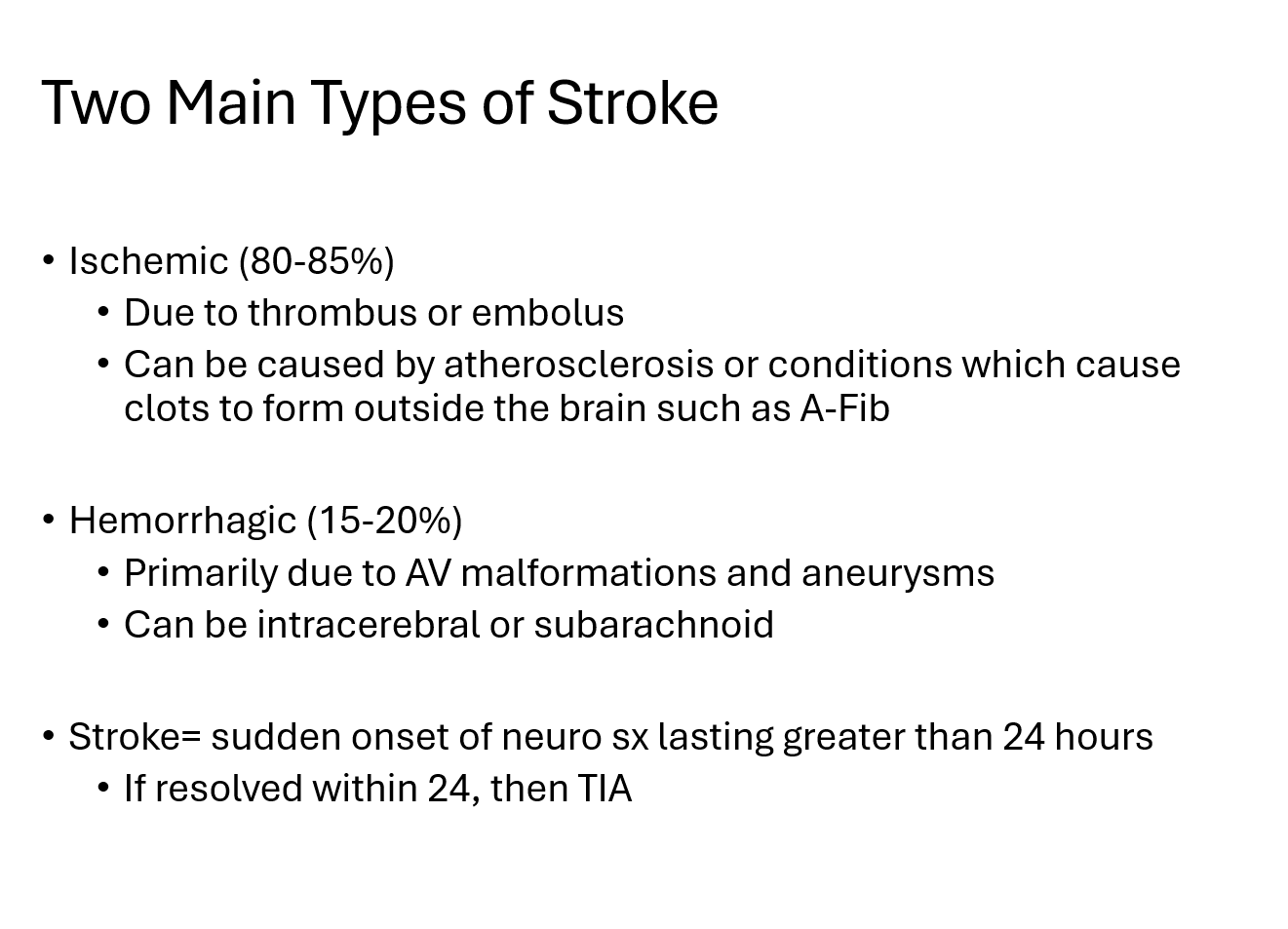
Ischemic stroke can be caused by?
Atherosclerosis
Condition which cause clot to form outside of brain - like A-fib
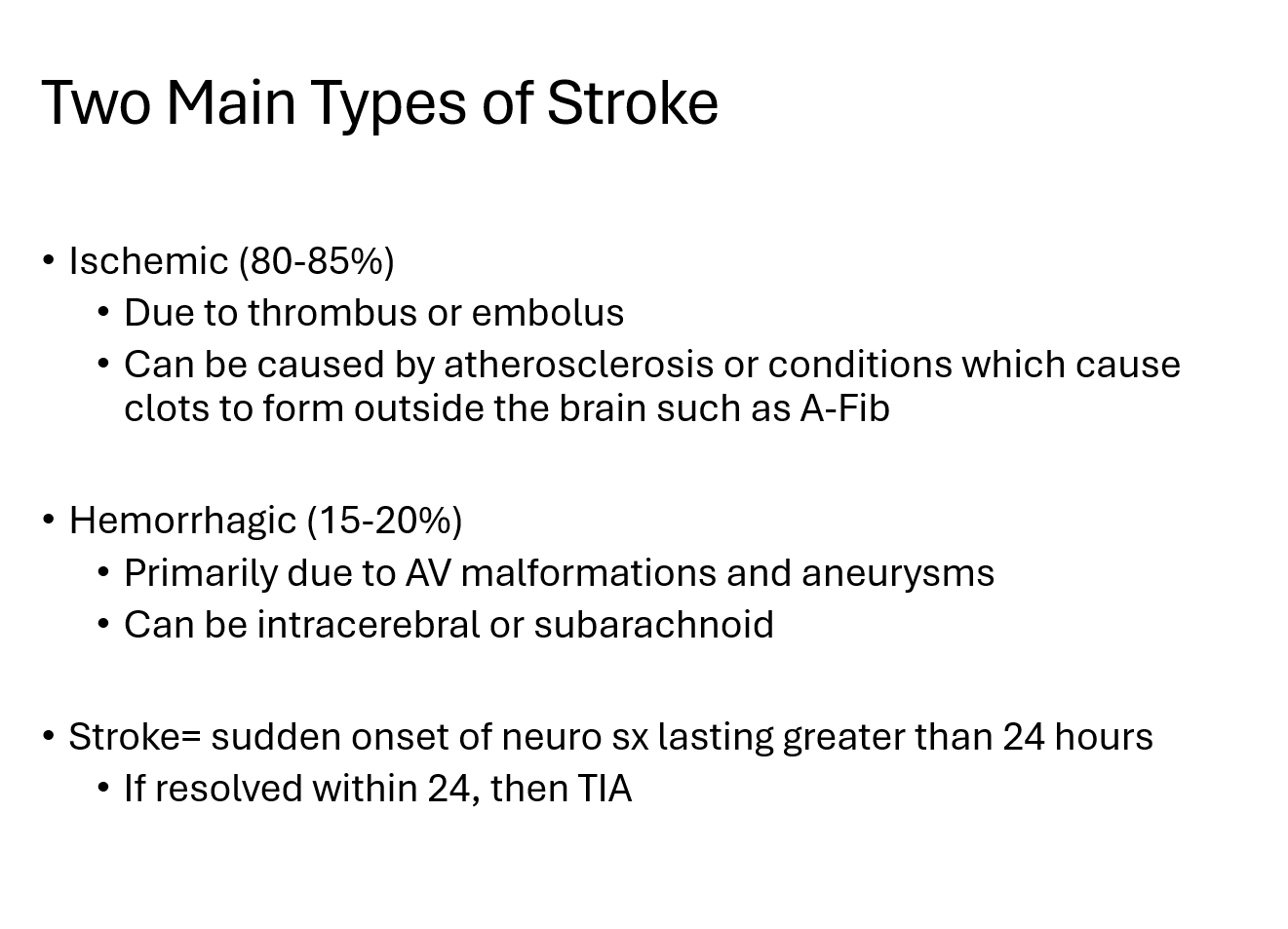
Hemorrhagic stroke is primarily due to?
AVM or aneurysm

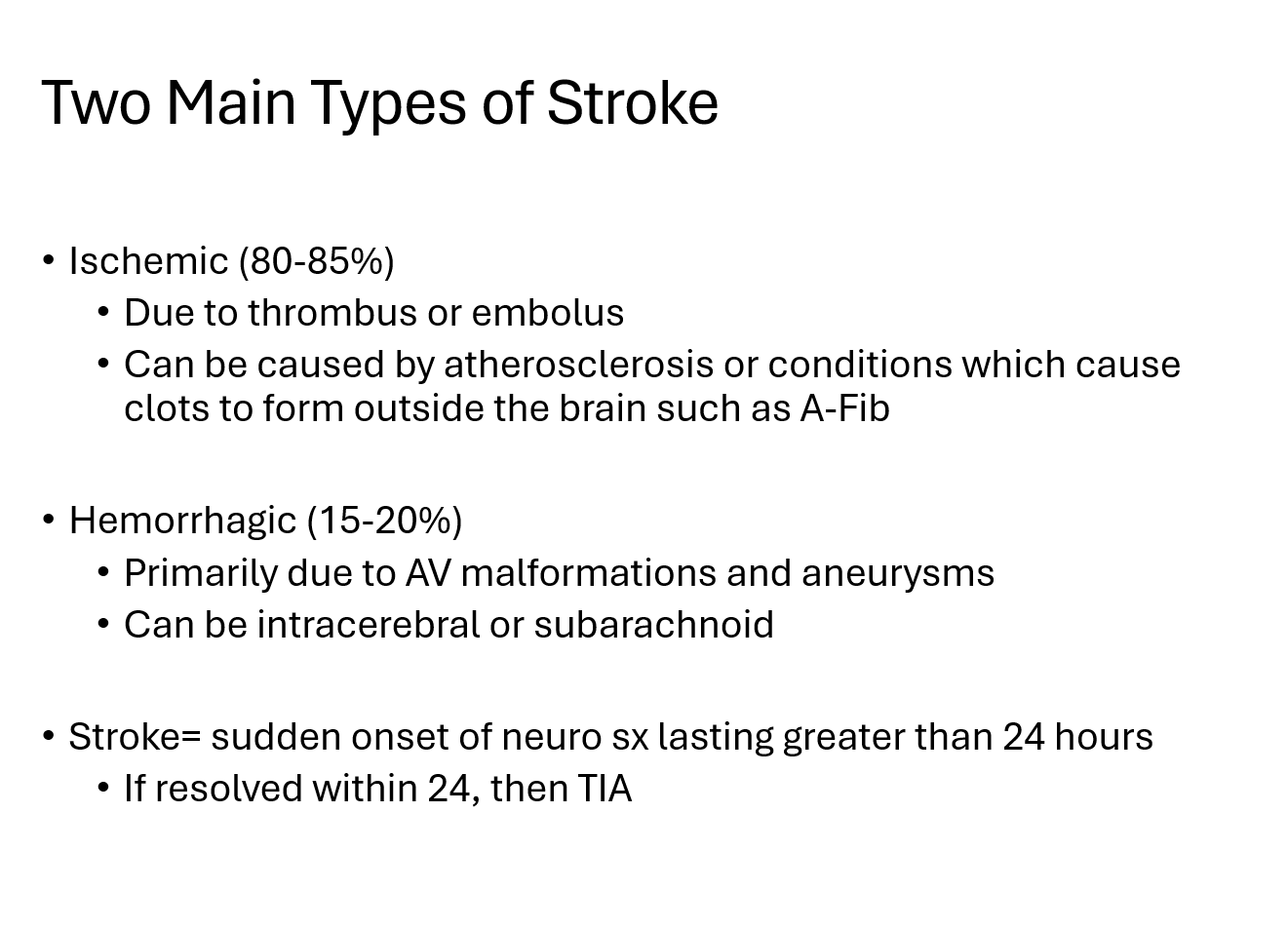
Hemorrhagic stroke can be?
ICH or SAH
intracerebral or subarachnoid
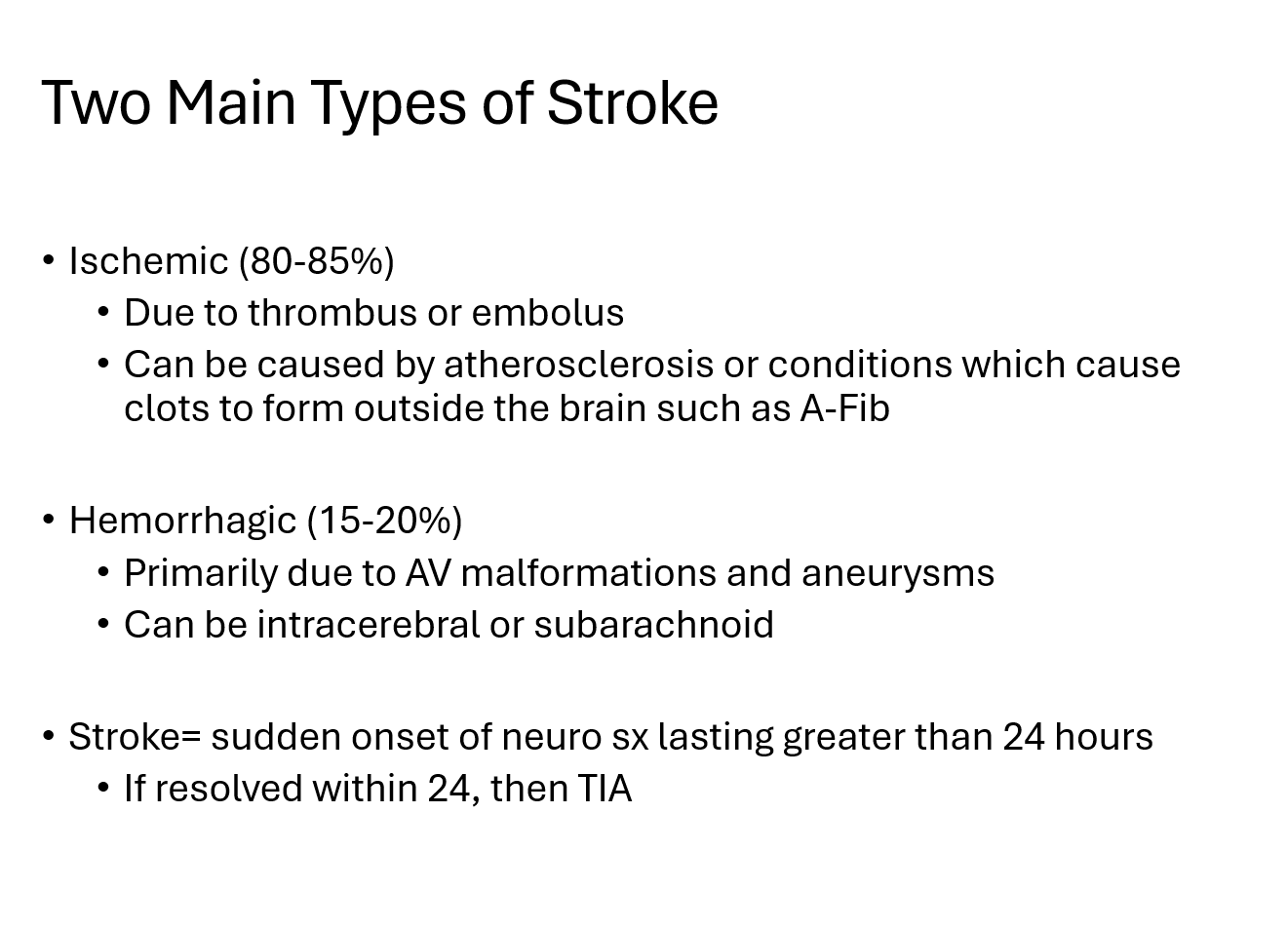
Sudden onset of neuro sx lasting greater than 24 hours?
If resolved within 24 hours?
Stroke: 24+ hours
TIA = resolved within 24 hours
The main focus of acute management of a stroke=
Restore cerebral perfusion

Restoring cerebral perfusion is accomplished by? (x5)
Optimize BP
Provide supplemental Oxygen
Possible tPA/tNK
Meds
Possible surgery

Ischemic Penumbra
what is this
why is it important after a stroke
part of brain tissue that surrounds where stroke took place - has compromised blood flow that can be restored
so stroke stays contained to more focal area
tPA/tNK
for what type of stroke only?
Must be giving within how many hours after stroke?
Ischemic stroke
Why CT scan is done quickly
3 hours

Picture of stroke type - extremities

MCA symptoms
Weakness & sensory loss:
Non-dominant:
Dominant:
Inferior branch:
Contralateral wkness/sensory loss: Face & arm
Non-dominant: neglect & perceptual deficits
Dominant: aphasia, acalculia (math), agraphia (writting)
Inferior branch: homo, visual field cut, loss of conjugate gaze

MCA stroke - if inferior branch, then what symptoms?
Homo, visual field cut, loss of conjugate gaze

ACA supplies
Frontal lobe & medial motor cortex

ACA symptoms
Contralateral wkness/sensory: Leg
Incontinence, apraxia
Frontal sign: abulia (reduced initiation/motivation)

PCA - what lobe
Occipital, some temporal
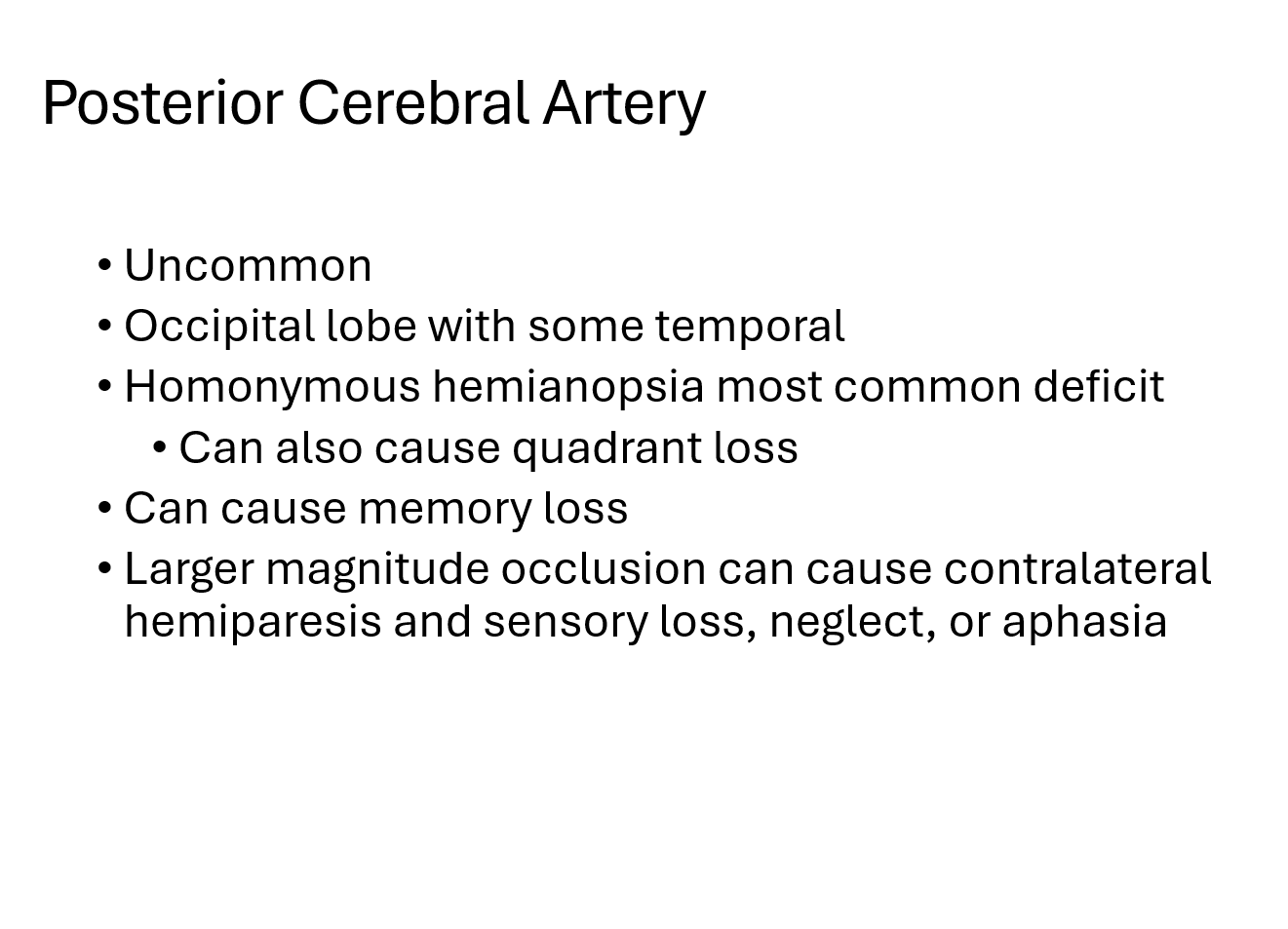
PCA - symptoms
Most common
Other sx
Large magnitude occlusion
Most common: homo
Also quadrant
Memory loss
Larger magnitude occlusion: contra hemi/sensory loss, neglect, aphasia

PCA - larger magnitude occlusion
Contra hemi/sensory loss
Neglect, aphasia
Lacunar stroke
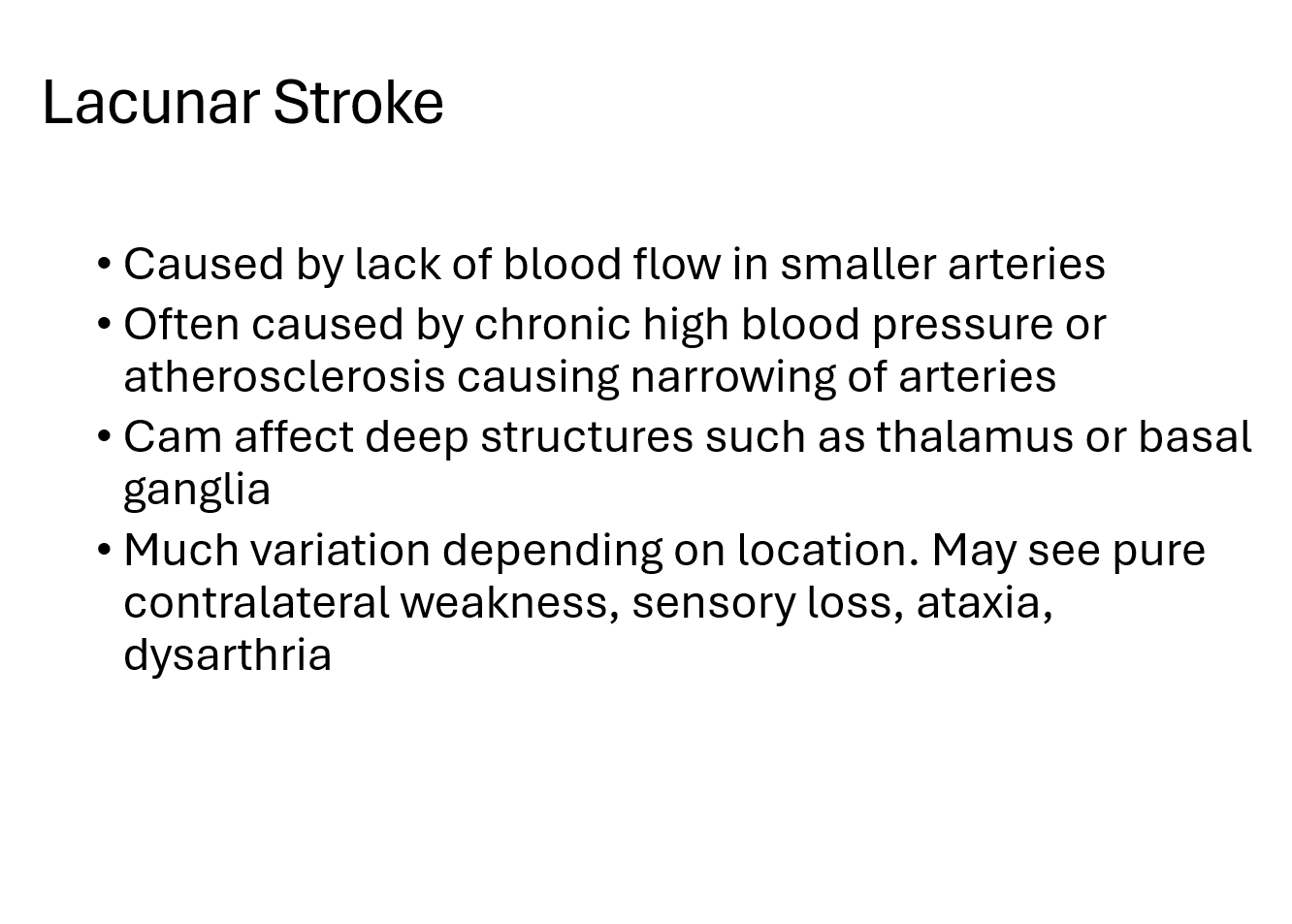
Caused by lack of blood flow in ___
Often caused by what conditions?
smaller arteries
Chronic high BP or atherosclerosis (narrowing of aa)

Lacunar stroke
Affects what structures?
May see?
Deep structures - thalamus, BG
Pure C/L weakness, sensory loss, ataxia, dysarthria
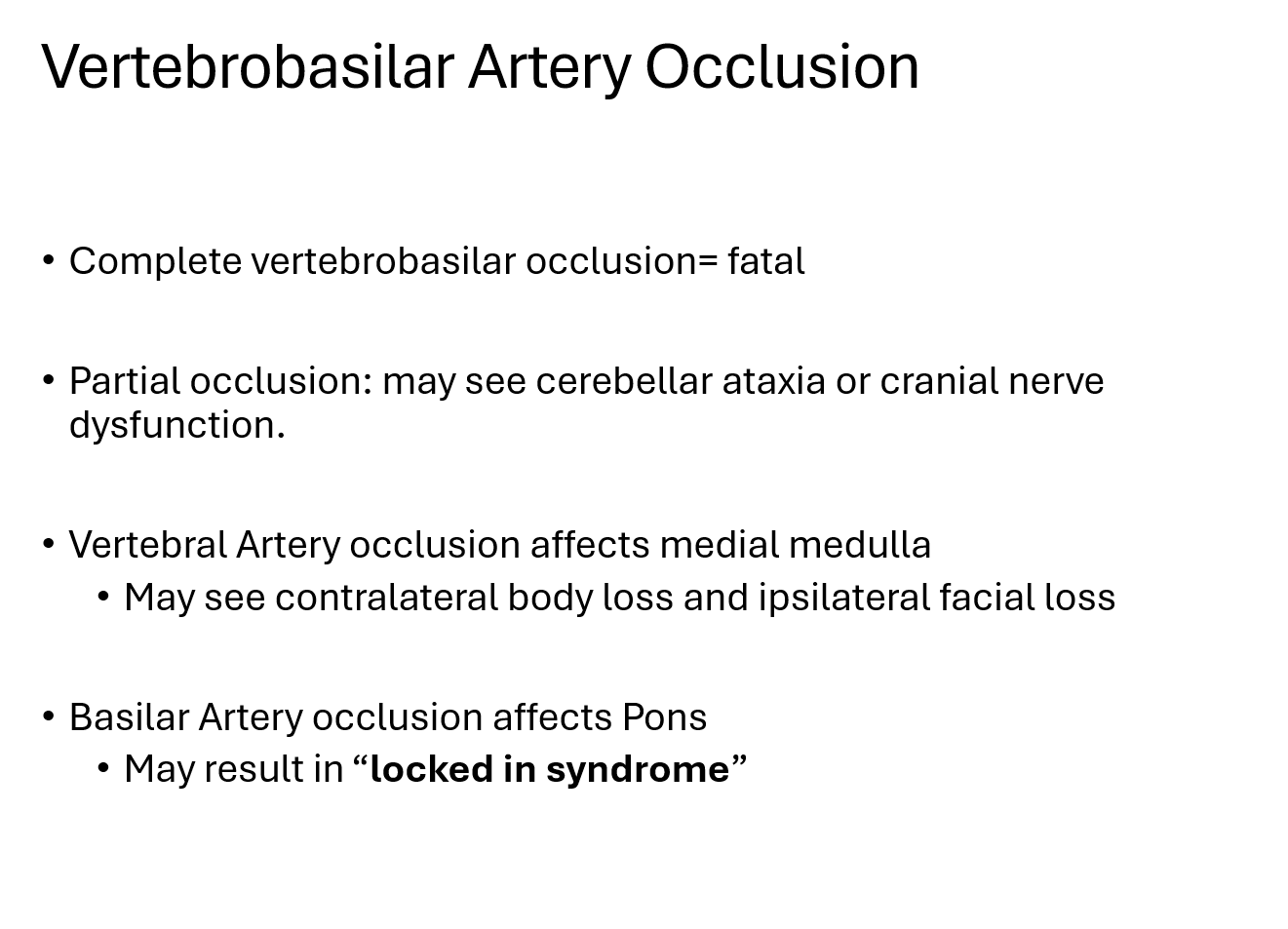
Complete vertebrobasilar occlusion=
Fatal
Vertebrobasilar artery occlusion - what will you see with partial occlusion?
Cerebellar ataxia or CN dysfunction

Vertebrobasilar artery occlusion affects what structures? symptoms?
Medial medulla
I/L: facial loss
C/L body loss
Basilar artery occlusion
Affects what structure?
May result in?
Pons
Locked in Syndrome

PICA stroke affects what structure?
Lateral medulla - Wallenberg Syndrome

PICA - symptoms
Ataxia, nystagmus, n&v, vertigo (common BS stroke sx)
Horner’s Syndrome
Impaired saccades
Dysphagia
Dysarthria (IX, X, XII)
C/L body weakness

is PICA or AICA more common
PICA

AICA stroke - affects which structure? symptoms?
Lateral pontine/pons
I/L: facial weakness (CN VII?), deafness (CN VIII), ataxia
C/L body weakness
Nystagmus, vertigo, n&v

Acute vs subacute vs chronic
Acute: onset - 7d
Subacute: 1w - 4m
Chronic: 4+m
Physical Therapy Examination of Direct Impairments

PT Examination of the Patient with Stroke Begins with Observation
Level of __, __, and possible __
Walking __ into room, preferably on what side?
Patients __ in bed or WC
__ arrangement

Continued Elements of PT Examination- Objective Measures
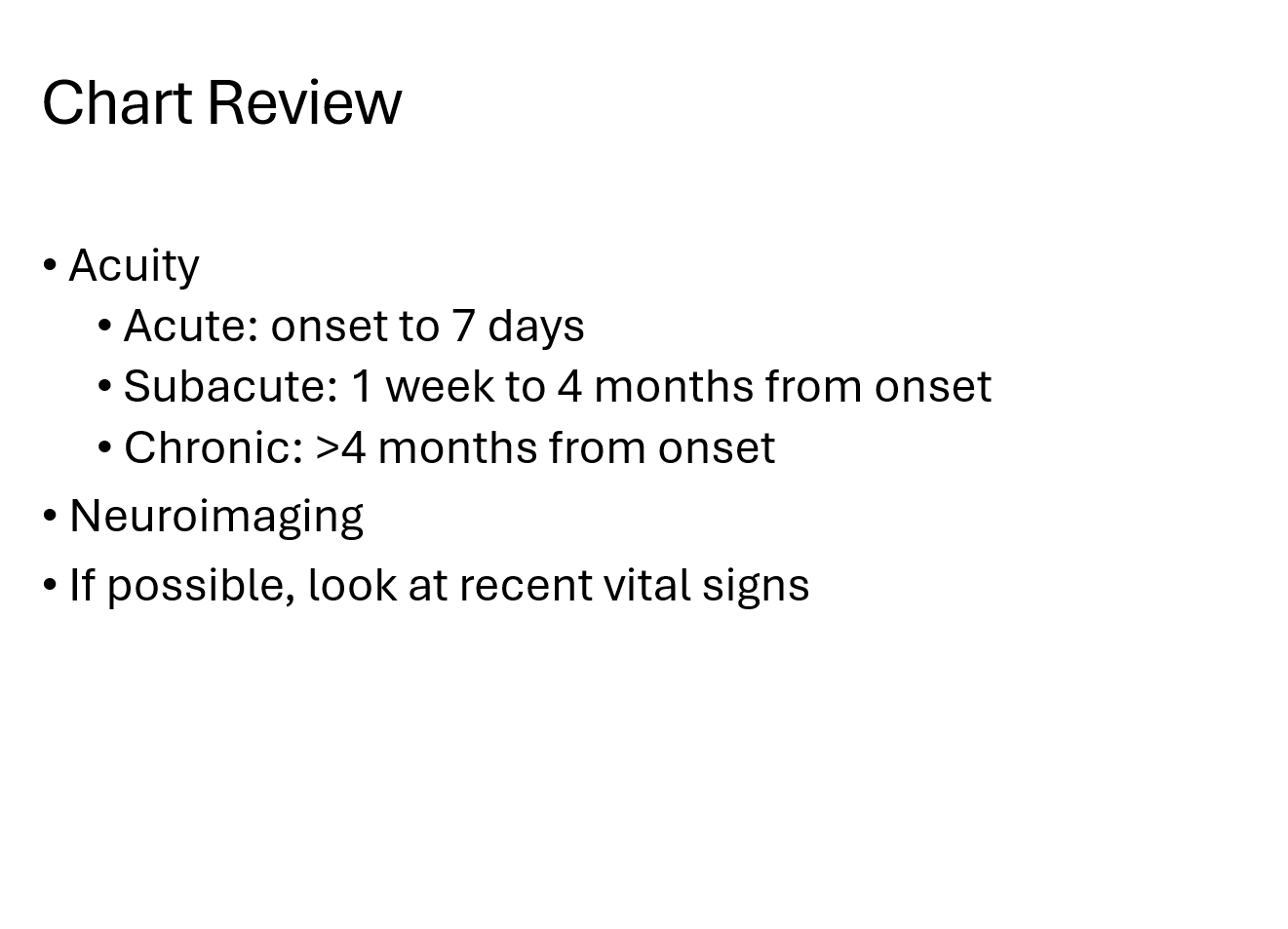
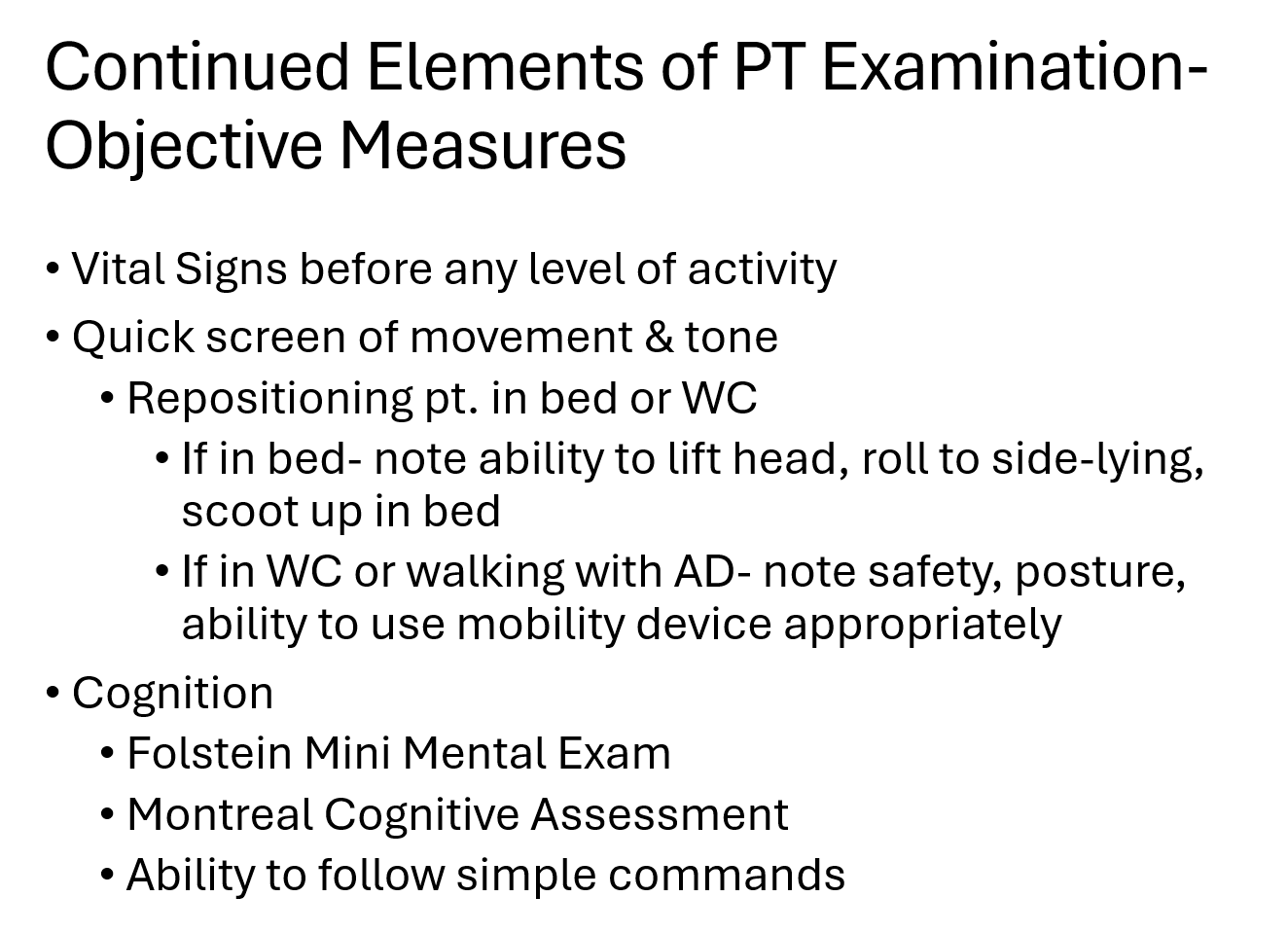
__ before any level of activity
Quick screen of movement & tone
If in bed - note?
If in WC or walking w/ AD - note?
Continued Elements of PT Examination- Objective Measures
Cognition
Mini Mental
Montreal
Ability to follow simple commands
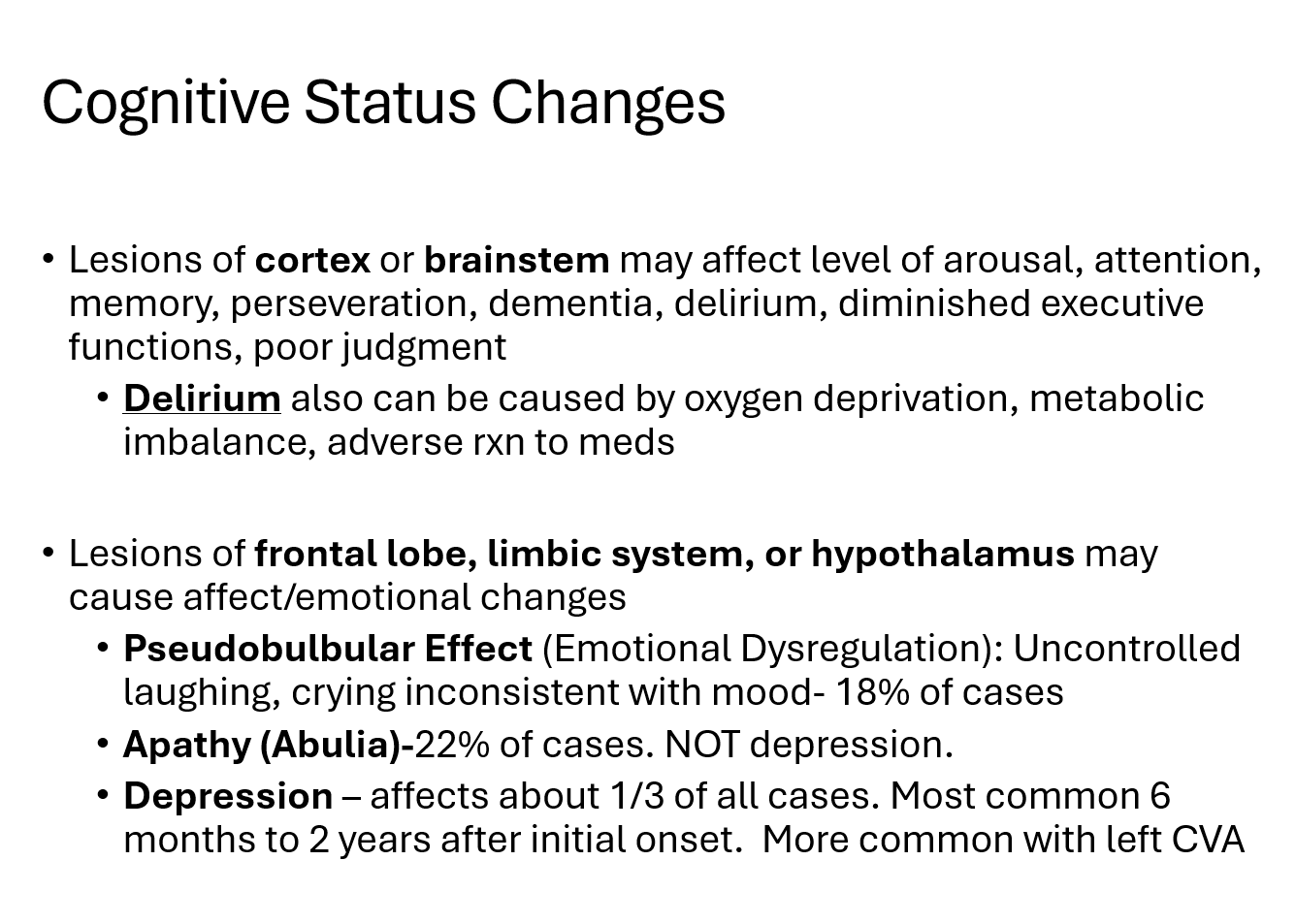
Lesions of ___or ___may affect level of arousal, attention, memory, perseveration, dementia, delirium, diminished executive functions, poor judgment
Cortex or BS

Delirium can also be caused by?
Oxygen deprivation
Metabolic imabalnce
Adverse rxn to meds
What lesions may cause affect/emotional changes
Frontal lobe, limbic sx, hypothalamus
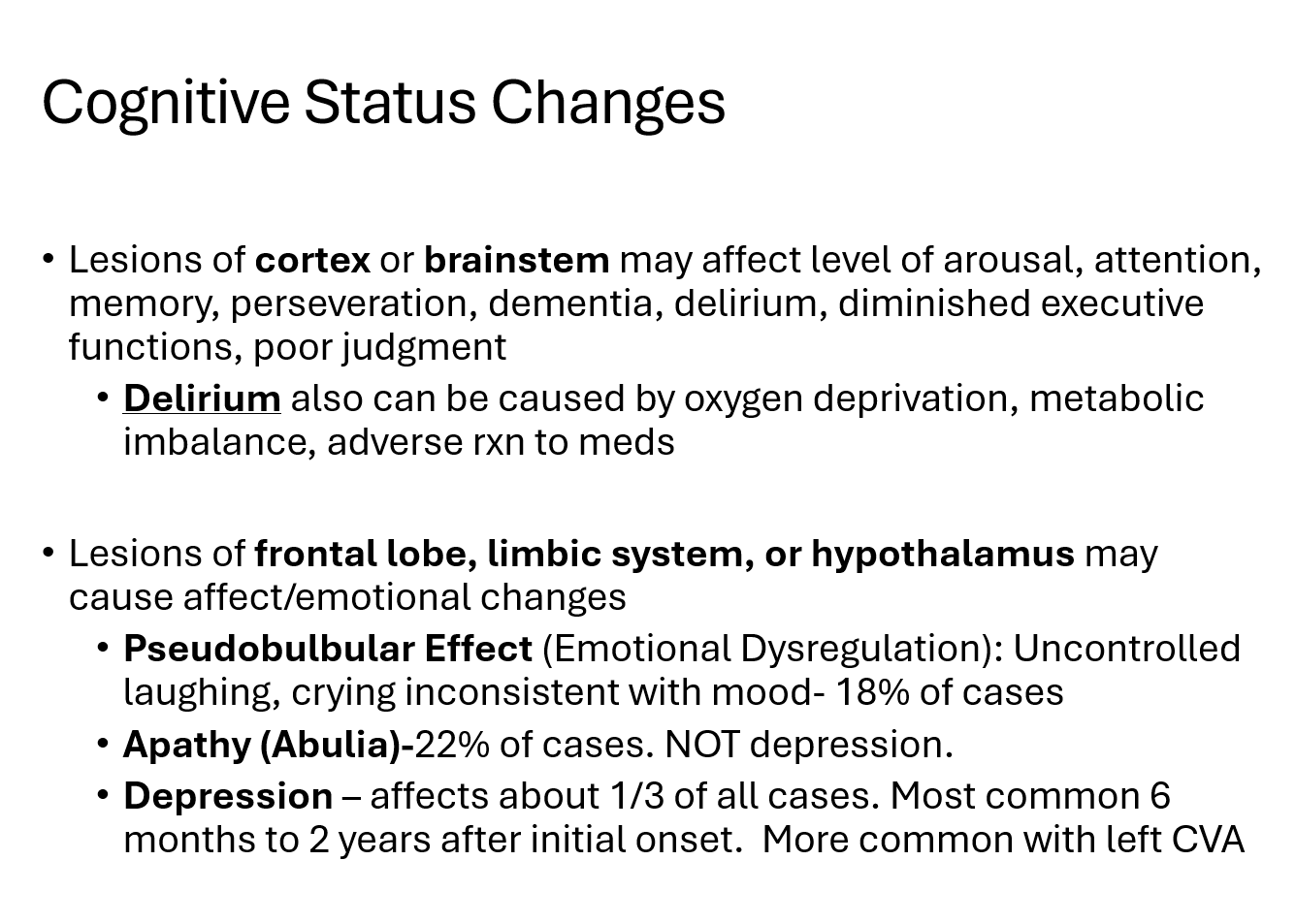
Lesion of Frontal lobe, limbic sx, hypothalamus - Results in what 3 things?
Pseudobulbar effect, apathy, depression

Uncontrolled laughing, crying inconsistent with mood
Pseudobulbar effect
Depression: most common how long after initial onset? and with which side CVA?
Lesion of frontal lobe, limbic sx, hypothalamus
6 months - 2 years after initial onset
Left CVA - dominant

Apathy is also called
Abulia
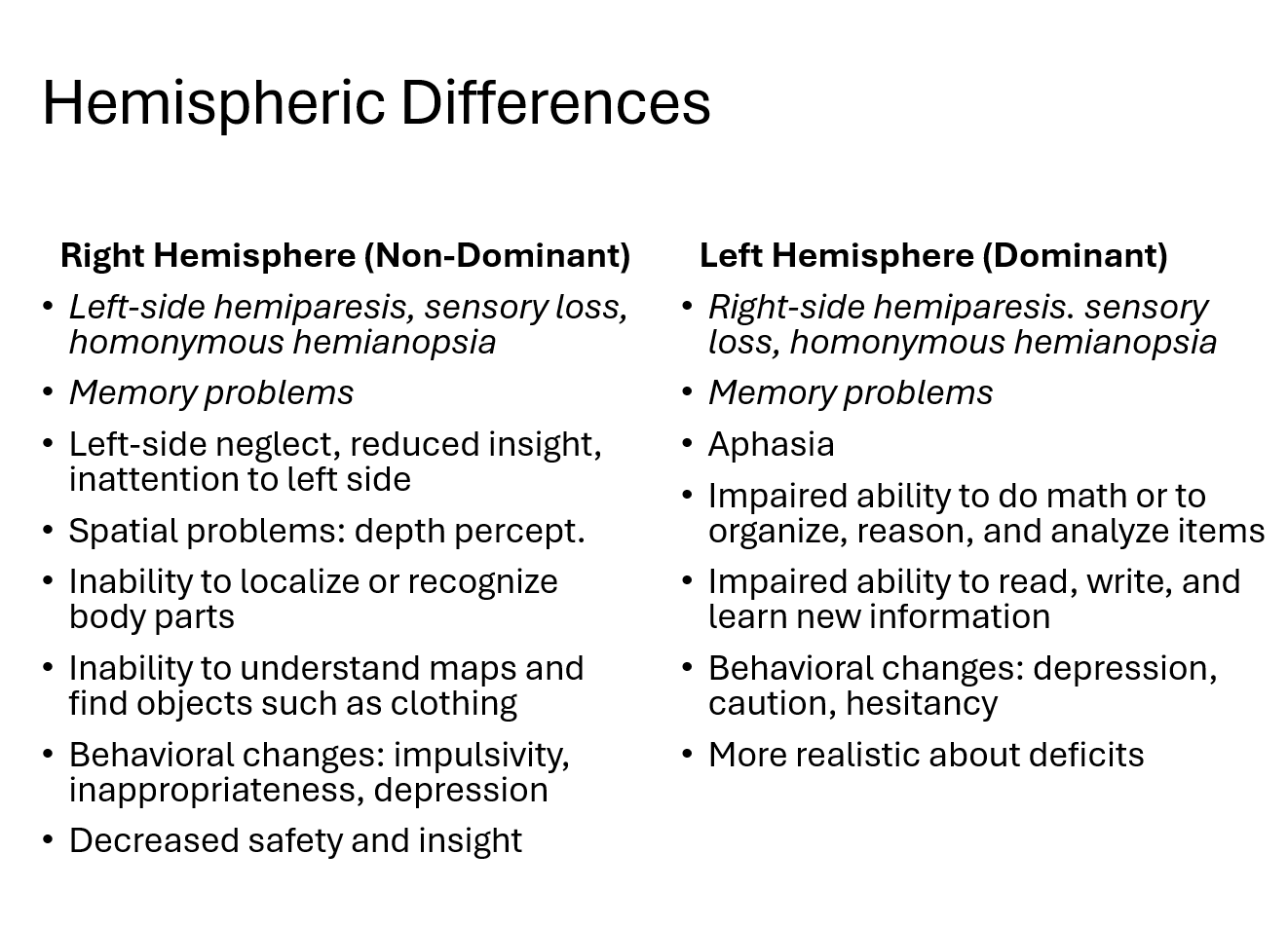
Symptoms that occur with damage to either hemisphere
•Left-side hemiparesis, sensory loss, homonymous hemianopsia
•Memory problems
Dominant hemisphere
__
Impaired ability to?
Impaired ability to?
Behavioral changes?
Aphasia
Impaired ability to do math or to organize, reason, and analyze items
Impaired ability to read, write, and learn new information
Behavioral changes: depression, caution, hesitancy
More realistic about deficits

Non-dominant hemisphere
C/L neglect, reduced insight, inattention to left side
Spatial problems: depth percept.
Inability to localize or recognize body parts
Inability to understand maps and find objects such as clothing
Behavioral changes: impulsivity, inappropriateness, depression
Decreased safety and insight

Perceptual deficits include?
Body scheme
Body image
Controversive pushing
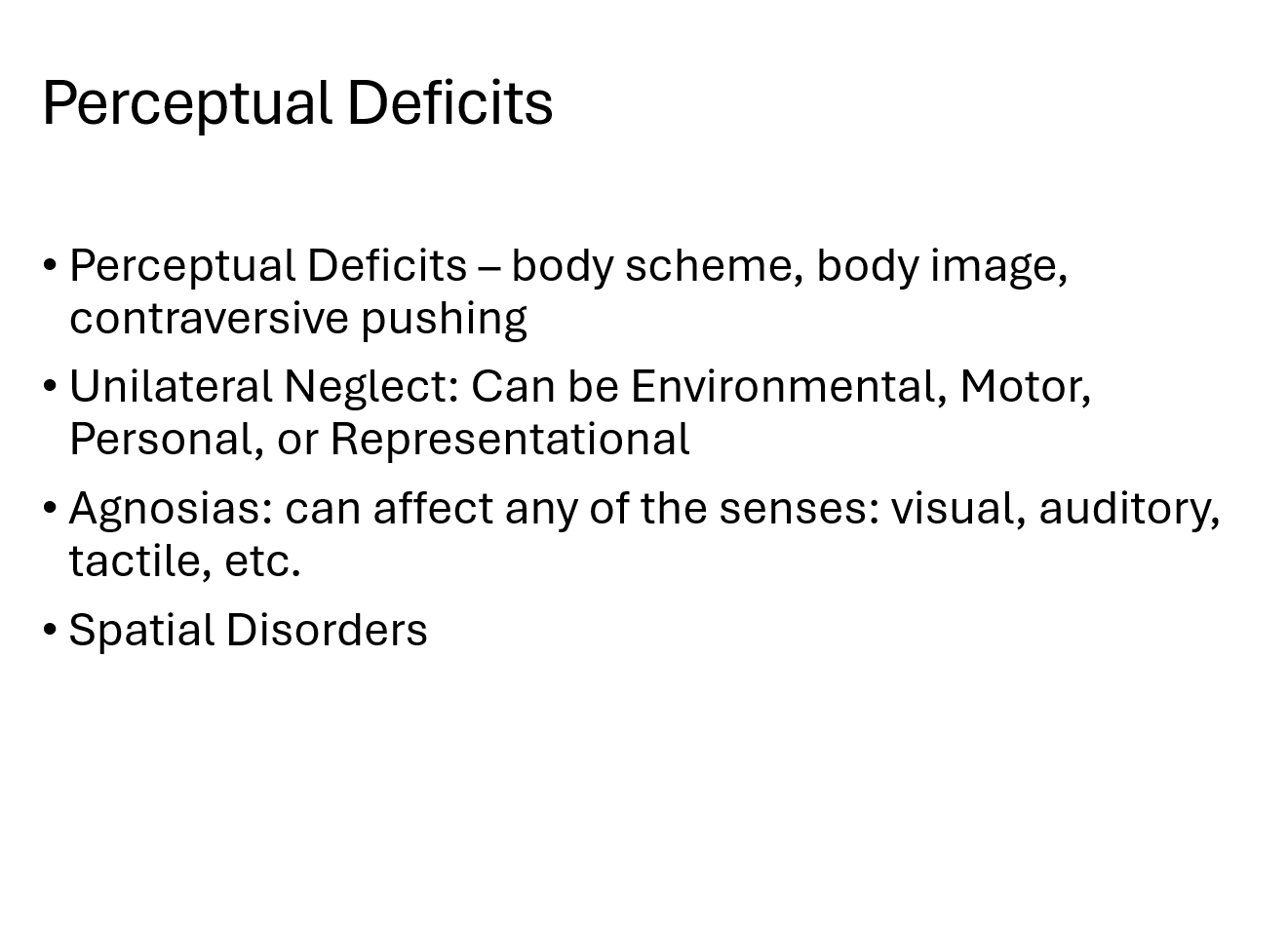
Unilateral neglect can be?
Environmental, Motor, Personal, or Representational

can affect any of the senses: visual, auditory, tactile, etc.

Cranial nerve assessment
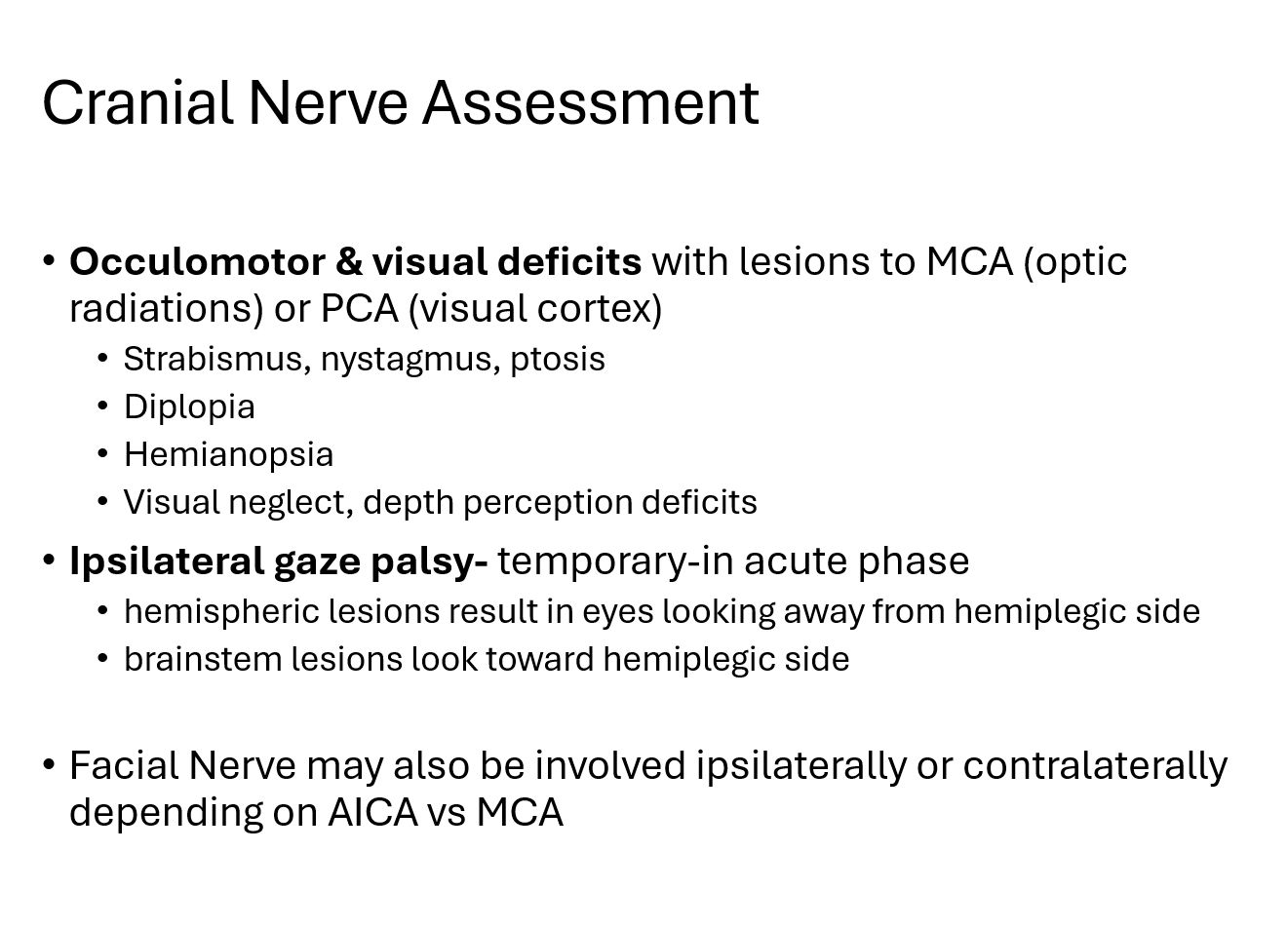
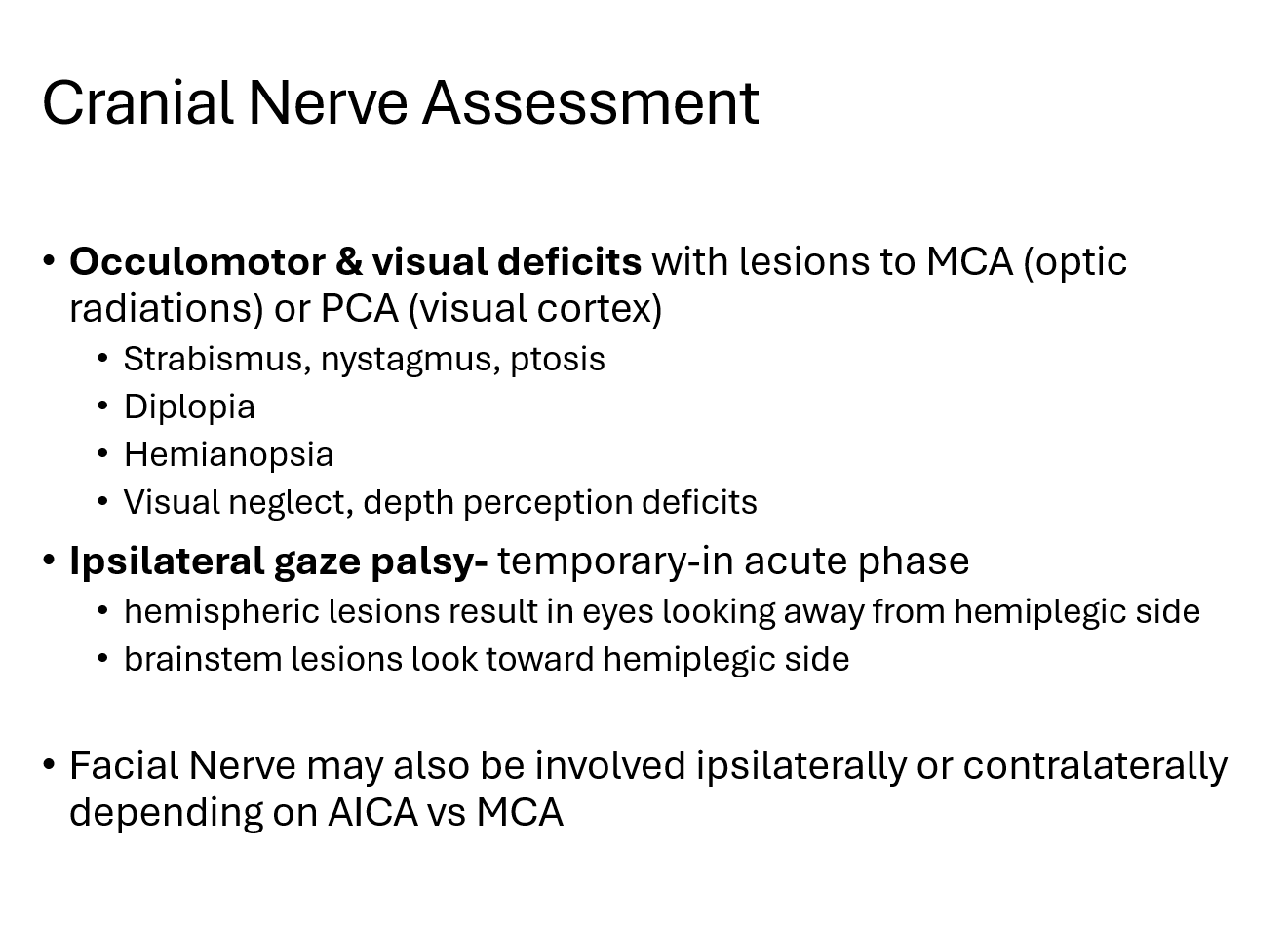
Oculomotor & visual deficits
which strokes?
symptoms?
MCA (optic radiation)
PCA (visual cortex)
Strabismus, nystagmus, ptosis
Diplopia, hemianopsias
Visual neglect, depth perception defects
Cranial nerve assessment
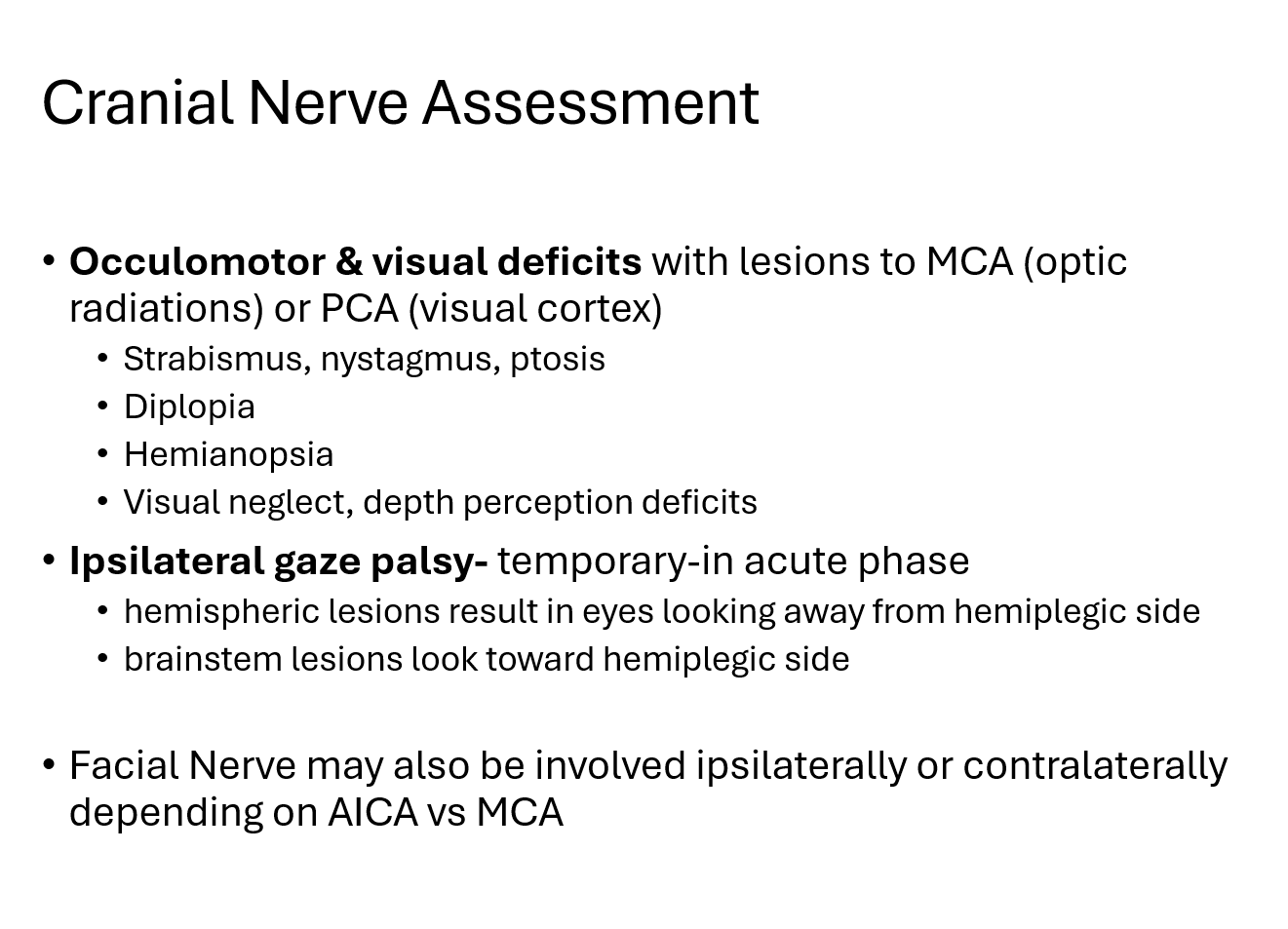
Ipsilateral gaze palsy
Is it permanent?
Which phase?
Which lesion - looks away from hemiplegic side
Which lesion - looks toward from hemiplegic side
Ipsilateral gaze palsy: patient cannot voluntarily move both eyes toward one side.
Temporary
Acute phase
Lesion Location | Eyes Look |
|---|---|
Cerebral hemisphere (MCA) | Toward lesion, away from weakness |
Brainstem (pons) | Toward weakness, away from lesion |
Cranial nerve assessment
Facial nerve - C/L or I/L? which strokes?
Either
AICA or MCA
AICA - I/L facial paralysis (entire face)
MCA - C/L lower facial paralysis
Speech & communication disorders include?
Aphasia - Brocas, Wernick’s, global
Dyarthria - motor
Is language affected with dominant or non-dominant lesions
Dominant lesion
acquired communication disorder caused by brain damage with impairment of comprehension, formulation, or use
Aphasia

Motor component of speech. May affect respiration, articulation, phonation, resonance, or sensory feedback
Dysarthria

Which artery is not paired?
Basilar - lesion here is fatal, lose all blood flow, breathing
Swallowing disorders - what cranial nerves?
CN 5, 7, 9, 10, 12

Swallowing disorders occur with lesions where?
Lesion of hemisphere or BS
Dysphagia is?
Delayed swallow reflexes
Reduced pharyngeal peristalsis
Reduced lingual control
penetration of food, liquid or saliva into airway. Poor coordination between eating and breathing
Aspiration

What should be screened first?
Cognition & communication
Is sensation usually impaired or absent on hemiplegic side?
Just impaired
Rarely absent
Most sensory impairments seen in?
Touch
Proprioception
Vibration
Sharp/dull
Look at protective sensation with?
Diabetes (DM) or PVD (peripheral vascular disorder)
Lesion location for sensory loss
Localized loss?
Diffuse loss?
Localized - cortical
Diffuse - thalamus

Pain - DIRECT impairments
Called?
Occurs when what structure is affected?
Triggered by?
Central Post Stroke Syndrome
Thalamus affected
Extreme neurogenic pain
Triggered by - touch, pinprick, temp change, loud noise, bright lights
Can be chronic and debilitating

Pain - indirect
From?
Muscle imbalance
Tone or weakness
CPRS
Knee hyperextension
Shoulder subluxation
Effects of immobility
Gross motor
Partial?
Complete?
Altered __ patterns
Changes in tone - predictable?
Abnormal __
__ deficits

Motor impairments in stroke
80% unable to generate normal levels of muscular __, __, or __ to initiate or control functional movements or maintain postures
What muscles are most affected? - loss of?
Easily __
Can be __ issue
Motor planning deficits - called?
Move in __ pattern

found in 80-90% of all patients with CVA ?
Paresis - weakness (even on uninvolved side)
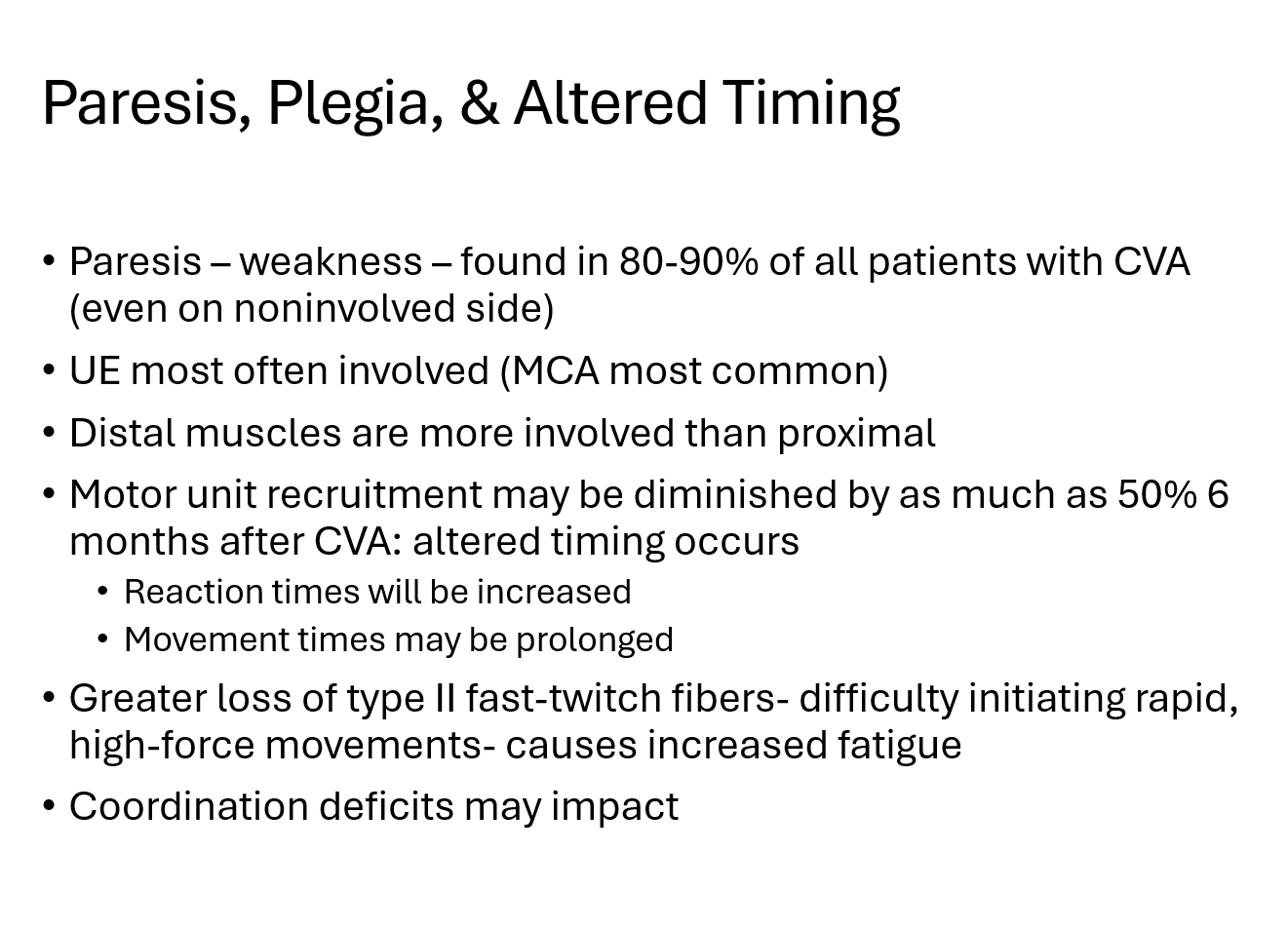
Paresis, Plegia, & Altered Timing - UE or LE more common? distal or proximal muscles?
UE, distal
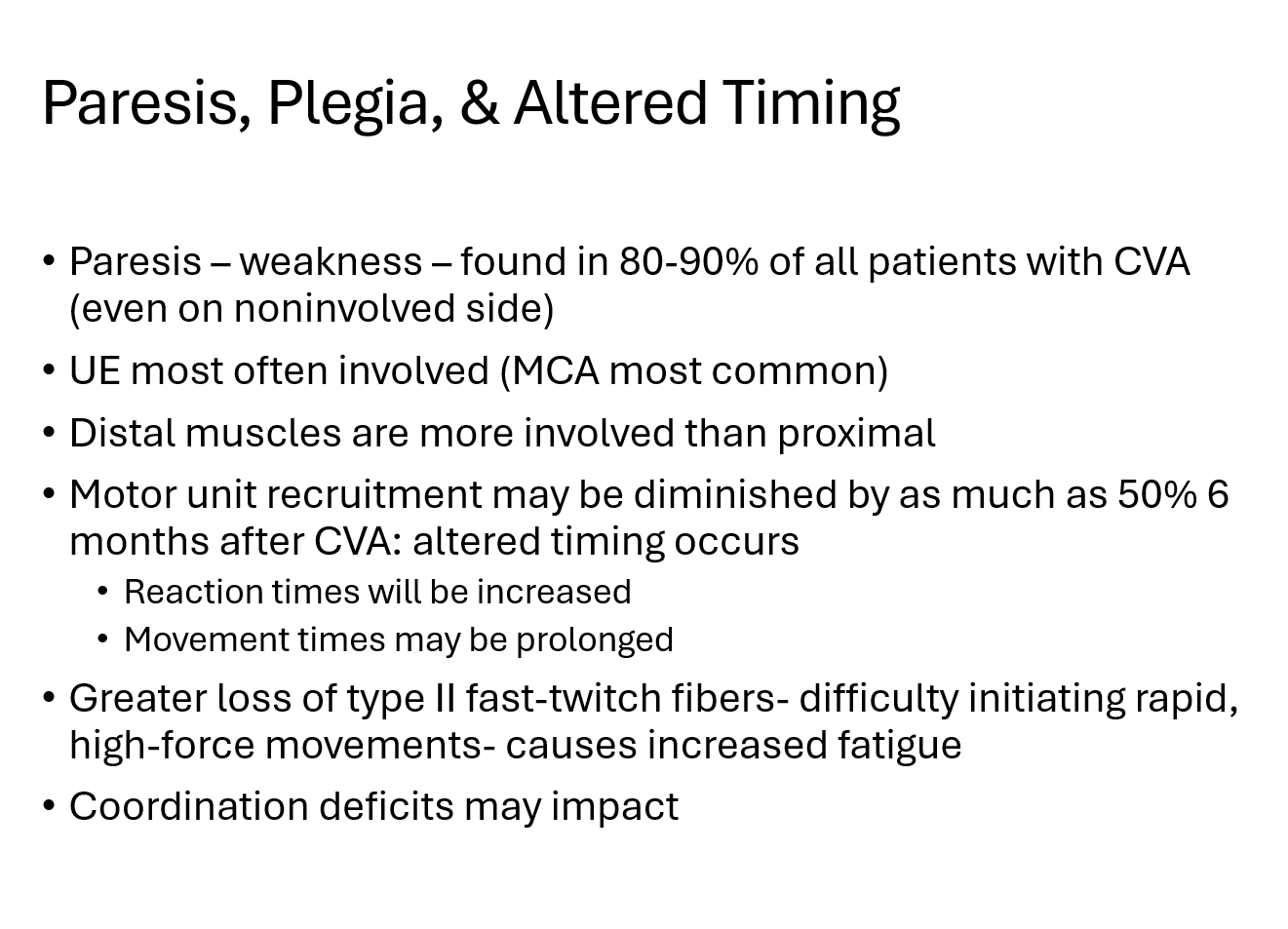
Motor unit recruitment may be diminished by as much as 50% 6 months after CVA - altered __ occurs
__ increased
__ prolonged
Altered timing
Increased reaction times
Mvmt times prolonged

Greater loss of type I or II fibers?
Fast or slow twitch?
Difficulty initiating __, __ movements
Causes increased __
Type II - Fast twitch
rapid, high force
increased fatigue

Tone changes
First stage
When?
Lasts?
Second stage?
In which muscles?
Last stage?
1st
Flaccidity (hypotonicity)
Immediately following acute episode
Transient - lasts few days/weeks
2nd
Spasticity
Primarily in anti-gravity muscles
Hyperreflexia & synergies
3rd
Return of controlled voluntary mvmt
Disappearance of spasticity/hyperreflexia

UE flexor synergy

UE extension synergy

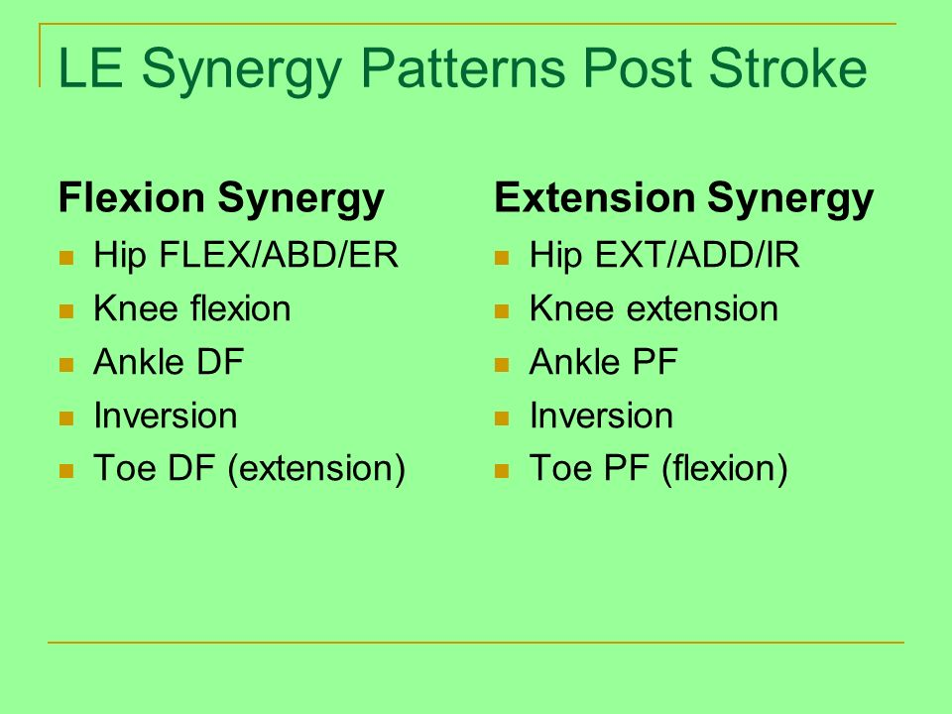
LE flexor synergy

LE extension synergy
Abnormal reflexes
1st:
middle to later stages:

unintentional involved limb mvmt resulting from active motion in another body part
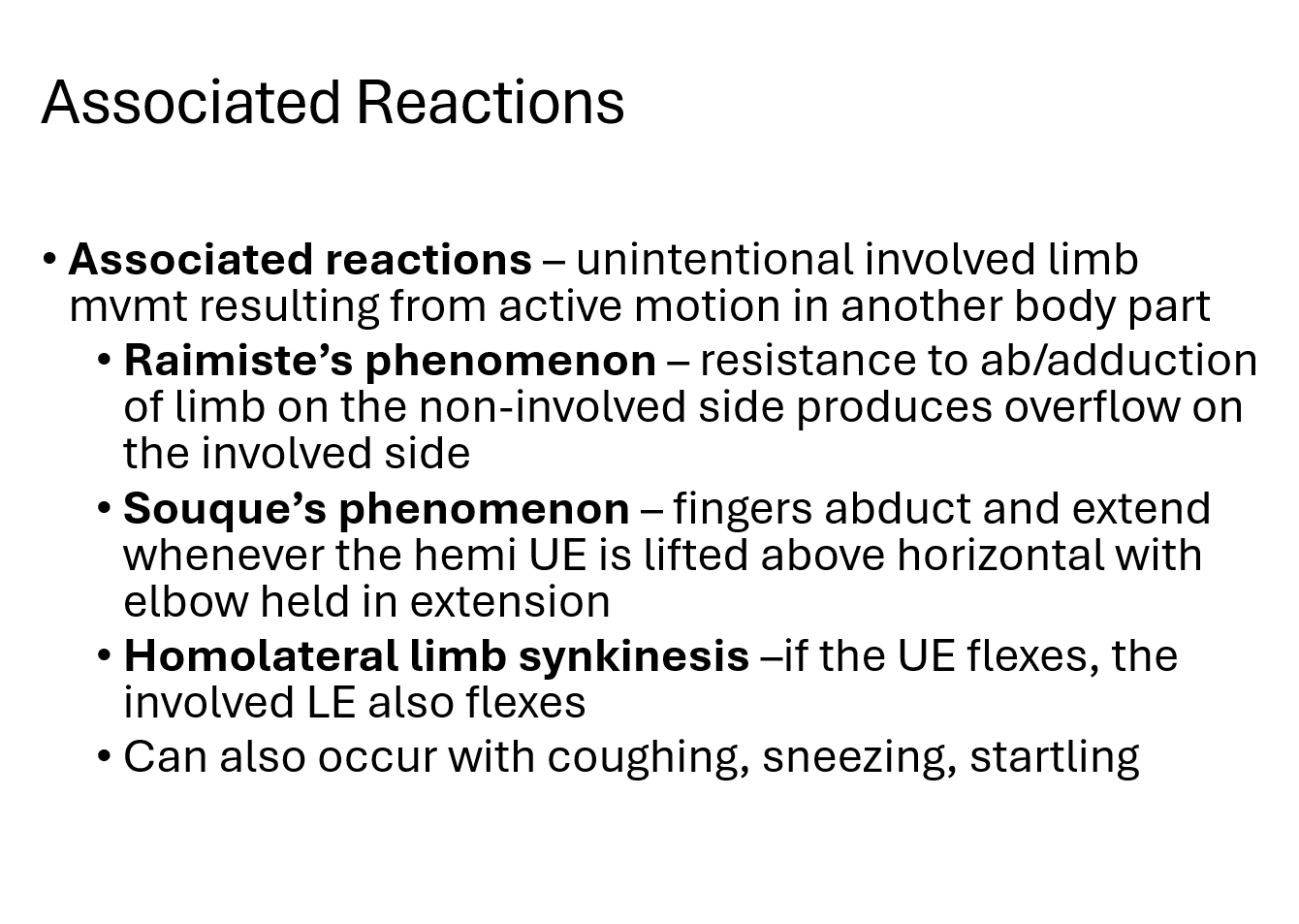
resistance to ab/adduction of limb on the non-involved side produces overflow on the involved side
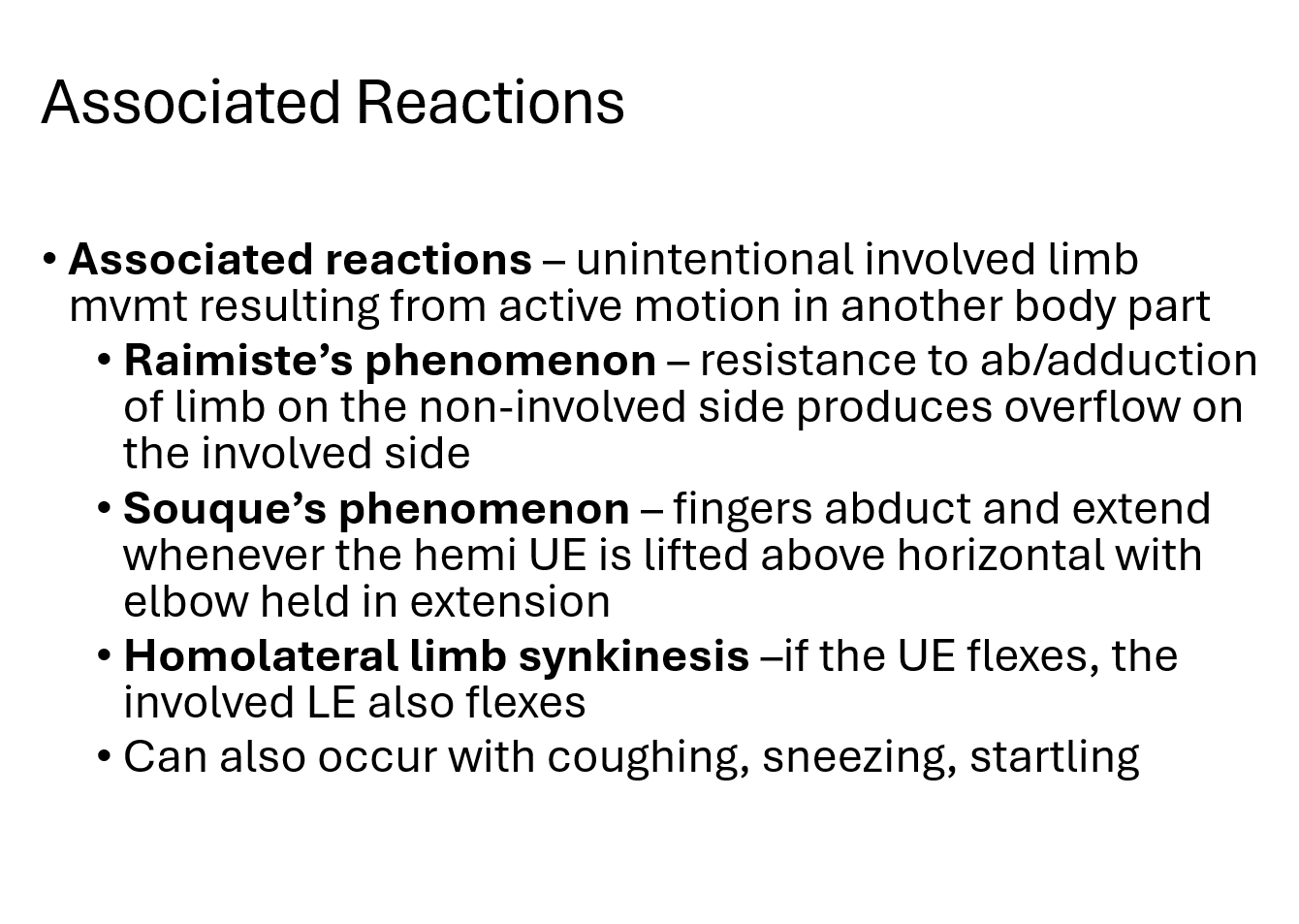
fingers abduct and extend whenever the hemi UE is lifted above horizontal with elbow held in extension

if the UE flexes, the involved LE also flexes

Motor apraxia - occurs with damage to what lobes? more common with damage to which hemisphere?

inability to conceptualize, plan, and execute

brain can not send motor command to mimic action or follow a command; can still do things automatically

inability to sustain a motor behavior or posture

Motor impersistence occurs with damage to which hemisphere?

Often will maintain weight shift to which side?
Most often fall to which side?

contraversive pusher syndrome

Many will demonstrate what in standing? from abnormal?

Multiple factors contribute to a loss of functional postural control after CVA
Delayed
Delayed
Loss of
Problems with

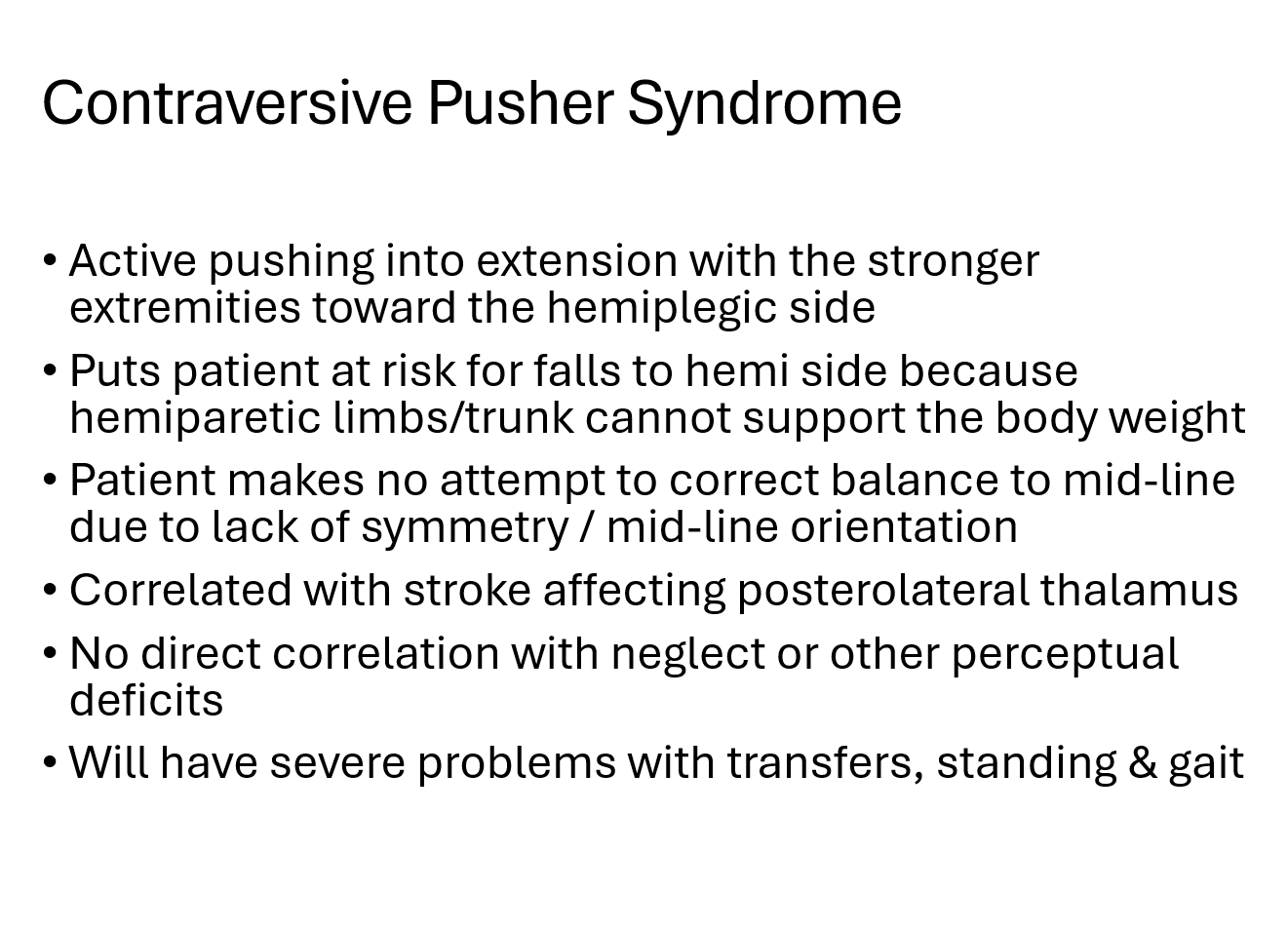
Contraversive Pusher syndrome
Active pushing into __ with the stronger extremities toward the __ side
Puts patient at risk for falls to which side?
Do they try to correct it?

Contraversive Pusher syndrome
Corrected with stroke affected ?
Will have severe problems with?
Gait analysis
Begin with?
Obtain quantitative measures of?

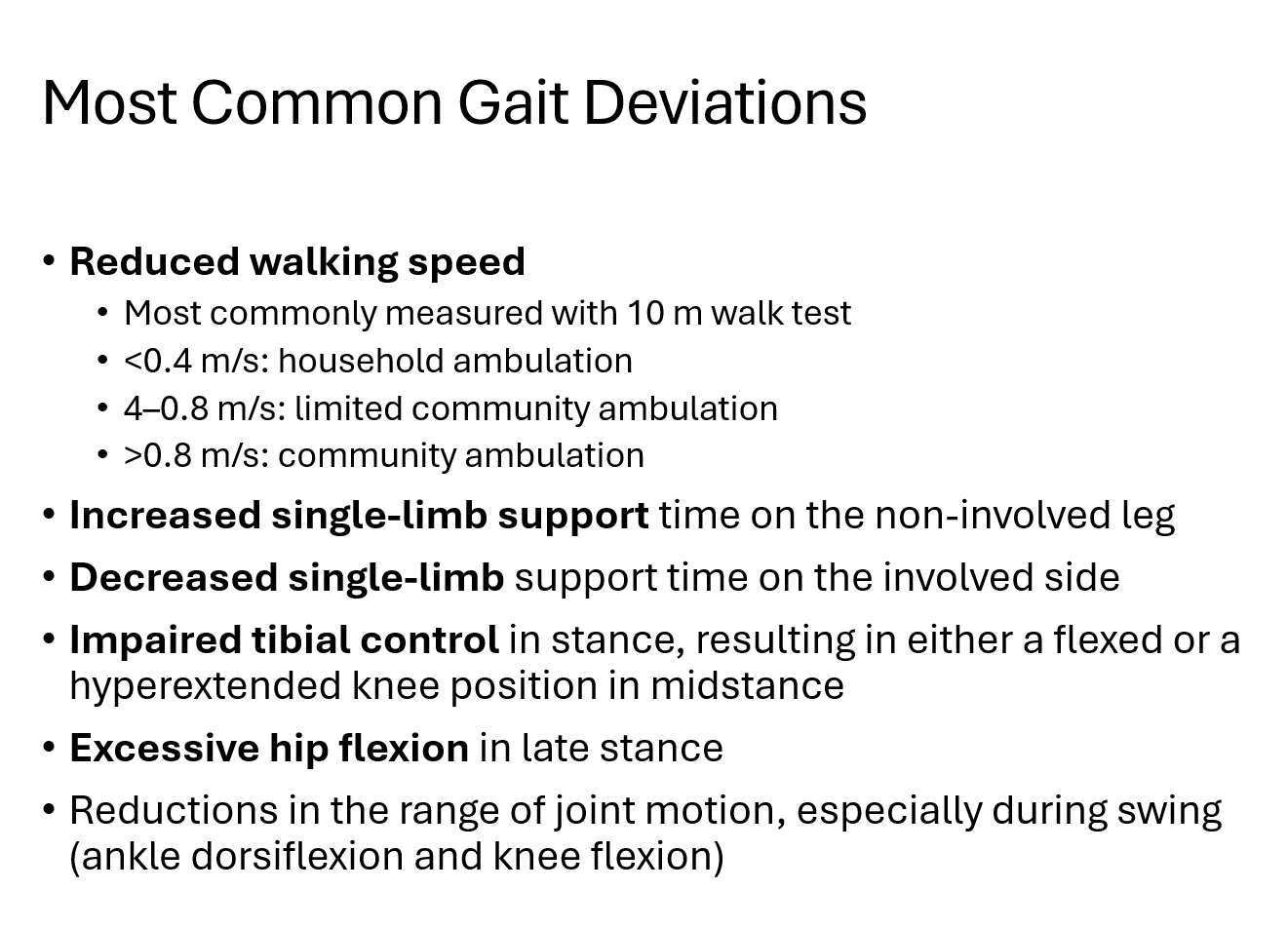
Reduced walking speed
Household ambulation:
Limited community ambulation:
Community ambulation:

Increased SLS support on which side?
Decreased SLS support on which side?
Impaired __ control in stance, resulting in?
Excessive __ in late stance
Decreased ROM in which phase?
Assessment of Physical Performance (FMA) – based on Brunnstrom’s 6 stages of recovery
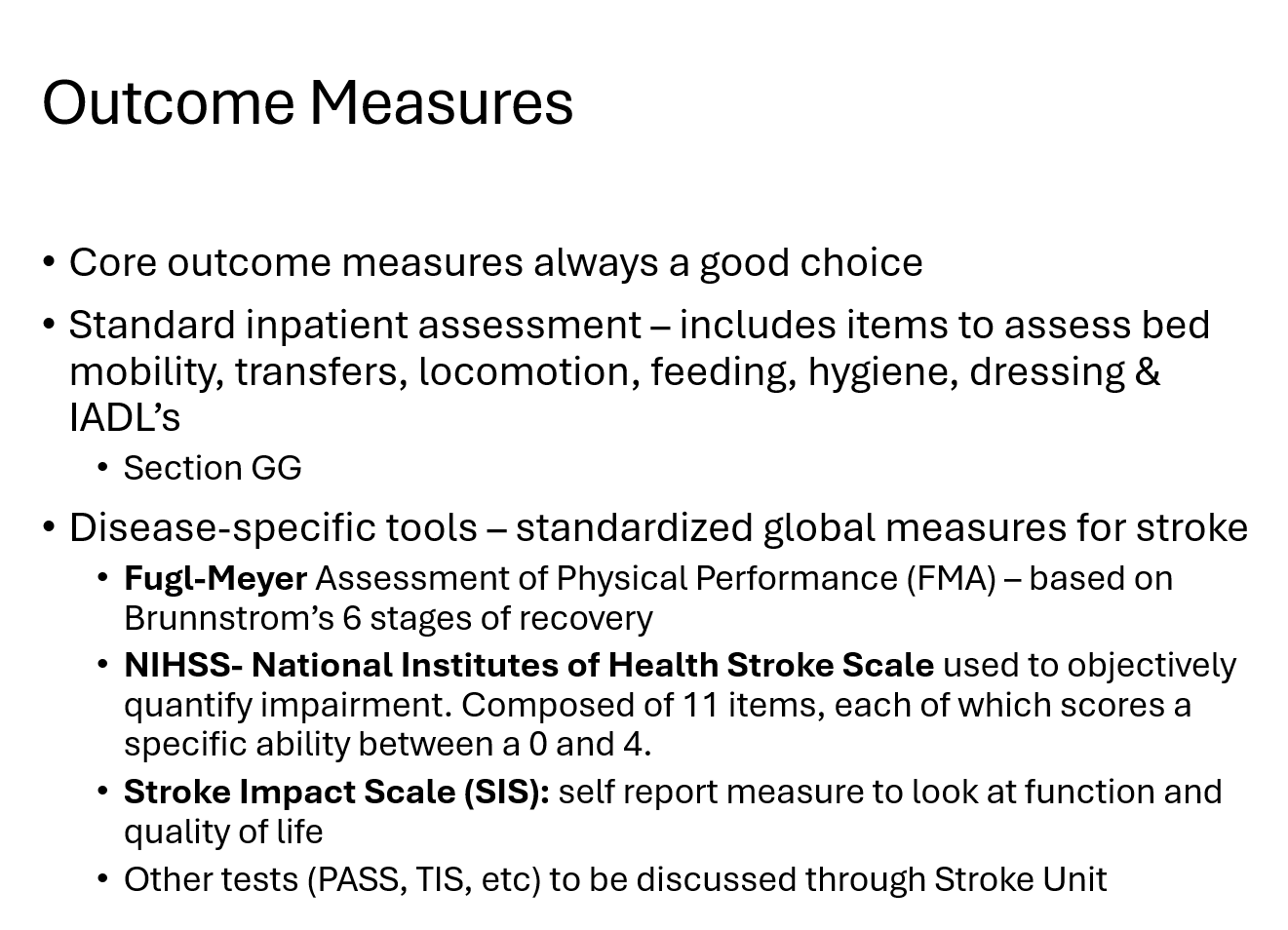
used to objectively quantify impairment. Composed of 11 items, each of which scores a specific ability between a 0 and 4.

self report measure to look at function and quality of life

UE function - test

Other components to consider in the exam

Aerobic Capacity and Endurance
