Chapter 20: Population genetics
 Call Kai
 Learn
 Practice Test
 Spaced Repetition
 Match
 Flashcards
 Knowt Play
1/27

There's no tags or description
Looks like no tags are added yet.
28 Terms
population genetics is…
an extension of Mendel’s basic principles
a tool to learn about biological function, evolutionary mechanisms, and human history
population
a group of interbreeding individuals of a single species living in the same time and place
gene pool
the total of all alleles carried in all members of a population
sample
a number of individuals used to make inferences about the entire population
Phenotypic frequency
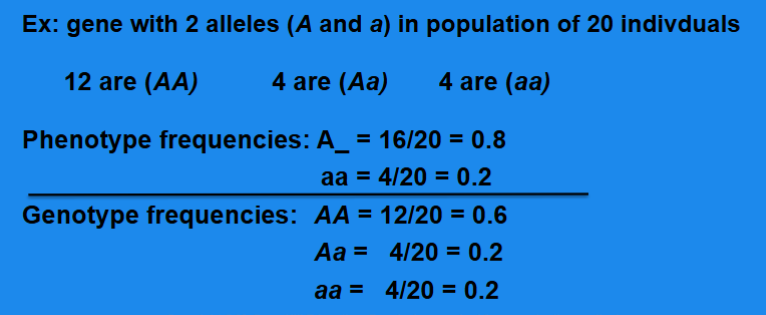
proportion of individuals in a population that have a particular phenotype
genotypic frequency
proportion of individuals in a population that carry a particular genotype

allelic frequency
proportion of gene copies in a population that are of a given allele type

Hardy-Weinberg Equilibrium
allel and genotype frequencies will not change unless one (or more) of the above conditions is violated
based off five simplifying assumptions:
population has infinite number of individuals
individuals mate at random
no new mutations appear
no migration into or out of the population
genotypes have no affect on ability to survive and transmit alleles to the next generation
predicting genotype frequencies in the next generation
sexually reproducing diploid organisms with equal segregation and random mating have two important outcomes:
allele frequencies should be the same in adults as in gametes
allele frequencies in gametes can be used to calculate expected genotype frequencies in zygotes of the next generation
equations for Hardy-Weinberg
p2 + 2pq + q2 = 1
p + q = 1
q = frequency (A)
p = frequency (a)
how many generations does it take to reshuffle normal genes into hardy-weinberg equilibrium?
one generation. this is because although allele frequency remains constant, the genotype frequency changes

how many generations does it take to reshuffle sex-linked genes into Hardy-Weinberg equilibrium?
several generations, usually around 6
Examples of violations to HWE
alleles that code for eye color. Brown is most common but blue is prevalent in places like Europe
what is Hardy-Weinberg useful in determining?
it is useful for estimating population changes through a few generations. However, natural populations rarely meet the assumptions of HW.
Monte Carlo simulation results
computer program that models possible outcomes of randomly chosen matings over a designated number of generations
starts with defined number of individuals in the population which are homozygous or heterozygous
mating pairs are chosen through random number generating program
genotypes of offspring at each generation are based on probabilities
multiple independent simulations are performed
each simulation represents a possible pathway of genetic drift
the results showed that THE LARGER THE POPULATION SIZE, THE MORE STABILITY IT HAS

Fixation
when only one allele in a population has survived and all individuals are homozygous for that allele. This means that no further changes can occur. populations with 2 alleles present at equal frequencies, median number of generations to fixation is roughly equal to the total number of gene copies in breeding individuals
founder effects
a few individuals separate from a larger population and establish a new population
population bottlenecks
large proportion of individuals die
mutation
variant DNA sequence in individual genome that was not present in either parent. there are 3 types:
deleterious
beneficial
neutral
deleterious mutation
disrupts important functions
beneficial mutation
provides selective advantages (not proven)
neutral mutation
no benefit or harm
molecular clock
mutations accumulate in populations at a fairly constant rate over time. The DNA differences between organisms can be used to estimate how long ago they shared a common ancestor
fitness
individual’s relative ability to survive and transmit its genes to the next generation. Cannot be measured in individuals in a population but can be measured by all the individuals with the same genotype in a population. Relies upon viability and reproductive success
natural selection
the process that progressively eliminates individuals whose fitness is lower. individuals whose fitness is higher parent the next generation. This occurs in natural populations, but it decreases genetic diversity
example of fitness of alternative genotypes in different environments
H. Sapiens in the evolutionary model. Exposure to UV rays from the sun affected vitamin D production and skin cancer incidence, but those closer to the equator evolved darker skin to protect against skin cancer, while lighter skin near the poles allowed enough UV to enter skin for adequate vitamin D production. This trait is determined by alleles at many genes
example of strong selection pressure
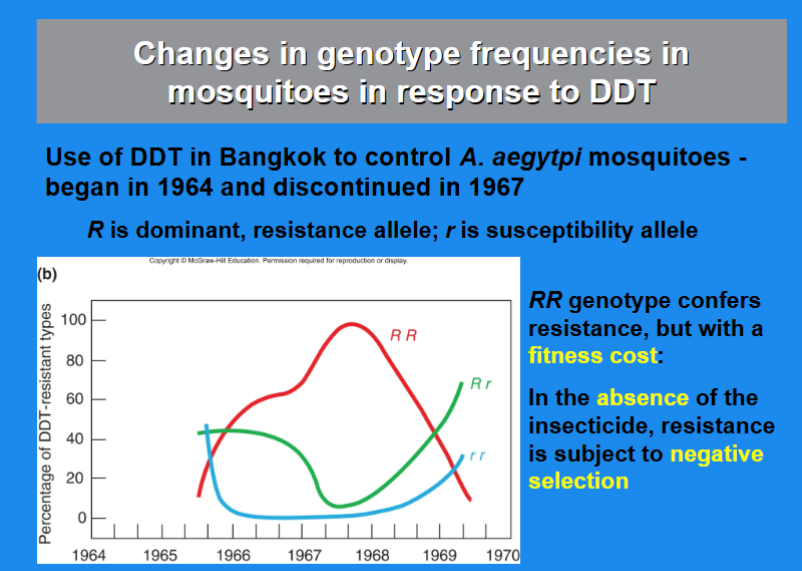
DDT and other insecticide use that affects the environment. Use of DDT shifted the advantage to insects with homozygous genotypes. However, over 450 species of mites and insects have become resistant
fitness cost and its relation to negative selection