Week 10: Attention and Memory
 Call Kai
 Learn
 Practice Test
 Spaced Repetition
 Match
 Flashcards
 Knowt Play
1/51

There's no tags or description
Looks like no tags are added yet.
52 Terms
What is Sensory Interaction?
What is the McGurk Effect?
Synesthesia?
Motion sickness?
Sensory interaction is when different senses work together to create an experience.
Example: Taste, smell, and texture combine to create the flavour of food.
Important examples:
McGurk Effect: Conflicting visual and auditory speech information causes us to mishear sounds.
Synesthesia: Stimulation of one sense produces an experience in another sense (e.g., hearing sounds and experiencing colours).
Motion sickness: Can occur when visual and bodily information conflict with information from the vestibular system (balance).
What is selective attention?
What is an example of a selective attention test?
What is the Cocktail party phenomenon?
Selective attention is when you are focusing on certain sensory information you ignore other stimuli.
Example: Concentrating on one conversation in a noisy room.
Selective attention test: People counting basketball passes may miss an unexpected event because their attention is focused elsewhere.
Cocktail Party Phenomenon: The ability to focus on one conversation in a noisy environment while still noticing personally meaningful information.
Demonstrates that the brain continues unconsciously monitoring some unattended information.
What is sensory adaptation?
What are saccades?
Sensory adaptation the decreasing of sensitivity to a stimulus after constant or prolonged exposure.
Example: Cold pool water feels less cold after a few minutes.
Purpose: Allows us to ignore constant stimuli and detect important environmental changes.
Saccades: Small, rapid eye movements that prevent visual images from continuously stimulating the same retinal receptors.
Without these movements, stationary images can begin to disappear from perception.
What is perceptual constancy?
What is shape constancy?
What is colour.brightness constancy?
Perceptual constancy is perceiving an object as unchanged despite changes in the sensory information received.
Two important types:
Shape constancy: A door appears to maintain its rectangular shape even as it swings open.
Colour/Brightness constancy: A white shirt still appears white in different lighting conditions.
Sensory interaction vs. selective attention vs. sensory adaptation vs. perceptual constancy
Concept | Meaning |
Sensory interaction | Senses work together |
Selective attention | Focus on certain information |
Sensory adaptation | Become less sensitive to constant stimuli |
Perceptual constancy | Recognize objects as unchanged despite changing sensory input |
What are illusions?
Illusions are errors in perception that occur when the brain incorrectly interprets sensory information.
Illusions demonstrate that perception is influenced by context, depth cues, and prior knowledge.
Cognitive illusions are examples of how our expectations can influence our perceptions.
What is the Müller-Lyer Illusion ?
Two equal-length lines appear different in length.
Caused partly by how the brain interprets depth cues

What is the Ponzo Illusion ?
Two equal-length lines appear different in length.
Linear perspective makes the upper, apparently distant line seem longer.

What is the Moon Illusion?
The moon appears larger near the horizon than overhead.
Caused by surrounding distance cues, even though its retinal image is the same size

What are brightness and colour illusions?
Identical colours or shades appear different depending on surrounding colours, lighting, and shadows.
Demonstrate how perceptual constancy can sometimes produce errors.
How can expectations influence perception?
What we believe will happen can change how we interpret sensory information.
motions and mindset: Affect how we perceive experiences.
Motivations and desires: Influence what we notice and how we interpret it.
Culture: Can influence which parts of an environment receive our attention.
What is Human Factors Psychology, and what is its main purpose?
Uses knowledge of sensation and perception to design safer, easier-to-use technology (e.g., airplane cockpits and screens), reducing human errors by accounting for perceptual limitations.
What is attention, limited capacity and their purpose?
Attention is the ability to focus on certain information while ignoring other information.
• Limited capacity: The brain has limited resources for processing information at one time.
• Purpose: Helps us focus on important information without becoming overwhelmed by distractions.
What are the four main types of attention?
Selective attention: Focusing on certain stimuli while ignoring others.
Sustained attention (vigilance): Maintaining concentration over a long period.
• Example: Monitoring a radar screen for unusual activity.
Divided attention: Distributing attention between multiple tasks.
Spatial attention: Focusing attention on a particular location and shifting it to other locations.
What is Dichotic Listening Studies and Shadowing and what are the finding from these studies?
• Dichotic listening: Presenting two different auditory messages simultaneously, one to each ear.
• Shadowing: Participants repeat the message presented to one ear while ignoring the other.
• People remember the meaning of the attended message.
• They usually notice only physical characteristics of the ignored message (e.g., voice pitch).
• They often fail to notice changes in the ignored message, including changes in language.
• Demonstrates that attention has a limited capacity for processing meaning.
Explain the Broadbent's Filter Model (1958)
What it is and its limitation
Broadbent’s Filter Model (1958) is an early selection model of attention that explains how the brain filters information.
Selection is based on physical characteristics (e.g., voice pitch, which ear receives the message).
Unattended information is blocked from further processing.
Limitation: Cannot explain why we sometimes hear our name in an ignored conversation.

What is Treisman's Attenuation Model (1960), and what did her study demonstrate?
Unattended information is weakened rather than blocked, allowing meaningful information to be processed (e.g., hearing your name or following a story when it switches ears).

What is the Late Selection Model (Deutsch & Deutsch, 1963)?
Late selection: All incoming information is processed for meaning before selection occurs.
Only information relevant to the task reaches conscious awareness.
Suggests unattended information can be understood without conscious attention.

What is the Multimode Model (Johnston & Heinz, 1978)?
Attention is flexible, with selection depending on the task. Early selection uses physical features (less effort), while late selection uses meaning (more effort).
Compare the four attention models: Broadbent, Treisman, Late Selection, Multimode
Broadbent: Blocked before meaning is processed Treisman: Weakened, but meaningful information can get through
Late Selection: Fully processed for meaning before filtering
Multimode: Processing depends on the task and its demands
What is Subliminal Perception?
Definition: Processing information without conscious awareness.
• Some evidence suggests unconscious stimuli can influence thoughts or behaviour.
Example: A famous claim that subliminal popcorn advertisements increased sales was later admitted to be fabricated.
What is divided attention and multitasking?
What is task switching?
Divided attention is allocating attentional resources between two or more tasks.
• Because attention has limited capacity, performing multiple demanding tasks can reduce performance.
Task switching: Rapidly moving attention between tasks rather than performing them simultaneously.
• Switching itself requires mental effort and can impair performance.
What is the difference between automatic and controlled processing, and what is choking?
Automatic processing: Well-practiced tasks require little conscious attention.
Ex. Walking without consciously thinking about each muscle movement.
Controlled processing: Complex tasks require greater conscious attention.
Ex. Reading difficult material while listening to someone speak.
Choking occurs when overthinking an automatic skill disrupts performance.
How is divided attention studied, and what did Spelke, Hirst & Neisser (1976) find?
Researchers compare performance on separate vs. simultaneous tasks.
The study found that practice improved multitasking without impairment, but this ability did not necessarily transfer to new tasks.
How does distracted driving demonstrate the limits of divided attention?
Driving requires attention to multiple sources of information.
• Using a phone while driving creates cognitive distraction, not just visual or physical distraction.
• Hands-free conversations can impair driving similarly to handheld conversations
What is inattentional blindness?
Inattentional blindness occurs when someone fails to notice a visible object because their attention is focused elsewhere.
Why it occurs: Our attention has limited capacity, so focusing on one task can prevent us from noticing other events.
What is selective attention and dichotic listening?
Selective attention: Focusing on certain information while ignoring other information.
Dichotic listening: Two different audio messages are presented, one to each ear.
What factors increase inattentional blindness?
High attentional demands: Difficult tasks reduce awareness.
Similarity: Objects resembling ignored stimuli are more likely to be missed.
Distractions: Divided attention reduces awareness of surroundings.
Limited cognitive resources: Memory tasks reduce attention available for noticing unexpected events.
What is inattentional deafness, and what did Dalton & Fraenkel (2012) demonstrate?
Inattentional deafness: Failing to notice unexpected sounds because attention is focused elsewhere.
Dalton & Fraenkel (2012): Participants focused on conversations through headphones often missed an unexpected voice repeatedly saying it was a gorilla.
Why is inattentional blindness surprising?
People assume important or unusual events automatically capture attention.
In reality, we often miss obvious events when focused on another task.
Conclusion: We overestimate how much of our surroundings we actually notice.
Why do we overestimate our awareness of our surroundings?
We remember what we notice but are unaware of what we miss.
We rarely realize when we've missed something.
This creates the false belief that our perception is complete and accurate.
Do individual differences in ability affect inattentional blindness? (working memory)
Working memory: Some studies suggest greater capacity improves awareness, while others find no relationship.
Being skilled at a task does not guarantee awareness of unexpected events.
Focused Attention vs. Awareness
Focused attention: Concentrating mental resources on one task or stimulus.
Failure of awareness: Missing information outside the focus of attention.
• The more attention a task requires, the greater the likelihood of missing unexpected events.
What is tunnel vision?
Tunnel vision: Distraction or intense focus limits awareness of the surrounding environment
Why is focused attention beneficial, and what is its trade-off?
Focused attention helps us concentrate on important tasks by filtering out irrelevant information.
The trade-off is that better focus on one task reduces awareness of other information and unexpected events.
How can we reduce the consequences of inattentional blindness?
Avoid distractions: Minimize unnecessary demands on attention, especially during driving.
Recognize attentional limitations: Understand that we cannot notice everything.
Do not assume others see you: Someone looking in your direction may not consciously notice you.
Avoid overconfidence: Being aware of inattentional blindness does not eliminate it.
What is memory, and how is it categorized?
Memory: The ability to store and retrieve information over time.
Memory can be categorized by:
Types: Explicit and implicit.
Stages: Sensory, short-term, and long-term.
Processes: Encoding, storage, and retrieval

What is explicit memory, and what are its two types?
Explicit memory is information that can be consciously remembered and intentionally recalled.
Two types:
• Episodic memory: Memories of personal experiences (e.g., your graduation).
• Semantic memory: Memories of facts and general knowledge (e.g., knowing the capital of Canada).
What are the three ways to measure explicit memory?
Recall: Retrieving information without options (e.g., short-answer exam).
Recognition: Identifying previously learned information (e.g., multiple-choice exam).
Relearning (savings): Learning previously studied information faster the second time.
What is implicit memory, and what are its three types?
Implicit memory influences behaviour without conscious awareness. Its three types are:
Procedural memory: Remembering how to perform skills (e.g., riding a bike).
Classical conditioning: Learning automatic associations between stimuli (e.g., a sound associated with food triggers salivation).
Priming: Previous experiences activate concepts and unconsciously influence later behaviour.
What did the Word Fragment Experiment and Bargh, Chen & Burrows (1996) demonstrate about priming?
Word Fragment Experiment: Reading about borrowing materials made related words (e.g., library, book) easier to identify, demonstrating unconscious activation of concepts.
Bargh et al. (1996): Participants exposed to elderly-related words walked more slowly afterward without realizing the connection.

Explicit vs. Implicit Memory

3 Stages of memory
• Sensory memory: Briefly holds incoming sensory information.
• Short-term memory (STM): Temporarily stores small amounts of information.
• Long-term memory (LTM): Stores information for extended periods; has a very large capacity.
What is Sensory Memory?
Definition: Brief storage of information received through the senses.
Purpose: Gives the brain time to process incoming sensations and experience the world as continuous.
• Information that is not attended to is quickly forgotten.
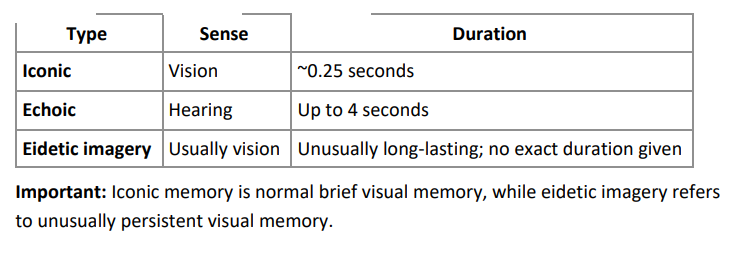
What is Ionic Memory?
Definition: Visual sensory memory.
Duration: Approximately 250 milliseconds (0.25 seconds).
• Briefly retains visual information after a stimulus disappears.
What is Echoic Memory?
Definition: Auditory sensory memory.
Duration: Up to 4 seconds.
Purpose: Briefly holds sounds so we can process speech and remember recently heard information.
• Example: Remembering the beginning of a sentence while listening to the end.
What is Eidetic Imagery?
Definition: Unusually long-lasting, detailed visual memory, sometimes called photographic memory. Duration: Can persist much longer than ordinary iconic memory; the chapter does not specify an exact duration.
• Some individuals report being able to visualize an image long after seeing it.
• Similar unusually persistent memories may occur with sounds or music.
Comparing the 3 sensory memories
What is Short-term Memory?
Definition: Temporarily stores small amounts of information for a short period.
Duration: Usually less than one minute.
Capacity: The chapter describes an average of approximately 7 ± 2 pieces of information (5–9 items).
What is Working Memory?
Definition: The mental processes used to hold, organize, manipulate, and interpret information in short-term memory.
Central executive: Directs attention, chooses strategies, and coordinates information processing.
Example: Remembering a sequence of letters while simultaneously solving math problems.
What is Maintenance Rehearsal?
Definition: Repeating information mentally or aloud to keep it in short-term memory.
• Example: Repeating a phone number until you can write it down.
• Helps prevent information from being forgotten while rehearsal continues.
What is Chunking
Definition: Organizing information into meaningful groups to make it easier to remember.
• Example: Remembering 12 letters as four familiar three-letter abbreviations rather than 12 separate letters.
• Purpose: Reduces the number of separate units short-term memory must hold.
