BIBC 100 Structural BIOCHEM
 Call Kai
 Learn
Learn Practice Test
 Spaced Repetition
 Match
Match Flashcards
 Knowt Play
1/154

There's no tags or description
Looks like no tags are added yet.
Name | Mastery | Learn | Test | Matching | Spaced | Call with Kai | Chat |
|---|
No analytics yet
Send a link to your students to track their progress
155 Terms
An example of small molecular changes having large biological consequences
SICKLE CELL ANEMIA
Hemoglobin (carries O2 into our blood stream), genetic mutation causes a slight change in structure (single amino acid replacement), mutant hemoglobin aggregates to rigid strands, aggregated hemoglobin distorts red blood cells to a sickle shape
What are biomolecules shaped and organized by?
Weak, reversible, and noncovalent interactions
→biomolecules interact w/water, ions and small molecules, as well as other biomolecules
Polarity
Uneven electron distribution creates partial charges
-partial charges drive many noncovalent interactions
Entropy
Measure of molecular disorder/randomness
→molecules arrange in ways that increase the number of micro-states or overall freedom of motion
→helps explain why non polar groups cluster in water (when non-polar groups cluster together, fewer water molecules need to surround them, allowing more freedom of movement n increasing entropy)
Electronegatiivty
atoms differ in how strongly they pull shared electrons
→the more electroneg atoms like N or O can pull e- greater due to high electroned/e- affinity
→H ≈ C < N < O
→ more electroneg atoms pull e- closer becoming partially negative, less electronegative atoms have less electron density and become partially positive
Which elements created polar bonds in biomolecules?
O and N (due to high electronegativity)
What does every polar bond create?
A Dipole
Dipole
a pair of equal but opposite electric charges seperated by a small distance
→when e- are shared unequally, one side becomes slightly neg, the other becomes slightly pos
What does Molecular Polarity depend on?
Shape!!!
-a molecule can contain multiple polar bonds, whether the molecule is overall polar depends on whether or not the bond dipoles cancel or add together

What are the 4 properties of Water?
Solvent, Organizer, Reactant/Product, Thermal Buffer
→Bonus: ice form is less dense than liquid water (normal solids r denser than liquids), but ice floats helping aquatic environments remain habitable
Solvent Property of Water
dissolves ions and polar biomolecules
Organizing Property of Water
drives hydrophobic groups together and helps membranes/proteins assemble
Reactant/Product Property of Water
participates directly in biochemical reactions
Thermal Buffer Property of Water
stabilizes temperature bc of high heat capacity and heat of vaporization
Bonus Property of Water
ice form is less dense than liquid water (normally solids r denser than liquids but not in this case) Ice floats, helping aquatic environments remain habitable
Ranking electronegativity
H ≈ C < N < O
Do atoms share electrons equally?
No, more electroneg atoms typically pull e- closer and become partially negative, less electronegative atoms have less electron density and become partially positive
NonCovalent Interaction #1 Hydrogen Bonds
-type of dipole dipole interaction, arises from X-H bonds
-this bond forms when a partial + H covalently attahced to an O or N is attached to a nearby electron rich O or H
-this bond requires a donor AND an acceptor
Donors and Acceptors for Hydrogen Bonds
Donor: O-H or N-H
AcceptorL O or N with available electron density
is C-H considered an H-bond donor?
No bc this is nonpolar
Is every polar interaction a hydrogen bond??
NO
An H bond must directly involve a hydrogen atom
-the donor H is covalently bonded to O or N
-the acceptor is an electron rich O or N
-a covalent bond is not a hydrogen bond
Water and Hydrogen Bonding
-water can H bond with multiple neighbors
-each water molecule has 2 H bond donors and 2 H bond acceptors
-in liquid water, each H20 averages abt 3-4 H bonds
-the network is dynamic, H bonds constantly form and break
How many neighbors can water hydrogen bond with
4 neighbors
Unusual Water Properties Due to Weak Hydrogen Bonds
-individual H bonds r weak but many H bonds together make water highly cohesive
-Cohesion gives water unusually high melting point, boiling point, and heat of vaporization
-as a result water remains liquid across much of the temp change compatible with life
NonCovalent Interaction #2 Ion-Ion
attractions between opposite charges
-between inorganic ions: Na+ and Cl- in table salts
-btwn metal ions and anionic biological groups
→Mg2+... phosphate
→Mg2+...COO-
→Ca2+...COO-
-btwn oppositely charged biological groups: NH3+...COO- salt bridge in proteins
Ion-dipole interactions
-ions attract polar molecules
-an anion attracts the part pos end of the polar molecule, cation attracts neg end of polar molecule
What does water form since its polar?
it forms ion dipole interactions with dissolved ions, (process is called ion hydration)
Ion Hydration
water dissolves salts by hydrating ions
-from the example, the ion hydration (ion-dipole interaaction) weakens Na+…Cl- (ion-ion interaction) and disrupts the crystal lattice, leads to dissolution of NaCl

NonCovalent Interaction #3 Van Der Waals (London Dispersion)
-weakest interaction
-arise from transient dipoles: electron clouds fluctuate constantly, a temporary dipole in one atom can induce a dipole in a nearby atom, the two transient dipoles weakly attract each other, these interactions occur between all atoms at close range
-as two atoms move closer, their electron cloud will repulse each other and at a particular distance, repulsive force=attractive force, this distance= vanderwaal radius
Van der Waal Radius
defines closest noncovalent contact
-estimates how closesly another atom can approach without forming a covalent bond
-for two atoms, the preferred contact distance is approximately the sum of their van der waals radii
-if two nonbonded atoms are closer than this distance, their electron clouds repel creating a steric clash
Non Covalent Interaction #4 Hydrophobic Effect
clustering of non polar molecules in water
-one of the most important interactions in biology, a major driving force for protein folding and membrane assembly
Why does biology depend on hydrophobic effect?
because it drives proteins to fold by hiding nonpolar parts from water and causes cell membranes to form by clustering hydrophobic fatty acid tails together.
What does hydrophobic effect do?
clustering nonpolar surfaces releases ordered water and increases water entropy
Why is it important that non-covalent interactions exist in biology?
because they are dynamic and reversible meaning weak interactions allow biomolecules to assemble, disassemble, and respond to signals
Predicting molecular natures from chemical structures
When you see molecules rich in covalent bonds differing greatly in electronegativity (ex: O-H or N-H) you know that the molecule is soluble in water or hydrophilic (polar + charged)
When you see molecules with polar bonds o n one side (water soluble), nonpolar bonds on the other side (insoluble) → amphipathic (both hydrophilic and hydrophobic)
Hydrophilic molecules
polar + charged
-ex: biomolecules: sugars and organic acids (GLUCOSE good example)
interactions: all weak interactions except for hydrophobic ones
Hydrophobic molecules
nonpolar molecules
ex: biomolecules:waxes
Interactions: Hydrophobic, Van der Waals

Amphipathic Molecules
both hydrophobic and hydrophilic molecules
-Ex: biomolecules: some amino acids, phospholipids
Interactions: all noncovalent interactions

Whats something that non covalent interactions build?
Micelles and Lipid Bilayers
-they help with building membranes and folding proteins as well
Amphiphathic lipids
have hydrophilic head groups and hydrophobic tails
-hydrophilic heads interact favorably w water, hydrophobic tails force nearby water into ordered gages
How do noncovalent interactions drive protein folding?
they stablizie the folded protein by burying hydrophobic side chains away from water, leaving polar and charged side chains exposed on the protein surface, and forming H bonds, Ionic interactions, and van der Waal contacts +hydrophobic effect
What interactions collectively stabilize the folded state of a protein?
H bonds, ionic interactions, van der Waals contacts, and the hydrophobic effect.
What happens when nonpolar lipid tails cluster together?
they reduce exposed nonpolar surface, release ordered water to the bulk (polar head groups remain exposed to water), and favor spontaneous lipid assembly
-micelles and lipid bilayers form spontaneously

What is the result of lipid assembly?
Nonpolar tails cluster, polar heads remain exposed to water, and micelles/lipid bilayers form spontaneously.
Lipid assembly reduces…. ___
exposed nonpolar surface
Less non polar surface leads to…
fewer water cages → higher water entropy → favorable assembly
How do noncovalent interactions drive biomolecular binding?
biomolecules bind through many weak interactions across an interface
-each individual interaction is weak but together many contacts can create a stable complex
-more matching contexts= stronger and more specific binding
What do chemical groups (charged, polar, nonpolar, etc.) determine?
Interaction types
-they determine which interactions a molecules can make
pKa
constant describing the tendency of losing protons
Peptide bonds
covalent bonds that link AA residues to form polypeptides
What determines the physical properties and function of the protein
Amino acids and modifications
Proteins can be isolated based on their…
physical properties
Amino acids link covalently , then fold through _____ interactions
noncovalent
ex: amino acids is joined into a chain through covalent bonds, and then folds into a 3d shape due to non covalent interactions
What do all the amino acids share?
a common backbone
-the amino, carboxyl, and hydrogen groups are constant for every standard AA
-the side chain is whats unique
What do the side chains (R groups) vary in?
Structure, size, and polarity/charge
-R group determines identity/chemistry
α carbon (Cα)
this refers to the 1st carbon atom attached to the carboxyl group

How many α-AAs are chiral? And what is the exception?
19/20
Exception: glycine, because its R group is H making the molecule Achiral
What makes an molecule chiral?
-if it cannot be superimposed on its mirror image
-a common source of chirality is a carbon bonded to four different groups
-most AAs have a chiral C so they are chiral molecules
What type of amino acids do proteins use
L-amino acids
-chiral amino acids can exist as two mirror-image forms : L and D
-ribosomally synthesized proteins use L amino acids
-some D-amino acids occur in bacterial cell-wall peptides (but not in bacterial proteins)

Why do hydrophobic molecules cluster in water?
-water pushes them together (hydrophobic effect)
-clustering reduces how much hydrophobic surface touches water, which lets water molecules interact more normally w one another
-hydrophic molecules cluster to minimize their contact w water
Can nonpolar molecules experience van der waal interactions?
YES!
-even though they dont have permanent partial charges, their electrons r constantly moving, which can create temporary dipoles that attract nearby molecules
-polar molecules can also experience them, all molecules can have london disperson forces
What forces can nonpolar vs polar molecules experience?
Nonpolar: mainly london disperson forces
Polar: london disperson, dipole-dipole, hydrogen bonds if they have the right groups like O-H or N-H
Is a carbon bound hydrogen considered an H bond donor? (C-H)
NO!
-this is nonpolar
-carbon does not pull e- density away from hydrogen strongly enough for a typical hydrogen bond
What happens to the entropy of the surrounding water molecules during micelle formation?
-entropy increases
-when hydrophobic molecules form a micelle, they cluster together so less hydrophobic surface is exposed to water
-before micelle formation, nearby water molecules are forced into a more ordered arrangement around the hydrophobic parts
-after the hydrophobic parts cluster together, many of those water molecules are released and can move freely
What type of bond is a disulfide bond?
covalent bond
What are the 5 common AA side chain groups (R)? And how many are in each?
1)Nonpolar, aliphatic (7)
2)Aromatic (3)
3)Polar but uncharged (5)
4)Positvely charged (3)
5)Negatively charged (2)
AAs with nonpolar, aliphatic R groups
Gly (G), Ala (A), Pro (P), Val (V), Leu (L), Ile (I), Met (M)
-smallest is Gly (G)
-Pro=ring Rigid, strongly affects protein structure
-Leu and Ille have the same molecular weight
-Met is a thioether group (consists of a sulfur atom bonded to two carbon groups R-S-R)
AAs with aromatic R groups
Phe (F), Tyr (Y), Trp (W)
-these r groups are flat and bulky
-on Tyr (Somewhat polar), the hydroxyl group can form H bonds
-Tyr and Trp R groups absorbs UV light at ~280 nm.
-This is why most proteins absorb 280 nm light

AAs with polar, uncharged R groups
Ser (S), Thr (T), Cys (C), Asn (N), Gln (Q)
-these side chains tend to form H bonds
-hydroxyl groups present on Ser and Thr
-Cys has a sulfhydryl group (SH)
-Asn and Glnm contain amide groups (H2N=C=O)
AAs with positively charged (basic) R groups
Lys (K), Arg (R), His (H)
-all have an amino group, Lys has an NH3+, Arg has an NH2+. Histidine has a NH+
Lys: amino group mostly + charged at pH 7, Arg: guandinium group (pic included) mostly positively charged at pH 7, His: imidazole group (ring in photo) can switch between neutral and positive near pH 7
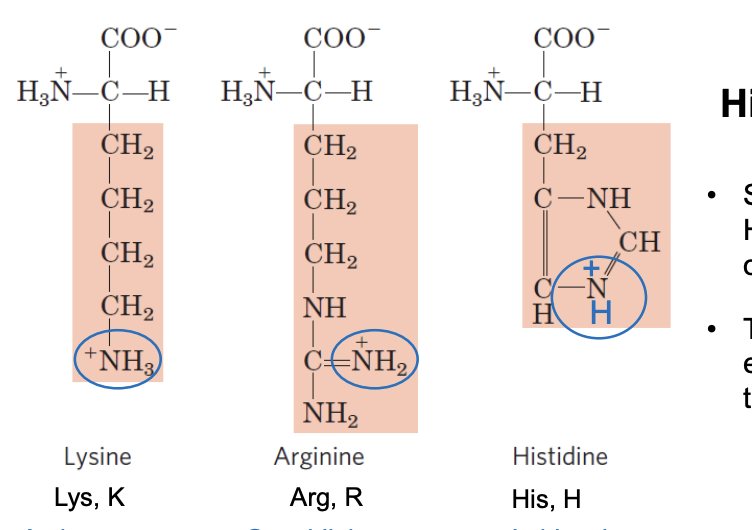
At or near physiological pH…____ are strongly basic; ____ is weakly basic and can change charge
Lys and Arg
His
Why is Histidine a special amino acid (pos charged R group)
-small pH changes can toggle His from charged to neutral or vise versa
-makes His USEFUL in enzyme catalysis and proton transfer
AAs with negatively charged (acidic) R groups
Asp (D), Glu (E)
-these r groups r mostly deprotonated at pH 7
-at low pH, these side chains become protonated (COOH) and lose their negative charge
-contain carboxyl groups (COO-)
How do we determine the charge of an amino acid???
Its protonation state
-protonation: gaining H+
-deprotonation: losing H+
Protonation effect on anion carboxyl group (COO-)
-turns an anion carboxyl group into a neutral group
COO- + H+ = COOH
Protonation effect on neutral amino group (NH2)
-turns neutral amino group to a cation group
NH2 + H+= NH3+
Ionization
a chemical group becomes charged by gaining or losing H+
Ionization of amino acids
-all amino acids undergo protonation or deportation resulting in changes in their net charge
-both the α-carboxyl and the α-amino groups can ionize
-the R group of some AAs can also ionize
-the protonation state of each group determines its charge and interactions
How do you determine the protonation state of a chemical group using pH and pKa?
pH high = H+ is low, so more deprotonation
pH low= H+ is high, more protonation
-lower pKa → Higher Ka → stronger acid → easier proton loss
pH
tells us the free proton concentration in the enviornment
pKa
tells us how easily a group loses H+
-deprotonation tendency
Ka
measures how much acid dissociates

Lower pKa = ___
easier proton loss (bc it would have a higher ka, making it a stronger acid)
To predict protonation state, compare _ and _
pH and pKa
-if ph=pka, 50 protonated, 50% deprotonated
-pka < pH , mostly deprontonated
-if pka > pH, mostly protonated
Higher pH means ____
fewer free protons, which means acid groups r more deprotonated
Compare pka and 7.4 to predict protonation
pka=7.4, 50% protonated 50% deprotonated
pka <7.4, mostly deprotonated
pka>7.4 , mostly protonated
What are the 3 possible ionizable groups of an amino acid?
alpha carboxyl group, alpha amino, and side chain (only for 7/20 of standard AA chave ionizable side chains)
What is the approximate pka of an α-carboxyl group?
2
At physiological pH (7.4), what is the charge of the α-carboxyl group?
predominantly deprotonated at ph 7.4
COO- , charge = -1
What is the approximate pka of the α- amino group?
9
At physiological pH (7.4), what is the charge of the α-amino group?
predominantly protonated at pH 7.4
(NH₃⁺), charge = +1.
Which 7 amino acids have ionizable side chains?
Asp (D), Glu (E), His (H), Cys (C), Tyr (Y), Lys (K), Arg (R).
-influences the net charge of the AA molecules
How does pH compared with pka determine protonation?
pH <pKa: Protonated (holds H+)
pH > pKa: Deprotonated (loses H⁺).
At physiological pH (7.4), what happens when pKa is less than 7.4?
Mostly deprotonated (lost H⁺).
At physiological pH (7.4), what happens when pKa is greater than 7.4?
Mostly protonated (kept H⁺).
What happens when pKa is near 7.4?
The protonation state is sensitive to small pH changes.
What are the side-chain pKa values of Asp (D) and Glu (E), and what are their charges at pH 7.4?
Asp = 3.65 and Glu = 4.25. Both are mostly negative (COO⁻).
What is the side-chain pKa of Lys (K), and what is its charge at pH 7.4?
pKa = 10.5. Mostly positive (NH₃⁺).
What is the side-chain pKa of His (H), and how does it behave at pH 7.4?
pKa = 6.0. Mostly unprotonated, but its protonation state can change with pH.
What can comparing pka to 7.4 help you predict?
Whether a group is mostly protonated or deprotonated
-pka below 7.4 means mostly deprotonated (Has lost H+)
-pka above 7.4 means mostly protonated (has kept H+)
-pka near 7.4 means sensitive to small pH changes