Art History Exam II Court Cities Maps
 Call Kai
 Learn
 Practice Test
 Spaced Repetition
 Match
 Flashcards
 Knowt Play
1/33

There's no tags or description
Looks like no tags are added yet.
34 Terms
Leon Battista Alberti, Self Portrait, bronze, c. 1435

Alberti, façade, Tempio Malatestiano (San Francesco), Rimini, marble, designed 1450, exterior 1447-60
renovation of old church of San Francesco designed for Sigismondo Pandolfo Malatesta

Tempio Malatestiano, St. Sigismund and Sigismund Malatea, Piero della Francesca, fresco, 1451

Palazzo Piccolomini and Duomo, façade, Pienza, Rossellino, marble/stone, 1459-62

Palazzo Piccolomini, Hanging Formal Garden, view from south-facing balcony

Palazzo Ducale, exterior view, stone/marble, Luciano Laurana and Francesca di Giorgio Martini, c. 1454-1485
Urbino, Italy

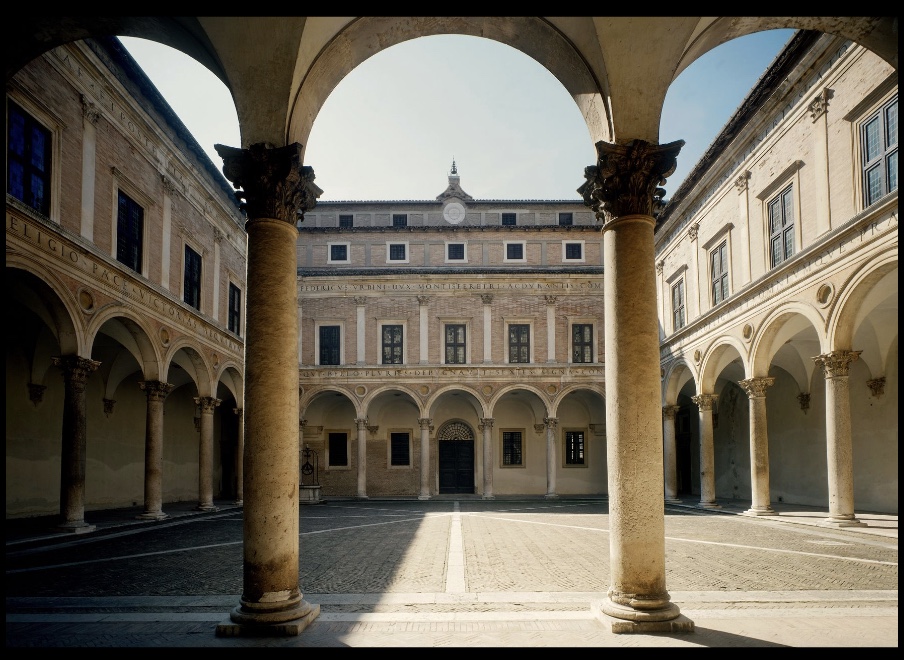
Cortile d'Onore (Court of Honor), main courtyard, Palazzo Ducale, mid 1460s
Studiolo, intarsia, paintings, tile, Palazzo Ducale, c. 1472-1476

Library, Allegorical Image of Rhetoric, Justus of Ghent, oil/panel, 1470s
Kneeling figure identified as Federico da Montefeltro, Duke of Urbino

Library, Divine Comedy, Frontispiece, Purgatorio, commissioned by Federico da Montefeltro, c. 1477-82

Portrait of Federico da Montefeltro and his son Guidobaldo, Pedro Berruguete, oil/panel, c. 1476-1477
Lord of Urbino

Federico da Montefeltro, from the Diptych with Portraits of Federico da Montefeltro and Battista Sforza, front side, Piero della Francesca, oil/panel, c. 1472 (now in Uffizi, Florence)

Battista Sforza, detail of the Diptych
Duchess of Urbino

Allegorical Triumphs, Battista, c. 1465
Portrait of Battista Sforza and Federigo da Montefeltro, Painted by Piero della Francesca

Allegorical Triumphs, Federico, c. 1465
Portrait of Battista Sforza and Federigo da Montefeltro, Painted by Piero della Francesca

Castello Estense (incorproated earlier castles), Bartolino da Novara (builder), brick, begun 1385
Ferrara

Portrait of Leonello d'Este, Pisanello, tempera/panel, 1441

Medal of Leonello d'Este, obverse, Pisanello, bronze, 1441-44

Allegorical Figure (the Muse Calliope), Cosimo Tura, tempera/oil/panel, 1458-60, originally for the studiolo at the Este villa of Belfiore
Tura became the favoured court artist of the Este family in the late 1450s. He was paid a monthly salary to paint anything from heraldry to fresco cycles. He also designed silverware and tapestries. He was the foremost painter of a series of pictures of the Muses for a 'studiolo' or study at the Este castle of Belfiore near Ferrara. This picture is thought to be one of the series.

Ercole dei Fedeli, Parade Sword, Ferrara, etched, gilded steel, 1500-1525

Palazzo Schifanoia, main portal with Este coat of arms, brick and marble, begun 1385

Palazzo Scifanoia, June, north wall, Salone dei Mesi

Palazzo Scifanoia, April, east wall, Salone dei Mesi

Woodcut of the "Erculean Addition", 1499
An expansion of the city commissioned by Ercole d'Este in the 1490s with streets set at right angles and the large avenue, the Street of Angels, created for promenades by the "angels" (courtiers).

Palazzo dei Diamanti, Erculean Addition, Biagio Rossetti, stone, 1493-1504

Alberti, Basilica of Sant'Andrea, designed 1470, completed by Luca Fancelli
Mantua, Italy

North Wall, Camera Picta (Camera degli Sposi), Gonzaga Family, Andrea Mantegna, fresco, Palazzo Ducale, 1465-74

West wall, Camera Picta, Mantegna, Palazzo Ducale

Corte Vecchia (Isabella d'Este's apartment), Palazzo Ducale, intarsia, stone, painting, c. 1520
Mantua, Italy. In 1519 Isabelle d'Este moved her apartments in the Ducal Palace from the Castello San Giorgio to the Corte Vecchia.

Pallas Expelling the Vices from the Garden of Virtue, Mantegna, tempera/canvas, c. 1499-1502

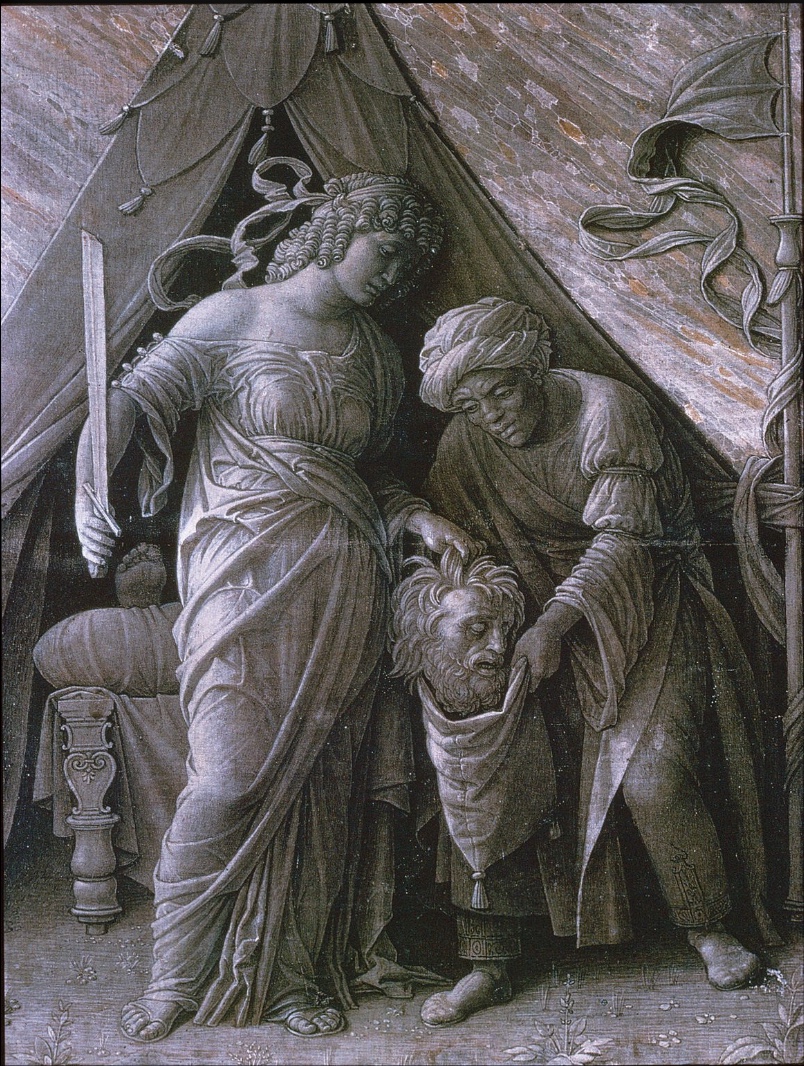
Judith with the Head of Holofernes, Mantegna, distemper/canvas, c. 1495-1502
Mantegna's house, courtyard, 1476-1502
Mantua, Italy. House of Andrea Mantegna, thought by many to also be designed by him. Land donated to Mantegna by patron Ludovico Gonzaga. Mantegna sold the house in 1502 to Francesco II Gonzaga, at which point it was joined with the adjacent palazzo della Pusterla. The house underwent a series of changes over the following centuries and reconstruction was only attempted beginning in 1940, though the studies undertaken were largely destroyed during World War II.

Courtyard façade, Palazzo del Te, Giulio Romano, 1524-34
Built as a pleasure palace for Federico II Gonzaga, Marquess of Mantua, the Palazzo comprises a square house built around a cloistered courtyard with a formal garden. Though the shell of the building was completed within eighteen months, work on frescoes, plasters, and carvings continued for a decade.

Sala dei Giganti, (designed by) Giulio Romano, fresco, Palazzo del Te, 1530-32
Mantua, Italy
