DNA Repair and Recombination
 Call Kai
 Learn
Learn Practice Test
 Spaced Repetition
 Match
Match Flashcards
 Knowt Play
1/20

There's no tags or description
Looks like no tags are added yet.
Name | Mastery | Learn | Test | Matching | Spaced | Call with Kai | Chat |
|---|
No analytics yet
Send a link to your students to track their progress
21 Terms
Mutations are Changes to the DNA Sequences
-They can occur in: ___ and ___
germ and somatic
Which mutations are heritable?
-Germ cells are cells that give rise to reproductive cells like eggs and sperm
-__ cells are non-germ cells
Somatic
When the DNA replication machinery fails, the cell has a backup mechanism called __
DNA repair
Repair corrects __% of the mistakes made by DNA replication, making the overall error rate 1 in __ nucleotides
99 : 10^9
DNA Repair includes:
-__&__ repair. Includes single strand break repair
-__ repair
-Base excision & nucleotide excision
-Double strand break
Mutations are introduced (__) if they are not corrected before the next round of replication. Fixed = “set” not “repaired”
fixed
3 Possibilities once an error is made:
-__: Permanent mutation in one strand or Template strand is uncharged
-“Repair: of __ strand only: “Repair” of the templates strand will lead to mutation in both strands
-Repair of __ strand: Error is corrected or Mutation prevented
-No repair
-template
-new
Therefore, mutation are only prevented is they are corrected in the __ strand before the next round of replication
NEW
Mechanism for Repair Involves 3 steps (Summary)
-__: Mistakes are recognized by specialized enzymes. A nuclease removes the mistakes, leaving a small gap
-__: The gap is filled by DNA polymerase (see also digestion of RNA primers)
-__: Ligase will seal up gap between the newly synthesized DNA (repaired) with existing strand
-Excision
-Resynthesis
-Ligation


When both strands of the DNA are damaged repair is difficult because of the lack of proper __ to use as guide
-Double strand breaks require special repair mechanisms:
Non-homologous __
Homologous __
template
end-joining
recombination
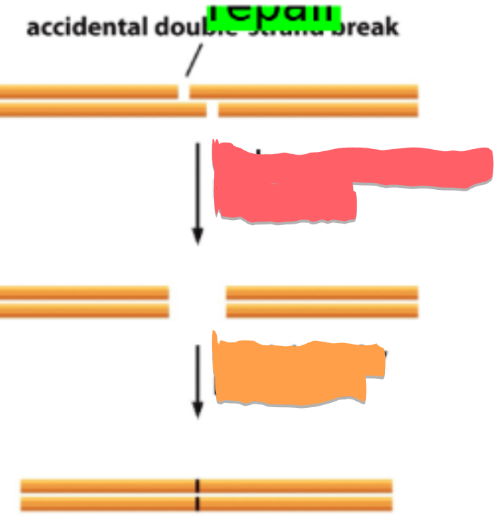
Non-homologous end-joining:
-Ligates the broken strands back together
-Typically a few nucleotides at the break points are lost
-Easy but prone to introduce __
What can happen?
Shift in __!
-mutations
reading frame

Homologous Recombination: A more complex mechanism & Required the presence of a homologous chromosome (extensive region of identity is needed)
-What is a homologous pair of chromosome?
Pair of the same chromosomes
But each is from a different parent
For example: Each human carried 1 chromosome #14 from the mother, and 1 chromosome #14 from the father
The two chromosomes 14’2 are __ to each other
parent
homologous

Step 1 of Homologous Recombination:
-__ and pairing of homologous chromosomes occurs
Orange=mom
red=dad
Double strand breaks


Step 2 of Homologous Recombination:
-Digestion of broken ends by a __
-Necessary to “attack” the __ DNA duplex
-nuclease
-homologous


Step 3 of Homologous Recombination:
-__. One strand of DNA pairs with a strand from the homologous chromosome
-Strand invasion


Step 4 of Homologous Recombination:
-__ DNA is synthesized using complementary strand of the homologous chromosome
New


Step 5 of Homologous Recombination:
-The __ can migrate as new DNA is synthesized
-branch point


Step 6 of Homologous Recombination:
-__ seals up the DNA strands
-All that is needed for this repair mechanism is another intact __!
-Ligation
-chromosome

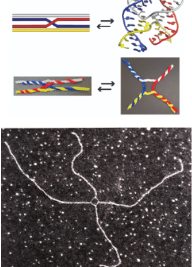
Creating the ____:
-Stage where the 4 strands of DNA from two __ chromosomes are partially paired with each other
DNA Junction
DNA cross? NO! —-
Holiday Junction
-homologous