Membrane Transport
 Call Kai
 Learn
 Practice Test
 Spaced Repetition
 Match
 Flashcards
 Knowt Play
1/59

There's no tags or description
Looks like no tags are added yet.
60 Terms
If delta GA is negative, what does that mean for transport of a molecule or ion?
molecule or ion moves inside spontaneously
If delta GA is (+), what does that mean for transport of molecules or ions?
moving a molecule or ion inside requires coupling to an exergonic reaction (like ATP hydrolysis)

Define what each variable means.
delta GA = change in electrochemical potential
R = gas constant
[A]in = concentration of molecule or ion “A” inside or destination
A]out = concentration of molecule or ion “A” outside or source
ZA = valence (charge) of the solute
F = faraday’s constant
delta psi = change in membrane potential

in the concentration of molecule or ion A, what will allow the transport of a molecule or ion to be thermodynamically favored
[A]out > [A]in b/c the ln([A]in/[A]out) would end up negative > (-) delta GA
How can passive diffusion of K+ lead to development of (-) membrane potential?
K+ leaks out of the cell, taking its (+) charge w it, leaving the inside
What is the difference btwn nonmediated (simple diffusion) and mediated transport (facilitated diffusion)?
nonmediated transport is driven by its chemical potential gradient; whereas, mediated transport requires the action of specific carrier proteins
what are examples of non-mediated transport?
O2 and steroids
What are types of mediated transport?
passive-mediated transport (or facilitated diffusion) and active transport
what is passive-mediated transport (or facilitated diffusion)
molecule moving from H [ ] to L [ ]
define active transport
an endergonic process in which the molecule is transported from L [ ] to H [ ], against the concentration gradient, so coupling is required
types of passive-mediated transport
carrier ionophores, channel-forming ionophores, porins, and ion channels
define ionophores
organic molecules that increase the permeability of membranes to ions
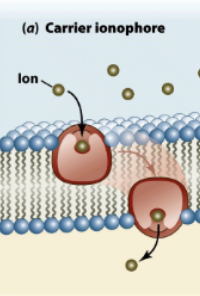
define carrier ionophores
bind selected ions, diffuse through the membrane, release ion to other side and return to original side

define channel-forming ionophores
transmembrane channels through which their selected ions can diffuse
What is the effect of ionophores across the membrane?
equilibrate the [ ] of their selected ions
define porins
a passive-mediated transport that is a B-barrel str exist along the outer mitochondrial membrane through which solutes selectively pass through the channel
define ion channels
allow for rapid passage of ions (such as Na+, K+, and Cl-)
what is the movement of these ions in these ion channels essential for?
maintaining osmotic balance, signal transduction, effecting changes in membrane potential that are responsible for neurotransmission
define K+ channels
allow K+ ions to passively diffuse from the cytoplasm to the extracellular space and some are open to keep the (-) membrane potential (neurons)
What are the structural features of KcsA responsible for high selectivity?
Before reaching the filter, the K+ ion is surrounded by water molecules > help the ion through the pore rapidly.
Rapid transit contributors:
the hydration shell of the K+ with 8 H2O molecules > ease of movement
Within filter, O molecules from H2O and protein > contributes to K+ selectivity
space btwn the K+ ions > prevents repulsion
define gating
the selective opening and closing of ion channels that response to various stimuli and allows for the transportation of ions across gradients of cell membrane
what are the ways that a gated ion channels opens or close?
mechanosensitive, ligand-gated, and signal-gated
what do mechanosensitive channels respond to
deformation in the lipid bilayers (touch, sound, delta Posmotic)
what do ligand-gated respond to
extracellular chemical stimulus (i.e. neurotransmitter)
what do signal-gated respond to
intracellularly binding Ca2+ ion or some other signaling molecules
what do voltage-gated respond to
change in membrane potential (i.e. nerve impulse)

identify what each part of the equation mean. in other words, what does the first term and then the second term mean.
first term: chemical potential difference generated by a difference in [ ] of substances on 2 sides of a membrane
2nd term: electrical potential difference which is the transmembrane movement of ions resulting in change differences across a membrane
define action potential
wave of transient change in the membrane potential
define aquaporin
a protein pore that conducts water through biological membranes
What is the structure of aquaporin
1) narrowest point of the channel is 2.8 Å (angstrom) wide
2) interior pore is lined w hydrophobic grps
3) regions w highly conserved Arg and His residues and backbone carbonyl
4) conserved Asn in the center
how does the str affect the mechanism of aquaporin
1) narrowest point of the channel matches the diameter of a water molecule > blocks any larger solutes (such as H3O+) from entering
2) the inner lining of hydrophobic grps causes a lack of strong interactions, so the molecules move at fast speed
3) regions w conserved Arg and His and backbone carbonyl “lure” other H-bonding H2O molecules
4) Conserved Asn has a NH2 group that can H-bond w H2O molecules > reorient the molecule, so they leave one at a time
What are gap functions made of
each connexon contain 6 connexin subunits
What is the func of gap functions
small molecules and ions can pass through

What is the function of glucose transport
move sugar in and out of a cell
define uniport
movement of a s single molecule at a time
example of uniport
GLUT1 (glucose transporter)
define symport
simultaneoulsy transport 2 diff molecules in the same direction
define antiport
simultaneously transport 2 diff molecules in opp directions
what are the types of active transport
P-type, A-type, and ABC transporters
define P-type
undergoes phosphorylation as they transport cations (NA+, K+, Ca2+)
define A-type
transport anions across membranes
define ABC transporters
ATP-binding cassette and transport a variety of substances, including ions, small metabolites, and drug molecules
what type of transport is (Na+ - K+)- ATPase?
P-type, primary active antiporter
what type of transport is (Ca2+)- ATPase?
P-type, primary active uniport
what type of transport is aquaporin?
mediated transport
What is the main diff btwn the Ca²+ ATPase and (Na+ - K+) ATPase?
Ca2+ ATPase: uses E to actively transport Ca2+ against its electrochemical gradient and out of the cytosol
(Na+ - K+) ATPase: uses E to actively transport 2 Na+ out of the cell and 2 K+ into the cell against their concentration gradients
What are the 3 transporters that play a role in glucose transport in intestinal epithelium?
Na+ - glucose symport, (Na+ - K+) ATPase, and glucose uniport
what type of transport is Na+ - glucose pump?
secondary active symport
What type of transport is the glucose pump?
passive-mediated uniport
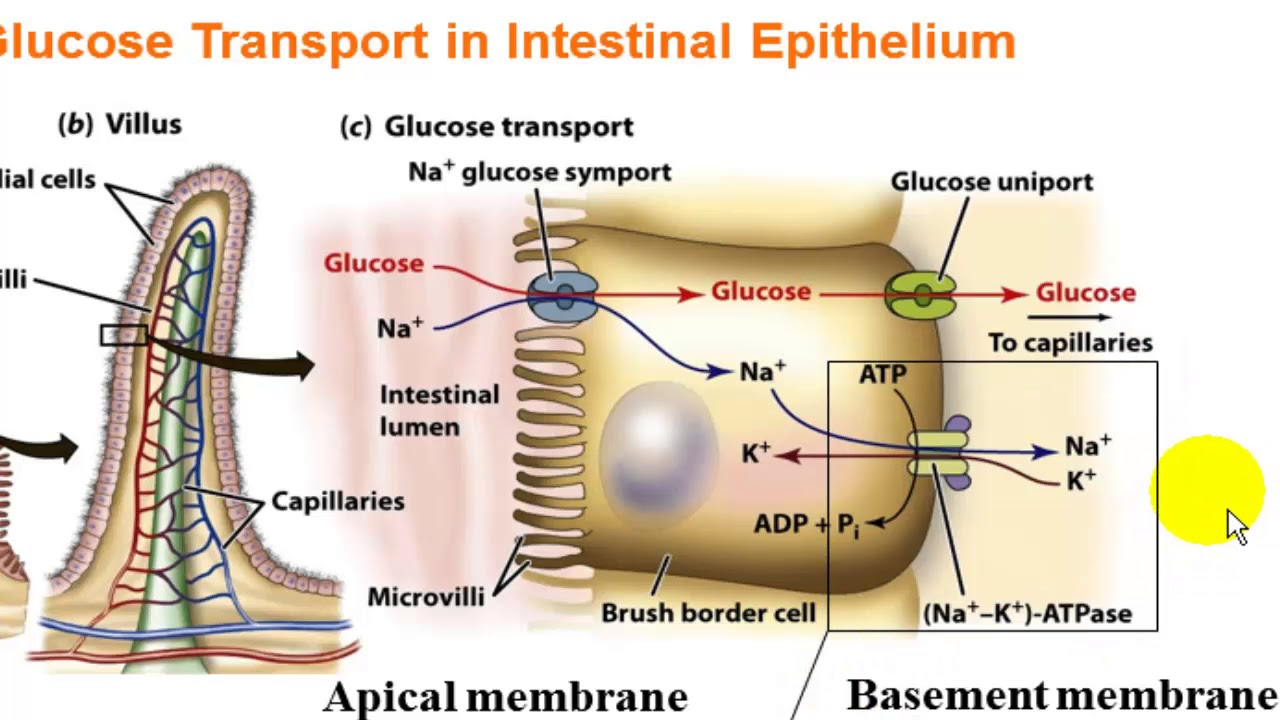
Explain what is happening in the image.
1) Na+ - K+ ATPase uses E to actively transport 3 Na + out of the cell and 2 K+ into the cell > creating a electrochemical gradient
2) Na+ - glucose symport is driven by the L [ ] of Na inside > moves 2 Na+ down their gradient and 1 glucose up against its [ ] gradient
3) Once glucose is inside the cell, the glucose exits into the capillaries via passive -mediated (facilitated diffusion) uniport
define membrane potential
charge difference across the membrane
Why is a charge difference across the membrane?
1) more K+ leaves from the inside to the outside than Na+ entering from the outside to the inside » (-) inside the cell
2) more K+ leaving to the outside and less Na+ entering the inside » (+) charge outside the cell
define chemical potential gradient
chemical potential where the molecules have the potential to move to an area of lower concentration within the soln
gradient means a diff in the distribution of matter within a system
define non-mediated transport (simple diffusion)
molecules move down their concentration gradient w/o assistance of membrane proteins, carriers, or ion channels
define mediated transport
molecules move across the membrane w the help of specific carrier proteins
what is a requirement for ionophore complexes?
soluble in nonpolar solvents
how is ionophores used to control coccidiosis?
ionophores added to the feed > settles in the membrane of the sporozite > picks up sodium in the cell > osmosis (movement of water from L to H solute [ ]) > cell bursts
what is an example of ion channels?
K+ channels
what does dr.mski want you to remember about the structural features of the KcsA?
1) 4 subunits > 2 helices > in total, 8 helices
a) (-) charge at the base when molecules move towards it > attracts the (+) ions / repels (-) ions
b) escorted up the filter by water
c) selectivity filter takes over where there is a (-) charge or polarity for the ions to go thru
how do voltage-gated channels work for nerve impulses?
1) at resting state, the inside of the cell (cytoplasm) is slightly negatively charged > nerve is polarized (-70 mV)
2) stimulation causes Na+ channels to open > Na+ enters the cell > increasing membrane potential (gate threshold) > inducing more sodium channels to open > charge across the membrane starts to disappears (depolarization)
3) Na+ channels close at the peak of the action potential
4) more K+ channels open > K+ leaves the cell (repolarization)
5) dropping below the resting potential (hyperpolarization) > neuron is prevented from receiving another stim immediately after the 1st one
6) sodium/potassium pumps eventually brings the membrane back to its resting state of -70mV (resting/refractory period)