npb 110a - midterm 2
 Call Kai
 Learn
 Practice Test
 Spaced Repetition
 Match
 Flashcards
 Knowt Play
1/198

There's no tags or description
Looks like no tags are added yet.
199 Terms
Ca2+ levels (inside and outside traits)
low cytoplasmic concentration and higher extracellular concentration
two classes of hormonal effects
organization and activational
organizational hormonal effects
impact the system early in development and usually have a permanent change
activational hormonal effects
trigger immediate behavior later in life after development that are usually reversible changes
describe the activational and organizational effects of testerone
organizational is impacting the early development of gonadal hormones from structural development that might not require continued hormone exposure to maintain sexual differentiation
what is the circuit system in which birdsong is produced in the brain
first auditory input goes to the motor pathway which consists of HVC then to RA and then to vocal organ of birds
HVC (high vocal center) importance for bird song
nucleus in brain that produces bird song and control song timing
RA (robust nucleus of arcopallium) importance for bird song (hint physical mech)
responsible for song motor behavior
when comparing make and females HVC and RA’s whcih one had the larger two and why
males because they’re they only one that sing
list the order of the sex hormone synthetic pathway
cholestrol produces testosterone which makes DHT and estradiol
androgens and impact on bird song
hormones that maintain male trait and affect song variability such as syllables and traits
what is estradiol/E2
active and potent form of estrogen
trill (bird song)
rapid repetition of a single note or syllabus in birds
what is another purpose of estradiol and describe the purpose
CAN REGULATE NEURONAL GROWTH, first estradiol enters the plasma membrane by itself bcs its a steroid and then forms pre-initiation complex which then acetylates histones and thus transcription finally proteins for neuronal growth
what is reproductive behavior in birds impacted by
season and they sing more in spring and early summer due to the increased sunlight
what are the activation effects of testosterone in birds (3)
bird song is seasonal, reproductive behavior is seasonal, and testis size varies based on the season so it changes color
describe the avian photoperiodic response for birds
first the light reaches the deep-brain photoreceptors since the skull is thinner than humans and then it makes TSH (thyroid stimulating hormone) and then it makes DIO3 which is an enzyme that then makes rT3 and T2 and rT3 is inactive and activates based on the season
describe the mammalian photoperiodic response
first light reaches the eye which then activates the SCN (circadian pacemaker) then melatonin is produced then TSH is made so then DIO2 can be made that then can make T3
what is the importance of thyroid hormones (T3 and T4)
regulators of metabolic rate and thermoregulation process and are important for normal growth and function of all body tissues
two main character traits of channels
permeable to certain ions and have high flux rate
what two forces are ions subjected to when channels open
chemical and electrical
chemical driving force
difussion due to thermal motion from high to low concentrations
five factors of fick’s law (laws of diffusion
concentration gradient, permeability of membrane, SA, MW of solute, and thickness of membrane
osmosis
water diffusing its concentration gradient
what happens when the membrane is permable to water but not solute
results in no net difusion of water when osmotic pressure appeares
osmotic pressure
pressure to stop inward flow of solvent across membrane and counteracts hydrostatic pressure
electric driving force
movement of charge particles along an electrical gradient due to electrostatic attraction/repulsion
restng membrane potential and formula
voltage difference across plasma membrane when cell is at rest (inside-outside voltage) and measured in millivolts
WHAT IS THE STANDARD RESTING MEMBRANE POTENTIAL and why
-70 mV due to more negative charges inside cell
how come standard resting membrane potential isn’t 0
since the remainder of the fluid is electrically normal but then charges at the membrane line up
does charge seperation across cellular membrane impact concentration gradients (y or no)
no
Na+/K+ATPase impact on establishing membrane potential (step 1) and describe how much sodium andp otasisum is tranproted and where
establishes unequal concentrations of sodium and potassium ions and uses ATP to pump 3 Na+ OUT of the cell and then 2 K+ into the cell
diffusion properties of Na+ and K+ and A- down their concentration gradient through leak channels (step 2) and describe permeabilities
Na+: extracellular permeability is much higher than intracellular making relative
K+: intracellular permeability is much higher than extracellular
A- (DNA/AA): intracellular permeability higher than extracellular so relative permeability is 0
what is equilibrium potential for ions
flow of a ion into or out of the cell is balanced
equilibrium potential (Vm) value for potassium
-90 mV
equilibrium potential (Vm) value for sodium
+60 mV
what equation describes equilibrium potential for a ion
Nernst equation
ion channels (two key traits)
permeable to certain ions and once open, ion move in response to electrical and chemical (diffusion) driving force
depolarization of cell
inside of cell BECOMES MORE POSITIVE so more positive charges flow inside
what is the purpose of the input zone (dendrites and cell body) in neurons
so that other neurons can give neurotransmitters that cause graded potentials (NO AP)
what is the purpose of axon hillock (trigger zone)
action potentials start from there

graded potentials defintion and chractertics
local changes in membrane potential that decay over short distances
what is the importance of the axon (conducting zone)
action potential runs down there
what is the purpose of the axon terminals (output zone)
release neurotransmitters to target neurons
four key steps on establishing membrane potential
1. Establishes and maintains concentration gradients for key ions (Na+, K+, A-) thru Na+/K+ ATPase (for those 2 ions)
2. Na+ and K+ diffuse down conc. gradient using leak channels
3. diffusion thru membrane results in charge separation. this creates a membrane potential; this voltage difference is an electrical gradient that exerts driving force on ion mvmt.
4. net mvmt. of charges continues until both forces (one exerted by electrical gradient and other from conc. gradient) balance one another
4 key properies of graded potentials
decay over short distances, decay over short times, scale with stimulus size, and get added together
A-
macromolecular anions w/ high intracellular conc. of nucleic acids and proteins that carry a negative charge
Concentration of Na+ (specfic values)
extracellular: 150
intracellular: 15
relative permeability: 1
Concentration of K+ (specific values)
extracellular: 5
intracellular: 150
relative permeability: 50-75
What membrane proteins underlie resting potential?
leak channels and Na+/K+ ATPase
hyperpolarization of cell
internal becomes more positive so then more negative ions flow in and more positive ions flow out
temporal summation of graded potentials
neuron receives rapid information from another synapse
spatial summation of graded potentials
neurons receives inputs from multiple other neurons
Why does Vm equal to -70 mV?
a large net diffusion of K+ outward drives this to a large negative potential and relatively small net diffusion of Na+ inward neutralizes some of the potential created by K+
what does summation do to graded potentials
adds up all positive and negative charges
why were squid giant axon important for actions potentials
help discover the ionic basis of action potentials
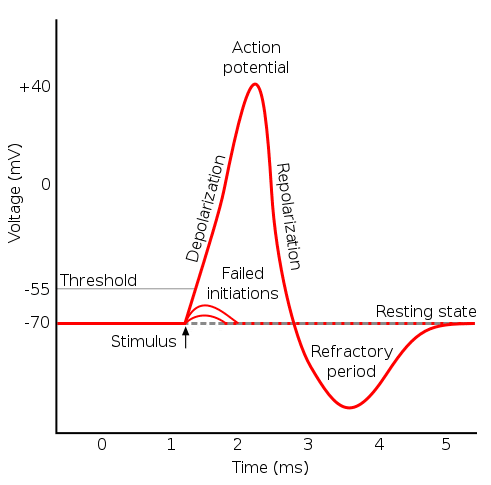
action potential
brief all-or-nothing reversal in membrane potential ("spike") that lasts ~1 millisecond that is brought by about by rapid changes in membrane permeability to Na+ and K+ ions
threshold for AP defintion and what happens afterwards and describe the positive feedback loo[
the level of stimulation required to trigger action potential and once it's crossed then depolarization occurs through positive feedback loop (depolarization leads opening of voltage gated sodium channels so then even more sodium flows in after the initial amount)
what does the action potential rely on (two things)
the voltage-gated K+ channel and the voltage gated Na+ channel
rising phase of action potential
Na+ activation gate opens ! and Na+ rushes in so membrane gets depolarized
falling phase of action potential (hypeprolatizaiton after hyper)
K+ channel opens! (Na+ inactivation gate closes so no more Na+ in ) and K+ out. then at hyperpolarization, Na+ inactivation gate opens, Na+ activation gate closes and then after hyp., K+ closes
what are the gates doing at resting potential?
both closed at -70mV
voltage-gated Na+ channel traits and then the three states it can be in a AP
open quickly in response to depolarization which allows Na+ to flow down its electrochemical gradient
3 states:
inactivated: closed and NOT capable of opening; can only be removed by depolarization to -70 mV
activated: open
deactivated: closed but capable of opening
voltage-gated K+ channel traits and the two states it can be in a AP
opens more slowly in response to depolarization which allows K+ ions to flow out of cell down electrochemical gradient. two states are deactivated and activated

absolute refractory period
brief period when a second spike CANNOT be generated. it begins with activation of voltage-gated Na+ changes and ends when inactivation is removed

relative refractory period
brief period following a spike during which a HIGHER intensity stimulus is NEEDED to generate a second spike. it begins with Na+ channel inactivation being removed and ends when voltage-gated K+ channels deactivate (CAN generate another if membrane reaches above threshold and helps move AP in one direction)
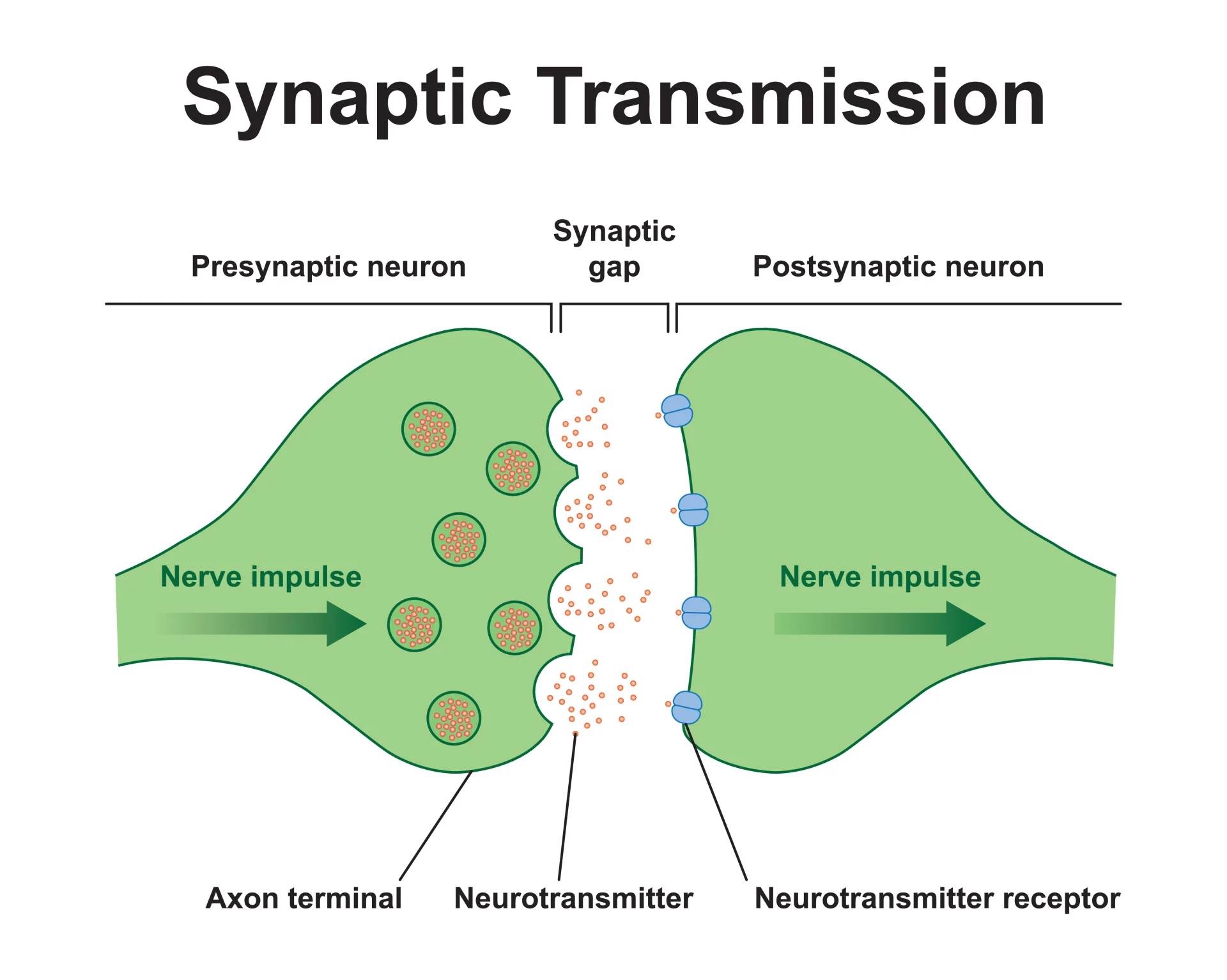
synapses
junctions between two neurons to electrically communicate with each other
two types of synapses
electrical and chemical

chemical synapse (5 steps)
action potential reaches the presynaptic neuron from axon terminal
Ca2+ influx into the presynaptic terminal due to the opening of voltage-gated calcium channels
release of neurotransmitter by exocytosis via vesicles into the synaptic cleft (gap btwn neurons)
receptor binding onto the postsynaptic cell’s receptor
opening of specific ion channels in the sub synaptic membrane (receiving target cell) to change its voltage and get the message across
at rest is the voltage-gated Ca2+ channel closed or opened
closed at rest
is a neurotransmitter receptor a ligand or chemically locked
ligand
what are postsynaptic potentials (PSP)
temporary changes in the charge of a neuron’s membrane that occur when neurotransmitters bind to its receptors ALSO is a graded potential
What ion flux in the presynaptic neuron drives neurotransmitter release by letting vesicles of neurotransmitter fuse with the membrane
Ca2+

inhibitory postsynaptic potential (IPSP) (also a type of graded potential)
HYPERPOLARIZING events that bring the membrane potential away from threshold TO MAKE IT LESS LIKELY TO FIRE AN AP
what is the ion selectivity of ipsp’s and why those ions
Cl- and K+ are selected for since Cl- will make internal more negative and K+ because it likes to exit the intracellular part

excitatory postsynaptic potential (EPSP) (also a graded potential)
DEPOLARIZING events that bring resting membrane potential closer to threshold SO MORE LIKELY TO FIRE AP
what is the ion selectivity of epsp’s
Na+ and Ca2+ because Na+ will enter the cell to make it more positive and then Ca2+ will also enter to make it more positive
common inhibitory neurotransmitters (2 types, hint double g)
GABA and glycine (Gly)
common excitatory neurotransmitters (2 types)
glutamate (Glu) and acetylcholine (Ach)
two classes of neuotransmitter receptors
ionotropic and metabotropic
ionotropic receptor properties
FAST synapses and ligand-gated ion channels
gap junctions
directly connect the cytoplasm of two cells, which allows various molecules, ions and electrical impulses to directly pass through a regulated gate between cells
metabotropic
slow synapses and GPCR’s so coupled to G proteins
purpose of acetylcholine esterase
breaks down acetylcholine
what three mechanisms limit the duration of neurotransmitters (can cause it to stop)
dilution, degradation, and reuptake into the presynaptic terminal by transporter proteins or into glial cells
do neutrotransmitter receptors have a low or high affinity for neurotransmitters
low
How are destinations identified?
by specific amino acids sequence (signal sequences/peptides)
Where does protein sorting start?
in cytosol, n-terminal signal sequence sends protein to the ER
cotranslational translocation
translocation and translation occur simultaneously
when a SRP binds can translation occur yes or no
no
exocytosis defintion and purpose and examples
contents of a cell vesicle are released to the exterior of cell and a form of active transport, can be used to get rid of waste and to insert membrane proteins into the cell membrane
to enter translocon, proteins must be....
UNfolded
endocytosis
active transport where a cell engulfs a protein and transport contents into the cell
three types of endocytosis
pinocytosis, phagocytosis, and receptor mediated endocytosis

pinocytosis (selective or not)
cell drinking and non selective
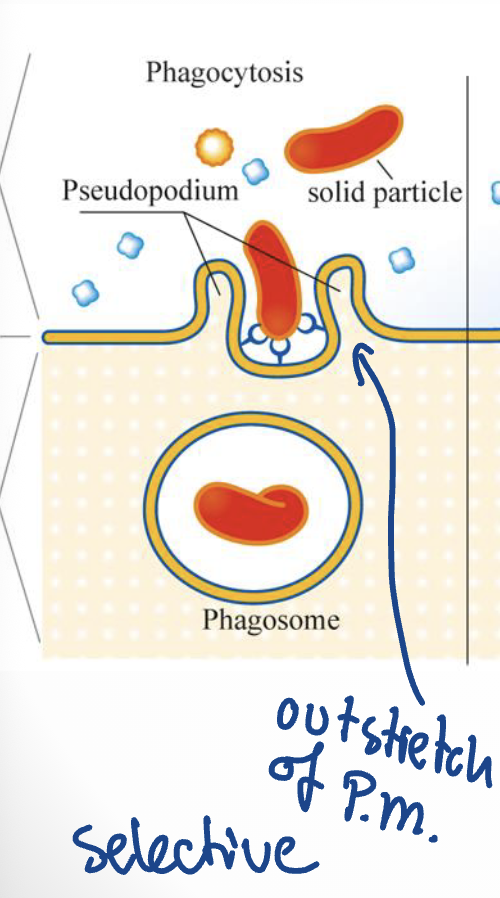
phagocytosis (selective or not)
cell eating and selective

receptor mediated endocytosis and describe with coat protiein is being used
uses receptors that then communicate with the clathrin (coat proteins) in order to dictate if the contents will be taken into the cell