Circulation
 Call Kai
 Learn
 Practice Test
 Spaced Repetition
 Match
 Flashcards
 Knowt Play
1/49

There's no tags or description
Looks like no tags are added yet.
50 Terms
What does a circulatory system consist of?
Muscular pump (the heart)
Fluid (blood)
Series of conduits (blood vessels)
What is the function of bulk flow of blood?
Transporting O2 rapidly throughout the body
Transport of nutrient molecules, hormones, heat, and metabolic wastes
What is a closed circulator system?
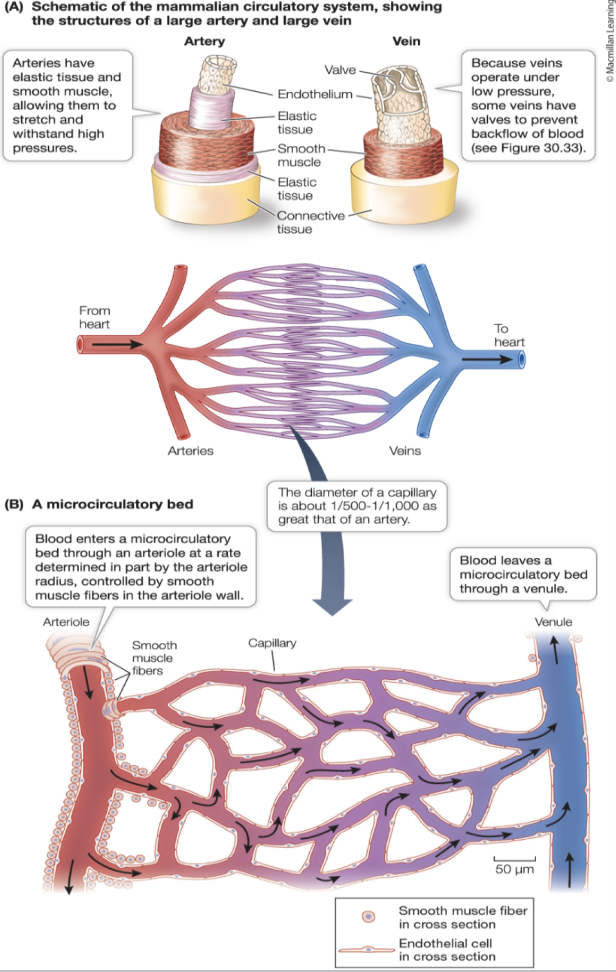
A heart pumps blood into arteries, which branch into smaller arterioles, and eventually into capillaries of microscopic size
As blood leaves tissues and organs, it flows into larger and larger vessels, the veins, back to the heart
Arterioles, capillaries, and venules comprise the microcirculation
Which animals have a closed circulatory system?
Vertebrates
What do capillary walls consist of?
Vascular endothelium, <1 micron thick
Small blood cells must pass through one at a time
Where are capillaries found?
Near every tissue cell
What happens in capillaries
Primary sites where O2, CO2, and other materials are exchanged between blood and cells
What is an open circulatory system?
Blood exits vessels as it flows through the body
No distinction between blood and interstitial fluids

Which animals have an open circulatory system?
Arthropods and most mollusks
What is the fluid in open circulatory systems referred to as?
Hemolymph instead of blood
What does blood consist of?
Plasma and cells
What is blood plasma?
Water and solutes such as glucose, ions, wastes, hormones, clotting proteins, and O2
What are red blood cells?
Erythrocytes
Contain hemoglobin
What are white blood cells?
Leukocytes
Participate in immune responses
What are platelets?
Cell fragments
Involved in blood clotting
What is the function of respiratory pigments?
Greatly increase the amount of O2 that can be carried in blood
What is oxygenation?
When a pigment combines with O2 (picks up O2) in the lungs
What is deoxygenation?
When a pigment releases O2 in the tissues
What does an oxygen equilibrium curve demonstrate?
Loading and offloading of O2
How does human hemoglobin interact with oxygen (O2)?
Hemoglobin in humans combines reversibly with O2 (oxygenation and deoxygenation)
How does the partial pressure of oxygen (PO2) control the reversible loading and unloading of O2 by hemoglobin?
Hemoglobin combines reversibly with O2 based on local partial pressure differences:
High PO2 (lungs) - promotes oxygenation, where hemoglobin binds tightly to O2
Low PO2 (active tissues) - promotes deoxygenation, causing hemoglobin to release O2, where it is needed for cellular respiration

What is myocardium?
The muscle tissue of a heart
What is cardiac output?
Volume of blood pumped per minute, affected by heart rate and stroke volume
What is stroke volume?
Volume of blood pumped per heartbeat
What happens to stroke volume and heart rate during exercise?
Both increase
How many chambers do fish, amphibians, mammals, and bird hearts have?
Fish have 2
Amphibians have 3
Mammals and birds have 4
How many ventricles and atria are in mammal and bird hearts?
2 ventricles and 2 atria
What is the purpose of one-way valves?
Ensure that blood flows through the chambers in the correct direction

What are the steps of circulation?
O2 depleted blood from systemic tissues enters the right atrium
Then flows into the right ventricle
Right ventricle contracts blood pumped to pulmonary arteries to the lungs
O2-rich blood from the lungs enter the left atrium
Passes into the left ventricle
Left ventricle contracts, pumping O2-rich blood is pumped through the aorta to the systemic tissues

What is the cardiac cycle?
Cycle of contraction and relaxation of the heart

What is systole?
When ventricles contract (max pressure)
What is diastole?
When ventricles relax (min pressure)
How is heartbeat initiated?
By pacemaker cells in the sinoatrial (S - A) node in the right atrial wall
Modified muscle cells generate pacemaker potentials (myogenic)
Electrical depolarization and contraction spread rapidly throughout the muscle
Depolarization reaches the atrioventricular (A-V) node, then spreads throughout the ventricles
Results in ventricular contraction

What is an electrocardiogram?
ECG or EKG
Record of heart-related voltage differences on the surface of the body over time
Provides a readout of electrical changes across the heart

What is the function of coronary circulation?
Providing blood flow and O2 to heart tissues
Necessary for healthy heart function
What is coronary artery disease?
Common
Arteries can become blocked leading to heart attack

What is extrinsic control in the heart?
Adrenal glands secrete a rush of epinephrine in response to fright or stress, which increases heart rate and stroke volume
What is the autonomic nervous system?
Sympathetic stimulation (high stress/energy) - increases heart rate and stroke volume
Parasympathetic stimulation (relaxed) - decreases heart rate
What is the structure of arteries leaving the heart?
Thick walls of elastic fibers and smooth muscles, so that they can withstand high pressure
What is the structure function of small arteries and arterioles?
Have smooth muscle
Exercise vasomotor control over blood flow to capillary beds
On an ECG, if the P wave is normal, but there is not a QRS complex, what could this mean?
There is a problem with electrical conduction between the pacemaker and ventricles
How is the blood pressure in veins?
Much lower blood pressure
Walls are thinner and expand more easily
Contraction of skeletal muscles help proper blood through the veins
One-way valves prevent backflow

What is the blood-brain barrier?
Many types of solutes can’t cross the capillary walls in the brain and spinal cord because the walls have no pores
Protects neurons from toxins and allows tight control of solute exchange
What is the role of kidneys in circulation?
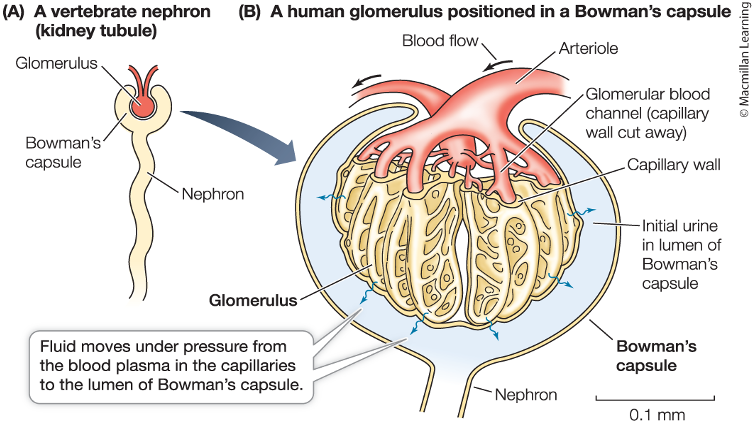
Capillaries in the glomerulus have many pores and allow many types of solutes to pass
Blood pressure drives fluid and solutes into kidneys
Kidney helps to regulate blood pressure
How do blood pressure levels change during blood flow?
It stays high in the arteries, because of their large diameter, but drops when blood reaches the arterioles, capillaries, then veins

How does blood move in and out of the capillaries?
Capillaries are so permeable that fluid is squeezed out by blood pressure
When blood reaches the end of the capillary, blood osmotic pressure (due to dissolved proteins) exceeds blood pressure, and some water move back in

What is the net effect of circulation each day?
Some loss of fluid from the blood
2-4 liters of fluid in a person’s systemic interstitial fluids each day
What is the function of the lymphatic system?
Returns interstitial fluid to the blood
Lymphatic capillaries continually take up excess fluid
They merge into larger and larger vessels that ultimately empty into veins in the neck
What does the countercurrent heat exchange depend on?
Parallel arrays of arteries and veins
How do tuna use a countercurrent system?
Keep swimming muscles warm
Numerous arteries and veins going to and from the red swimming muscles are closely juxtaposed
Red swimming muscle produces a lot of heat
Blood returning from periphery picks up heat and returns it to swimming muscles
