Unit 2 Test - H. Chemistry
 Call Kai
 Learn
 Practice Test
 Spaced Repetition
 Match
 Flashcards
 Knowt Play
1/36

Earn XP
37 Terms
Bond
force that holds groups of atoms together and makes them function as a unit
Bond energy
The energy required to break a chemical bond (and the energy released when a chemical bond forms)
To either break or make a bond, there's an exchange of bond energy.
Why do bonds form?
Most atoms bond to achieve an octet of valence electrons
Meaning that they have 8 electrons in their valence shell
Atoms become more stable when energy released upon bonds forming
Ionic Bonds
Transfer of electrons between 2 atoms
The nonmetal typically becomes negatively charged because it takes electron(s) to achieve an octet
The metal typically becomes positively charged because it gives away electron(s) to achieve an octet
The bond is the attraction between the 2 atoms since the nonmetal is negatively charged and the metal is positively charged
The attraction between the positive and negative charges
An ionic compound results when a metal reacts with a nonmetal
Ions are packed together into a lattice to maximize the attractions between ions
Atomic Radius of Ions
Cations will always be smaller than their neutral atom
gives up the valence electrons so drops a shell
lower n (principal energy level) value
Anions will always be larger than their neutral atom
due to increased repulsion of electrons
Covalent Bond
A covalent bond results when electrons are shared by nuclei of two non-metals
A compound that solely contains covalent bonds is called a molecular compound
Octet Rule
elements tend to bond so that each atom has eight valence electrons in its outer shell to completely fill its outermost s and p subshells
Binary Ionic Compounds
one metal (positive ion) and one nonmetal (negative ion)
Type I Binary Ionic Compounds
Metal present forms only one cation
Rules for Naming Type I Binary Ionic Compounds
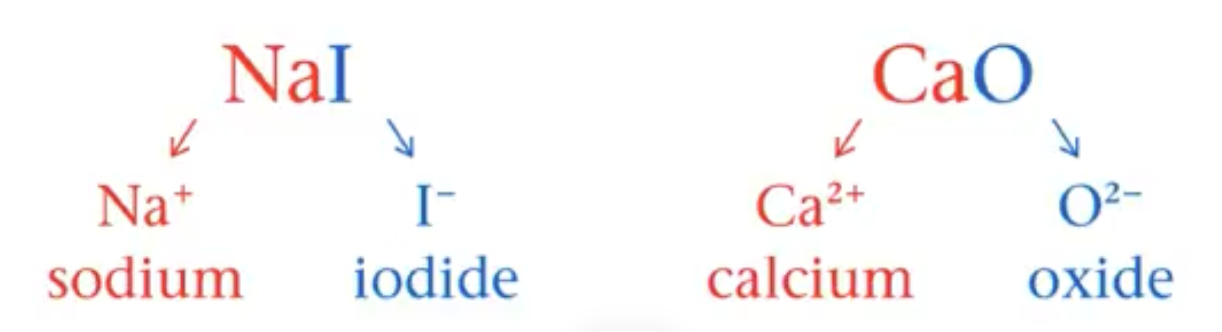
The cation (metal) is always named first and the anion (nonmetal) second.
A simple cation (obtained from a single atom) takes its name from the name of the element.
A simple anion (obtained from a single atom) is named by taking the first part of the element name (the root) and adding -ide.
Write the name for the compound by combining the names of the ions (but leave a space between them).
Polyatomic Ions
A group of two or more atoms that are covalently bonded together and behave as a single unit with a net charge
Ternary Ionic Compounds
A metal bonded to a polyatomic anion, a polyatomic cation bonded to a non metal, or a polyatomic cation bonded to a polyatomic anion
Naming ternary ionic compounds (that contain polyatomic ions) follows rules similar to those for binary ionic compounds, except:
No automatic -ide ending
Use the name of the polyatomic ion
Type II Binary Ionic Compounds
Metal present can form 2 or more cations with different charges so we show the difference is by using roman numerals
Since the metal ion can have more than one charge, a Roman numeral is used to specify the charge.
Roman numerals are used for and tin, lead, and all transition metals (except for zinc and silver)
Binary Molecular Compounds
two non metals bonded together with covalent bond(s)
Naming Binary Molecular Compounds
uses prefixes (see video for more details)
Molecules
Shortened way of saying molecular compounds (Nonmetals bonded together with covalent bonds)
Electronegativity
The relative ability of an atom in a molecule (covalently bonded) to attract shared electrons to itself
Elements that have more valence electrons are more able to attract electrons because they are closer to achieving the octet of valence electrons
Moving down a group, the outer electrons are farther away from the nucleus and shielded by inner electron shells, which changes how strongly the atom attracts additional electrons or holds onto existing ones.
An atom with higher electronegativity is more likely to hold onto its lone pair.
Expanded Octets
When the central atom in a molecule has more than an octet of valence electrons
Only occurs in elements in period 3 or more since they have available and empty d orbitals
Double Bonds
Two bonds between the same two atoms.
Four ve- are involved in a double bond.
See lewis structure instructions for when to use
Triple Bonds
Three bonds between the same two atoms.
Six ve- are involved in a triple bond.
See lewis structure instructions for when to use
VSEPR Model
Valence Shell Electron Pair Repulsion
Shows how atoms of a molecule are arranged in 3D space
The arrangement of the electrons around the central atom plays an important role in how the molecule behaves.
The shape also is influential on its behavior.
Need accurate Lewis structure to determine the shape!
Lone Pairs
A pair of valence electrons that are not shared with another atom in a covalent bond
Linear VSEPR Shape
2 elements bonded to central atom
No lone pairs on the central atom
Bond angle: 180
Ex: CO2

Trigonal Planar VSEPR Shape
3 elements bonded to central atom
No lone pairs on the central atom
Bond angle: 120
Ex: BF3

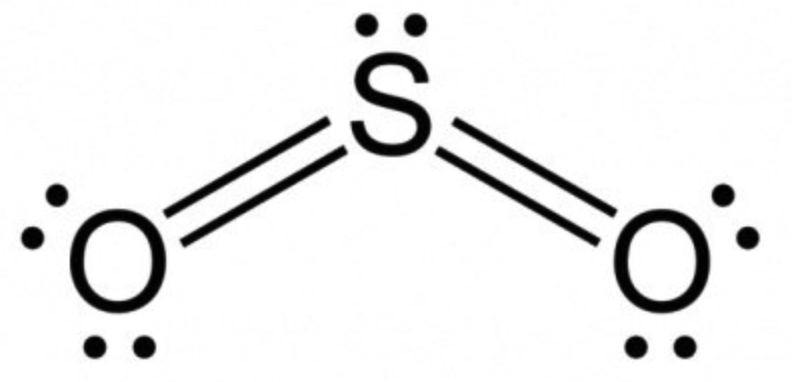
(2,1) Bent VSEPR Shape
2 elements bonded to central atom
1 lone pair on the central atom
Bond angle: 118
Ex: SO2
Tetrahedral VSEPR Shape
4 elements bonded to central atom
No lone pairs on the central atom
Bond angle: 109.5
Ex: CH4

Trigonal Pyramidal VSEPR Shape
3 elements bonded to central atom
1 lone pair on the central atom
Bond angle: 107
Ex: NH3

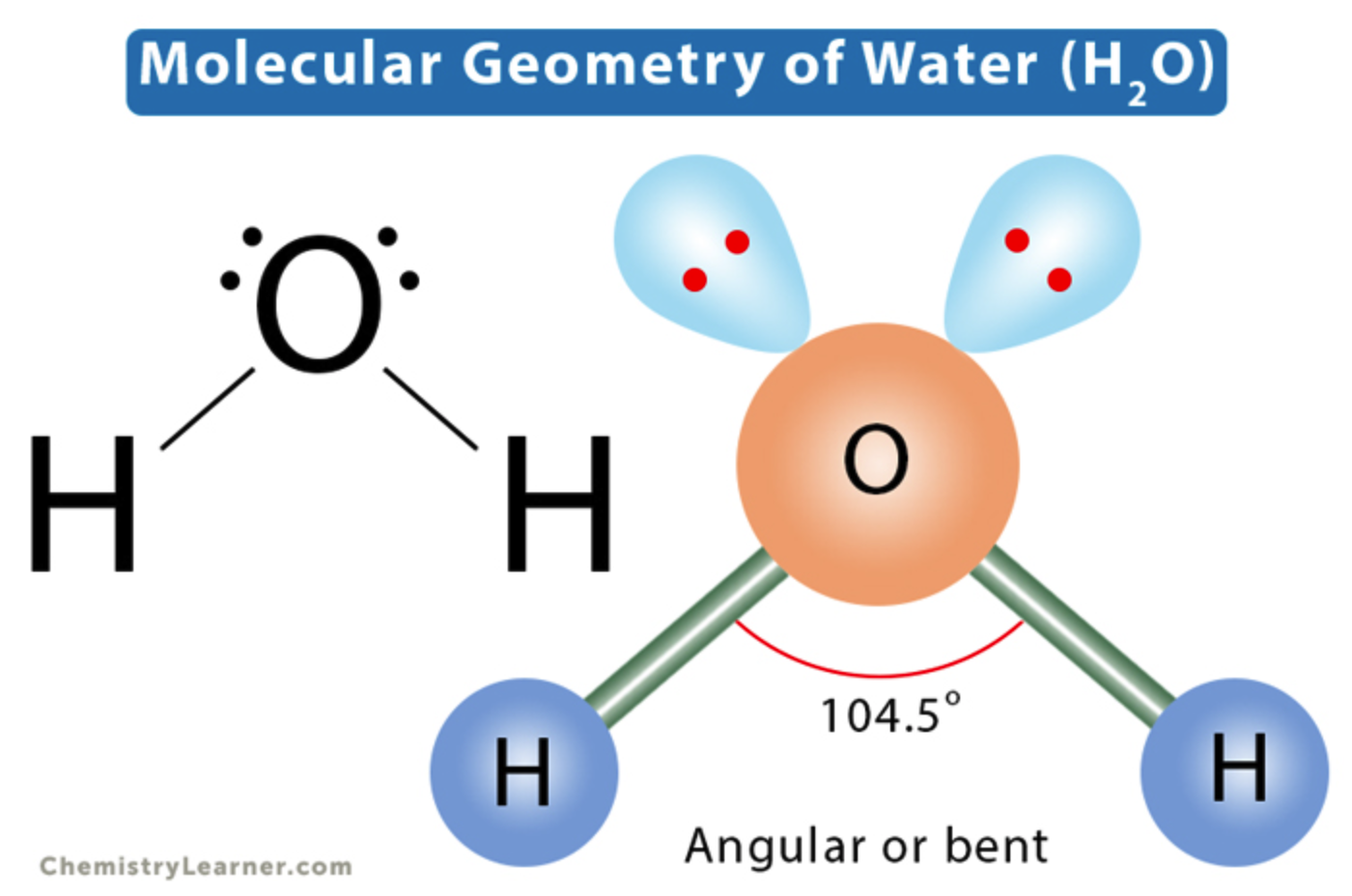
(2,2) Bent VSEPR Shape
2 elements bonded to central atom
2 lone pairs on the central atom
Bond angle: 105
Ex: H2O
Trigonal Bipyramidal
5 elements bonded to central atom
No lone pairs on the central atom
Bond angle: 90 & 120
Ex: PF5

Octahedral
6 elements bonded to central atom
No lone pairs on the central atom
Bond angle: 90
Ex: SCl6

Why does a lone pair electrons have a greater repulsive force than a bond?
Because when electrons are being shared in a bond, they are pulled slightly away from the nucleus of the central atom. While the electrons in the lone pair are as close to the nucleus of the central atom as possible. So it would exert a greater repulsive force on the bonds since they are closer to the bonds.
Polar Covalent Bonds
Results when electrons are shared unequally by different nuclei (opposite: nonpolar)
One atom attracts the electrons more than the other because it is more electronegative
No distortion of the electron cloud
Non polar
Only occurs between two identical nuclei
same isotope of the same element

Distortion of the electron cloud
Polar
Notated with lowercase Greek letter delta

2 separate electron clouds
a cation and an anion
this occurs when there is such a great difference in electronegativity
that the electrons are no longer shared meaning the pull on the electrons
meaning the difference in electronegativity is so great that the electrons were transferred and a transfer of electrons is an ionic bond

Dipole moment
Results when a polar molecule has a center for positive charge separate from a center for negative charge.
the positive delta refers to the side of the atom that has less electronegativity—this is called a partial positive charge
the other side that has a partial negative charge has more electronegativity so it pulls on the electrons more in the shared bond
Molecular Polarity
Determined by electronegativity and VSEPR shape
When individual dipole moment of polar bonds don't cancel each other out, there is an overall dipole moment and the molecule is polar.
When individual dipole moment of polar bonds do cancel each other out, there is no overall dipole moment and the molecule is nonpolar.
Bent and Trigonal Pyramidal cannot be nonpolar