BSC 282 Chapter 27 Adaptive Immunity: MHC, T Cells, and Antibodies
 Call Kai
 Learn
 Practice Test
 Spaced Repetition
 Match
 Flashcards
 Knowt Play
1/77

There's no tags or description
Looks like no tags are added yet.
78 Terms
What are Major Histocompatibility Complex (MHC) molecules also known as in humans?
Human leukocyte antigens (HLAs)
What are the two types of MHC proteins?
Class I and Class II

Where are Class I MHC proteins found?
On all nucleated cells (not red blood cells)
What do Class I MHC proteins present to CD8+ T cells?
Internal antigens from viral or cancer proteins

What is the role of Class II MHC proteins?
To present external antigens to CD4+ T cells

Which cells express Class II MHC proteins?
Antigen presenting cells (APCs) such as B lymphocytes, macrophages, and dendritic cells
What is the significance of MHC polymorphism?
MHC molecules have many different alleles for each gene, affecting tissue compatibility

What is T Cell Receptor (TCR) specificity?
TCRs bind only to MHC molecules with foreign antigens embedded

What are the two signals required for T cell activation?
TCR interaction with MHC-antigen complex and co-stimulatory protein binding
What happens to T cells without secondary activation signals?
They become anergized (unresponsive)
What are the two main classes of T cells?
T cytotoxic cells (Tc cells) and T helper cells (Th cells)
What is the function of T cytotoxic cells?
To directly destroy infected or cancerous cells

What is the role of T helper cells?
To coordinate the adaptive immune response by stimulating other white blood cells
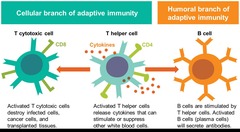
What cluster of differentiation (CD) protein is found on T cytotoxic cells?
CD8
What cluster of differentiation (CD) protein is found on T helper cells?
CD4
What do T helper cells secrete to activate other immune cells?
Cytokines
What cytokines do Th1 cells secrete?
Gamma interferon and others that activate macrophages

What is the role of Th2 cells?
To activate B cells and promote antibody production
What do Th17 cells recruit?
Neutrophils

What do T regulatory (Treg) cells do?
Suppress immunity and inflammation

What is clonal anergy?
A state of silence or unresponsiveness in T cells
How is TCR diversity generated?
Through genetic mechanisms like somatic recombination and random chain reassortment
What is the function of granzymes in Tc cells?
To induce apoptosis in target cells
What is the significance of antigen presentation by dendritic cells?
It drives the differentiation of naive CD4 Th cells into various Th subsets

What is the primary role of T cytotoxic (Tc) cells?
To kill cells displaying surface foreign antigens
What is the relationship between TCRs and MHC proteins?
TCRs bind to both self MHC and foreign peptides presented by MHC
What is adaptive immunity?
The acquired ability to recognize and destroy a pathogen, dependent on previous exposure.
How long does it take for adaptive immunity to fully activate?
4-7 days
What are the primary effector cells for adaptive immunity?
Lymphocytes (T and B cells)
What are the two parts of the adaptive immune system?
Cellular response (T cell-mediated immunity) and Humoral response (antibody-mediated immunity)
What is the goal of both the cellular and humoral responses?
To eliminate an identified antigen and remember it for faster future responses.
What do T lymphocytes express on their surfaces?
Antigen-specific receptors called T cell receptors (TCRs)
What are B cell receptors (BCRs)?
Membrane-bound immunoglobulins that serve as antigen-binding proteins on B cells.
What is the primary immune response?
The response generated upon the first exposure to an antigen.
What is the secondary immune response?
A faster and stronger response generated upon subsequent exposure to the same antigen.
What is tolerance in the immune system?
The acquired inability to produce an immune response to particular antigens.
What is positive selection in T cell development?
The process where T cells that recognize MHC-peptide complexes are retained.

What happens during negative selection in T cells?
T cells that strongly bind to self-antigens are eliminated.
What is clonal deletion in B cells?
The elimination of self-reactive B cells during their development in the bone marrow.
What are immunogens?
Substances that induce an immune response.
What is the difference between an antigen and an immunogen?
All immunogens are antigens, but not all antigens are immunogens.
What intrinsic factors determine immunogenicity?
Size, complexity, and physical form of the antigen.
What extrinsic factors affect immunogenicity?
Dose and route of administration.
What is an epitope?
The distinct portion of a molecule that antibodies or TCRs interact with.
What is a homologous antigen?
An antigen that induces the production of antibodies.
What is a heterologous antigen?
A non-inducing antigen that interacts with antibodies.
What is active immunity?
Immunity generated from exposure to an antigen, leading to memory cell development.
What is passive immunity?
Immunity that involves the transfer of pre-formed antibodies or immune cells.
What is natural active immunity?
Immunity developed after recovering from a disease.
What is artificial active immunity?
Immunity developed after receiving a vaccination.
What is natural passive immunity?
Immunity passed to infants through breast milk.
What is artificial passive immunity?
Immunity received through pre-formed antibodies (antiserum).
What are the two types of active immunity?
Natural and artificial active immunity.
What are the two types of passive immunity?
Natural and artificial passive immunity.
What is the role of B cells in the immune response?
B cells produce antibodies and present antigens to helper T cells.
What do B cell receptors (BCRs) do?
BCRs encounter external antigens and internalize them for presentation.
What are plasma cells?
Plasma cells are differentiated B cells that produce antibodies.
What is the function of memory cells?
Memory cells provide long-term protection against previously encountered antigens.
What are antibodies also known as?
Immunoglobulins (Igs).
How do antibodies neutralize toxins or viruses?
By binding to them and preventing their harmful effects.
What is opsonization?
The process by which antibodies bind to foreign cells, making them easier for phagocytes to engulf.
How many antibody isotypes are there?
Five: IgG, IgA, IgM, IgE, and IgD.
What is the most common antibody in the body?
IgG.
What is the structure of IgG?
IgG has four polypeptide chains: two heavy and two light chains.
What are the two forms of IgA?
IgA can be a monomer or a dimer.
What is the role of IgM?
IgM is produced early in infection and can be a monomer or pentamer.
What is the function of IgE?
IgE fights parasites and mediates allergic responses.
What is the function of IgD?
IgD is present in serum but has no known function; it is the rarest antibody.
What is the primary antibody response?
The initial response to an antigen, producing short-lived plasma cells and mostly IgM.
What happens during the secondary antibody response?
Memory cells activate without T cell help, producing more antibodies (mostly IgG) quickly.
What is an antibody titer?
A measure of the concentration of antibodies in the blood.
What contributes to the diversity of antibodies?
Somatic recombination, random heavy and light chain reassortment, and hypermutation.
What are complementarity-determining regions (CDRs)?
Regions in variable domains that determine the specificity of antibody-antigen interactions.
What is somatic hypermutation?
The mutation of immunoglobulin genes at higher rates, leading to affinity maturation.
What is allelic exclusion in B cells?
Only one allele of an antibody gene is expressed, ensuring a single specificity per B cell.
How many possible antibodies can be expressed due to random reassortment?
At least 3,360,000 possible antibodies.
What is the significance of the antigen-binding site in antibodies?
It is formed by the interaction of heavy and light chains, allowing for specific antigen recognition.
What is the role of variable domains in antibodies?
Variable domains differ in amino acid sequence, allowing for diverse antigen binding.