gen bio outline 6 & 7 (membrane & transport, metabolism)
 Call Kai
 Learn
Learn Practice Test
 Spaced Repetition
 Match
Match Flashcards
 Knowt Play
1/62

There's no tags or description
Looks like no tags are added yet.
Name | Mastery | Learn | Test | Matching | Spaced | Call with Kai | Chat |
|---|
No analytics yet
Send a link to your students to track their progress
63 Terms
Membrane Components
Membrane protein
Carbohydrates
But PRIMARLY phospholipids
Bilayer formation
forms spontaneously
amphipathic nature (hydrophobic+hydrophilic) due to phospholipid shape
held together by hydrophobic interactions (van der wals)
Phospholipids
Main Structural component of membranes
Gylerol + 2 fatty acid tails (hydrophobic) + phosphate-head group (hydrophilic)
Forms a phospholipid bilayer
Membrane proteins
determine many membrane functions
can be on one side or transmembrane (span across the membrane)
Some move within the membrane
Some cannot move
amphipathic nature
Why can’t some membrane proteins move?
Attached to ECM (extracellular matrix) or cytoskeleton
Membrane protein FUNCTIONS:
transport
enzyme activity
signaling/communication
cell-to-cell recognition
attachment to cytoskeleton & ECM
structure
Carbohydrates
polysaccharides attached to protein (glycoprotein) or lipid (glycolipid)
primarily cell identification
Fluid Mosaic Model
fluid-membrane components can move laterally within the membrane
Mosaic-emergent properties of the membrane as a whole due to the combination and arrangement of components
Membrane Transport
plasma membrane is selectively permeable (only some molecules can go through)
2 types of transport
Passive Transport
does NOT need metabolic energy (ATP)
net movement down a concentration gradient (molecules travel spontaneously from a highly crowded area to a less crowded area)
simple diffusion, osmosis, facilitated diffusion
results in dynamic equilibrium
Diffusion
tendency for molecules of a substance to fill an available space due to random constant molecule motion
What can diffuse directly across a membrane?
small nonpolar molecules
VERY small polar molecules
ex: gas, H2O, small hydrocarbons
No ions or charged molecules AT ALL
Dynamic Equilibrium
no NET movement at equilibrium; reactions do NOT stop; molecules keep changing back and forth. (ex: water bottle; water evaporates into gas and condenses back into liquid at the same speed)
Osmosis
diffusion of water across selectively permeable membrane
Solvent
a substance capable of dissolving other substances, the medium in which something is dissolved (ex: water)
Solute
a dissolved substance (ex: salt)
Direction of osmosis determined by…
difference in total solute concentration
Water diffuses from:
Lower solute concentration to higher solute concentration
Tonicity
ability of a solution to cause a cell to gain or lose water
Isotonic
solute concentration outside = solute concentration inside
no net H2O movement (water molecules flow into and out of a cell at exact same rate, so cell stays the same size and does not swell or shrink)
Hypertonic solution
solute concentration outside > solute concentration inside
cell loses H2O
Hypotonic solution
solute concentration outside < solute concentration inside
cell gains H2O
What can’t diffuse directly across a membrane?
Large molecules (too big)
Ions and anything charged (even H+)
Non-small polar molecules (even a lil bigger than H2O)
Faciltated Diffusion
passive transport through a transport protein
Doesn’t need ATP
Transport protein specific to the substance that’s transported
2 types
channel (no change in shape)
carrier (change in shape)
Active Transport
requires ATP
works against concentration gradient (building the gradient, moving molecules from a less crowded area to a highly crowded area)
Transport through a carrier protein
ex: sodium-potassium pump
Sodium-Potassium Pump
each cycle requieres one ATP
Using energy to build gradients
Bulk transport
transport many molecules at once using vesicles
not carrier mediated, type of active transport; always requires ATP
enter/exit cell WITHOUT crossing bilayer
Exocytosis
Vesicle containing water/secretory products fuses with plasma membrane
releases content form cell
adds lipids to plasma membrane (primary mechanism to grow plasma membr.)
Endocytosis
materials taken into the cell by forming vesicles from the plasma membrane
Phagocytosis and Pinocytosis
(cells swallow large things outside of them by wrapping their outer skin around the material to bring it inside- folding the plasma membrane inwards)
Phagocytosis
large food particles, bacteria-eating
Pinocytosis
fluids and dissolved molecules, cellular-drinking
Metabolism
Sum of all chemical reactions and energy transformations in an organism
emergent property of life
regulated to maintain homeostasis
Metabolic Pathways
series of chemical reactions, each involves energy transformation
each step catalyzed(stimulated) by specific enzyme
Anabolic pathway
synthetic, requires energy—making new bonds
simple molecules → complex molecules
builds larger molecules from smaller ones
ex: making polypeptide from amino acids
Catabolic pathways
break bonds, releases energy—large molecules are broken into smaller ones
complex molecule → simple molecules
ex: cellular respiration
energy (E)
the capacity to do work (or supply heat), 2 forms of energy
Kinetic
energy of motion
Potential
stored energy, the capacity to do work
1st law of thermodynamics
Energy cannot be created nor destroyed, only converted from one form to another—”principle of conservations of energy”
2nd law of thermodynamics
every energy transfer or transformation increases entropy in the universe
Entropy (S)
measure of disorder, randomness; represents energy that isn’t usable—disperses into the environment
ex: heat released during respiration
Energy flow through ecosystems
series of energy conversions
(source of E) sun →stored as chemical E → converted to ATP → ultimately lost as heat
no conversion is 100% efficient
Car internal combustion engine ~20-30% efficient
Cells ~40% efficient
Free energy (G)
energy available to do work— E we can use
can’t measure directly, can measure change (△G)
Free energy in cells:
potential E stored in covalent bond:
Build new bonds → store E = +△G
kinetic E released when bonds are broken:
Break bonds → release E = -△G
exergonic (catabolic)
-△G
E released
spontaneous, just happens, no E required
endergonic (anabolic)
+△G
E stored
not spontaneous, requires E input
Adenosine triphosphate
high-energy molecule (3 phosphate groups)
primary energy molecule of the cell
How do cells use ATP?
coupled reactions
pair endergonic reaction (requires E) with exergonic reaction (provides the E)
exergonic reaction often involves ATP hydrolysis
Exergonic reactions need…
often too slow to be useful so need a catalyst—chemical that speeds a reactions w/o being consumed
Enzymes decrease Activation Energy
initial energy needed to start a reaction
Causes reaction to occur faster – cannot cause reaction that wouldn’t happen anyway
Enzyme structure
globular proteins
substrate
enzymes are specific
Enzyme function
enzymes work by forming enzyme substrate complex (attaching to specific molecule)
globular proteins
often have grooves due to 3° or 4° structure
Active site: region that interacts with the substrate
substrate
any substance acted upon by an enzyme
Induced Fit
enzyme changes shape slightly after binding to substrate for better fit, causes slight change in substrate, facilitates breaking/forming bonds
Why redox reactions matter?
make bonds → store E; break bonds → releases E
(Breaking bonds always requires energy, while making bonds always releases energy)
requires: electron transfer
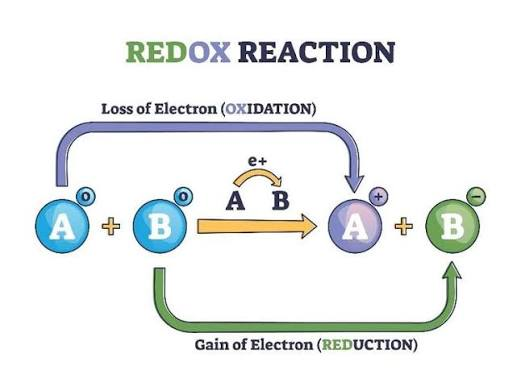
Redox Reactions
involve the movement/tranfer of an electron (e-)
Oxidation and reduction always happen together
electrons alone are difficult to remove from covalent compound
Oxidation
donating an electron (losing e-)
Reduction
accepting an electron (gaining e-)
Oxidizing agent
e- acceptor, becomes reduced
Reducing agent
e- donor, becomes oxidized
A+ is ___ and B- is ___
Oxidized, Reduced
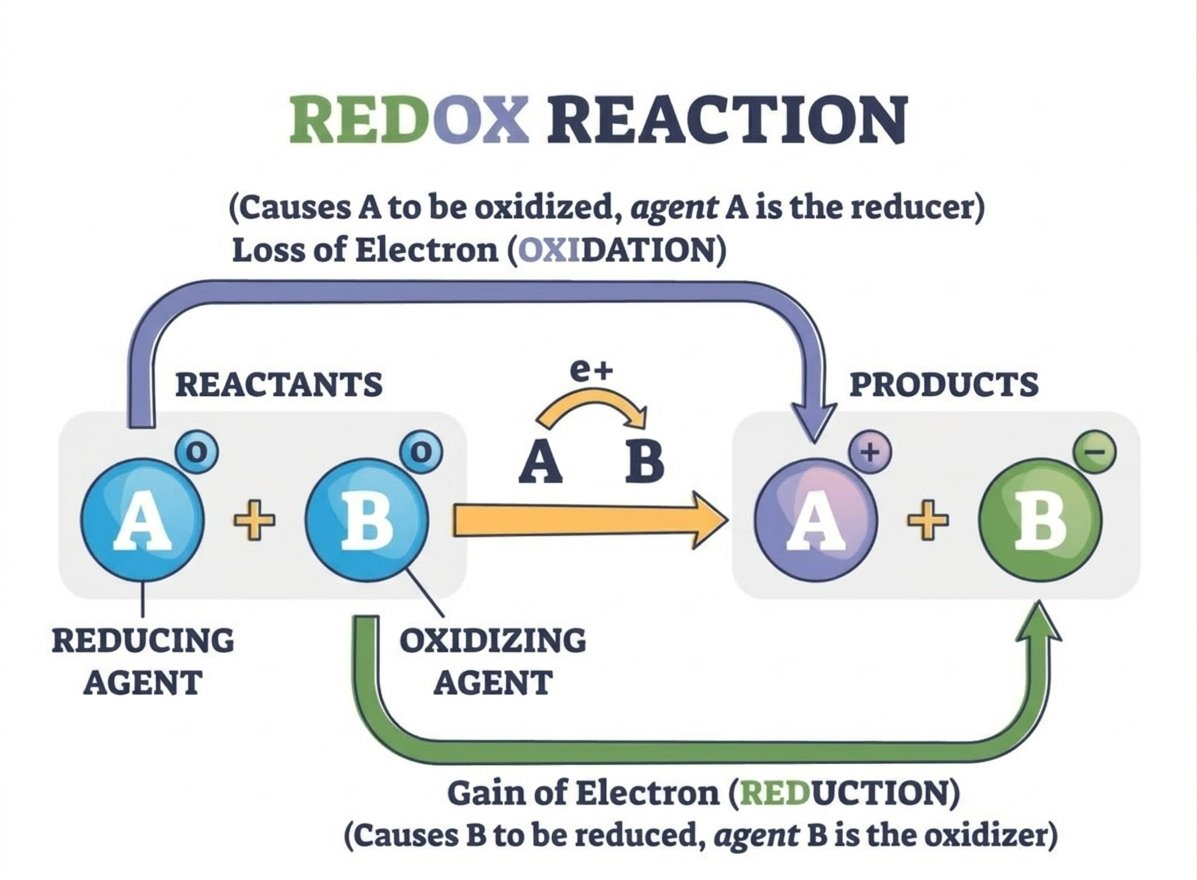
Ao is ___ and Bo is ___
reducing agent, oxidizing agent