R4 - Epidemiology ,pathology and aetiology of asthma and COPD
 Call Kai
 Learn
 Practice Test
 Spaced Repetition
 Match
 Flashcards
 Knowt Play
1/23

There's no tags or description
Looks like no tags are added yet.
24 Terms
What is a respiratory disease?
●Respiratory diseases affect the airways, lungs, and breathing processes.
●Two major chronic respiratory diseases:
○Asthma
○Chronic Obstructive Pulmonary Disease (COPD)
●Both involve airflow limitation but differ in causes, pathology and progression.
What is asthma?
Asthma is a chronic respiratory condition usually associated with airway inflammation and hyperresponsiveness, characterised by:
-Reversible airflow obstruction
-Airway hyperresponsiveness ( exaggerated narrowing of airways due to trigger)
-Episodic symptoms (wheezing, cough, dyspnoea, chest tightness)
What is the epidemiology of asthma ?
epidemiology - the scientific study of how often diseases and health events happen in groups of people and why

What is the economic impact of asthma?
direct costs
prescriptions, hospital stays, GP appointments
indirect costs
school and work absences, loss of productivity
social, psychological
What is the pathology of asthma?
The scientific study of how diseases originate, develop, and cause structural and functional changes in the body's cells, tissues, and organs.
2 phases :
early phase
late/chronic phase

Describe the early phase in asthma?
Initial exposure- Contact with a trigger prompts the immune system to create specific immunoglobulin E antibodies
Chemical release - Mast cells release histamine and leukotrienes (potent inflammatory chemicals).
Vascular changes - Permeability changes so blood vessels become leaky, causing bronchial walls to swell with fluid (oedema).
Mucus plugging - Goblet cells are stimulated to secrete thick, excess mucus, further trapping air in the lungs.
The clinical result: sudden onset of wheezing, coughing, chest tightness and shortness of breath.
Rapid smooth muscle contraction (bronchospasm) → acute asthma attack.
Describe the late chronic phase in asthma?
Airway remodelling:
Chronic inflammation :
bronchial smooth muscle hypertrophy ( cellular enlargement or involuntary thickening of tissue)
the formation of new vessels
interstitial collagen deposition ( the abnormal build-up of structural collagen proteins in the interstitial space)
which results in persistent airflow obstruction
Note - usually happens when asthma inflammation is poorly controlled, recurs frequently, long-term cellular remodelling permanently alters the airway architecture

What is the pathophysiology of asthma?
The study of how disease or injury affects the normal physiological function of the body.
Pathophysiology
Bronchospasm + Oedema + Mucus: Wheeze, shortness of breath, chest tightness.
Mucus Plugging & Epithelial Damage: Persistent, often nocturnal cough.
Airway Hyperresponsiveness (AHR): Exaggerated bronchoconstrictor response to sub-threshold stimuli (e.g., histamine, cold air, exercise).
Diurnal Variation: Symptoms typically peak early morning/late night due to circadian cortisol and autonomic tone changes.
What is the aetiology of asthma?
The causes or origins of disease
The why
No single cause of asthma ,certain environmental and genetic factors are known to contribute to the development of the condition

What can the aetiology of asthma be categorised into ?
Intrinsic ( host predispositions - individual susceptibility)
genetics
atopy
female hormones
Extrinsic (environmental drivers)
allergens
pollutants
occupational exposures
viral infections
smoking
How is air pollution linked to asthma?
Air pollution
Particulate matter pollution-particles and traffic-related pollutants (e.g. NO₂, PM2.5-10) irritate the airways.
Pollutants promote oxidative stress and airway inflammation, increasing bronchial hyperresponsiveness and worsening asthma control.
Exposure is associated with increased risk of wheeze, respiratory symptoms and asthma exacerbations.
Poor air quality is linked to ~ 33% of UK childhood asthma cases
What are some ways you could minimise air pollution?

How does poor housing link to asthma?
Poor housing –
Dampness, inadequate insulation, and poor ventilation trap moisture and indoor pollutants
Contributing to extreme temperatures.
Damp conditions promote mould and dust mite proliferation, releasing allergens that trigger airway inflammation.
Worsening asthma control and increasing the risk of severe exacerbations.
What are the different types of asthma?
Atopic – IgE antibodies (classic asthma),viral
Non-atopic – no allergen sensitisation – normally a viral infection
Drug-induced (talk about triggers next time)
Occupational – from stimulants
Exercise- induced
Summary of asthma
Asthma is a heterogeneous, chronic inflammatory airway disorder driven by combined genetic and environmental factors.
Pathology involves both acute inflammatory mediator release (early phase) and cellular recruitment/remodeling (late/chronic phase).
Airway remodelling leads to irreversible loss of lung function if chronic inflammation remains uncontrolled
What is COPD?
Chronic Obstructive Pulmonary Disease (COPD)
A progressive chronic inflammatory lung disease characterised by:
-Persistent airflow limitation
-Poor reversibility
-Chronic bronchitis and/or emphysema
common symptoms: chronic cough,sputm production,breathlessness
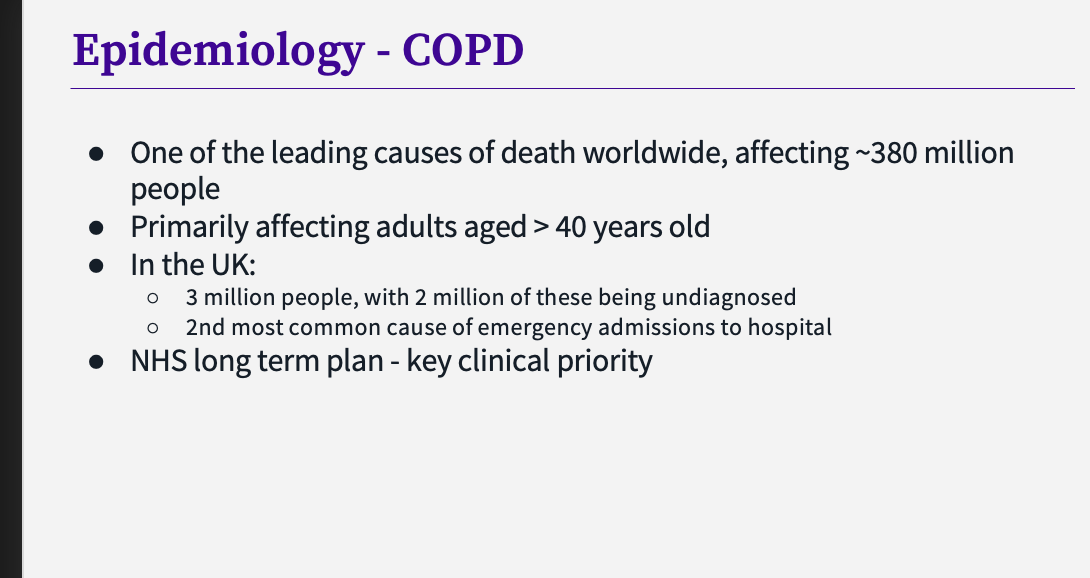
What is the epidemiology of copd?
Second most common lung disease
under-diagnosed
inequalities in diagnosis, quality in care
socioeconomic determinants of health- worse outcome sin low income populations
healthcare burden on locality ( emergency care,drug budgets,home oxygen)
What is the pathogenesis of COPD?
Pathogenesis is the step-by-step biological process by which a disease originates, develops, and progresses inside the body.
The exact mechanism is not known; it likely activation of the innate and adaptive immune systems
Generally:
The inhalation of noxious agents, such as cigarette smoke, leads to the activation of parenchymal cells, which in turn recruit additional inflammatory cells from the systemic compartment into the resident tissue and airway (cytokine- and chemokine-mediated)
imbalance between proteases/antiproteases and an imbalance between oxidants and antioxidants (oxidative stress)
What is the pathology of COPD?
Chronic inflammation → Lung tissue remodelling → Airway obstruction
●Chronic neutrophilic inflammation, oxidative stress and protease-antiprotease imbalance
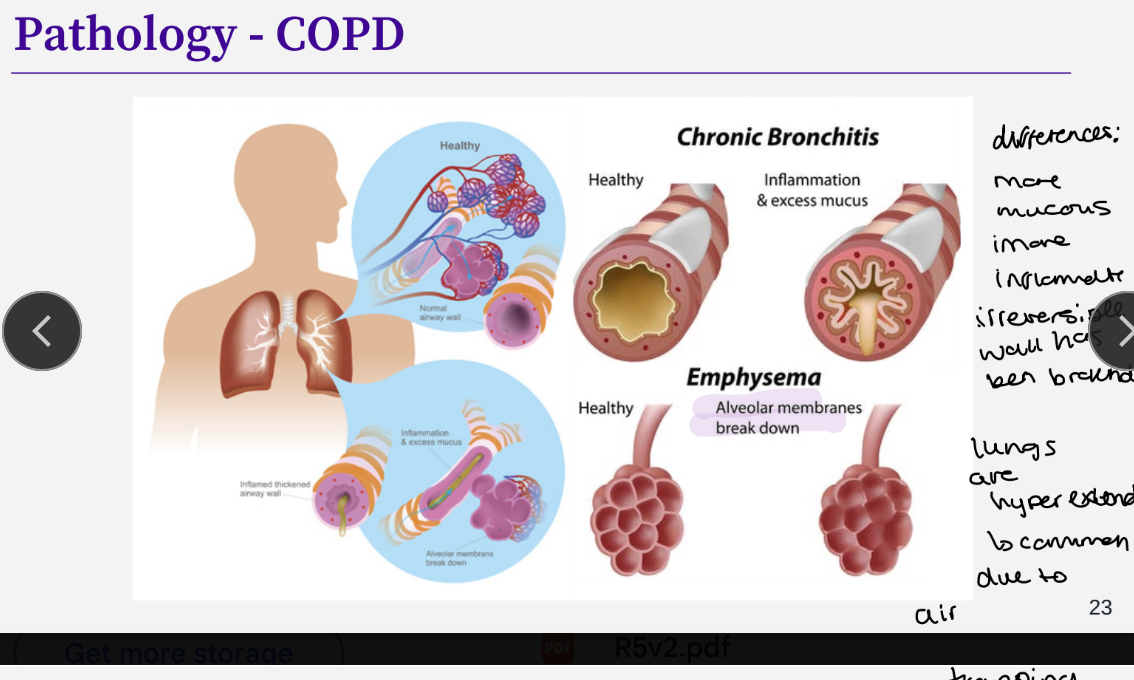
●Structural alterations combine small airway narrowing (chronic bronchitis) with alveolar destruction (emphysema), leading to loss of elastic recoil and irreversible air trapping.
What are the forms of COPD?
Can be broadly divided into: Bronchitis & Emphysema
Bronchitis = inflammation of the bronchioles
Emphysema = abnormal permanent enlargement of the airspaces distal to the terminal bronchioles, accompanied by destruction of their walls

What is the pathophysiology of copd?
Progressive airflow limitation that is not fully reversible, associated with an abnormal inflammatory response of the lungs to noxious particles or gases
Combination of airway inflammation, increased smooth muscle tone, small airway destruction, pulmonary hyperinflation and excessive mucus secretion leads to gradual decline in lung function and reduced gas exchange efficacy
Management aimed at managing exacerbations and improving symptoms and quality of life - there is no cure
Symptoms = Shortness of breath + Reduced exercise tolerance, chronic cough & wheeze
What is the Aetiology of COPD?
Risk factors:
Tobacco smoking is the major risk factor for COPD; most cases are attributed to a current or past history of smoking (around 75%)
Ambient air pollution: fine particulate matter and NO2 contributing to disease acceleration
Occupational exposures to dust and chemicals
Childhood respiratory illnesses (including TB & RSV)
Advancing age & low socioeconomic status
Biomass fuel & indoor pollution (including wood-burning stoves) primary cause amongst non-smokers
How do genetic factors link to COPD?
Alpha-1 antitrypsin deficiency is the most common genetic cause
Protective protein that prevents enzymatic damage of lung tissue
Increased risk of early-onset COPD (even in non-smokers)
Other genetic variations can affect lung function, airway remodelling, and susceptibility to environmental triggers
Summary of asthma and copd
Major chronic respiratory diseases - high prevalence
asthma more common in childhood; COPD is more common in adults above 40
Both involve airflow limitation, but with different mechanisms:
Asthma: reversible airway inflammation often triggered by allergens
COPD: complex, progressive disease driven primarily by long-term inhalation of noxious particles (most commonly cigarette smoke) combined with genetic vulnerability.
Understanding pathology and causes helps treatment strategies
smoking cessation singe biggest impact on health outcomes of patients with COPD
