Neurotransmitters, Synapses, and Nervous System Structure - Chapter 6 Part 3-4
 Call Kai
 Learn
Learn Practice Test
 Spaced Repetition
 Match
Match Flashcards
 Knowt Play
1/70

There's no tags or description
Looks like no tags are added yet.
Name | Mastery | Learn | Test | Matching | Spaced | Call with Kai | Chat |
|---|
No analytics yet
Send a link to your students to track their progress
71 Terms
What is a neuroeffector junction?
A synapse where neurons of the PNS connect to muscle, gland, or other cells.
What happens at neuroeffector junctions?
The neurotransmitter is released from the efferent neuron, diffuses to the effector cell, and binds to its receptors.
What are the two types of receptors on effector cells?
Ionotropic and metabotropic receptors.
What is a neuronal synapse?
An anatomically specialized junction between two neurons.
What are the two types of neuronal synapses?
Chemical and electrical synapses.
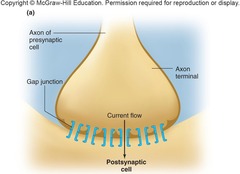
How do electrical synapses work?
Presynaptic and postsynaptic cells are connected by gap junctions, allowing electrical activity to pass directly.
What occurs at chemical synapses?
Presynaptic neurons release neurotransmitters that bind to receptors on postsynaptic neurons.
What is the process of neurotransmitter release?
Involves docking of vesicles at the presynaptic terminal and fusion with the membrane to release neurotransmitters.

How is the signal terminated in a chemical synapse?
By removing unbound neurotransmitters through reuptake, degradation in glial cells, diffusion, or enzymatic transformation.
What is an excitatory postsynaptic potential (EPSP)?
A depolarizing graded potential that brings the postsynaptic membrane potential closer to threshold.

What is an inhibitory postsynaptic potential (IPSP)?
A hyperpolarizing graded potential that decreases the likelihood of the postsynaptic cell reaching threshold.
What ion channels are typically activated by EPSPs?
Na+ ion channels.
What ion channels are typically activated by IPSPs?
K+ or Cl- ion channels.
What is synaptic summation?
The process where EPSPs and IPSPs combine at the axon hillock to determine if an action potential will occur.

How do drugs affect synaptic transmission?
By interfering with or stimulating processes in neurotransmitter synthesis, storage, release, and receptor activation.
What is the effect of tetanus toxin on synaptic transmission?
It destroys SNARE proteins, preventing vesicle fusion and inhibiting neurotransmitter release, causing spastic paralysis.
What is the effect of botulinum toxin on synaptic transmission?
It blocks neurotransmitter release by destroying SNARE proteins, leading to flaccid paralysis.
What therapeutic uses does botulinum toxin (Botox) have?
Treating facial wrinkles, severe sweating, uncontrollable blinking, and misalignment of the eyes.
What is the role of glial cells in neurotransmitter removal?
They can transport neurotransmitters for degradation.
What is the function of gap junctions in electrical synapses?
They allow direct electrical communication between presynaptic and postsynaptic neurons.
What is the primary function of excitatory synapses?
To increase the likelihood of the postsynaptic neuron firing an action potential.
What is the primary function of inhibitory synapses?
To decrease the likelihood of the postsynaptic neuron firing an action potential.
What is the significance of the axon hillock in synaptic transmission?
It is the site where summation of EPSPs and IPSPs occurs to determine action potential generation.
What is the role of neuromodulators?
Neuromodulators modify the postsynaptic cell's response to neurotransmitters, amplifying or dampening synaptic activity.
How do neurotransmitters affect postsynaptic cells?
Neurotransmitters influence ion channels that directly affect excitation or inhibition of the postsynaptic cell.
What is the difference in the time scale of neurotransmitter and neuromodulator effects?
Neurotransmitters act within milliseconds, while neuromodulators can take minutes to days for their effects.
Name a major neurotransmitter found at the neuromuscular junction.
Acetylcholine (ACh)
What are cholinergic neurons?
Neurons that release acetylcholine.
What enzyme degrades acetylcholine?
Acetylcholinesterase
What happens when acetylcholinesterase is inhibited?
It causes a buildup of ACh in the synaptic cleft, leading to overstimulation of postsynaptic receptors.
What are nicotinic receptors?
Ligand-gated ion channels that are stimulated by acetylcholine and nicotine, permeable to Na and K.
What is the function of muscarinic receptors?
G-protein coupled receptors that activate enzymes or ion channels, present in the brain and parasympathetic pathways.
How does Alzheimer's disease affect cholinergic neurons?
It leads to degeneration of cholinergic neurons, resulting in decreased ACh and cognitive decline.
What percentage of people over age 65 are affected by Alzheimer's disease?
10% to 15%
What are biogenic amines?
Small, charged molecules synthesized from amino acids, including dopamine, norepinephrine, serotonin, and histamine.
What are catecholamines?
A class of biogenic amines that include dopamine, norepinephrine, and epinephrine, formed from the amino acid tyrosine.

What is the role of monoamine oxidase (MAO)?
Enzyme that breaks down catecholamine neurotransmitters in the extracellular fluid and axon terminal.
From which amino acid is serotonin produced?
Tryptophan
What amino acid is histamine derived from?
Histidine
What is the primary function of acetylcholine in the PNS?
To transmit signals at the neuromuscular junction.
What is the effect of nerve gas Sarin on acetylcholine?
It inhibits acetylcholinesterase, causing excessive stimulation of muscles.
What are the protective elements associated with the brain?
Meninges, cerebrospinal fluid, and the blood-brain barrier.
What is synaptic integration?
The process by which multiple synaptic potentials combine within a postsynaptic neuron.
What is synaptic strength?
The efficacy of synaptic transmission, influenced by factors like neurotransmitter release and receptor sensitivity.
What role do glial cells play in the nervous system?
They support, nourish, and protect neurons.
What is the resting membrane potential?
The electrical potential difference across the membrane of a resting neuron, typically around -70mV.
What are action potentials?
Rapid, temporary changes in membrane potential that propagate along the axon of a neuron.
What neurotransmitters are utilized by adrenergic receptors?
Norepinephrine (NE) and epinephrine (Epi)
Where is norepinephrine found?
In both the central nervous system (CNS) and peripheral nervous system (PNS)
What is the primary function of alpha-adrenergic receptors?
To stimulate or inhibit K channels postsynaptically and inhibit the release of NE presynaptically
What are the subclasses of beta-adrenergic receptors?
Beta_1 (β_1), Beta_2 (β_2), and Beta_3 (β_3)
How do beta-adrenergic receptors increase cellular activity?
By acting via stimulatory G proteins to increase cAMP in postsynaptic cells
What is serotonin also known as?
5-hydroxytryptamine (5-HT)
What is the primary role of serotonin in the nervous system?
It acts as a neuromodulator involved in various brain and spinal cord functions
Where is the majority of the body's serotonin found?
Approximately 90% is found in the digestive system
What is the mechanism of action for selective serotonin reuptake inhibitors (SSRIs)?
They inactivate the presynaptic membrane serotonin transporter, preventing reuptake of serotonin
What effect does LSD have on serotonin receptors?
It stimulates a subtype of serotonin receptor, causing intense visual hallucinations
What are the most prevalent neurotransmitters in the CNS?
Amino acid neurotransmitters
Which amino acid neurotransmitters are associated with excitatory synapses?
Aspartate and glutamate
What role does glutamate play in the CNS?
It is the primary neurotransmitter at 50% of excitatory synapses
What are the two subtypes of ionotropic glutamate receptors?
AMPA receptors and NMDA receptors
What is long-term potentiation (LTP)?
A synaptic modulation process involving cooperative activity of AMPA and NMDA receptors

What is the major inhibitory neurotransmitter in the brain?
GABA (gamma-aminobutyric acid)
How does GABA affect the postsynaptic membrane?
It increases Cl- flux into the cell, resulting in hyperpolarization
What is the effect of benzodiazepine drugs on GABA receptors?
They increase Cl- flux through the GABA receptor, reducing anxiety and inducing sleep
What are neuropeptides?
Short chains of amino acids linked by peptide bonds, acting as neuromodulators
Name an example of a synthetic opioid.
Morphine or codeine
What distinguishes gas neurotransmitters from traditional neurotransmitters?
They diffuse from their sites of origin and do not bind to postsynaptic receptors
What is the role of nitric oxide (NO) in the body?
It acts as a vasodilator
What are purines in the context of neurotransmitters?
ATP and adenosine, acting principally as neuromodulators
What are cannabinoids and their primary psychoactive component?
They are lipid-derived substances; THC is the principal psychoactive component of cannabis