L05 speech production
 Call Kai
 Learn
 Practice Test
 Spaced Repetition
 Match
 Flashcards
 Knowt Play
1/26

There's no tags or description
Looks like no tags are added yet.
27 Terms
speech production
mental processes that convert ideas into sounds
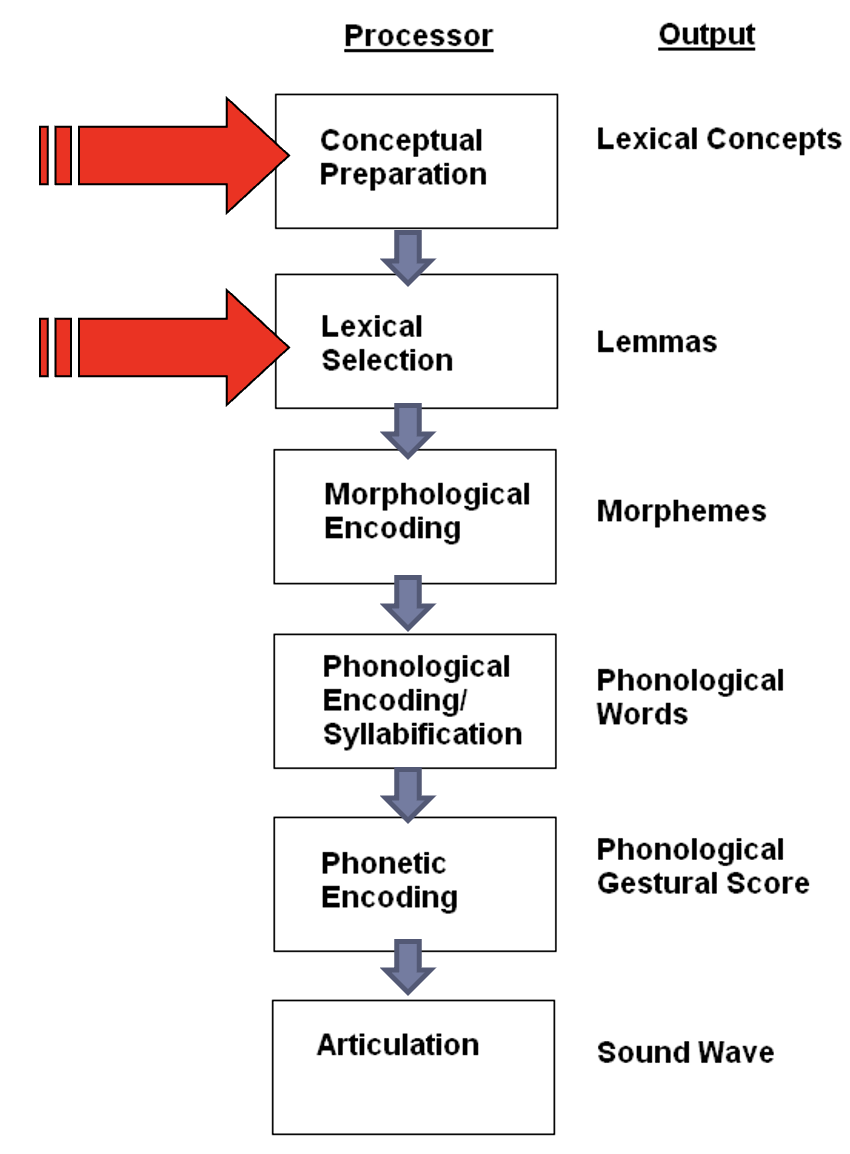
basic processes in production
conceptualisation
formulation
articulation
WEAVER
Model of speech production
World Encoding by Activation and VERification
by Levelt 1989

lexical concepts
concepts for which your language has a specific word
e.g. “mare” vs “female elephant”
lemmas
a mental rep that incorporates semantic (meaning) and syntactic (combinatory) information
morphemes
language “atoms”; smallest unit of language that carries meaning
e.g. eat vs eats vs eating vs ate
phonological word
a set of speech sounds produced as a single unit (=/= word)
e.g. “he will escort us” —> /ess-core-tuss/
phonological gestural score
detailed map of phonemes and syllables needed for an utterance, as well as metrical info (e.g. stress), used to plan specific motor movements
–E.g. “banana” —> σ σ’ σ
–vs. “Panama” —> σ’ σ σ
evidence for WEAVER-style models
3 kinds of studies:
speech errors
tip of the tongue experiences
picture-naming studies
1/ speech errors general idea
errors are not random
=> systematic patterns : each type of error provides info about how diff components work
a) semantic substitution errors
b) sound exchanges
c) word exchange errors
a) semantic substitution errors
e.g. “dog” for “cat”
concepts stored in LTM
activation spreads across concepts with similar meanings
==> reflects conceptual preparation or lexical selection component
can also happen at level of lemma
b) sound exchanges
most occur within the same phrase
most involve mvm of only single pair of phonemes
most respect the positional constraint (onsets/codas exchange w onsets/codas)
bc planning unit = syllable
=> suggests articulatory plan is built for no more than one phrase at a time
c) word exchange errors
e.g. “my piano plays the gf”
obey the category constraint (parts of speech)
reflects clause-level planning
frame & slot model
layout frame at planning stage, slots labelled, more than one candidate with same tag activated, wrong one assigned to slot
2/ tip-of-the-tongue
you have the correct lemma
you don’t have all the phonemes
=> distinction b/w semantic activation & phonological activation processes
phonological encoding = culprit

tip-of-the-tongue data/research methods
diary methods
prospecting: induce TOT & ask detailed questions about xp
how much info do ppl have about target word?
cf. slide 13
during tip-of-the-tongue, what happens?
accurately predict whether they will come up with the correct word soon (so not failure to activate meaning)
report the correct number of syllables (so correct lemma activated)
accurately report the first phoneme (so some phonological info)
are more accurate about the beginning & end phonemes than the middle
report words that sound like the target
have more TOT’s for less frequent words
resolve about 40% of TOT’s within a few seconds to a few minutes (so temporary failure of phonological activation)
picture-naming studies (1)
1/ activation of of diff concepts at about same speed
picture-recognition speed is constant
picture-naming depends on word frequency, less frequent names => longer
=> amount of time taken to plan response affected more by frequency of producing sound that label concept than by frequency of thinking about it
picture-naming studies (2)
2/ concepts compete for selection
stored in LTM
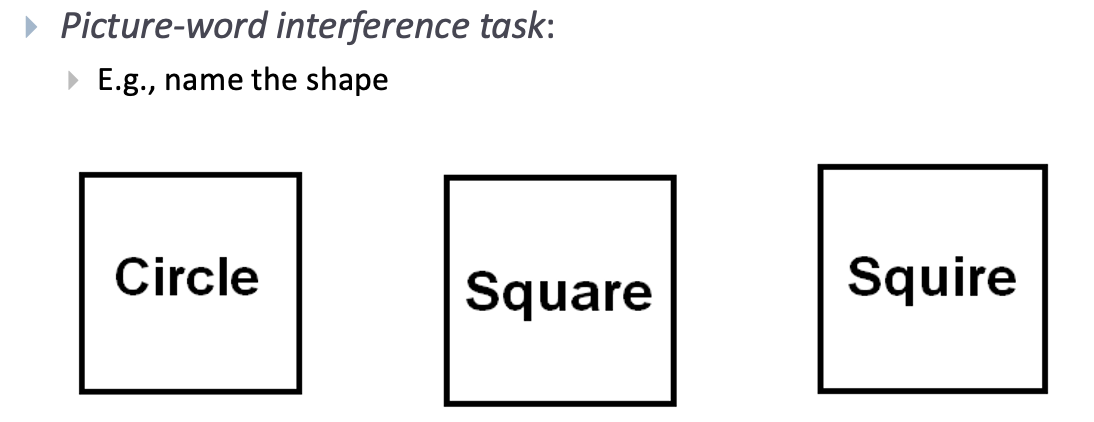
picture-word interference task (e.g. in image)
semantic identity and phonological conditions
controlled by semi-independent processes
reinforces distinction b/w semantic activation & phonological activation
spreading activation model vs weaver++
weaver = feedforward pattern of activation
spreading activation = interactive (feedback + activation cascades through system, info forward + backward flow)

evidence for feedback general
1/ lexical bias fx
2/ errors respect phonotactic constraints, almost never violate rules of how phonemes can be combined
3/ mixed errors
lexical bias fx
errors more likely than chance to produce real words
common w 2 real words
big feet => fig beet > big horse => hig borse
BC feedback from phonological to lemma level

3/ mixed errors
word substations sound like & have similar meaning to target
e.g. lobster for oyster > octopus for oyster
=> phonological-lemma feedback during lemma selection
potential limitations of lemma theory
lemma reps include info about a word’s grammatical ft. - how the word can combine with other words
so damage to lemma => affect spoken and written output in same way
BUT some make errors during spoken but not written or vice versa
Caramazza 1997 proposes…
diff sources of word form info: one for written, one for spoken
to check : Also that grammatical info stored separately from lemma representations, so problems with function or content words
self monitoring & self repair
self repair happens after error
self monitoring helps prevent overt errors (pre-output monitoring)
self monitoring & self repair evidence
when speakers make error, often they replace error with correct word immediately
speech planning takes (1/2 a sec) => error detected before spoekn