Chapter 8: Electron Configuration and Chemical Periodicity
 Call Kai
 Learn
 Practice Test
 Spaced Repetition
 Match
 Flashcards
 Knowt Play
1/27

28 Terms

Pauli exclusion principle
States that no two electrons in the same atom can have the same four quantum numbers
Within a specific sublevel and orientation, spin numbers must oppose each other, limiting the number of electrons in each orbital to 2
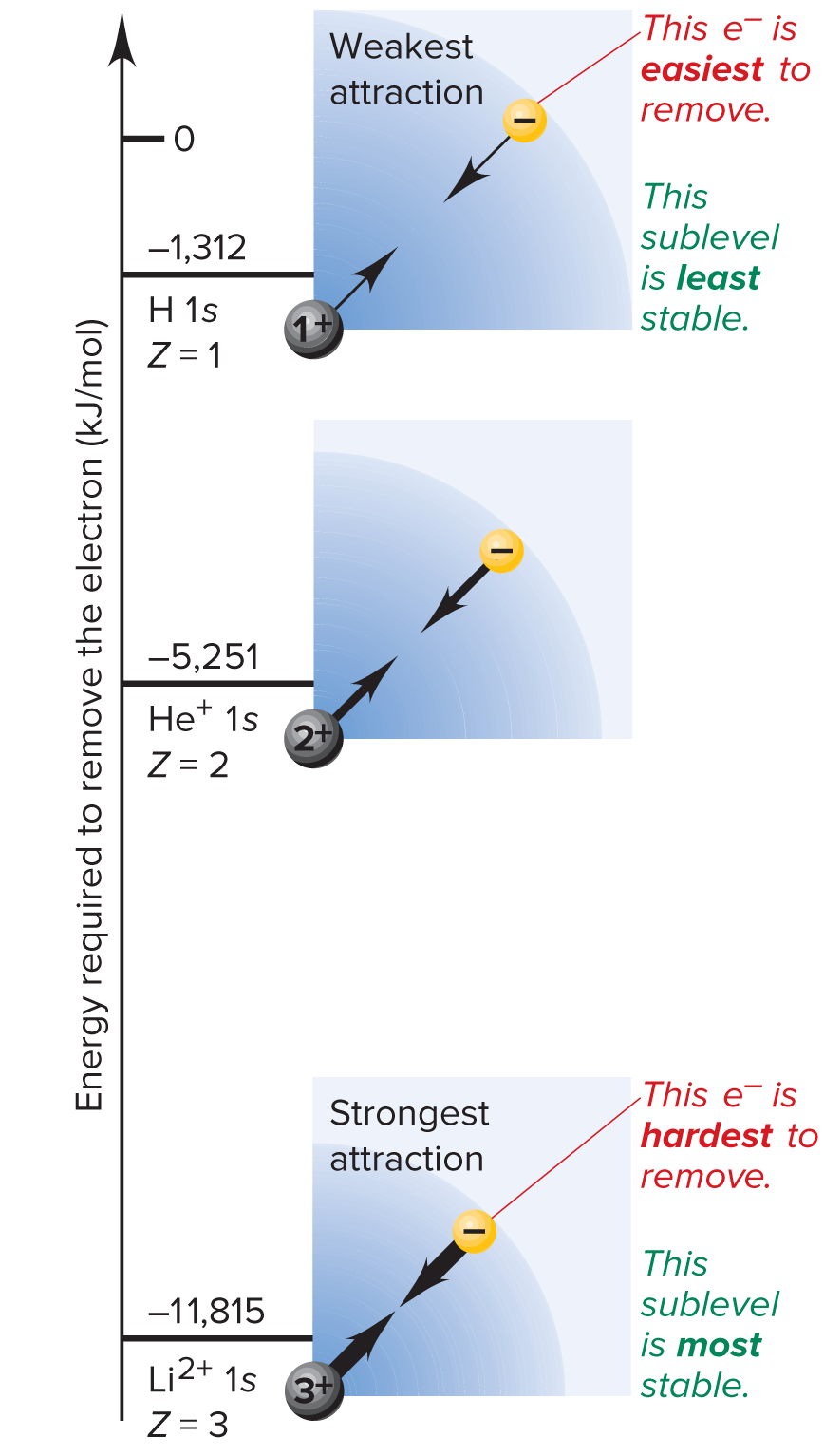
Nuclear charge (Z)
As this number increases, denoting more protons in the nucleus, sublevels are stabilized due to increased nucleus-electron attractions
Results in more energy being needed to remove a specific electron
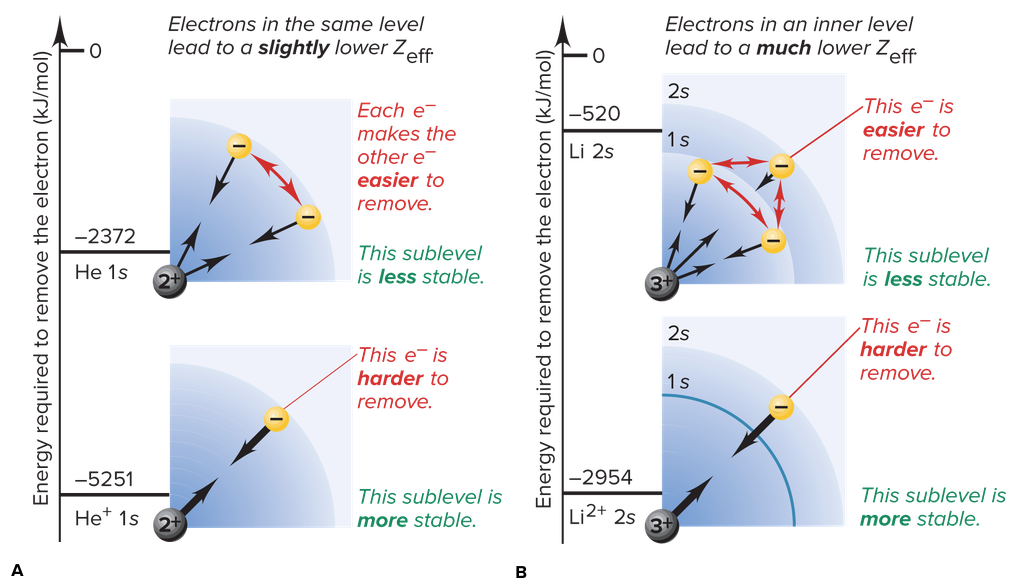
Shielding
The ability of other electrons to lessen the nuclear attraction for an outer electron through repulsion, creating a lower effective nuclear charge (Zeff) and enabling easier transfers
Primarily performed by electrons in the same or inner energy levels

Penetration
The phenomenon in which an outer electron moves through the region occupied by the core electrons to spend part of its time closer to the nucleus
This increases effective nuclear charge and decreases the effects of shielding by other electrons
Ground-state configuration
The lowest energy distribution of electrons in the levels and sublevels of atoms
Aufbau principle
An approach for building up atoms by adding one proton and one electron at a time to obtain the ground-state configurations of elements
Electron configuration
A way to notate the distribution of electrons in sublevels using the form nl# (like 2s2)

Orbital diagram
A way to visualize electron distributions via boxes filled with up to 2 arrows representing each energy level and electron spin
Filled according to the lowest and least repulsive electron orbital available

Hund’s rule
States that lowest energy electron configurations maximize unpaired electrons with parallel spins

Partial orbital diagram
An electron diagram with only the filled sublevels present
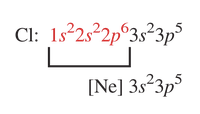
Condensed electron configuration
A way to write the electron configuration using the noble gas from the previous row to represent the configuration prior to the filled electrons
Cl can be written as [Ne] 3s23p5

Transition elements
An element that occupies the d or f block of the periodic table with those orbitals filled last
Fills after the next energy level’s s sublevel due to penetration causing lowered energies
Half-filled and filled sublevels, though, may fill first due to greater stability (Cr has [Ar] 4s13d5 and not 4s23d4 — this also applies to Cu filling 3d early)

Inner electrons (core electrons)
Electrons an atom has in common with the previous noble gas and any completed series

Outer electrons
Electrons with the highest energy level (n) that are farthest from the nucleus
These correlate with similar chemical behavior due to electron interactions

Valence electrons
Electrons involved in forming compounds
These are the outer electrons for main-group elements, and include the previous block’s d sublevel as well for transition elements

Atomic size (atomic radius)
A measure of how closely one atom lies next to another, determined from the distances between nuclei of atoms
Knowing the value of this for an element in a bond can help in finding this for another atom
Increases with n and decreases with Zeff due to electrons being present in more distant energy levels or pulled closer to the nucleus

Metallic radius
The atomic size as defined for metals, equal to half of the shortest distance between atoms in a crystal of the element

Covalent radius
The atomic size as defined for molecules and nonmetals, equal to half of the shortest distance between nuclei of bonded atoms

Ionization energy (IE)
The required energy input for the removal of 1 mol of electrons from 1 mol of gaseous atoms or ions
Can be described as part of a series, numbered with subscripts to refer to removal order
Can be used to determine reactivity, as low values create cations while high values create anions given greater nuclear attraction
Decreases down a group (lower Zeff, except for group 13)
Increases across a period (greater Zeff, except for group 13 and 16 for periods 2 and 3 due to greater stability)
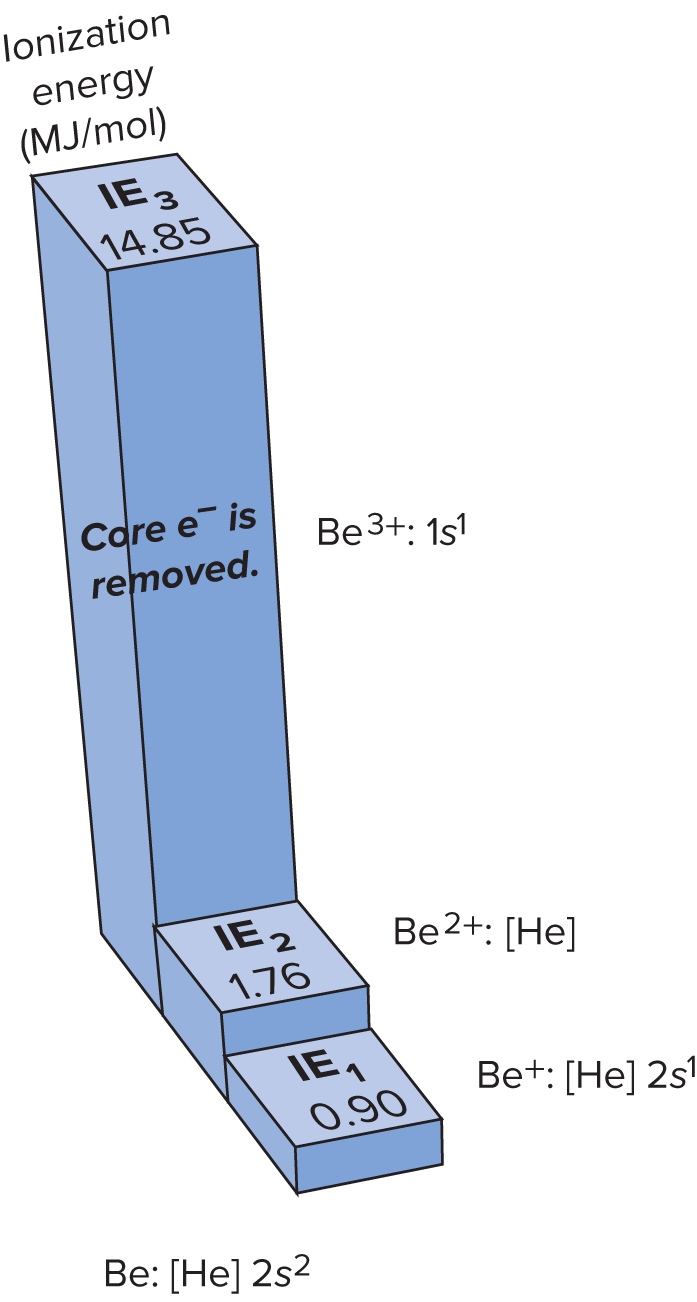
Core electrons
These are the most difficult to remove due to needing a large ionization energy after removing the valence electrons, thus not being involved in reactions

Electron affinity (EA)
The energy change after the addition of 1 mol of electrons to 1 mol of gaseous atoms or ions
First is typically negative due to attraction, as energy is released
Second is always positive, as energy must be absorbed to add another electron
While sublevel energies and repulsions affect trend regularity, some can be stated:
Very exothermic for reactive nonmetals due to negative attraction
Slightly exothermic for reactive metals, due to positive ion affinity instead
Slightly endothermic for noble gases, due to little electron attraction
Metallic behavior
The properties of being shiny, conductive, ductile, malleable, and generally positive; these decrease going across a period and increase going down a group
Electron loss
A property of metals relating to charge that:
Increases down a group due to lower Zeff and IE
Decreases across a period due to higher Zeff and IE
Creates strong reducing agents in lower groups, and strong oxidizing agents in higher groups

Redox behavior
A property of metals in aqueous solutions that:
In lower groups (metals): Involves electron transfer to form ionic oxides, which create bases by generating OH- in water (like MgO + H2O → Mg2+ + 2OH-)
In higher groups (nonmetals): Involves electron sharing to form covalent oxides, which create acids by releasing H+ in water (like SO3 + H2O → 2H+ + SO42-)
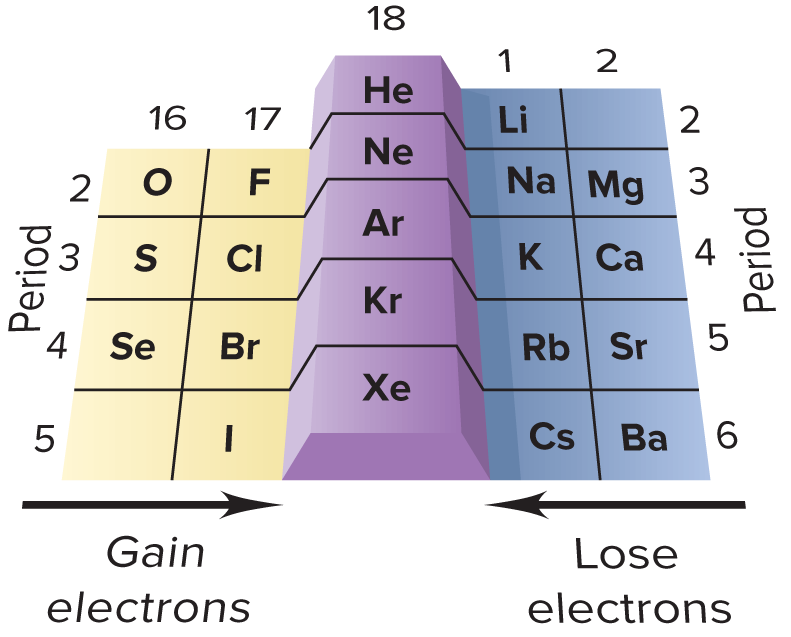
Isoelectronic
Having the same number and configuration of electrons as another species
Elements at either end of a period typically target a similar configuration to noble gases, forming anions or cations for full sublevels
Transition metals lose ns# sublevels first
Electrons lost or gained must be denoted as e-

Paramagnetic
A species with at lest one unpaired electron that is attracted by an external magnetic field
Includes many transition metals and their compounds due to unpaired electrons

Dimagnetic
A species with all paired electrons that are not attracted by a magnetic field
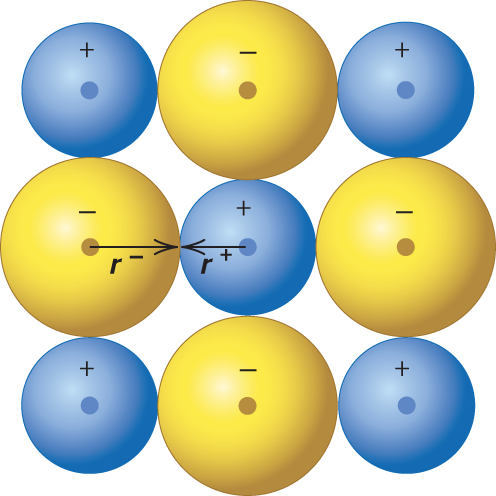
Ionic radius
The size of an ion, measured through nuclear distance between ions in a crystal
Cations become smaller due to weaker pull of electrons
Anions become larger due to greater pull of electrons
Can be ordered by first accounting for n, then realizing that increasing Zeff reduces size after adding or removing electrons (important when isoelectronic)