Drugs Affecting Cardiac Rhythm
 Call Kai
 Learn
 Practice Test
 Spaced Repetition
 Match
 Flashcards
 Knowt Play
1/48

There's no tags or description
Looks like no tags are added yet.
49 Terms
Normal duration of PR interval
120-200 ms
Normal duration of QRS interval
60-100 ms
abnormal if above 120 ms
Normal duration of QT interval
~400 ms
abnormal if below 390 or above 450
a prolonged PR interval is a red flag for
AV conduction issues
A prolonged QT interval is a red flag for
arrhythmia risk (Torsades de pointes)
These classes of antiarrhythmias are mainly for rhythm control// restoring normal sinus rhythm and often lead to what change in the ECG?
Class I (Na+ blockers)
Class III (K+ blockers)
widen QT interval
These classes of antiarrhythmias are mainly for rate control// restoring normal sinus rhythm and often lead to what change in the ECG?
Class II (Beta-blockers)
Class IV (Ca2+ blockers)
Digoxin
affect the PR interval
Common side effects of Class I antiarrhythmics
proarrhythmic risk
quinidine —> cinchonism
Torsades de pointes
procainamide —> Lupus-like symptoms
Common side effects of Class II antiarrhythmics
Bradycardia
bronchospasm
fatigue
Common side effects of Class III antiarrhythmics
Amiodarone → pulmonary toxicity
thyroid dysfunction
hepatotoxicity
blue skin
Common side effects of Class IV antiarrhythmics
heart block
hypotension
Common side effects of Adenosine as an antiarrhythmic
transient asystole
flushing
chest discomfort
Common contraindications of Class I antiarrhythmics
Avoid class IC (flecainide) in structural heart disease (e.g. heart failure)
Common contraindications of Class II antiarrhythmics
avoid in:
asthma
severe bradycardia
Common contraindications of Class III antiarrhythmics
Should be avoided in severe lung disease like COPD (e.g. avoid Amiodarone)
Common contraindications of Class IV antiarrhythmics
avoid in:
heart failure
high-degree AV block
(Ca+ channel blockers selectively affect SA nodal tissue)
Amiodarone has a ______ T1/2 (half-life) such that the patient should _________
LONG (20-100 days); be continuously monitored
Adenosine has a _______ T1/2 (half-life) such that the patient should ________
SHORT (<10 sec); rapidly metabolize the drug
Quinidine (IA):
Oral Bioavailability:
T1/2:
Metabolism/Clearance:
Oral Bioavailability: ~80%
T1/2: 6-8 hrs
Metabolism/Clearance: Hepatic metabolism (CYP3A4)
Lidocaine (IB):
Oral Bioavailability:
T1/2:
Metabolism/Clearance:
Oral Bioavailability: IV → 100% bioavailable
T1/2: 1-2 hrs
Metabolism/Clearance: Hepatic clearance
Flecainide (IC):
Oral Bioavailability:
T1/2:
Metabolism/Clearance:
Oral Bioavailability: ~90%
T1/2: 12-20 hrs
Metabolism/Clearance: Hepatic/Renal Clearance
Metoprolol (II)
Oral Bioavailability:
T1/2:
Metabolism/Clearance:
Oral Bioavailability: ~50%
T1/2: 3-7 hrs
Metabolism/Clearance: Hepatic Metabolism
Verapamil (IV):
Oral Bioavailability:
T1/2:
Metabolism/Clearance:
Oral Bioavailability: ~20-35% (LOW)
T1/2: 3-7 hrs
Metabolism/Clearance: Hepatic Metabolism
Digoxin:
Oral Bioavailability:
T1/2:
Metabolism/Clearance:
Oral Bioavailability: ~70-80%
T1/2: 30-48 hrs
Metabolism/Clearance: N/A
Class IA drugs are for rhythm control in _____________ arrhythmias. An example is _________ for A-fib
Atrial/Ventricular; quinidine
Class IB drugs are for rhythm control in _____________ arrhythmias. Some examples are _________ and _________, usually post-MI
Ventricular; Lidocaine, Mexilitine
Class IC drugs are for rhythm control in _____________ arrhythmias and sustained ventricular tachycardia. An example is _________ for paroxysmal A-fib
Supraventricular arrhythmias; flecainide
Class ID drugs are for rhythm control to suppress ____________, an example is the drug ________
V-Tach; Ranolazine
Class II/IV drugs are for rate control in _______ (arrhythmia type). Examples are _________ and __________
A-Fib; metoprolol and diltiazem
Class III drugs are for rhythm control in _____________ arrhythmias. An example is _________
A-fib/VT; amiodarone
drug that can treat acute SVT
adenosine
drug that slows AV nodal conduction for Afib
Digoxin/Magnesium
Ivabradine (class 0) targets _______________ (arrhythmia/dysfunction) by selectively blocking the If “funny” currents in the SA node
Sinus Tachycardia
Ranolazine (class Id) targets _____________ (arrhythmia/dysfunction) by inhibiting the late inward sodium current (INa,L) - prevents Ca+ overload —> QT prolongation and risk of torsades
Chronic Angina
Adenosine (class IIe) targets _____________ (arrhythmia/dysfunction) by acting as an A1 receptor agonist hyperpolarizing the AV node and causing a transient therapeutic asystole
Acute SVT
Digoxin (class IId) targets _____________ (arrhythmia/dysfunction) by inhibiting Na+/K+ ATPase and enhancing central vagal tone
A-Fib for rate control thereof
Magnesium sulfate (unclassified) targets _____________ (arrhythmia/dysfunction) by blocking Ca+ (naturally) and therefore suppressing early afterdepolarizations
Torsades de Pointes and digitalis-induced arhythmias
Class I antiarrhythmics serve as
sodium channel blockers
target Atrial and Ventricular Muscle (His-Purkinje Fibers)
Class II antiarrhythmics serve as
Beta Receptor Blockers
target SA and AV nodal cells
Class III antiarrhythmics serve as
Potassium Channel Blockers
target AP repolarization - blocking it to extend the QT interval
Class IV antiarrhythmics serve as
Calcium Channel Blockers (Non-Dihydropyridines)
target: SA and AV nodal cells (should not be used in combo w/ Class II (Beta Blockers))
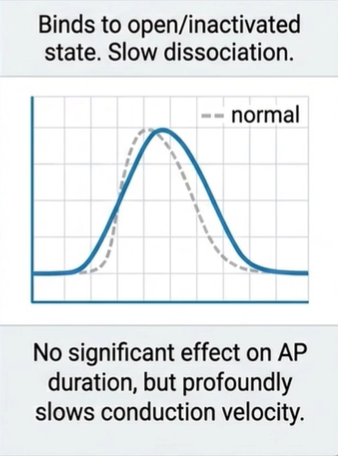
Class Ia
(intermediate)

Class Ib
(rapid)

Class Ic
(slow)
Types of SVT arrhythmias
A-Fib/Flutter
commonly associated with heart block, 50-250 bpm
atria quiver
can lead to formation of blood clots in the atria
AVNRT (AV nodal reentrant tachycardia) —> e.g. WPW syndrome
AVRT (AV reentrant tachycardia) —> often mimics V-tach
Junctional Tachycardia —> often seen in digitais toxicity or heart block
indicates a 1st degree heart block
prolongation of PR interval
indicates a 2nd degree heart block
intermittent failure of atrial impulses, dropping of QRS complexes
indicates a 3rd degree heart block
total electrical dissociation between the atria and ventricles
hypokalemia results in ________________ of the heart whereas hyperkalemia results in ___________ of the heart
uncontrolled acceleration of activity; stopping (inactivated Na+ channels due to sustained depolarization)