CTXT 121--Quiz 3 (Christian Empire)
 Call Kai
 Learn
 Practice Test
 Spaced Repetition
 Match
 Flashcards
 Knowt Play
1/44

There's no tags or description
Looks like no tags are added yet.
45 Terms
Arch of Constantine
Period: Late Antique
Location: Rome, Italy
Material: Marble (incorporating recycled reliefs/spolia)
Purpose: Triumphal arch built by the Senate to commemorate Constantine’s victory over Maxentius at the Battle of the Milvian Bridge, using spolia from earlier "good" emperors (Trajan, Hadrian, Marcus Aurelius) to associate Constantine with Roman stability and power.

Christian Community House, Dura Europos
Period: Early Christian
Location: Dura-Europos, Syria
Material: Mud brick, plaster, and paint
Purpose: Remodeled private home used as a covert place of Christian worship (domus ecclesiae) prior to the Edict of Milan, featuring a central courtyard, a meeting room for the Eucharist, and a dedicated baptistery with early wall paintings.

Painting in the Catacomb of Saints Peter and Marcellinus, Rome
Period: Early Christian
Location: Rome, Italy
Material: Fresco (pigment on plaster)
Purpose: Ceiling decoration in a subterranean burial chamber (cubiculum) depicting the Good Shepherd at the center surrounded by lunettes illustrating the story of Jonah, symbolizing salvation, resurrection, and eternal life.

Sarcophagus from Santa Maria Antiqua
Period: Early Christian
Location: Rome, Italy
Material: Marble
Purpose: Christian funerary chest featuring carved relief narratives, including Jonah and the whale, an orant figure, a philosopher reading, and the Good Shepherd, illustrating the early Christian syncretism of Classical motifs with Christian themes.

Old St. Peter’s
Period: Early Christian
Location: Rome, Italy
Material: Brick, stone, wood, and marble
Purpose: Monumental basilica built over the site of Saint Peter's tomb under Emperor Constantine; served as a pilgrimage church and burial site, establishing the classic early Christian longitudinal basilica layout with a nave, aisles, transept, and apse.

Santa Costanza (the Building and its vault mosaic)
Period: Early Christian
Location: Rome, Italy
Material: Brick, concrete, marble, and glass mosaics
Purpose: Mausoleum built for Constantine’s daughter, Constantina, designed on a central plan with a central dome supported by twelve pairs of columns and surrounded by an ambulatory featuring vault mosaics depicting grape harvesting (winemaking) as both pagan motifs and Christian Eucharistic symbolism.

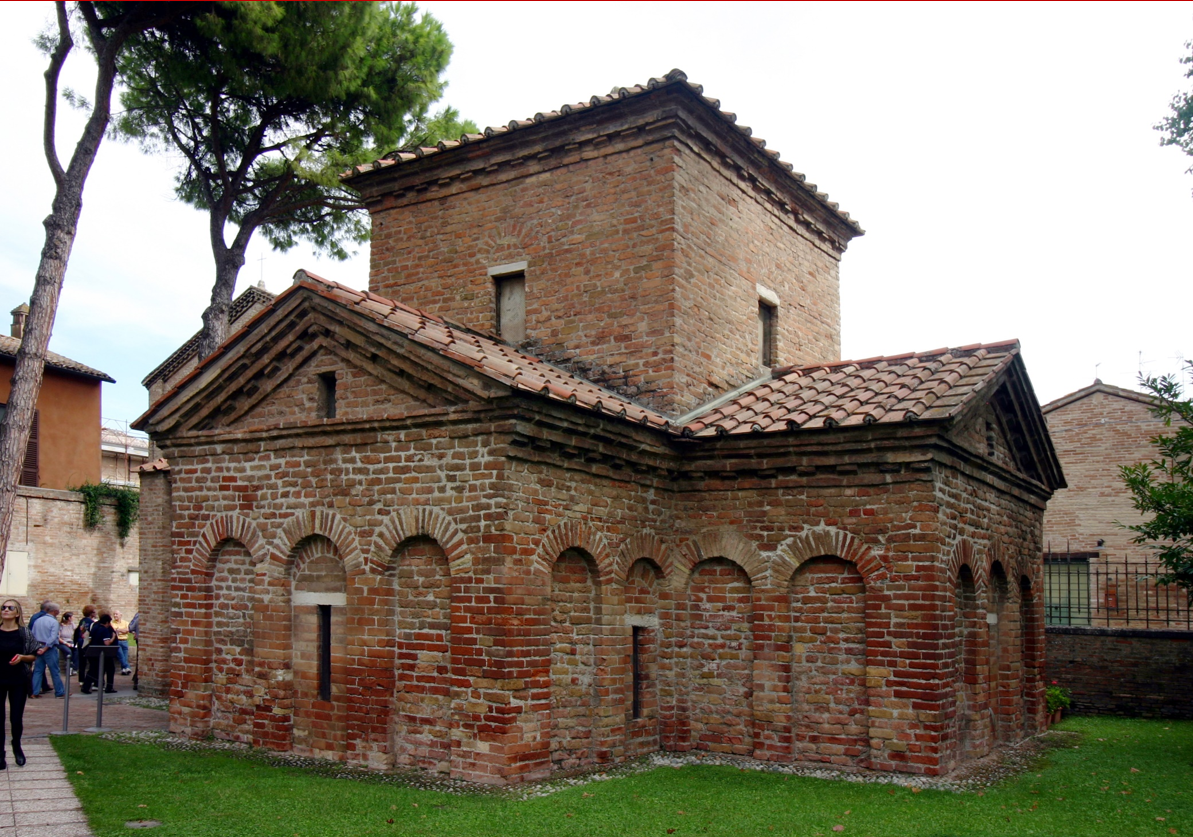
Mausoleum of Galla Placidia
Period: Early Christian
Location: Ravenna, Italy
Material: Brick, mortar, and glass mosaics
Purpose: Cruciform (cross-shaped) chapel/mausoleum housing exquisite internal glass mosaics, including Christ as the Good Shepherd dressed in royal imperial purple and gold among his flock.
Constantine
Period: Late Antique Location: Rome and Constantinople (Istanbul) Material: N/A (Historical Ruler) Purpose: First Christian Roman emperor who issued the Edict of Milan (313 CE) legalizing Christianity, relocated the imperial capital to Constantinople, and patronized monumental Christian building projects across the empire.
tessera
Period: Late Antique and Byzantine Location: Mediterranean basin Material: Glass, stone, marble, or metal foil leaf Purpose: A small cube-shaped piece of glass, stone, or ceramic used to construct intricate mosaic compositions on walls, floors, and vaults.
orant
Period: Early Christian Location: Catacombs and early Christian monuments Material: Fresco/Marble Purpose: A representation of a figure standing upright with hands raised outward in a traditional posture of prayer, symbolizing the soul of the deceased or divine devotion.
central plan
Period: Early Christian and Byzantine Location: Italy and the Byzantine Empire Material: N/A (Architectural layout) Purpose: An architectural design organized around a central focal point (often under a dome), such as a circle, octagon, or Greek cross, typically used for mausoleums, baptisteries, and martyria.
catacomb
Period: Early Christian Location: Subterranean outskirts of Rome and other Roman cities Material: Tuff (carved bedrock) Purpose: Underground network of galleries and burial chambers (cubicula) used by early Christians and Jews to bury the deceased and celebrate commemorative funerary meals (refrigeria).
nave
Period: Early Christian and Early Medieval Architecture Location: Christian basilicas Material: Stone/Brick/Wood Purpose: The long, tall central hall of a basilica church, flanked by side aisles, where the main congregation gathers during services.
ambulatory
Period: Early Christian and Byzantine Location: Central-plan churches and mausoleums Material: Stone/Brick/Concrete Purpose: A covered ring-shaped passage or aisle surrounding the central vaulted core/altar of a circular or octagonal building, allowing worshippers to walk around the interior.
transept
Period: Early Christian Architecture Location: Christian basilicas (e.g., Old St. Peter's) Material: Stone/Brick/Wood Purpose: An aisle crossing the main nave at right angles in front of the apse, giving the basilica floor plan its symbolic T-shape or Latin-cross shape while providing extra space for clergy and pilgrims.
apse
Period: Early Christian and Byzantine Location: End of the main nave of a church Material: Stone/Brick Purpose: A semi-circular niche, traditionally vaulted with a half-dome and located at the eastern end of a basilica, which housed the altar and the bishop's seat (cathedra).
longitudinal plan
Period: Early Christian Architecture Location: Christian basilicas Material: N/A (Architectural layout) Purpose: An elongated church plan (basilican plan) organized along a long central axis leading from the entrance (narthex) down the nave directly to the altar in the apse.
Byzantine
Period: Byzantine Empire (c. 330–1453 CE) Location: Eastern Roman Empire (capital: Constantinople) Material: N/A (Historical/Artistic Era) Purpose: Refers to the art, culture, and architecture of the Eastern Roman Empire, characterized by rich gold mosaics, spiritualized flat/stylized iconography, linear figures, and domed central-plan churches.
Hagia Sophia
Period: Byzantine (Architects: Anthemius of Tralles and Isidorus of Miletus)
Location: Constantinople (Istanbul, Turkey)
Material: Brick, mortar, stone, and marble, decorated with gold mosaic
Purpose: Commissioned by Emperor Justinian as the primary patriarchal cathedral of Constantinople; famous for its colossal central dome resting on pendentive arches, creating the visual effect of a dome suspended from heaven.

San Vitale (building and Mosaics with Justinian and Theodora)
Period: Byzantine
Location: Ravenna, Italy
Material: Brick, terracotta, marble, and glass mosaic
Purpose: Octagonal central-plan church housing iconic choir mosaics depicting Emperor Justinian and Empress Theodora carrying liturgical vessels, establishing their divine right to rule and their sacred connection to the church.

Apse Mosaic, Church of Saint Apollinaris in Classe
Period: Byzantine
Location: Ravenna, Italy
Material: Glass and stone mosaic
Purpose: Monumental apse composition depicting Saint Apollinaris standing in an orant posture in a lush green landscape beneath a large jeweled cross in a blue star-filled sky, symbolizing the Transfiguration.

Justinian
Period: Byzantine (6th Century CE) Location: Constantinople (Istanbul, Turkey) Material: N/A (Historical Emperor) Purpose: Byzantine emperor who codified Roman law (Corpus Juris Civilis), reconquered parts of the Western Empire, and directed massive architectural projects including Hagia Sophia and San Vitale.
Pendentive
Period: Byzantine Location: Domed architecture (e.g., Hagia Sophia) Material: Brick/Stone Purpose: A curved triangular wall section that transitions the structural weight from a circular dome down to four square supporting piers.
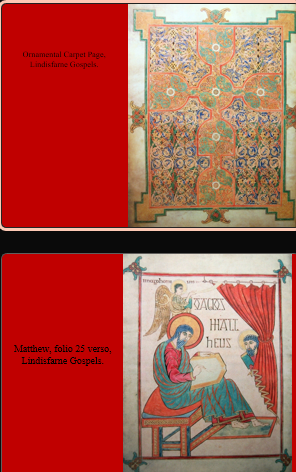
Lindisfarne Gospels (Carpet Page and St. Matthew)
Period: Early Medieval (Hiberno-Saxon/Insular)
Location: Lindisfarne Abbey, Northumbria, England
Material: Ink and tempera on vellum
Purpose: Illuminated manuscript gospel book created by Eadfrith; features complex interwoven geometric patterns (Carpet Page) and a portrait of Evangelist Matthew seated in his study with Greek-influenced labeling.
Purse Cover from Sutton Hoo
Period: Early Medieval (Anglo-Saxon)
Location: Sutton Hoo ship burial, Suffolk, England
Material: Gold, glass, and cloisonné garnet decoration
Purpose: Ornamental lid for a leather pouch found in a royal ship burial, decorated using the interlace style and animal style showing birds of prey and humans flanked by wolves.

Viking Animal-Head Post
Period: Early Medieval (Norse/Viking Art)
Location: Oseberg ship burial, Norway
Material: Carved wood
Purpose: Carved wooden post terminating in a roaring animal head with intricate interlace patterns, likely used for ceremonial rituals or displayed on a royal ship.

Portal of the Stave Church at Urnes, Norway
Period: Early Medieval (Viking/Norse Art)
Location: Urnes, Norway
Material: Carved timber (pine wood)
Purpose: Carved door frame of a wooden timber church featuring graceful, winding interlace panels showing stylized beasts wrestling with serpents, symbolizing the triumph of good over evil.

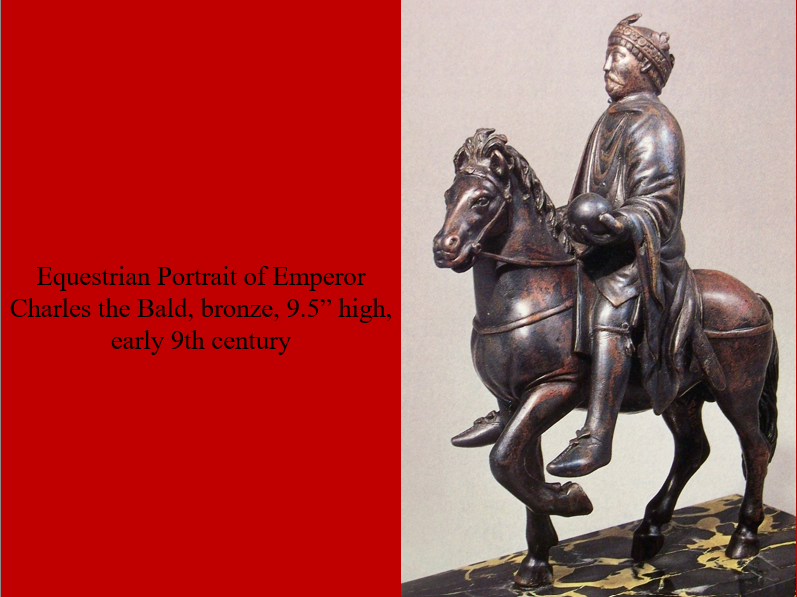
Equestrian Portrait of a Carolingian Ruler (Charles the Bald)
Period: Early Medieval (Carolingian)
Location: Metz, France
Material: Bronze
Purpose: Small bronze statuette modeling the emperor after ancient Roman equestrian monuments (like Marcus Aurelius), holding a globe to emphasize divine worldwide authority and imperial rebirth (renovatio imperii).
St. Matthew from the Coronation Gospels of Charlemagne
Period: Early Medieval (Carolingian)
Location: Aachen, Germany
Material: Ink and tempera on vellum
Purpose: Gospel book illustration displaying a revival of classical Roman painting traditions through dynamic brushwork, shaded drapery, and realistic volumetric modeling of the seated evangelist.

Palatine Chapel of Charlemagne
Period: Early Medieval (Carolingian; Architect: Odo of Metz)
Location: Aachen, Germany
Material: Stone, marble, and bronze
Purpose: Royal chapel of Charlemagne’s palace complex, modeled directly after the central octagonal plan of San Vitale in Ravenna to legitimize Charlemagne's claim as the successor to Roman and Byzantine emperors.

Plan for a Monastery at Saint Gall
Period: Early Medieval (Carolingian)
Location: Saint Gall, Switzerland
Material: Red ink on parchment
Purpose: Idealized architectural blueprint designed for a self-sufficient Benedictine monastic community, organizing a central church, cloister, scriptorium, workshops, and infirmary around a modular grid system.

Saint Michael’s, Hildesheim (Church, Doors)
Period: Early Medieval (Ottonian)
Location: Hildesheim, Germany
Material: Stone (building); cast bronze (doors)
Purpose: Double-ended Ottonian abbey church featuring monumental cast-bronze doors (Bernward Doors) depicting relief scenes of the Fall of Man on the left matched with the Redemption of Christ on the right.

Column of Bishop Bernward
Period: Early Medieval (Ottonian)
Location: Saint Michael’s, Hildesheim, Germany
Material: Cast bronze
Purpose: Monumental bronze column modeled after Trajan’s Column in Rome, featuring a continuous spiral relief winding upward that depicts key events from the life and ministry of Jesus Christ.

Otto III Enthroned, Gospel Book of Otto III
Period: Early Medieval (Ottonian)
Location: Reichenau, Germany
Material: Tempera on vellum
Purpose: Full-page manuscript illumination showing Emperor Otto III seated on a throne flanked by representatives of the Church and State, alongside female personifications of the provinces bringing tribute, asserting his sacred imperial rule.

codex
Period: Late Antique and Early Medieval Location: Roman Empire and Europe Material: Parchment or vellum bound together Purpose: A manuscript book constructed of bound pages sewn along one edge, replacing the older ancient scroll (rotulus) format for easier reading and reference.
westwork
Period: Early Medieval (Carolingian and Ottonian Architecture) Location: Entrance of western European churches Material: Stone/Brick Purpose: A massive, fortress-like western entrance facade containing two towers and multiple interior stories, serving as a monumental royal entrance and chapel space for emperors.
King Oswald of Northumbria
Period: Early Medieval Location: Northumbria, Anglo-Saxon England Material: N/A (Historical King) Purpose: 7th-century Christian Anglo-Saxon king of Northumbria who promoted the spread of Christianity across northern England and helped establish the monastery at Lindisfarne.
scriptorium
Period: Early Medieval Location: Monasteries across Western Europe Material: N/A (Architectural room/workshop) Purpose: A specialized writing and production room in a monastery where monk scribes and illuminators copied, transcribed, and decorated holy manuscripts.
crossing-square module
Period: Early Medieval Architecture Location: Carolingian and Ottonian churches Material: N/A (Architectural design principle) Purpose: A design unit formed by the intersection of the nave and transept (crossing), used as the standard base measurement to dictate all dimensions and proportions of the church layout.
St. Cuthbert
Period: Early Medieval Location: Lindisfarne and Durham, England Material: N/A (Historical Saint/Bishop) Purpose: 7th-century Anglo-Saxon monk, bishop, and hermit of Lindisfarne whose cult and relics inspired major Christian pilgrimages and illuminated manuscript artistic production.
scribe
Period: Early Medieval Location: Monastic scriptoria Material: N/A (Monastic role) Purpose: A trained monk or scholar responsible for hand-copying text onto parchment pages to create manuscripts.
illuminator
Period: Early Medieval Location: Monastic scriptoria Material: N/A (Monastic artist role) Purpose: An artist responsible for decorating manuscript pages with bright pigments, gold leaf, narrative illustrations, and intricate initials.
seated-author figure
Period: Late Antique and Early Medieval Location: Manuscript frontispieces Material: Tempera on vellum Purpose: A traditional portrait convention depicting an evangelist, scholar, or saint seated at a desk with writing tools, inspired by classical portraits of Roman philosophers.
parchment
Period: Late Antique and Early Medieval Location: Europe and Mediterranean Material: Prepared animal skin (typically sheep or goat) Purpose: A durable writing surface created by scraping and drying animal hide under tension, heavily used for copying codices and manuscripts.
vellum
Period: Late Antique and Early Medieval Location: Europe and Mediterranean Material: High-quality calfskin Purpose: A fine, supple grade of parchment prepared specifically from young calf hides, reserved for luxury illuminated manuscripts.