Human Biology by Sylvia Mader CH 1, 2, 3 - Aaron
 Call Kai
 Learn
 Practice Test
 Spaced Repetition
 Match
 Flashcards
 Knowt Play
1/123

There's no tags or description
Looks like no tags are added yet.
124 Terms
Levels of Organization
atoms, molecules, cells, tissues, organs, organ systems, populations, community, ecosystem, biosphere
metabolism
sum of reactions involved in life processes
photosynthesis
responsible for producing organic molecules that serve as food
Life must:
reproduce, experience growth, develop, acquire materials and energy from the environment, maintain homeostasis, respond to stimuli, adapt, and have an evolutionary history
Scientific Method Steps
observation, hypothesis using inductive reasoning, experimentation, make prediction, collect and analyse data, form a conclusion, present findings
matter
anything that takes up space and has mass.
composed of elements.
elements
basic building blocks of matter that cannot be broken down by chemical means
atoms
smallest units of an element that retain the element's physical and chemical properties
molecules
2+ atoms bonded together
atomic number
the number above the abbreviation

neutrons
uncharged subatomic particles
electrons
negatively charged subatomic particles that orbit the nucleus
Isotopes
atoms that have the same atomic number but different atomic mass because the number of neutrons differ
radioisotopes
useful in dating old objects, imaging body organs and tissues through X-rays, and killing cancer cells
Ionic bonds
atoms donate or take on electrons which results in a stable outer shell
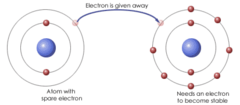
anion
negative charge
cation
positive charge
Covalent bonds
atoms share electrons that result in a stable outer shell

polar covalent bond
unequal sharing of electrons

non-polar covalent bond
evenly distributed electrons, no overall charge

hydrogen bonds
relatively weak bonds that occur between a hydrogen in a covalent bond and a negatively charged atom

Why is water the universal solvent?
it is polar
hydrophilic
interact easily with water
hydrophobic
do not interact well with water
Acids
dissociate and release H+ (hydrogen ions), but decrease pH of water.
Bases
take up H+ (hydrogen ions) or release OH- (hydroxide ions), but increase pH of water
pH scale
measure of hydrogen ion concentration that reflects whether a solution is acid or basic (alkaline). 7 is neutral, 0 is acidic and 14 is basic.

buffers
help cells and organisms maintain a constant pH.
organic molecules
carbohydrates, lipids, proteins, and nucleic acids
macromolecule
contains many subunits
Dehydration reaction
type of synthesis reaction where a water molecule is removed as the molecule forms
Hydrolysis reaction
components of water are added during the breaking of the bond between the molecules
Carbohydrates
monosaccharides, disaccharides, and polysaccharides that function as immediate energy and stored energy as well as structural molecules.

lipids
fats, oils, phospholipids, and steroids that function as long-term energy storage and membrane components.

proteins
structural, enzymatic, carrier, hormonal, and contractile that function as support, metabolic transport, regulation, and motion.

Nucleic acids
DNA and RNA that store genetic information

pH logarithmic scale
The concentration of Hydrogen ions between each whole number changes by a factor of 10.
What are carbohydrates made of?
C, H, and O in which the H and O atoms are in a 2:1 ratio. (C1H2O1)n
monosaccharides
a simple carbohydrate that has 1 carbon ring as found in glucose

disaccharides
a simple carbohydrate that has 2 carbon rings as found in maltose (2 glucose)

polysaccharides
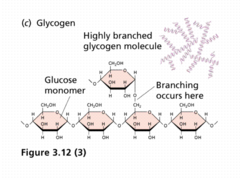
a complex carbohydrate with 3+ carbon rings. Either glycogen or starch.

glycogen
carbohydrate storage form in animals
starch
carbohydrate storage form in plants. (linear)

Where are lipids found?
cell membrane
Do lipids dissolve in water?
No. They are nonpolar.
How are lipids found?
fats, oils, phospholipids, and steroids
What is the structure of triglycerides?
1 glycerol molecule and 3 fatty acids.

What does saturated mean?
All carbons are bonded with hydrogen.

What type of fat can the body not break down?
trans
Phospholipid
primary components of the cellular membrane

What is the structure of a phospholipid?
polar (hydrophilic) head with non-polar (hydrophobic) tails.

In phospholipids, one fatty acid is replaced by what?
a polar phosphate group

What is the structure of a steroid?
4 fused carbon rings

Examples of steroids
cholesterol and sex hormones (testosterone and estrogen)
amino acids
subunits that proteins are made up of
Why are proteins important?
hormones, enzymes, antibodies, and transport
denature
undergo a change in 3-dimensional shape that causes loss of function
What is the structure of an amino acid?

Examples of amino acids
valine, glutamic acid, lysine, tryptophan, aspartic acid, and cysteine
4 levels of protein organization
primary, secondary, tertiary, quaternary
dipeptide
2 amino acids
What are nucleic acids made of?
nucleotide subunits
What is the function of nucleic aicds?
make proteins
What are the three parts of a nucleotide?
phosphate group, sugar, nitrogen-containing base

What bases pair in DNA?
A pairs with T and G pairs with C

DNA
Double stranded with deoxyribose. Long term information storage.
RNA
Single stranded with ribose. Short term information storage.
What are the bases of RNA?
A, U, C, and G

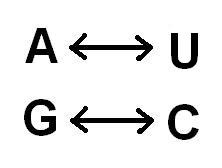
How do RNA bases pair?
A and U, G and C
Cell Theory
basic unit of life
all living things are made up of cells
new cells arise from pre-existing cells
Prokaryotic cells
thought to be 1st cells to evolve
Which cells don't have nuclei?
prokaryotic
How are prokaryotic cells represented?
bacteria and archaea
Eukaryotic cells
Have a nucleus that houses DNA with many membrane-bound organelles. (only one domain)
Plasma membrane
surrounds and delineates the cell
cytoplasm
semi-fluid substance inside the cell that contains the organelles
5 ways things move across the plasma membrane
Diffusion, Osmosis, Facilitated Transport, Active Transport, and Endocytosis and exocytosis
Diffusion
random movement of molecules from a higher concentration to a lower concentration to attain equilibrium.

Osmosis
diffusion of water molecules across membrane
Isotonic
equal amount of solute inside and outside the cell
Hypotonic
have less solute than the inside of the cell and lead to lysis (bursting).
Hypertonic
have more solute than the inside of the cell and lead to crenation (shrivelling).
Facilitated Transport
transport of molecules across the plasma membrane from a higher concentration to a lower concentration via a protein carrier

Active Transport
movement of molecules from a lower concentration to a higher concentration using ATP as energy. It requires a protein carrier.

Endocytosis
transports molecules or cells into the cell via invagination of the plasma membrane to form a vesicle.
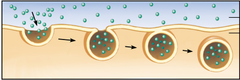
Exocytosis
transports molecules outside the ell via the fusion of a vesicle with the plasma membrane

What structures are involved in protein production?
Nucleus, ribosomes, and endomembrane system
Nucleus
bound by a porous nuclear envelope that houses chromatin (DNA with associated proteins).
What does the nucleolus contain?
rRNA (ribosomal RNA)
Cytoskeleton
Maintain cell shape and assists movements of cell parts
Microtubules
Cylinders of protein molecules present in cytoplasm, centrioles, cillia, and flagella
Immediate filaments
Protein fibers that provide support and strength
Actin filaments
Protein fiberd that play a role in movement of cell and organelles
Vesicle
Membrane-bounded sac that stores
cytoskeleton
maintains cell shape and assists in the movement of cell parts

microtubules
cylinders of protein molecules present in cytoplasm, centrioles, cillia, and flagella

immediate filaments
protein fibers that provide support and strength

actin filaments
protein fibers that play a role in movement of cell and organelles

lysosome
vesicle that digests micromolecules and cell parts

nuclear envelope
double membrane with nuclear pores that encloses nucleus
