Management Terms
 Call Kai
 Learn
Learn Practice Test
 Spaced Repetition
 Match
Match Flashcards
 Knowt Play
1/32

There's no tags or description
Looks like no tags are added yet.
Name | Mastery | Learn | Test | Matching | Spaced | Call with Kai | Chat |
|---|
No analytics yet
Send a link to your students to track their progress
33 Terms
Weber's bureaucratic management: TWO of its core principles and 1 example
Formal Rules/regs and clear hierarchy
University: Every standard procedure follows a set of written, published rules that apply equally to everyone, regardless of personal relationships. Ensures consistency & fairness
Taylor's Scientific Management ("one best way")
maximizing efficiency and productivity
systematically analyzing tasks using scientific methods (instead of tradition or individual worker judgment.)
select and train workers for specialized tasks
One best way - by scientifically studying a job = discover the single most efficient process
Larry Fink's 2026 letter to investors
To address rising economic anxiety and wealth inequality, society must move away from short-term market noise and expand participation in long-term capital markets.
As countries invest heavily in defense, energy, AI, and as technology creates massive asset value, prosperity will remain concentrated among asset owners unless more ordinary citizens are given pathways to invest in and grow alongside their country's economy.
Chobani CEO Hamdi Ulukaya and Humanistic Management
- He hired refugees, language support, and equal pay above the minimum wage.
- humanistic management: prioritizing human dignity, employee well-being.
- stakeholder purpose over the pure maximization of profit
- Treats workers not as replaceable costs or labor, but as respected human beings whose contributions and dignity are honored.
4 drives - Lawrence and Nohria
Acquire: Motivated by obtaining rewards, status, and recognition. (Example: Performance Bonuses)
Bond: Motivated by forming meaningful relationships, feeling connected,d and belonging. (Example: team building activities)
Comprehend/learn: Motivated by curiosity, growth, mastering skills, and making sense of the world. (skill-building workshops)
Defend: Motivated by protecting against threats, achieving security, and ensuring fairness (job security)
Hicks' 10 essential elements of dignity (3)
Hicks = I.B.A.
Inclusion: Creating a sense of belonging where team members feel welcomed, included in key discussions, and valued regardless of their status.
Benefit of the Doubt: Employee missing deadline, to assume people are trustworthy and have good motives, not that they are lazy. Being inquisitive about what might have happened
Accountability: taking responsibility for mistakes and acknowledging how to fix them next time
Barry-Wehmiller (BW) & "Truly Human Leadership."
During financial crises, instead of massive layoffs, shared sacrifices such as asking everyone, including leadership, to take short, unpaid temporary leave.
Measuring success not by financial profit alone, but by positively touching and improving the lives of their team members and employees.
Tuckman's five stages of team formation
Forming: Early days, learn about team goals and roles, be polite, tend to avoid conflict
Storming: expressing different ideas and opinions, conflict and disagreement emerge
Norming: establishes shared norms, expectations, and ground rules, building trust, mutual understanding, and cohesion.
Performing: high productivity and synergy; clear understanding of roles, and collaboration is efficient and effective in meeting goals.
Adjourning: Tasks or projects are completed; the team reflects on achievements, reaches closure, and prepares to transition into new roles.
Team Composition and ABCs of Teamwork
Affective. Behaviroal. Cognitive
Affective States: Team members' feelings and attitudes toward the team and tasks.
Example: trust
Behavioral Processes: Interdependent actions that translate team inputs into outputs.
Example: information sharing.
Cognitive States: Structure of knowledge organization, collective perception, and information acquisition within the team.
Example: Shared mental models/systems.
Collins' "first who, then what" principle
& CCIP example
Emphasizes getting the right people on the team ("on the bus") before deciding on the specific strategy or direction ("where to drive it"). You want capable, adaptable, and cooperative members
Since you can't select teammates, the team can "get the right people on the bus" by creating a strong team charter to align roles, values, and explicit ground rules, and actively developing deep-level attributes such as preference for teamwork, mutual support, and psychological safety, and leveraging each individual's unique complementary strengths and capabilities effectively.
Input-output
Inputs: Resources, conditions, and factors present before teamwork.
Example: Teammate characteristics
Process: interactions and group dynamics that occur while the team works.
Example: Communication norms
Outputs: The results or outcomes produced by the team.
Example: Performance/deliverables
Hackman's model of team effectiveness (3 elements)
O.C.I
Output: A team must successfully achieve its primary task/objective and meet/exceed the performance standards to be considered functional.
Collaborative Capability: The social processes used to carry out the work should enhance the team's capability to work together in the future. (Success today should not compromise the team's ability to succeed tomorrow by destroying relationships.)
Individual Growth: The group experience should positively contribute to team members' learning, development, and personal well-being. (A successful team fosters whole-person growth rather than burning out or exploiting its members.)
Lencioni's five dysfunctions
R.A.C.C.T
Inattention to Results
Avoidance of Accountability
Lack of Commitment
Fear of Conflict
Absence of Trust
Social Identity Theory
When individuals identify with a group, the shift from "I" to "we" occurs, and the stronger a person's identification with the group, the greater the group's norms influence on their behavior.
Benefit: Increases team cohesion
Downside: we VS them mentality
Hurley defines trust
Trust: confident reliance on someone when you are in a position of vulnerability
Decision-Maker: Intrinsic characteristics of the person deciding whether to trust (ex. risk tolerance & relative power).
Situational: Characteristics of the relationship and specific context involving the trustee (ex Predictability/Integrity and level of communication).
Asch conformity
Frequently agree with an obviously incorrect group consensus, conforming to social pressure even when their own senses tell them the majority is wrong.
What Reduced Conformity: The presence of just one person who gave a different or correct answer dramatically reduced the subject's likelihood of conforming.
To avoid: encourage diverse viewpoints so that team members feel empowered to speak up against incorrect group assumptions
Process View of Conflict
P.T.I.D.R.
Prelude to Conflict: This is "everything that you come into the conflict with, including your personal history, your mood that day, your emotional state... your past experience with conflict"
Triggering Event: "This is the thing that actually kind of ignites the conflict, someone did something or said something that got you riled up or vice versa"
Initiation Phase: "This is when conflict becomes obvious to you, and you're like, okay, I'm in conflict now"
Differentiation Phase: "This is when both parties are now aware that there's conflict... there's maybe arguing there's some tense words... but it's clear to both parties or all parties that conflict is present"
Resolution Phase: "The resolution phase is where conflict is kind of hashed out and people, the group or the two people involved... come to a solution"
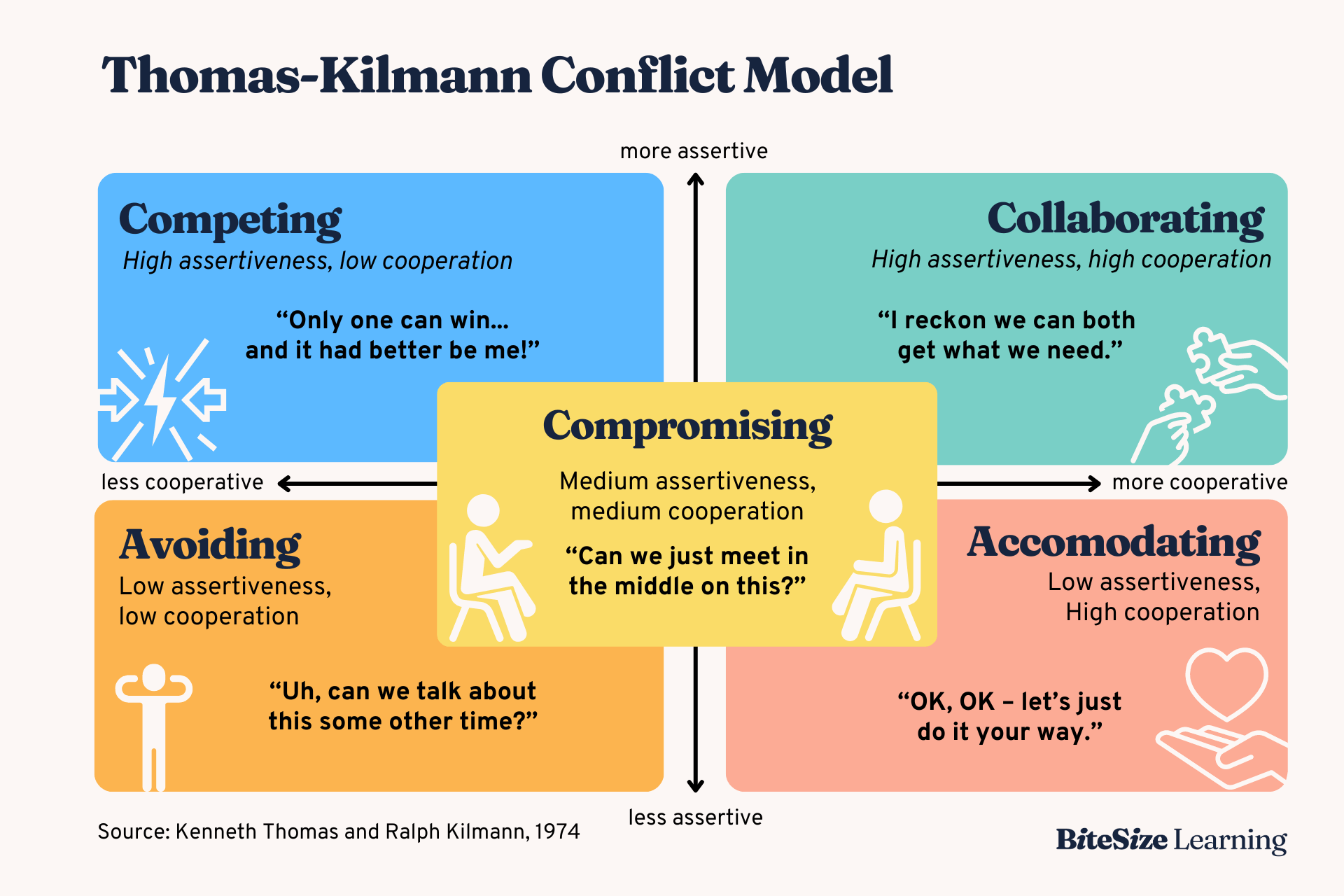
Thomas-Kilmann Conflict model
Compromising: Useful "when the cost of conflict is higher than the cost of losing ground, suitable for scenarios where both sides have equally important goals"
Avoiding: "if the issue is trivial or when there's no chance of winning, it's also useful when the potential damage of confronting a conflict outweighs the benefits of its resolution"
Determinants of Job Satisfaction (3)
Autonomy and Growth opportunities – The level of choice employee has over their work tasks.
Pay & Security – Financial compensation and the stability/safety of employment.
Supervisor Support / Worker Relations – Having supportive management, positive relationships, and a sense of connection with colleagues.
Know, Do, Be (and Pirson)
Knowing ("What is right?") and Doing ("How do I act?)
Being focuses on identity, character, values, and personal growth ("Who am I becoming?").
Pirson argues that management is not just about technique or organizational output, but about developing the whole person, which, without managers, risks adopting a more authoritarian mindset.
Leadership: Know, do, be
KNOW- understand the characteristics that define a leader and the difference between leadership and management.
DO - make it applicable by taking charge of calling team meetings, establishing a clear project vision, and providing direction.
BE- you've internalized the ethical values of leadership so deeply that they become default. You have a deep moral responsibility, even when no one is watching, because it's so deeply embedded in your character.
Management VS Leadership
Management enables order, leadership enables direction.
Management is task and performance-focused; it deals with executive functions such as organizing and maintaining order and predictability.
Leadership is relationship and vision-focused; it involves social influence, inspiring, setting direction, and driving change.
TWO UN Sustainable Development Goals
Goal 8: Decent Work and Economic Growth
Goal 9: Industry, Innovation, and Infrastructure
Goal 8
Decent Work and Economic Growth
promotes sustained economic growth, productive employment, and entrepreneurship.
Intuit- financial tools help small businesses start, manage, and grow, and support job creation and business stability.
Goal 9
Industry, Innovation, and Infrastructure
promoting inclusive and sustainable industrialization, and fostering innovation.
Intuit can expand its digital platforms to help underserved small businesses integrate modern technology into their operations.
Dignity VS Respect (Hicks)
Dignity - inherent, non-negotiable worth of every human person, innate right that everyone is born with and does not need to be earned,
Respect- earned or granted based on actions, achievements, character, status, or behavior. (to get it: expertise, leadership, performance)
3 out of 6 principles of Humanistic Management
P.S.W.
Protection of Human Dignity- Every person has inherent worth and treating people as people not profit
Stakeholder Focus – Focus on value creation for employees, customers, communities, and investors
Well-Being – Organizations should support human flourishing
In class example of team breakdowns
What’s wrong with the conflict in class? (asked yes or no questions to find what the conflict is)
Model Used: The Input-Process-Output (Input-Output) framework.
Three Components: Inputs, Processes, and Outputs.
Model used as a diagnostic tool by analyzing where a breakdown originates (whether from inputs, porcess, or outputs)
Weak VS STrong Team Culture
Strong Team Culture: high clarity and consistency in member behavior, but risk of enforcing strict conformity.
Weak Team Culture: Offers flexibility and diversity of thought/approach, but lacks behavioral consistency and alignment across members
Team Culture
the shared norms, values, assumptions, and expectations that shape how team members behave and interact with one another.
Advocacy VS Inquiry
Advocacy: means making statements and expressing your own views or ideas
Inquiry: means asking questions to gather information or draw out other perspectives
Components of active-empathic listening (3)
S.P.R.
Sensing: attending to all cognitive, verbal, and nonverbal cues sent by the speaker.
Processing: Synthesizing, remembering, and critically interpreting the information and emotional context provided.
Responding: Providing verbal and nonverbal feedback to show understanding, empathy, and reassurance to the speaker.
“12 Angry Men” Identify ONE input and ONE process that shaped the verdict
ONE Input: Individual Characteristics (Personality & Prejudices): varied backgrounds, personal biases, pre-existing attitudes (Juror 3's strained relationship with his son, Juror 10's bigotry), and the initial 11-1 vote distribution formed the starting conditions/inputs of the jury.
ONE Process: Inquiry & Information Exchange: The rigorous re-examination of evidence (re-enacting the old man's walk to the door, testing the switchblade knife) and open debate allowed team members to question assumptions and shift their votes over time, ultimately driving the team output (the unanimous "not guilty" verdict).