Unit 2
 Call Kai
 Learn
 Practice Test
 Spaced Repetition
 Match
 Flashcards
 Knowt Play
1/74

There's no tags or description
Looks like no tags are added yet.
75 Terms
Cultural Competence
A clinician’s core ability to understand, appreciate, and interact with people from various cultures and belief systems
Cultural Humility
A modern clinical competence, which is the awareness of one’s limitations in understanding a client’s cultural background
Cultural Formulation Interview
A 16-question, semi-structured tool created by the American Psychiatric Association (APA) to help clinicians understand how a patient's cultural background, beliefs, and social environment influence their mental health symptoms and care
Fundamentals of Psychometrics
Standardized
Useful
Reliable
Valid
Alcohol Use Disorders Identification Test (AUDIT)
Considered to be the best screener to assess alcohol dependence, alcohol abuse, and alcohol-related problems that do not meet DSM-5 criteria: free and meets all psychometric fundamentals
Sensitivity
The ability of a tool to correctly identify those with a disorder, which should typically be 0.80 or higher
Sensitivity Formula
True Positive / (True positive + False negative)
Specificity
The ability of a tool to correctly identify those without a disorder, which should typically 0.80 or higher
Specificity Formula
True Negative / (True negative + false positive)
Higher Cutoff (conservative) value
A cutoff value that has low sensitivity and high specificity, meaning that very few people will qualify for the disorder
Lower Cutoff (liberal) value
A cutoff value that has high sensitivity but low specificity, meaning that more people qualify for having a disorder, even if it is not that severe
True Positive
When the results from a tool and a structured clinical interview both confirm the individual has a disorder it is a…
True Negative
When the results from a tool and a structured clinical interview both confirm the individual does not have a disorder it is a…
False Positive
When the results from a tool claim a person has a disorder, but a structured clinical interview claims the same person does not it is a…
False Negative
When the results from a tool claim a person does not have a disorder, but a structured clinical interview claims the same person does it is a…
Clinical Approach
An approach to assessments that mostly relies on the psychologist’s personal experience and judgment
Actuarial Approach
Assessment approach that includes
identifying risk factors based on empirical literature
measuring risk factors using agreed-upon best approaches
calculating a risk score by combining (weighted) risk factors using an empirically derived prediction equation
Violence Risk Appraisal Guide (VRAG)
A 12-item scale that moderately predicts recidivism following the release of violent, mentally-ill male offenders by weighing each risk factor (actuarial approach)
Low Base Rate Events
Events that occur infrequently, like mental disorders, that are thus difficult to accurately predict
Clinical Interview
An assessment method that relies on client-directed information that aim to define problems, provide a diagnosis, formulate a case, and specify client goals
Unstructured
A type of clinical interview that has no standard set for questions or structured method for integrating and summarizing information that is great for building rapport
Structured
A type of clinical interview that uses predetermined questions, order, and flow based on symptoms and context described in the DSM-5 and has mid to high interrater reliability
Rapport
The foundational, trusting, and collaborative relational bond between a therapist and a client that creates a safe, non-judgmental space and allows clients to open up and engage deeply in the healing process
Structured Clinical Interview for Mental Disorders (SCID)
The gold standard diagnostic instrument for DSM-5 disorders
Semi-Structured
A diagnostic assessment tool that blends a set of predetermined core questions and diagnostic criteria with the flexibility to adapt, probe, and follow up based on a patient's unique response
Mental Status Exam
A behavioral observation tool, used alongside other tools, that provides common criteria and language to describe General Appearance, Affect and Mood, Memory, Activity Level, and Attitude
Naturalistic Observational Setting
A type of behavioral observation that is within normal situational contexts and naturally occurring reinforcements and consequences, which has high external validity but low internal validity
Structured Observational Setting
A type of behavioral observation that is done in role-played scenarios in which a person engages in simulated social interactions, which has high internal validity but low external validity
Functional Behavioral Assessment
A tool that observes natural antecedent, behaviors, and consequences and then structurally measures each to assess behavior and diagnosis implications
Self-Monitoring
An assessment strategy used by a client to observe and record their own behaviors, thoughts, emotions, bodily sensations, events, etc.
Evidence-Based Symptom Record
A self-monitoring tool that gives templates to clients that contain critical aspects of potential underlying disorders to develop a symptomatic record over time
Reactivity
An empirically supported treatment for changing behaviors being assessed due to the process of self-monitoring that helps individual recognize behavior patterns, causes, and frequencies
Singular Model
Spearman’s theory of intelligence that labels intelligence as a singular ability, identified as the ‘g’ factor
Plural Model
Thurstone’s theory of intelligence that labels intelligence as a sum of multiple abilities that may not relate to each other
Hierarchal Model
A theory of intelligence that blends singular and plural models by labeling a global intelligence (g) factor that includes ability-specific factors
Wechsler Adult Intelligence Score (WAIS)
A hierarchal assessment of intelligence that identifies a singular ‘g’ factor score, specific-ability scores, and sub-test scores that represent narrow skills
General Ability Index
A combination of WAIS’ verbal comprehension, visual spatial reasoning, and fluid reasoning indices that account for potential motor skill deficiencies
Verbal Comprehension Index
A subset of the WAIS that measures abstract verbal reasoning of similarities and knowledge of vocabulary
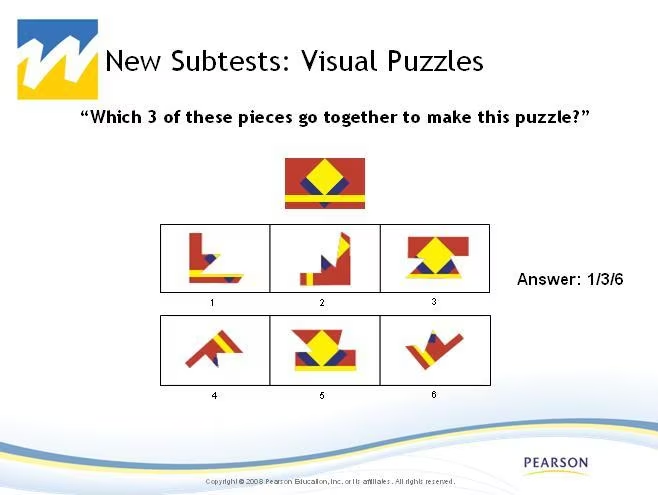
Visual Spatial Index
A subset of the WAIS that measures spatial and visual abstract processing and problem-solving through Block Designs and Visual Puzzles


Fluid Reasoning Index
A subset of the WAIS that measures non-verbal abstract problem-solving, inductive reasoning, and spatial reasoning through Matrix Reasoning and Figure Weights

Working Memory Index
A subset of the WAIS that measures verbal working memory, mental manipulation, and the maintenance of recent information through Digit Sequencing and Running Digits

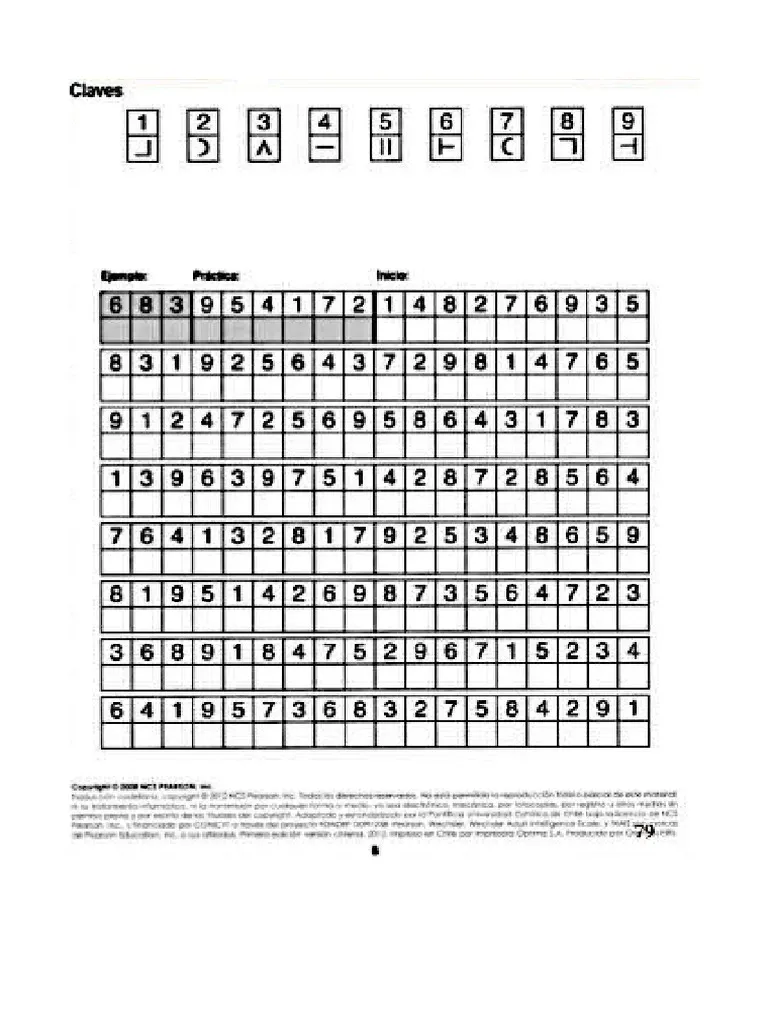
Processing Speed Index
A subset of the WAIS that measures visual perception and speed, visual-motor coordination, and mental speed through Symbol Search and Coding
Norm-Reference Assessment
Individual scores from the WAIS-5 are scored relative to the scores of same-age peers and/or other stratum
100
The average IQ for any same-age peer group
90-109
The cutoff scores for the Average IQ group
110-120
The cutoff scores for the High Average IQ group
121-129
The cutoff scores for the Superior IQ group
>/= 130
The cutoff score for the Gifted IQ group
80-89
The cutoff scores for the Low Average IQ group
70-79
The cutoff scores for the Borderline Impaired IQ group
<70
The cutoff score for the Impaired IQ group
Major concerns about WAIS
does not measure other/all types of intelligence
does not measure all attributes that contribute to intelligence (e.g., impulsivity, enthusiasm, etc.
0.40 to 0.80
Heritability of intelligence, showing a major influence of environmental factors, such as SES, nutrition, and education

Projective Test
The administration of unstructured or ambiguous stimuli with open-ended responses from which the client is assumed to reflect their unconscious responses, which has poor psychometrics, to assess personality

Objective Test
The administration of a standard set of questions with fixed responses, which has good psychometrics but can lead to question biases and misinterpretations, to assess personality
Minnesota Multiphasic Personality Inventory (MMPI)
The most psychometrically sound self-report measure of personality/psychopathology, which scores a specially curated collection of true/false questions to identify mental disorders using t-scores
MMPI-1
The MMPI version with 550 items that used a poor normative sample and an empirical approach to questions, which led to irrelevant questions/low content validity
MMPI-2
The MMPI version with 567 items that used a widespread normative sample and theoretical approach to designing questions, which increased content validity, but had issues with heterogeneity and comorbidity
MMPI-2-RF
An intermediate MMPI version that blended the theoretical and empirical approaches to question design, reducing heterogeneity and comorbidity
MMPI-3
A MMPI version with 335 items that used a normative sample to reflect the 21st century and combined the theoretical and empirical approaches to question design, which included modern terminology and scientific vocabulary
70-80
The t-score range of concern on the MMPI
Validity Scales
If a person’s responses to the MMPI score high on the t-scale range, clinical psychologists should check this portion of the assessment first to determine validity
F (Infrequency) Scale
A validity scale on the MMPI that flags potential over-exaggerations of negative characteristics that are infrequent in the general population, thus overreporting psychological problems
L (Lie) Scale
A validity scale on the MMPI that flags potential excessive moral attributes/activities that are rare in the population (i.e., pretending good), thus underreporting psychological problems
K (Defensiveness/unrealistically positive) Scale
A validity scale on the MMPI that flags potential understatements of psychological flaws or emotional distress, or overstatements of psychological adjustment
Malingering
The faking or exaggeration of symptoms for external gain, which clinical psychologists aim to catch on the MMPI using validity scales
Restructured Clinical Scales
Empirically-derived scales on the MMPI that are based on dimensional theories of psychopathology designed to fix high item overlap (heterogeneity)
RCd - Demoralization
A restructured clinical scale that measures the overall emotional discomfort that is common across multiple features of psychopathology, which helps eliminate comorbidity
A major concern about the MMPI-3
Less questions potentially limit its sensitivity
10% (Cohen’s d = .89)
According to Grove et al., the percentage of how much more accurate actuarial approaches are than clinical approaches in correctly identifying mental disorders
Mini International Neuropsychiatric Interview (MINI)
A brief structured interview designed to assess for major psychiatric disorders, sorted by modules, in a shorter timeframe than the SCID
Goals of Psychological Assessment and Prediction
Screening
Diagnosis (specifically, conceptualization/case formulation)
Prognosis & prediction
Treatment monitoring and evaluation
Empirical Approach
The question design approach used in the first MMPI and incorporated into later formats, which curates questions based on a known-group paradigm, which led to some items having statistical correlations but irrelevancy
Theoretical Approach
The question design approach used in the MMPI-2 and integrated into later formats, which curates questions based on psychopathologic definitions and its subcomponents