Surfaces no. 1
 Call Kai
 Learn
 Practice Test
 Spaced Repetition
 Match
 Flashcards
 Knowt Play
1/25

There's no tags or description
Looks like no tags are added yet.
26 Terms
Surface
The outside part or uppermost layer of something.
It is what one touches when holding an object.
Importance of surfaces
1. Visual reasons—surfaces that are smooth
and free of scratches and blemishes are more
likely to give a favorable impression to the
customer..
2. Surfaces affect safety
3. Friction and wear depend on surface
characteristics.
4. Surfaces affect mechanical and physical
properties; for example, surface flaws can be points
of stress concentration
5. Assembly of parts is affected by their surfaces;
for example, the strength of adhesively bonded
joints
Surface Properties
Surfaces have different properties depending on the
method used to manufacture an item.
The surface can be examined to check its properties:
1. Surface texture
2. Surface integrity
Surface Texture
is the deviation from the normal surface of the object.
Roughness
refers to the small, finely spaced deviations from the
nominal surface.
Waviness
is defined as the deviations of much larger spacing
Lay
is the predominant direction or pattern of the surface texture.
It is determined by the manufacturing method used to create the
surface.
Flaws
are irregularities that occur occasionally on the surface;
these include cracks, scratches, inclusions, and similar defects in the surface
Surface Integrity
is the surface condition of a
workpiece after being modified by a manufacturing
process such as welding, machining and casting.
Manufacturing processes can change the surface of
the part and the layer beneath the surface.
Manufacturing Flaws
Surface cracks, micro cracks and voids are the most
Common manufacturing flaw types:
Surface Cracks
Voids (Holes)
Manufacturing flaws can impact the safety of the
components as well as their look.
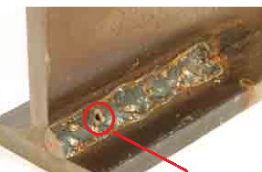
Void

Cracks
Friction
is a force that acts between two surfaces in
contact.
It acts in the opposite direction of the applied force.
Types of Friction Surfaces
1. Vehicle tires and the road:
Rubber tire for high friction
2. Brake pads: Semi metallic and ceramic
3. Brake rotors: Steel, composite fiber ceramic
4. Engine bearings: hardened steel shaft and brass
alloy bearing
Reducing Friction
1. Smoothing the surfaces so they are less rough
and wavy.
2. Eliminating contact between surfaces by using
lubrication between surface
Wear
Loss of material from a surface
Caused by:
Abrasion
Fatigue
Corrosion
Abrasion (Wear Type)
Abrasive wear occurs when a hard rough surface
slides across a softer surface.
Can be caused by sand/dirt rubbing between the surfaces
Surface Fatigue (Wear Type)
Surface fatigue wear is caused by repeated loading
and unloading on a surface
ex; Steel train wheels put high pressure on the rail track
causing surface fatigue.
Corrosion (Wear Type)
caused by corrosion of the metal
surface.
Surface modification to reduce wear
Can be reduced through:
1) Selecting a suitable materials.
2) Increasing hardness property of the surface to be
protected.
3) Applying a coating layer on the contact surfaces
Increasing Surface Hardness (Reduce Wear)
1- Carburizing:
• It involves heating a part of low carbon steel in the
presence of a carbon-rich environment so that C is diffused
into the surface.
• The carburizing temperature is about (875 to 925 °C)
• The internal region is unaffected and remains tough and ductile
2- Nitriding: to create a layer of hard nitride ceramic on the surface.
3- Carbonitriding: is a treatment in which both carbon and nitrogen are absorbed into the steel surface, usually
by heating in a furnace containing carbon and ammonia.
Carburizing
It involves heating a part of low carbon steel in the
presence of a carbon-rich environment so that C is diffused
into the surface.
• The carburizing temperature is about (875 to 925 °C)
• The internal region is unaffected and remains tough and ductile
Nitriding
to create a layer of hard nitride ceramic on the surface.
Carbonitriding
is a treatment in which both carbon and nitrogen are absorbed into the steel surface, usually
by heating in a furnace containing carbon and ammonia.
Applying Coatings (Reduce Wear)
Surface wear can also be reduced by applying a layer
of special coating on one or both contact surfaces.
Lubrication
Is used to reduce surface wear and friction
They used to form a layer of fluid between the two contact surfaces.