Microbiology Exam 3
 Call Kai
 Learn
 Practice Test
 Spaced Repetition
 Match
 Flashcards
 Knowt Play
1/185

There's no tags or description
Looks like no tags are added yet.
186 Terms
doubling time
from this equation, what is Td?

growth rate
from this equation, what is u?

growth rate
this depends on bacterial species, amount of nutrients, and environmental conditions
number of bacteria
in this equation, what is N?

original number of bacteria
in this equation, what is No?
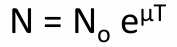
time
in this equation, what is T?

1.2 × 10^6
If you start with 1 × 10⁴ bacteria, how many bacteria will you have after 24 hrs if the growth rate is 0.2h-1 at 37°C?

growth rate
will altering growth rate or reducing initial microbial load have a greater impact on the final number of bacteria?
368 hrs/15 days
If the manufacturer considers an initial microbial load of 104 reasonable, how long can you hold the bacteria at 4°C if the growth rate at this time is 0.025h-1 and 108 bacteria is considered the spoilage point?

d value
the time it takes to reduce bacteria 1 log/10 fold
12D
many food manufactures use the ___ concept based on botulism spores to provide a large safety margin against contamination
96 min
How long would you need to incubate the food to achieve a 12 D process if the D value was 8 min at 90°C?
-0.29
what is the slope from this data?

3.4
what is the D-value if the slope is -0.29?

41.4 min
To ensure there are absolutely no traces of Bacillus spores, you recommend using the 12D concept. How long would you need to hold the product at 90°C to achieve this?
D-value: 3.4 min
z-value
the change in conditions required to change the D-value tenfold
9.9×10^5, 8.34 days
1) Your company makes a pasteurized juice product with an initial microbial load of 105 CFU/ml. Storage studies show that after 5 days at 35C, the microbial load is 108 CFU/ml. Your process engineer finds that by increasing the pasteurization temperature a few degrees, the initial microbial load can be lowered to 103 CFU/ml. If this process were used, what would the final microbial load be after 5 days at 35C assuming all other conditions are identical?
2) Using the problem above, if you started with the lowered microbial load of 103 CFU/ml and all other growing conditions were identical, now how long could you now store the juice before it reaches the spoilage point of 108 CFU/ml

b. 7.7
c. 120
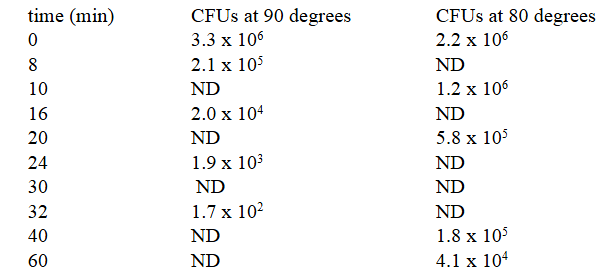
You are determining the D value for organisms in a given solution. You have one at 90C and another at 80C. You periodically take out samples and determine microbial load by serial dilution and plating.
a) Using the data above, what is the D value at 80C?
b) Using the data above, what is the D value for 90C?
c) Many food manufacturers use the 12D concept to provide a large safety margin against contamination. Using the data from the previous question, how long would you need to incubate the food at 90C to achieve this process?
15 C
If an organism has a D80C of 20 min; a D95C of 2 min; and a D 110C of 0.2 min; what is the Z value?
vertical gene transfer
the transmission of genetic material from parent to offspring through reproduction
horizontal gene transfer
movement of genetic materials between organisms other than parent to off spring inheritance
bacterial transformation
the uptake of “naked”/free-floating DNA from the environment
smooth
if a bacteria has a capsule it is described as ___
rough
if a bacteria has no capsule, it is described as ___
competent
cells must be __ to do bacterial transformation
quorum sensing
what is bacterial transformation regulated by?
homologous
in microbiology, meaning similar DNA sequence
homologous recombination
the process in which similar or identical DNA sequences exchange genetic material
heteroduplex
original strand of DNA
natural transformation
__ __ can be used to vary surface antigens of microbes as a way to avoid our immune system
bacterial conjugation
the exchange of plasmid DNA
cell to cell contact/mating pair formation
what is required for bacterial conjugation?
plasmid
small DNA that is non-essential, includes “bonus” genes
false
true or false: all plasmids do conjugation
1
how many strands of DNA are transferred in bacterial conjugation?
can cross species and genus
what is “scary” about bacterial conjugation?
transconjugant
the recipient cell that has successfully acquired genetic material from a donor through the process of conjugation
transduction
the transfer of DNA by phage/virus
generalized
which type of transduction uses the lytic cycle?
specialized
which type of transduction uses the lysogenic cycle?
generalized transduction
this is all based on a mistake in the packaging
homologous recombination
what process does generalized transduction use?
specialized transduction
results from a mistake during excision when some chromosome DNA is pulled with the viral DNA
specialized
which type of transduction is easier to track?
prototrophic bacteria
bacteria that can grow in minimal media because they have the genes required to make everything else
auxotrophic bacteria
bacteria that lack gene encoding enzymes required for synthesis of amino acids, nucleotides, or another substance
conjugation
blocking cell to cell contact would prevent ____
transformation
the addition of DNAse to a mixture tube would be used to rule out ___
pathogen
any organism that causes a disease
bacteria that live in us and on us
what does the human microbiome consist of?
commensals
the organisms that live with us and on us
holobiont
host and the many other species living in or around it which together form a discrete ecological unit
germ-free
have zero detectable microorganisms
gnotobiotic
animals that may start germ-free but are then intentionally colonized with a defined, known set of microbes or single strains of bacteria
germ-free
do germ free or gnotobiotic animals require a greater amount of food to reach normal weight?
short chain fatty acids
most carbohydrates are digestible only by bacteria resulting in the production of __ __ __ __
short chain fatty acids
all of the following are positive functions of what?
proper growth, maturation, differentiation of intestinal cells and hepatocytes
maintain intestinal integrity
regulate glucose and lipid metabolism
lower pH aids in absorption of minerals and impedes growth of harmful bacteria
produce signals that: inhibit fat accumulation, provide feeling of satiety, aid in insulin sensitivity
firmicutes and Bacteroidetes
what are the two bacteria that are most common in the adult gut microbiome?
obesity
the ratio of firmicutes to Bacteroidetes strongly correlates with __
obese
and increase in firmicutes results in ___ humans and animals
weight loss
an increase in Bacteroidetes in individuals results in what?
probiotic
live organism that when consumed results in a health benefit
prebiotic
a polysaccharide that when consumed, results in a health benefit
vaginal
which type of child delivery resulted in more beneficial probiotic bacteria?
breast milk
this also contains a diverse group of microbes and unique carbohydrates associated with an increase in beneficial probiotic bacteria in newborns
antibiotics
these at low doses were found to increase adiposity and changes in hormone levels related to metabolism in young mice
estrogen
the microbiome can help regulate the bioavailability of ___ which is also a potent driver of tumor progression
infection
invasion and multiplication of a microorganism in or on body tissue resulting in harm to the host
commensalism
microbes living in an on us without causing harm, may cause opportunistic infections (depending on location)
disease
symptoms of infection as a result of the interplay between pathogen and host immune response
pathogenicity
the ability to cause disease
virulence
the degree of pathogenicity
same
Koch’s Postulate 1 says: the __ microorganisms are present in every case of the disease
pure
Koch’s postulate 2 says: the microorganisms are isolated from the tissues of a dead animal and a __ culture is prepared
3
which of Koch’s postulates say the microorganisms from the pure culture are inoculated into a healthy, susceptible animals, the disease is reproduced
4
which of Koch’s postulates says the identical microorganisms are isolated and recultivated from the tissue specimens of the experimental animal?
equally
one problem of Koch’s postulates is that it implies that all strains of a species are __ virulent when actually many vary in severity or may cause different symptoms depending on types of virulence genes
attachment, invasion of tissue, avoid escape from immune system, produce toxic compounds that damage tissue
what are the 4 “weapons” that microbes have?
bacteria
Koch’s postulates imply that virulence/disease is a trait of ___ only and is independent of host, but you must consider the balancing act between host and microbes and location
opportunistic pathogens
this is demonstrated by less virulent organisms causing illness in immunocompromised patients
outbreak
a smaller, more contained period of time or location where a disease is occuring
epidemic
a larger, longer period of time and location that a disease is occurring
suspected case
a person for whom there is suspicion of the disease but no strong evidence or lab confirmation
probable case
a case is whom there is strong circumstantial evidence of infection
confirmed case
a person for whom there is definitive clinical or lab confirmation that they are a case
sensitivity
looks at ensuring those that test positive truly have the disease
specificity
looks at ensuring those that test negative do not have the disease
relative risk
a measure of association between two variables
1
a relative risk greater than __ means exposure is associated with the disease
attack rate
the number of people in a group who developed the disease divided by the total number of people at risk for infection
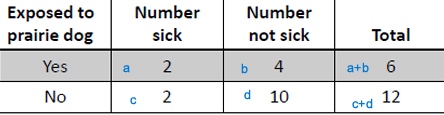
33.3%, 16.7%, 2
what is the attack rate in exposed children?
what is the attack rate in unexposed children?
what is the relative risk?
dose-response relationship
an increase in attack rate with an increase in exposure
basic reproductive number/Ro
the number of people infected by a single infectious individual in a fully susceptible population
transmissibility
what does the basic reproductive number measure?
spread
an Ro value greater than 1 means the infection will __
die out
a Ro value less than one means the infection will __ __
susceptible
Ro values will be dependent on the percentage of the population that is ____
herd immunity
a state where a significant proportion of the population is immune to an infection leaving few people susceptible to being infected and transmitting on the infection
natural immunity
immunity due to having the disease before and now being immune to it
vaccinate/treat infected/quarantine/isolation/active monitoring/decrease insect vectors/mask/social distance
what are some interventions to try and decrease the Ro value?