lec 14 - positive and negative selection
 Call Kai
 Learn
 Practice Test
 Spaced Repetition
 Match
 Flashcards
 Knowt Play
1/22

There's no tags or description
Looks like no tags are added yet.
23 Terms
T/F: Each T cell carries only one TCR on its surface.
false! Each T cell carries ~30K TCRs on its surface, but EACH TCR is identical.
Why is each TCR on a given T cell identical?
Because rem. each T cell carries only one VDJ/VJ recombination. cuz rem. each T cell is specific for one target (antigen).

A TCR must be able to detect peptides presented by our MHC.
What does “our” mean?
Hint: In humans, our MHC is called _ _ _.
MHC = HLA in humans

You get 3 MHC-1 types from mom and 3 from dad, i.e., 3 per _____some.
This is 6 MHC-1 types total. Same goes for MHC-2.
You get 3 MHC-1 types from mom and 3 from dad, i.e., 3 per chromosome.
The T cell can only bind properly if it meets 2 requirements. The TCR must dock the correct:
?
?
The TCR must dock the correct:
peptide
MHC

If a TCR binds the wrong MHC, it is called “MHC …”
If a TCR binds the wrong MHC, it is called “MHC Restriction”
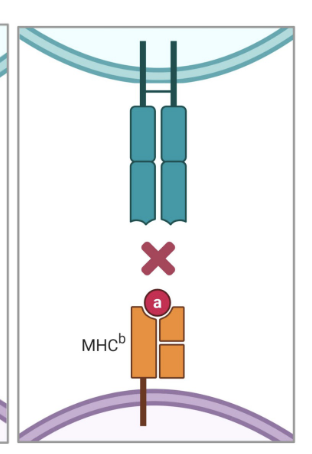
Recall we were introduced to positive selection in the last lecture….
We will review it in this lec and learn negative selection too!
…
HOW do our cortical epithelial cells (stromal cells) test out if the TCR can bind to MHC-1 and MHC-2?
Doesn’t that mean these stromal cells must carry both?
yup! the cortical epithelial cells carry both MHC-1 and MHC-2

Recall what section of the thymus does positive selection occur in?
in the cortex!


T/F: In positive selection, only MHC binding is being tested, not peptide binding (since the cortical epithelial cells are presenting a blank self-peptide for practice).
true!
Now let’s learn about NEGATIVE selection. This is to ensure that we don’t bind to ____ proteins.
Now let’s learn about NEGATIVE selection. This is to ensure that we don’t bind to self proteins.
If TCRs bind to self proteins, this causes what condition?
autoimmunity!
Positive selection happens in the cortex of the thymus, where does negative selection happen?
Also in the cortex!
To be specific: Negative selection occurs as thymocytes travel from the cortex towards the medulla. Thus occurs most prominently at the cortico-medullary junction.
So cortical epithelial cells mediate positive selection, what stromal cells mediate negative selection?
a bunch! medullary epithelial cells, dendritic cells, and macrophages

Correction: Negative selection is PRIMARILY mediated by __________ cells but minorly mediated by MECs.
Correction: Negative selection is PRIMARILY mediated by immune cells but minorly mediated by MECs. You’ll see why in the next few flashcards.
T cells that bind to self-antigens with high affinity are instructed to DIE. Cuz otherwise …
cuz otherwise if that T cell is activated —> could cause autoimmunity!


T cells that bind to self-antigens with medium affinity are NOT instructed to DIE. Why are they spared?
cuz positive selection requires someeeee affinity for MHC. and just cuz they have medium self-affinity doesn’t mean they won’t have high non-self affinity
Rem. that we don’t want to bind to self proteins. So we want to avoid our brain proteins, kidney proteins, etc.
How does the thymus produce proteins that are from all organs in the body?
Hint: rhymes with “air”
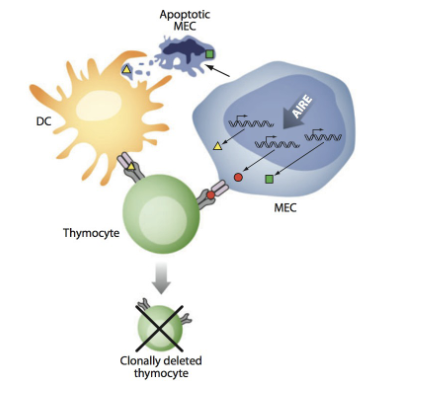
Medullary thymic epithelial cells (mTECs) turn on a unique protein called AIRE (autoimmune regulator).
AIRE is a master key that unlocks the entire genome, forcing mTECs to manufacture samples of ~every protein in the body.

These mTECs eventually die by apoptosis and hand off their bespoke proteins to neighbouring ___________ cells!
What do these cells do with them?
These mTECs eventually die by apoptosis and hand off their bespoke proteins to neighbouring dendritic cells!
Dendritic cells process these self-proteins and present them to T cells. If a T cell has high affinity for it —> gets clonally deleted!
What happens after thymocytes leave the thymus? Are they mature yet? Are they activated?
They’re mature but still naive (not activated)!
Rem. they still need to go to lymphoid organs like the lymph nodes to await activation from DCs.
T/F: 98% of thymocytes die in the thymus.
true!
I’m too lazy to write out the negative selection mouse experiment but it boils down to how negative selection was proven.
When a T cell successfully doesn’t bind to self-proteins, it is allowed to pass out of the … and into the …
When a T cell successfully doesn’t bind to self-proteins, it is allowed to pass out of the thymus and into the lymph nodes!
Summary of positive and negative selection:
…
