test 2
 Call Kai
 Learn
Learn Practice Test
 Spaced Repetition
 Match
Match Flashcards
 Knowt Play
1/83

There's no tags or description
Looks like no tags are added yet.
Name | Mastery | Learn | Test | Matching | Spaced | Call with Kai | Chat |
|---|
No analytics yet
Send a link to your students to track their progress
84 Terms

Aldehyde
-al

Ketone
-one

Carbonyl group

Pentanal
Aldehyde

2-pentanone

3-pentanone
Structural isomer, middle carbon splits

2-methylcyclopentanone

3-methylcyclohexanone

Benzene

Toluene

Phenol

Benzaldehyde

Parent; cyclopenanone
Cloro and methyl
3-Cloro-2-methylcyclopentanone

Functional group: alcohol
2-methylcyclopentanol
Oxidation: aldehydes
Form carboxylic acid.
Ethanol to ethanoic acid
-H → [o] → -OH
Ketones : oxidation
Does nothing, no reaction
-CH3 →[o]→ N.R.
Tollens’ test
Distinguish between aldehydes and ketones, used for aldehydes
Uses Ag+ (silver)
Silver ion reduced and forms silver mirror

Benedict’s test
Aldehyde test
Cu2+ added to aldehyde and heated, brick red solid of Cu2O forms
Negative for ketones
Can be used to determine presence of glucose in blood or urine

Benedict’s test
Aldehyde test
Cu2+ added to aldehyde and heated, brick red solid of Cu2O forms
Negative for ketones
Can be used to determine presence of glucose in blood or urine

Benedict

Reduction: general
Aldehydes and ketones are reduced hydrogen using catalyst like nickel (Ni), platinum (Pt) or palladium
Reduction of aldehyde or ketones…
There is decrease in number of carbon oxygen bonds
Aldehydes reduce to…
Primary alcohols
Ketones reduce to….
Secondary alcohols

Aldehyde reduction
Primary alcohol
OH
R-C-H
H

Primary alcohols have
H on terminal end

Ketone reduction
Secondary alcohol

Seoncdary alcohols have what
R (CH3) on terminal end
OH
CH3-C-CH3
H
Hemiacetal formation : general
When one alcohol adds to the carbonyl group of aldehyde or ketones
Hemiacetals contain what two functional groups
Hydroxyl (-OH)
Alkoxy group (-OR)
ARE BONDED TO SAME C ATOM
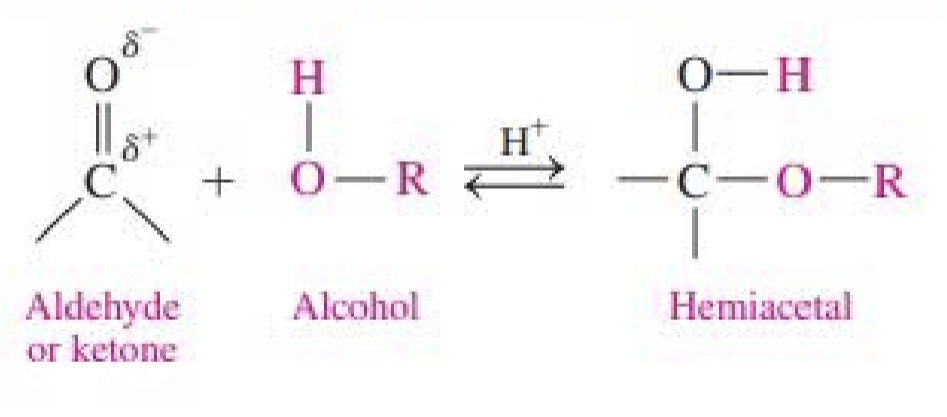
General equation for the formation of a hemiacetal

Examples of formation of hemiacetal, aldehyde

Example of formation of hemiacetal, ketone
Acetal formation: general
Acetal forms when 2 alcohols add to carbonyl group of aldehyde or ketones in presence of acid catalyst
Acetal contains what
2 alkoxy groups (-OR) attached to initial carbonyl carbon atom

General equation for the formation of an acetal
Acetals also have what at the end product, but typically not written?
H2O

Carbonyl group

Aldehyde

Ketone

Carboxylic group

Ester
Naming carboxylic acids (-OH)
Drop e and add -oic acid
Naming carboxylic acid: if there are substituents
The carbon chain is numbered beginning with the carboxyl carbon
Common names of carboxylic acids
Prefixes form, acet, propion, butyrate
Uses Greek prefixes for substituents alpha (a), beta (B), gamma (y)
Assigned to carbons adjacent to carboxyl carbon
Preparation of carboxylic acids
Carboxylic acids can be prepared from primary alcohols or aldehydes
Oxidation converts ethyl alcohol (primary) to acetaldehyde and then to acetic acid
Acidity
PH below 7 when dissolved in water
Neutralization
Reaction with a base makes salt and water
Basic pH
7-14
When carboxylic acid dissociates in water….
H+ is transferred to water mole
forms negatively charged carboxylate ion AND positively charged hydronium ion (H3O+)
Carboxylic acids are more…
Acidic than others, but are weak acids


Acids examples
CH3-OH
HO-H
HCL
O
CH3-C-OH
Adding H+ to acid examples.,.. they give up what
H+
CH3-O^-
HO^-
Cl^-
O
CH3-C-O^-
Carboxylic acids are completely neutralized by
Strong bases (NaOH and KOH)
Products of carboxylic acids
Carboxylate salt and water
Naming carboxylic acid neutralization products: carboxylate ion is named by
Replacing -ic acid ending with -ate

Neutralization of carboxylic acids


Neutralization


Neutralization
Swap Na for reactant H usually

When methanoic acid is neutralized w/ sodium hydroxide..
sodium methanoate Is product
When butanoic acid is neutralized W/ sodium hydroxide…
Sodium butanoate is product
Butanoic acid neutralized w/ potassium hydroxide…
Potassium butanoate
Benzoic acid neutralized w/ sodium hydroxide….
Sodium benzoate
Esterification: making an ester formula
Acid + alcohol → H+ → ester + h2o
How is ester made
—H of carboxylic acid is replaced by alkyl group

Carboxylic acid to ester

Esterification
Ester is produced when a carboxylic acid and an alcohol react in presence of an acid catalyst (H2SO4) and heat
Esterification process
The —OH group from carboxylic acid and the —H from alcohol are removed and combine to form water
Excess alcohol used to shift the equilibrium in the direction of the formation of ester product

Esterification example

Naming esters
First word indicates the alkyl part from alcohol
Second word is name of carboxylate from carboxylic acid
IUPAC names of esters
IUPAC names of acids
Reaction of esters: acid catalyzed hydrolysis for an ester forms
The acid and alcohol
Saponification
When ester undergoes hydrolysis w/ strong base (NaOH/KOH)
Amine
Nitrogen bonded to at least 1 carbon (one lone pair)
: CH3-OH
Methynal
CH3-OH-CH3
Ether
CH3-NH2
An amine
Naming amines: IUPAC
Drop e and add -amine
Naming amines ex: CH3-NH2
Methanamine
Naming amines ex; common name
Methylamine
R-NH3 / CH3-NH2
Primary amine
R2-NH / CH3-N-H
CH3
Secondary amine
R3-N
Tertiary amine