The eye
 Call Kai
 Learn
 Practice Test
 Spaced Repetition
 Match
 Flashcards
 Knowt Play
1/18

There's no tags or description
Looks like no tags are added yet.
19 Terms
Human eye anatomy
Retina - light sensitive surface of the inner eye.
Sclera- tough outer layer of the eye that protects the inside.
Fovea- inside the macula. Central vision, highest acuity (sharpness) and most detailed vision.

Macular degeneration
Damage to the retina in the macula (fovea). Causes irreversible blindness, loss of central vision.
The optic disc

Optical system

Light
Light is electromagnetic energy, calculated in wavelengths. Light is the means that enables us to perceive objects. The shorter the wavelength, the higher the electromagnetic energy.
Visible light
Vision is based on visible light. The spectrum of visible light for humans is 400-700 nanometres (nm). Short wavelength light is blue/green, long is yellow/red.
Transformations
1st transformation - light waves → retinal object representation.
2nd transformation - retinal object representation → electrical signal.
1st transformation
Light from an object enters the eye through the lens, so the representation of the object falls onto the retina.
Light enters the eye at a certain angle. Object representations are upside down and left side right.
A thick lens will bend the light more, a thin lens will bend light less.

Accommodation
Focusing on near/far objects. The problem is the fixed distance between the lens and the retina. Our eyeball is always the same size.
The lens is attached to ciliary muscles which relax and contract, changing the thickness of the lens. Bends the light onto the fovea.

Accommodation to a far/near object
Far away - relaxed ciliary muscles, slim lens. Light is only bent a little.
Close - Tight ciliary muscles, contracted lens. Light is bent a lot.
Myopia
Nearsightedness. Far objects are blurry because their lens is too thick or eyeball is too long. Requires concave correction glasses. This DIVERGES the light before it enters the eye. )(
Hyperopia
Farsightedness. Near objects can’t be seen. The eyeball is too short, so the lens cannot get any thicker. Requires convex correction lens. It CONVERGES the light before it enters the eye ().
2nd transformation
Transduction- retinal image is transformed into electrical energy. Done by photo receptors - cones and rods.
Photo receptors
Photo receptors have to get their electrical activity to the ganglion cell. These are senders to the optic nerve, then the brain. Between them is the bipolar cells. Called that because they have axons on each side that connect to photo receptors and ganglion cells.
Light enters through retina and goes down all the layers until it gets to the pigment epithelium. This is like aluminium foil and so will reflect the light back. As it is reflected, the heads of the rods and cones (because they are upside down) are picking up on this energy. The light sensitive chemicals in these then change, and this chemical reaction sparks an action potential to the bipolar cells.
The optic disc (blind spot) is because there are no photo receptors in that section of the retina.

Rods and cones differ in: absolute number
About 120 million rods and only 6 million cones.
Rods and cones differ in: density and distribution in the retina
In the fovea, there are only cones. Very few cones in the peripheral retina, especially compared to the number of rods. More photo receptors in central vision.
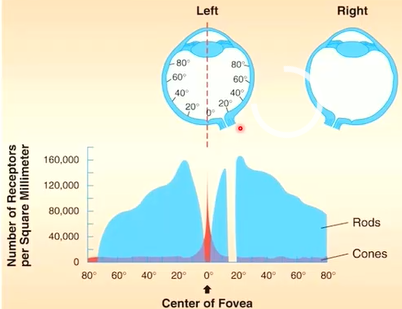
Rods and cones differ in: dark adaptation
Eyes need to be able to increase sensitivity to light when it gets dark. Photo receptors change the way they perceive light.
CONES very rapidly adapt to darkness in the fovea. Can only adapt very quickly, but not a lot. Cones provide colour vision.
RODS it takes much longer to adapt to darkness, but adapt much better. Build a higher sensitivity to light. Rods provide no colour sensation.
The rod-cone break is where the initial adaptation to darkness is achieved, and then the rods take over to get the maximum adaptation to the darkness.
Light sensitivity is better in rods, but visual acuity is better in cones. This is to do with determining what the light is and where it is coming from. Both have to do with NEURAL CONVERGENCE
Neural convergence
Many neurons will always converge (synapse) onto fewer neurons. 120 mil rods, only 1 mil ganglion cells. So one ganglion cells receives info from many photo receptors. More convergence for rods than cones.
Purkinje shift
A shift towards greater sensitivity to shorter wavelengths when the eye is dark-adapted.