cognition exam 2 - textbook + lecture
 Call Kai
 Learn
Learn Practice Test
 Spaced Repetition
 Match
Match Flashcards
 Knowt Play
1/69

Earn XP
Description and Tags
chapters 5, 6,
Name | Mastery | Learn | Test | Matching | Spaced | Call with Kai | Chat |
|---|
No analytics yet
Send a link to your students to track their progress
70 Terms
memory
mental processes encoding information and retaining and retrieving the memory
memory is…
“gateway” to cognition
“workspace” - depending how you are processing and encoding information
William James - theory of memory
functionalism - two systems
primary memory = short term (last a few minutes) and hold information in a conscious state
secondary memory = longer term (unlimited duration) brought to consciousness if desired
visual sensory memory
aka iconic memory
brief persistence of the image
lasts less than a second, <1
retention
auditory sensory memory
aka echoic memory
brief sensory memory for auditory stimulus
lasts for 2-3 seconds
retention
George Sperling Experiment
how much information people can take in from briefly presented stimuli
flashed letters on the screen for 50 milliseconds
participants had to do a whole report = report all of the stimuli they saw in a brief presentation.
able to report 4.5/12 on average
partial report method
Procedure used in Sperling’s experiment on the properties of the visual icon, in which participants were instructed to report only some of the stimuli in a briefly presented display.
A cue tone immediately after the display was extinguished indicated which part of the display to report; low, medium, and high - corresponding to a row in a grid formation
on average able to report 3.3/4
delayed partial report method
participants were instructed to report only some of the stimuli in a briefly presented display.
A cue tone that was delayed for one second after the display was extinguished indicated which part of the display to report.
able to report only slightly over 1 letter out of 4
decay
Process by which information is lost from memory due to the passage of time.
From Sperling’s delayed partial report method
The Modal Model of Memory
proposed by Richard Atkinson and Richard Shiffrin
describes memory as a mechanism that involves processing information through a series of stages, including short-term memory and long-term memory.
(It is called the modal model because it contained features of many models that were being proposed in the 1960s)

short term memory
aka working memory
holds five to seven items for about 15 to 20 seconds
described as a bottleneck
recall
Subjects are asked to report stimuli they have previously seen or heard
digit span
the number of digits a person can remember. Digit span is used as a measure of the capacity of short-term memory
Miller
change detection
A memory strategy that puts random items into a meaningful order within a story that can then be more easily remembered
Luck and Vogel
depended on the complexitiy of the stimuli

Miller
suggested and estimated the capacity of the STM is 7 ± 2 items
Chunking
chunking
Miller - grouping of information
retaining the unit - helps you remember more information
Combining small units into larger ones, such as when individual words are combined into a meaningful sentence. Chunking can be used to increase the capacity of memory.
LOL, ATM, MAC,FYI
story mnemonic
A memory strategy that puts random items into a meaningful order within a story that can then be more easily remembered.
Cowan
More recent measures of STM capacity have set the limit at about four items
“working memory”
more complex mental processes involved than just retaining sensory information
mental math, reasoning, learning, overall processing information
Baddeley and Hitch’s model of working memory
Baddeley and Hitch’s model of working memory
**there is a simplified early version with only central executive, phonological loop, and visuospatial sketchpad

phonological loop
The part of working memory that holds and processes verbal and auditory information
speech and sound - inner voice
articulatory loop= active rehearsal
articulatory rehearsal process
Rehearsal process involved in working memory that keeps items in the phonological store from decaying.
articulatory suppression effect
inhibit subvocal rehearsal when you are speaking something else
apple tree vs rehearsing the list
interference with operation of the phonological loop that occurs when a person repeats an irrelevant word such as “the” while carrying out a task that requires the phonological loop.
reduces memory because it interferes with rehearsal
phonological similarity effect
harder to remember words that sound similar than words that sound difference
key, pea, flea, tea
vs cat, pull, near, tow
word length effect
harder to remember longer words than shorter words
cat, glass, red, bag, shoe
vs kettle, paperclip, experiment, website, printer
visuospatial sketchpad
maintain and manipulate visual and spatial information
information coded as visual imagery = an image is experienced in the absence of a visual stimulus.
mental rotation,
central executive
The part of working memory that coordinates the activity of the phonological loop and the visuospatial sketch pad.
The “traffic cop” of the working memory system - the CEO of WM
planning actions, retrievals, decision processes, integrating information, attentional allocation
episoder buffer
A component added to Baddeley’s original working memory model that serves as a “backup” store that communicates with both long-term memory and the components of working memory.
It holds information longer and has greater capacity than the phonological loop or visuospatial sketch pad
information is integrated to form new episodic memories
control processes
In Atkinson and Shiffrin’s modal model of memory,
active processes that can be controlled by the person and that may differ from one task to another.
Ex. Rehearsal
prefrontal damage
phineas gage - personality change
low impulse control, poor ability to plan, and poor social skills.
thing that babies have - object awareness? out of sight out of mind- developed in the prefontal lobe
activity-silent working memory
Stokes?
Short-term changes in neural network connectivity that has been hypothesized as a mechanism for holding information in working memory.
reading span
Measure used by Daneman and Carpenter to determine individual differences in working memory. It is the number of 13- to 16-word sentences that a person can read and then correctly remember the last words of all of the sentences.
reading span test - used by Daneman and Carpenter to measure reading span
long term memory - ch 6
can hold a large amount of information for years, with some lasting as long as you live
any amount of time longer than 30 seconds
acts as an archive
long duration, large capacity
Sternberg memory task
encoding- you will get a list of letters one at the time
recognition test = a probe letter will appear at the end, you will say YES/NO if the letter was on the list
3 possible explanations - parallel search, serial self-terminating search, serial exhaustive search

parallel search
search for all the letters happen at the same time would derive yes of no given if there’s an answer or not
even if the list is longer it would take the same amount of time equally fast or slow

serial self-terminating search
happening in order and them self terminates, given lit and it doesn’t include the probe item, you are searching through and scanning the item one by one
how long it takes you to search first and second will be shorter depending on where the matching item is
the item is longer… more searching to do

serial exhaustive search
first, I don’t have a probe - look serially
given five items and it includes the probe, you are still searching all of them (exhaustive)
even though there is a match, search until the end of the list
this is the correct way we do it

serial position curve
Murdoch
In a memory experiment in which participants are asked to recall a list of words, a plot of the percentage of participants remembering each word against the position of that word in the list.
good memory for the beginning and the end - forgets the middle
effect is present even if the list is longer

primacy effect
enhanced memory for words presented at the beginning of the list.
possible explanation = time to rehearse the words
Dewey Rundus - remember the list, testing if the better memory for the first half of the list is from rehearsal, people really rehearse these earlier items more than those later in the list
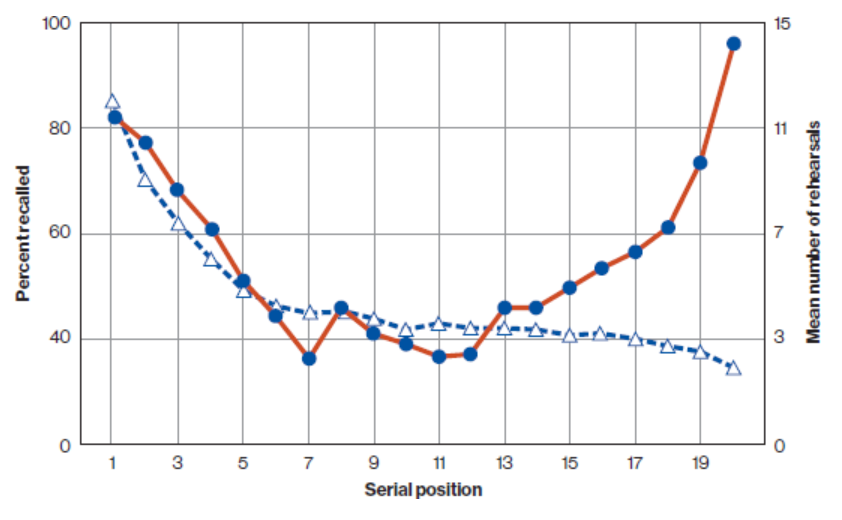
recency effect
enhanced memory for items appearing at the end of the list
possible explanations - the information is staying the echoic or iconic STM (?) - the phonological loop
Glazner - after encoding the list there was a distractor task, start recalling with some time-delay OR count backwards from 30 (apple tree)
disrupting the rehearsals of the STM - interfering with performance - after longer delay, poor recall, leads to STM decay (over time)

decay
forgetting occurs due to the passage of time (fading)
interference
forgetting occurs due to other interfering materials
backwards counting task
coding
The form in which stimuli are represented in the mind.
For example, information can be represented in visual, semantic, and phonological forms
mental approach to coding
The Wickens Experiment
On each trial, participants were presented with words related to either
(a) fruits (the “fruits group”) or
(b) professions (the “professions group”).
Participants in each group listened to three words (for example, banana, peach, apple for the fruits group), counted backward for 15 seconds, and then attempted to recall the three words. They did this for a total of four trials, with different words presented on each trial. Because participants recalled the words so soon after hearing them, they were using their STM
idea was to create proactive interference
proactive interference
interference in memory caused by earlier events
driven- forward looking
old information/memory moves forward in time - interfering with remembering new info
the new group of information causes a release of PI
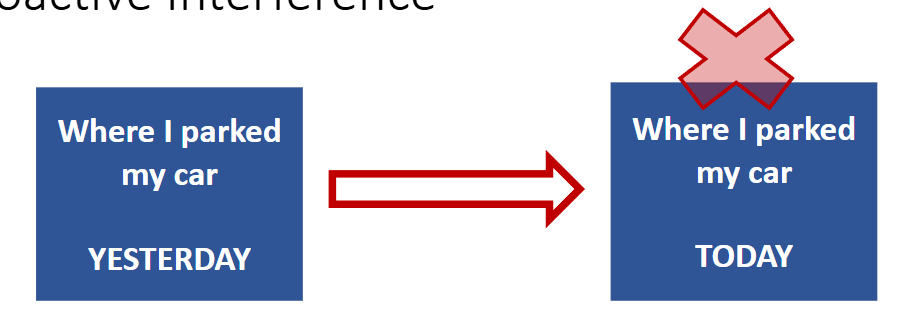
release from proactive interference
A situation in which conditions occur that eliminate or reduce the decrease in performance caused by proactive interference
retroactive interference
interference caused by later events (recent events)
backward looking - interferes with the retrieval of older info/memory
old passwords —— new password

interference and serial position effects
primacy effect
reduced proactive interference
nothing came before the first time
recency effect
reduced retroactive interference
nothing came after the last items
middle
suffers from both retroactive and proactive interference
types of LTM - Patient KC
impaired episodic memory
unimpaired semantic memory
Tulving assessment - KC cannot remember in the sense of brining back to conscious awareness, a single thing that he as ever done in his life or experienced in his past
hippocampus
A subcortical structure that is important for forming long-term memories, and that also plays a role in remote episodic memories and in short-term storage of novel information.
declarative memory
explicit memory
episodic memory + semantic memory
nondeclarative memory
implicit memory
knowledge that influences thought and behavior without consciousness
procedural memory
skills and habits
retrospective memory
this is what most memory is - looking backward at events
prospective memory
using memory to remember to do something in the future
utilize the LTM
“i need to remember to move my dentist appt”
“A type of memory used to remember and perform planned actions at some point in the future.” - textbook
Patient HM
full removal of his hippocampus
unable to create new memories- still had his STM
unimpaired implicit memory - nondeclarative ( mirror tracing task - could not remember previous attempts but got better)
anterograde amnesia
A type of memory loss in which new memories are unable to be created or stored.
mental time travel
According to Tulving,
the defining property of the experience of episodic memory, in which a person travels back in time in his or her mind to reexperience events that happened in the past
priming
exposure to one stimulus influences how one responds to another subsequent stimulus -unconscious
buy from a familiar brand than an unknown onere
repetition priming
faster processing of content that was presented before
propaganda effect
People are more likely to rate statements they have read or heard before as being true, just because of prior exposure to the statements
implicit memory
classical conditioning
A procedure in which pairing a neutral stimulus with a stimulus that elicits a response causes the neutral stimulus to elicit that response
operant conditioning
A learning process by which behaviors are made more likely to recur by the inclusion of reinforcers or less likely to recur by the inclusions of punishments. Operant conditioning can be used to shape behavior toward a more desired outcome
Word Stem competition task
asked to read a set of words last week
repeated again - more likely to fill in a blank with the repeated word
remember/know procedure
A procedure in which subjects are presented with a stimulus they have encountered before and are asked to indicate remember, if they remember the circumstances under which they initially encountered it, or know, if the stimulus seems familiar but they don’t remember experiencing it earlier.
familiarity = the stimulus seems familiar but the details of how you remember are blurry

semanticization of remote memories
Loss of episodic details for memories of long-ago events
mindfulness
Paying attention on purpose, in the present moment, and nonjudgmentally, to the unfolding of experience moment to moment.
expert induced amnesia
Amnesia that occurs because well-learned procedural memories do not require attention
ch 7 - LTM
autobiographical memory
Memory for specific events from a person’s life, which can include both episodic and semantic components
personal semantic memories
Semantic components of autobiographical memories