Climate Fachbegriffe
 Call Kai
 Learn
 Practice Test
 Spaced Repetition
 Match
 Flashcards
 Knowt Play
1/35

There's no tags or description
Looks like no tags are added yet.
36 Terms
Anthropogenic climate forcings
Simple explanation:
Human activities that push the climate out of balance.
They can change how much energy the Earth receives or keeps. F.e. burning/combusting fossil fuels adds gases (CO2, CH4, N2O), that act like a blanket and trap the heat.
Changing land surfaces (deforestation, farming, building cities) can alter surface albedo and the carbon sink, by affecting reflection and evaporation.
Aerosols (pollution particles) exert negative forcing and mostly cool the planet by reflecting sunlight, but overall humans make the planet warmer.
radiative forcing= Strahlungsantrieb/Änderung der energiebilanz der erde
→ mehr/weniger energie/wärme (kw) gelangt ins system, als rausgeht (lw)
carbon sink= Kohlenstoffsenken (natürl.: Ozeane, Wälder), die mehr CO2 speichern aus Atm. als abgeben→GHG sinken
Scientific explanation:
Human-caused influences/perturbationsthat alter the Earth’s radiative energy balance (Strahlungsbilanz), including greenhouse gas emissions, aerosols and land-use change. These drivers can produce especially positive radiative forcing (CO2, CH4, N2O) and affect climate at global or regional scales.
Climate extremes
Simple explanation:
Rare and very strong weather events (for a particular place and season; beyond normal range) like: heatwaves, heavy rainfall, floods, severe droughts and storms.
When climate warms, some of them become more frequent or more intense.
→even at only small shifts in the average climate: range moves towards warmer
f.e. warmer air holds more water vapour → stronger heavy rainfall
Scientific explanation:
Weather or climate conditions occurring near or beyond the extremes of the historical distribution for a location. The threshold is defined relative to local climatology, so an event considered extreme in one region may be normal elsewhere.
(Severe Weather events that occur outside typical patterns, such as heatwaves, heavy rainfall, storms, often exacerbated by climate change).
Components of the climate system
Scientific explanation:
They describe various elements and processes that interact to regulate the earth’s climate, including: atmosphere (air), hydrosphere (oceans, lakes, rivers), cryosphere (ice), lithosphere (soil, rock, topography), biosphere (plants, animals, humans) and anthroposphere (infrastructure, social/economic systems).
These subsystems exchange energy and matter (heat, water, carbon) through processes such as evaporation, precipitation and carbon cycling.
They influence the energy balance, temperature and weather patterns globally.
Because they are connected, a change in one can affect the others.
f.e. they react at different speeds: atmosphere changes in days, while oceans/ice sheets change over centuries
-Forcing: Anstoß von außerhalb des Klimasystems: Sonnenaktivität, Vulkanausbruch, CO2-EMissionen
-Feedback: Antwort des Systems auf Prozesse innerhalb des Systems/Anstöße
→können Anstoß verstärken (positive) oder abschwächen (negative)
Coriolis effect
Simple explanation:
The Earth rotates around its own axis. Different places on Earth move at different speeds, depending on their latitude. When air or water moves across the Earth's surface, it keeps some of its original eastward motion. Because of this, its path appears to curve rather than follow a straight line.
WICHTIG: Corioliskraft setzt Luft nicht selbst in Bewegung sondern verändert nur Bewegungsrichtung! (Luft bewegt z.b. durch Druckunterschiede)
Scientific explanation:
The Coriolis effect is the apparent deflection (scheinbare Ablenkung/Krümmung) of moving objects, such as air and ocean currents, caused by Earth's rotation.
It acts perpendicular to the direction of motion, deflecting movement to the right in the Northern Hemisphere and to the left in the Southern Hemisphere. Its strength increases with latitude, is strongest at the poles and is zero at the equator.
It shapes general circulations (trade winds, westerlies).

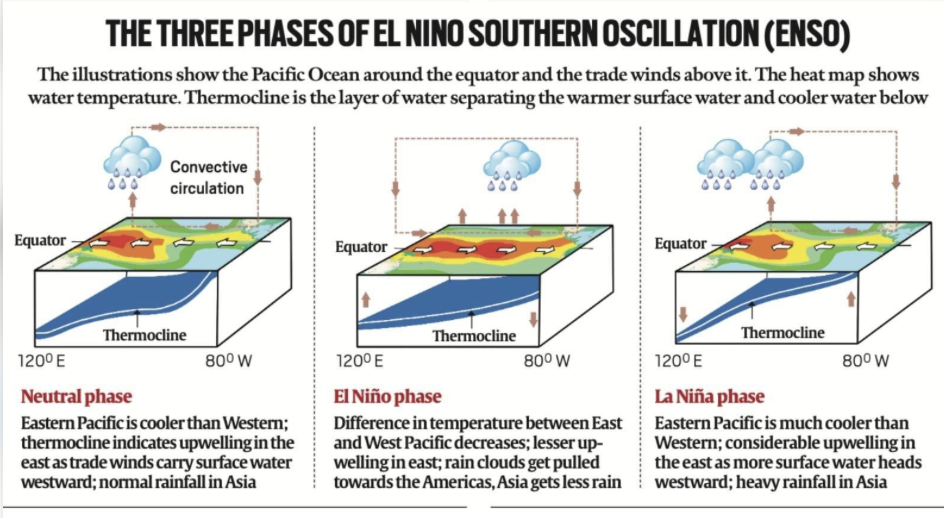
ENSO
El Niño - Southern Oscillation
Simple explanation:
Normally, (trade) winds blow from east to west across the tropical Pacific Ocean, pushing warm surface water towards Indonesia and Australia. This allows cold, nutrient-rich water to rise to the surface near South America.
During El Niño these winds weaken→ allowing warm water to spread eastwards (central/eastern tropical Pacific is unusually warm)→ more rain eastwards + droughts in Indonesia and Australia.
During La Niña these winds become stronger, pushing more warm water westwards
→ bring more cold water to the surface in eastern Pacific. These changes influence weather in different parts of the world.
Scientific explanation:
El Niño–Southern Oscillation: naturally occurring coupled ocean-atmosphere phenomenon.
It describes coupled fluctuations of sea-surface temperatures and atmospheric circulations in the tropical Pacific Ocean.
El Niño (unusually warm SST & reduced upwelling east) and La Niña (unusually cold SST east) are opposite phases that alter trade winds, rainfall patterns and temperature variability on a global scale.
The cycle repeats every 2-7 years.
+neutral phase
Southern Oscillation = Schwankungen des Luftdrucks zw. östl. und westlichem Pazifik.
ist nicht Monsun: saisonal durch Land-Meer-Temp-unterschied und ITCZ
Greenhouse effect
Simple explanation:
Sunlight (easily passing) warms Earth’s surface with energy in form of sw-radiation. The warm surface then releases energy/heat as lw-radiation (infrared).
Certain gases in the atmosphere, GHG, absorb some of this outgoing energy and emit it in all directions, including back to Earth.
This makes the surface warmer than it would be without those gases.
=natural and essential process, but human activities increase GHG concentrations
→ strengthening the effect
natural GH effect: keeps eath warm enough to support life→ without it: -18°C instead of +15°C
enhanced GH effect: additional warming due to human activities = PROBLEM today
Scientific explanation:
It’s a natural process in which greenhouse gases [water vapour (H₂O), carbon dioxide (CO₂) and methane (CH₄)], absorb and re-emit outgoing terrestrial longwave radiation. This process reduces the rate of outgoing infrared energy and warms the Earth's surface and lower atmosphere more than without these gases.
Increasing greenhouse gas concentrations through human activities enhances this effect, creating positive radiative forcing and leading to an increase in global temperatures.

Greenhouse gases
Simple explanation:
Some gases let much of the incoming sunlight through but interact strongly with the infrared energy (longwave) the Earth emits.
More of these gases can reduce how efficiently energy escapes to space and redirect it in all directions, including back towards the surface.
→most of them increased by human activities (burning fossil fuels, agriculture, deforestation)
Scientific explanation:
GHG are atmospheric gases that absorb (sw-r.) and emit infrared (lw) radiation, contributing to the natural GH effect and regulating the Earths energy balance.
They differ due to their molecular structure and difference in radiative efficiency and atmospheric lifetime & include:
water vapour (H2O), carbon dioxide (CO₂), methane (CH₄), nitrous oxide (N₂O), ozone (O3) and CFCs.
The most important human-emitted and long lasting gas is CO2 (centuries), coming from burning coal/oil/gas. Methance (~12 yr) comes from cows and landfills.
→This enhances the greenhouse effect, creates positive radiative forcing (verstärkend) and contributes to global warming.
H2O= wichtiges natürliches GHG aber hauptsächlich als positives feedback wirkt
d.h. stiegende temp.→mehr Verdunstung→mehr vapour in Atmosphäre→stärkerer GH effect →further warming →VERSTÄRKER der Erwärmung
CO2, CH4, N2O=climate forcing →AUSLÖSER der Erwärmung
Jet streams
Simple explanation:
High above the ground, narrow bands of air move very fast, usually from west to east due to the Earths rotation.
They form where warm/tropical and cold/polar air masses meet, so bc. of large temperature differences, and meander in waves (Rossby waves).
Main ones are: polar jet (guides low pressure sytems towards Scandinavia) and subtropical jet. Their position changes and affects weather systems and causes long-lasting weather like heatwaves.
-polar (~50-60°): cold polar air and warmer air from the mid-latitudes
-subtropical (~25-30°): forms at the poleward edge of the Hadley cell
-Westerlies: generall wind in mid-latitudes
→Jet streams: special form of westerlies in high altitudes
Scientific explanation:
Fast and narrow bands of strong upper-tropospheric west winds associated with horizontal temperature gradients. They occur near the tropopause (~9-12 km height) and their strength and position influences regional weather patterns.
They are shaped (direction) by the coriolis effect and generally flow from W→E.

Köppen Climate classifications
Simple explanation:
The Köppen climate classification is a system used to divide the world into different climate zones based on long-term temperature & precipitation patterns.
It distinguishes 5 main climate groups: tropical, dry, temperate, continental and polar climates.
Each group is further divided into smaller categories also closely related to the types of vegetation found in different regions.
A tropical, B dry, C temperate, D continental (cold), E polar. The second letter describes precipitation (f = humid all year, s = dry summer, w = dry winter, W/S = desert/steppe), the third describes temperature (a = hot summer, b = warm summer, c = cool summer, h = hot dry).
Scientific explanation:
It is a widely used classification system that categorizes global climates, based mainly on mean temperature and precipitation patterns.
It divides climates into 5 major climate groups (A-E), which are further subdivided according to seasonal temperature and precipitation characteristics.
It is used to compare regional climates, by defining climatic thresholds.
These climatic conditions also influence the distribution of natural vegetation.

Natural climate forcing
Simple explanation:
Natural climate forcings are natural factors that influence the Earth's climate by changing its energy balance, f.e. changes in sunlight, volcanic eruptions and variations in Earth’s orbit (Milankovitch cycles) can alter the energy balance.
These factors can cause warming or cooling over different timescales without human influence.
Scientific explanation:
They are naturally occurring and non-anthropogenic influences that alter the Earths energy balance and can lead to changes in global and regional climate.
They include variations in solar activity, volcanic eruptions that release aerosols into the atmosphere and changes in Earths orbital parameters.
Depending on the forcing, these processes can produce positive or negative radiative forcing, causing warming or cooling over different timescales.
(Veränderung der E-Bilanz durch GHG or radiation)
positiv r.f.: mehr E bleibt im Klimasystem als rausgeht → Erwärmung
negativ r.f.: weniger E im System → Abkühlung
Ocean acidification
Simple explanation:
The ocean absorb CO₂ from the atmosphere. When CO₂ dissolves in seawater, it forms carbonic acid, which releases hydrogen ions and lowers the ocean's pH.
→makes seawater more acidic and can harm marine organisms, especially corals and shellfish
Scientific explanation:
A long-term decrease in seawater pH primarily caused by uptake of atmospheric CO₂. Dissolved CO2reacts with seawater to form carbonic acid (H₂CO₃), which releases hydrogen ions (H⁺) and reduces carbonate ion availability.
This makes it more difficult for marine organisms, such as corals and shellfish, to build and maintain calcium carbonate shells and skeletons.
Radiative Forcing
Simple explanation:
Radiative forcing describes a change in the Earth's energy balance (how much more/less energy Earth receives, bc. of one thing) caused by factors such as greenhouse gases, aerosols or changes in solar radiation.
Positive radiative forcing leads to warming, while negative radiative forcing leads to cooling.
Scientific explanation:
A change in the Earths net radiative energy balance (incoming-outgoing radiation, W/m²). It can result from natural or anthropogenic factors/drivers such as changes in solar radiation, greenhouse gas concentrations (mostly positive) or atmospheric aerosols (mostly negative).
Positive radiative forcing tends to warm the climate system, whereas negative radiative forcing tends to cool it.
General circulation of the atmosphere
Simple explanation:
It describes the large-scale movement of air around the Earth.
It is mainly driven by unequal heating of the Earth's surface: the equator receives more solar energy than the poles.
Warm+wet air rises near the equator, while colder+dryer air sinks at higher latitudes (~30°). Together with Earth's rotation (Coriolis effect), this creates global wind patterns that redistribute heat and moisture.
Scientific explanation:
It refers to large-scale atmospheric circulation patterns driven by unequal solar heating between the equator and the poles.
Temperature and pressure differences, together with the Coriolis effect, produce 3 major circulation cells in each hemisphere (Hadley, Ferrel, Polar cells)
It also generates global wind patterns (trade winds/E/tropic, westerlies, polar easterlies) that redistribute heat and moisture across the globe and influence regional climate and precipitation patterns.

Thermohaline circulation
Simple explanation: Seawater density depends partly on its temperature and salt content. Cold, salty water can sink, while other waters rise and flow elsewhere. These movements help connect deep and surface ocean circulation.
Scientific explanation: Density-driven ocean circulation influenced by temperature and salinity differences. Density differences contribute to deep-water formation and are part of the broader overturning circulation, which also depends on winds and mixing.
Aerosols
Simple explanation: Tiny solid or liquid particles float in the air, such as dust, sea salt, smoke or sulfate droplets. They can reflect or absorb sunlight and affect cloud formation.
Scientific explanation: Suspended solid or liquid atmospheric particles that influence radiation and cloud microphysics. Aerosols may scatter or absorb solar radiation and can act as cloud condensation nuclei, changing cloud properties.
IPCC
Simple explanation: Scientists around the world study climate change. The IPCC reviews and assesses their published findings so governments can understand what is known, uncertain and projected. It does not conduct most of the original research itself.
Scientific explanation: Intergovernmental Panel on Climate Change: the UN body assessing scientific knowledge related to climate change. It synthesizes and evaluates published research, including evidence, uncertainties and possible future climate risks.
Heatwaves
Simple explanation: Sometimes temperatures stay unusually high for several days. The exact threshold depends on the region and definition used. Such periods can stress people, ecosystems and infrastructure.
Scientific explanation: Prolonged periods of unusually high temperatures relative to local climatological conditions. Heatwaves are defined using region-specific temperature thresholds and durations and may have major health and ecological impacts.
NAO
Simple explanation: Air pressure over the North Atlantic does not stay constant. Changes in the pressure difference between the Azores region and Iceland affect westerly winds and European winter weather.
Scientific explanation: North Atlantic Oscillation: variability in the sea-level pressure difference between the subtropical and subpolar North Atlantic. Its positive and negative phases influence the strength and path of Atlantic westerlies and European winter conditions.
Correlation
Simple explanation: When two things tend to change together, they are correlated. They might rise together or one might fall when the other rises. This does not prove that one causes the other.
Scientific explanation: A statistical measure of the direction and strength of association between variables. Correlation may be positive or negative, but it does not by itself demonstrate a causal relationship.
Scenario
Simple explanation: We cannot know exactly what society will do in the future. Researchers therefore explore several plausible pathways, such as different emissions levels, and model possible climate outcomes.
Scientific explanation: A plausible description of how future conditions may develop, used to explore possible climate outcomes. Climate scenarios specify possible developments in emissions or socioeconomic conditions and are not predictions of what must happen.
Regional and local climates (climographs)? NICHT nötig war nur ne überschrift
Simple explanation: Different places have different typical temperatures and rainfall. A climate graph shows how average temperature and precipitation change through the months. Location, altitude and nearby oceans help explain the pattern.
Scientific explanation: Long-term climate characteristics of a particular area, often represented by monthly temperature and precipitation climographs. Climographs commonly display mean monthly temperature and precipitation and help compare seasonal climate patterns between locations.
Air masses
Simple explanation: A large body of air can form over a broad area and take on similar temperature and humidity characteristics. When it moves, it brings those conditions to other places.
Scientific explanation: Large volumes of air with relatively uniform temperature and moisture properties. Air masses acquire these properties over source regions and can change as they move over different surfaces.
Positive and negative feedbacks (CLOUDS, AEROSOLS, ICE, WATER-VAPOUR, VEGETATION!)
Simple explanation: A change in climate can trigger another change that either strengthens or weakens the original one. Melting ice exposes darker surfaces and amplifies warming. Some responses instead reduce the initial change.
Scientific explanation: Positive feedback amplifies an initial perturbation; negative feedback counteracts it. Feedbacks operate through processes such as ice–albedo, water vapour and vegetation responses to climate change.
Desertification
Simple explanation: Land in dry regions can become less productive when vegetation and soil deteriorate. Drought, unsustainable land use and other pressures can contribute. It does not simply mean that sand dunes spread everywhere.
Scientific explanation: Land degradation in arid, semi-arid and dry sub-humid areas resulting from climatic variations and human activities. It involves a long-term decline in land productivity and ecosystem condition and can result from interacting climate and land-use pressures.
Effects of land-use changes on climate
Simple explanation: Replacing forests with farms or cities changes how the ground reflects sunlight, releases water and stores carbon. These changes can affect local temperatures and sometimes the global climate.
Scientific explanation: Climatic effects of land-cover modification through changes in albedo, evapotranspiration, surface roughness and carbon fluxes. Deforestation, agriculture and urbanization alter surface energy and water balances and may also change greenhouse gas emissions.
Factors determining regional climates
Simple explanation: A place’s climate depends on where it is and how air and water move around it. Latitude affects sunlight; altitude, mountains, oceans and prevailing winds affect temperature and rainfall.
Scientific explanation: Geographical and dynamical controls on regional temperature and precipitation, including latitude, elevation, circulation, continentality and topography. These factors control the distribution and seasonality of heat and moisture, producing distinct regional climate patterns.
POSSIBLE effects of climate change on extremes
Simple explanation: As the planet warms, the likelihood and intensity of some extreme events change. Heat extremes generally become more frequent and intense; heavy rainfall can intensify because warmer air can hold more moisture. Effects vary by region and event type.
Scientific explanation: Changes in the frequency, intensity, duration or spatial extent of extreme climate events due to climate change. Changes depend on the hazard and region; warming generally increases heat extremes and can intensify heavy precipitation.
Role of the oceans in the climate system
Simple explanation: Oceans store huge amounts of heat and move it around the planet with currents. They also exchange water and carbon dioxide with the atmosphere, shaping climate and rainfall.
Scientific explanation: Oceanic regulation of climate through heat storage and transport, carbon uptake and air–sea exchanges. Ocean circulation redistributes heat, while air–sea exchanges of moisture, heat and carbon influence atmospheric conditions.
Biodiversity
Simple explanation: An ecosystem contains many different living things. Diversity includes differences between species, within species and between ecosystems. This variety can support ecosystem functions and resilience.
Scientific explanation: The variability among living organisms, including genetic, species and ecosystem diversity. It includes genetic diversity within species, diversity among species and diversity of ecosystems.
Sea level change
Simple explanation: Sea level can rise when ocean water warms and expands or when ice on land melts and adds water to the ocean. Local sea level can also change as land rises or sinks.
Scientific explanation: Changes in mean sea level caused by ocean thermal expansion, land-ice mass change and regional land–ocean processes. Global mean sea-level rise is mainly driven by thermal expansion and land-ice loss, while local relative sea level also depends on vertical land movement.
Attribution
Simple explanation: First we observe that climate has changed. Then scientists investigate why, comparing observations with what different causes would produce. This helps separate human influences from natural ones.
Scientific explanation: The process of evaluating the relative contributions of causal factors to an observed climate change. Attribution compares observed patterns with expected responses to different forcings, including human and natural influences."
Detection
Simple explanation: Scientists examine measurements to determine whether a change is large enough to stand out from normal variability. Detection establishes that a change occurred, not what caused it.
Scientific explanation: Demonstrating that climate has changed in a defined statistical sense without assigning its cause. Detection uses statistical evidence to distinguish a change from internal variability, without identifying its causes.
Climate change vs climate variability
Simple explanation: Climate naturally fluctuates from year to year and decade to decade. Climate change means a lasting shift in average conditions or their variability. Short-term ups and downs can occur within a long-term warming trend.
Scientific explanation: Climate variability describes fluctuations around climate statistics; climate change is a persistent shift in those statistics, typically over decades or longer. Climate variability concerns fluctuations across multiple timescales, whereas climate change involves a persistent alteration of the climate state."
Tipping point
Simple explanation: Some systems change gradually until a threshold is crossed. After that, a small extra push can cause a much larger shift that may be difficult to reverse.
Scientific explanation: A critical threshold beyond which a system reorganizes, often abruptly or irreversibly. Crossing such a threshold may trigger self-reinforcing changes that persist even if the original forcing is reduced.
Climate model
Simple explanation: Scientists represent climate processes with mathematical equations in computers. Models simulate interactions between air, ocean, land and ice to explore past and possible future climates.
Scientific explanation: A numerical representation of the climate system based on physical, chemical and biological processes. Climate models use mathematical representations of physical processes to simulate climate behaviour under different conditions or forcings."
Desertification!