BSC110 - Chapter 10 HW, Recharges, and Animations (Fall 2026)
 Call Kai
 Learn
 Practice Test
 Spaced Repetition
 Match
 Flashcards
 Knowt Play
1/102

There's no tags or description
Looks like no tags are added yet.
103 Terms
Meiosis is associated with
binary fission.
asexual reproduction.
sexual reproduction.
sexual reproduction.
Sperm and eggs are reproductive or sex cells that are collectively referred to as __________.
gametes
Adult organisms will develop from the egg and sperm, combining to form a __________.
zygote
Homologous chromosomes are
chromosomes which have different genes.
identical copies of chromosomes attached at the centromere.
pairs of chromosomes in which members of the pair have genes for the same traits.
pairs of chromosomes in which members of the pair have genes for the same traits.
The term homologous chromosome has the same meaning as __________.
homologues
genes
alleles
chromatid
homologues
Meiosis occurs as a part of __________ reproduction, with the resulting daughter cells having __________ % of the chromosomes.
sexual
haploid, n, 50, or 50%
Alleles are composed of
short sequences of RNA.
sequences of DNA.
a combination of DNA and RNA information.
sequences of DNA.
Normal gametes will contain the __________ number of chromosomes.
diploid
triploid
haploid
haploid
What is the end result of meiosis?
4 unique haploid cells
2 unique haploid cells
2 identical diploid cells
4 identical diploid cells
4 unique haploid cells
The merging of two gametes results in a(n) __________.
sperm
spore
zygote
egg
zygote
Select the stages of the cell cycle in which bivalents are present.
Prophase I
Metaphase I
Prophase II
Metaphase II
Prophase I
Metaphase I
Which of the following is true about a homologous chromosome pair?
They are genetically identical to one another.
They contain genes for the same traits but can have different variations.
They are present only in animal cells.
They separate during Anaphase II.
They contain genes for the same traits but can have different variations.
The term bivalent refers to
four chromatids.
four chromosomes.
three chromosomes.
two chromatids.
four chromatids.
Which feature(s) are associated with homologues?
They are different in length
They have the same centromere position
They contain genes for completely different traits
They look alike
They have the same centromere position
They look alike
Place the order of events in a plant's life cycle in the correct sequence. Put the first event at the top and then move down.
Haploid spores become the haploid generation
Gametes are produced by mitosis
Haploid spores germinate
Daughter cells become haploid spores
1. Daughter cells become haploid spores
2. Haploid spores germinate
3. Haploid spores become the haploid generation
4. Gametes are produced by mitosis
Alternate forms of the gene that cause long or short fingers would be called __________.
chromosomes
alleles
mutated genes
alleles
In the animal life cycle, gametes include __________.
eggs
sperm
pollen
spores
eggs
sperm
The central purpose of meiosis is to __________.
reduce the chromosome number from 2n to n
keep the same number of chromosomes for the life of the organism
increase the chromosome number from n to 2n
reduce the chromosome number from 2n to n
What role does genetic variation play in a species?
Pushes the species into extinction
Causes mutations to occur
Enables a species to evolve
Enables a species to evolve
During which phase of Meiosis will bivalents form?
Metaphase I
S phase
Prophase I
Prophase II
Prophase I
Which chromosomes are involved in crossing-over?
nonsister chromatids
sister chromatids
homologous chromosomes
nonsister homologous chromosomes
nonsister chromatids
A pair of homologous chromosomes that have synapsed is called a(n) __________.
bivalent, tetrad, bivalents, or tetrads
The daughter cells produced during meiosis in a plant's life cycle will eventually germinate to become the __________ generation.
haploid
Homologous chromosomes separate independently or in a random manner during independent __________.
assortment
Daughter cells in the animal life cycle can become __________, which are either sperm or eggs.
gametes
Meiosis and crossing-over increases the amount of genetic variation in a population. This is important because __________.
it is neutral with respect to long-term survival but the genetic variations may cause the population size to increase
it reduces the genetic variation in a population while enhancing its long-term survival
it enhances long-term survival of a species by providing genetic variations for natural selection to act on
it enhances long-term survival of a species by providing genetic variations for natural selection to act on
Which of the following contributes to the genetic variation of a species?
Binary fission
Mitosis
Meiosis
Meiosis
Which of the following are phases of meiosis?
G2
Synapsis
Prophase I
Anaphase II
Telophase I
Metaphase II
Prophase I
Anaphase II
Telophase I
Metaphase II
Crossing-over occurs between the two sister chromatids of a bivalent.
True
False
False
Which of the following occurs during Prophase I of meiosis in animal cells?
Crossing-over
Nuclear envelope fragments
Homologous pairs become visible
Sister chromatids split apart
Crossing-over
Nuclear envelope fragments
Homologous pairs become visible
If a cell starts meiosis with four chromosomes, how many chromosomes will each cell contain during Metaphase II?
One
Four
Eight
Two
Two
What happens to the homologous chromosome pairs during independent assortment?
The chromosomes separate randomly.
The chromosomes decondense into chromatin.
The chromosomes separate based upon the alleles inherited from the mother or the father.
The chromosomes are copied.
The chromosomes separate randomly.

Which phase of mitosis is shown last in this diagram (in an organism with n=2)?
Anaphase I
Metaphase I
Prophase I
Telophase I
Anaphase I
Identify the advantages of variation within a population.
Provides more genetic diversity.
Increases the chances of predation.
Increases the chances of survival in changing environments.
Makes the population more susceptible to extinction.
Provides more genetic diversity.
Increases the chances of survival in changing environments.
A human cell in metaphase I will look identical to a cell in metaphase of mitosis.
True
False
False
What is the first stage of meiosis?
Metaphase I
Prophase I
Anaphase II
Telophase I
Prophase I
Homologous chromosomes are pulled toward opposite poles of the cell during __________ I of meiosis.
anaphase
The first phase of meiosis is __________ I.
prophase
The spindle disappears and interkinesis occurs following __________ I of meiosis I.
telophase or cytokinesis
Which cell would contain the greatest number of chromosomes?
A cell in Prophase II
A cell in Prophase I
A cell in Anaphase II
A cell in Metaphase II
A cell in Prophase I
What stage is immediately prior to interkinesis?
Telophase II
Prophase II
Prophase I
Telophase I
Telophase I
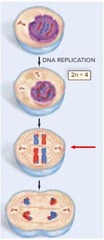
In this organism with n=2, which phase of meiosis is occurring in the third cell from the top of this diagram?
Anaphase I
Telophase I
Metaphase I
Prophase I
Metaphase I
Homologous chromosomes align on the equator during __________.
anaphase I
telophase I
prophase I
metaphase I
metaphase I
The fully formed spindle aligns a haploid number of chromosomes along the center of the cell during __________.
anaphase II
metaphase I
metaphase II
anaphase I
metaphase II
The chromosomes of the bivalents separate and move to opposite poles during __________ of meiosis.
metaphase I
anaphase I
prophase I
telophase I
anaphase I
Are cells going through Prophase II haploid or diploid?
Haploid
Diploid
Haploid
During meiosis, which stage is immediately before interkinesis?
Prophase I
Metaphase I
Anaphase I
Telophase I
Telophase I

The blue arrow is pointing to which stage of meiosis II (in an organism with n=2)?
Prophase I
Anaphase I
Metaphase II
Anaphase II
Metaphase II
Interkinesis occurs after __________ and before __________ during meiosis.
telophase I; prophase II
prophase I; metaphase I
metaphase I; anaphase I
anaphase II; telophase II
telophase I; prophase II
During Anaphase II of meiosis, __________ separate and go to opposite poles.
anaphase tetrads
tetrads
homologous chromosomes
sister chromatids
sister chromatids
At the end of telophase II, there will be __________ haploid gametes.
four or 4
What key structures are used to identify if a cell is in Metaphase II?
chromosomes
contractile ring
metaphase plate
homologous pairs of chromosomes
chromosomes
metaphase plate
During prophase II of meiosis, each cell has __________.
none of the chromosomes from each homologous pair of chromosomes.
both chromosomes from each homologous pair of chromosomes.
one chromosome from each homologous pair of chromosomes.
one chromosome from each homologous pair of chromosomes.

Which stage of meiosis II (in an organism with n=2) is circled?
Anaphase I
Prophase II
Prophase I
Metaphase II
Prophase II
Sister chromatids are separated, and they travel to opposite poles of the cell during __________ II of meiosis.
anaphase
What event signals the end of telophase II?
The formation of the cell plate in plant cells
The separation of homologous chromosomes
Crossing over of homologous pairs of chromosomes
The completion of cytokinesis
The completion of cytokinesis
Which type of cellular division accounts for the greatest amount of genetic variation?
Meiosis
Mitosis
Cytokinesis
Meiosis
__________ occurs in all tissues of organisms while __________ only occurs during certain times in the reproductive organs of organisms.
Meiosis; Mitosis
Mitosis; Meiosis
Mitosis; Meiosis
Chromosomes line up at the cell equator during which stages of cell division?
Metaphase, Metaphase I, and Metaphase II
Prometaphase and Metaphase
Metaphase and Metaphase I
Prometaphase and Metaphase I
Prometaphase, Metaphase I, and Metaphase II
Metaphase, Metaphase I, and Metaphase II
Which of the following events will occur during meiosis I, but not mitosis?
separation of sister chromatids which become daughter chromosomes that move to opposite poles
crossing-over
reduction of the amount of genetic material within the cell
formation of bivalents
crossing-over
reduction of the amount of genetic material within the cell
formation of bivalents
Which of the following is characteristic of meiosis II but not mitosis?
New cells form with haploid nuclei
New cells form with diploid nuclei
New cells form with haploid nuclei
Which event occurs in meiosis but NOT in mitosis?
Sister chromatids separate
Disintegration of the nuclear envelope
Cells remain diploid
Crossing-over
Spindle fibers attach to centromeres
Crossing-over
The reproductive events that occur from one generation to the next generation is termed the life __________.
cycle
Identify the events of a sexually reproducing organism's life cycle during which mitosis will occur.
Reproduction
Growth
Repair
Death
Growth
Repair
What is the common feature found in Metaphase, Metaphase I, and Metaphase II?
The haploid number of chromosomes
The diploid number of chromosomes
Homologues
A metaphase plate
Chromosomes that have crossed over
A metaphase plate
Sperm are reproductive cells produced in the __________.
testes and ovaries
ovaries
testes
testes
During which phase of cell division will crossing-over occur?
Anaphase I
Prophase
Interphase
Prophase I
Prophase I
Which of the following are produced as a result of oogenesis?
Mitosis
Sperm
Primary spermatocytes
Eggs
Tetrads
Eggs
How many cells will be the result of mitosis compared to meiosis II?
two versus four
four versus two
four and four
two and two
two versus four
Identify the features associated with oogenesis.
males
ovaries
eggs
mitosis
females
ovaries
eggs
females
The life cycle refers to all of the __________.
reproductive events from one generation to the next
length of time an organism lives
seasonal activities that occupy an organism's time
reproductive events from one generation to the next
The process of sperm production is known as __________.
spermatogenesis
__________ occurs in all tissues of organisms while __________ only occurs during certain times in the reproductive organs of organisms.
Mitosis; Meiosis
Meiosis; Mitosis
Mitosis; Meiosis
List the cells of spermatogenesis in the order they are produced, beginning with the first cell to be produced at the top of the list.
Primary spermatocyte
Spermatids
Sperm
Secondary spermatocyte
Primary spermatocyte
Secondary spermatocyte
Spermatids
Sperm
What is produced as a result of meiosis in a male?
sperm
somatic cells
zygotes
eggs
sperm
When will the secondary oocyte undergo meiosis II?
24 hours after meiosis I has occurred
Immediately after meiosis I
After it has been fertilized by a sperm cell
After it has been fertilized by a sperm cell
What is the end result of meiosis in a female?
zygotes
sperm
somatic cells
eggs
eggs
The resulting gain or loss of chromosomes during meiosis is due to __________.
nondisjunction
The process of egg formation in females is called __________.
oogenesis
The stem cells required for spermatogenesis are called __________.
somatic cells
primary spermatocytes
spermatogonia
oocytes
spermatogonia
If an egg that is missing a chromosome is fertilized by a normal sperm, the offspring has inherited
trisomy.
triploidy.
monosomy.
monosomy.
What is the end result of spermatogenesis?
4 genetically different sperm
1 sperm & 3 polar bodies
2 genetically different sperm
4 genetically identical sperm
4 genetically different sperm
The cells resulting from oogenesis that either disintegrate or divide again are called __________ bodies.
polar
An individual that inherits three copies of a chromosome has
trisomy.
trichromosomy.
monosomy.
karyosomy.
trisomy.
What are the immediate results of nondisjunction?
Decreased reproductive success of the parent
Gain or loss of chromosomes in the egg
Abnormal development of the zygote
Reduction or addition of the normal chromosome numbers in the sperm
Gain or loss of chromosomes in the egg
Reduction or addition of the normal chromosome numbers in the sperm
Which individual has the greatest chance of survival?
Monosomy of an autosome
Trisomy of an autosome
Trisomy of an autosome
At what age does a woman's chances of having a child with Down syndrome begin to significantly increase?
early 40s
22
mid 30s
early 30s
early 40s
The genetic designation for an individual who is monosomic is __________.
2n
2n-1
n
n+n
2n-1
During pregnancy, parents can use a fetal test to determine the number of chromosomes that the fetus has inherited. They would be looking at the __________ of the fetal chromosomes for this information.
shape
karyotype
organization
color
karyotype
Why does a zygote with only one X chromosome survive?
A zygote only receives one X chromosome
X chromosomes are not necessary for normal development
Only one X is active even when two are present under normal conditions
Only one X is active even when two are present under normal conditions
If a human egg with 24 chromosomes is fertilized by a normal sperm, the result is
trisomy.
trichromosomy.
monosomy.
karyosomy.
trisomy
What are the characteristics of Turner syndrome?
Underdeveloped ovaries
Broad chest
Longer arms
Neck webbing
Underdeveloped uterus
Underdeveloped ovaries
Broad chest
Neck webbing
Underdeveloped uterus
Which of the following conditions would make a newborn less likely to survive?
Abnormal sex chromosome number
Klinefelter syndrome
Turner syndrome
Monosomy of autosomal chromosomes
Monosomy of autosomal chromosomes
Klinefelter syndrome results from
a male with two or more X chromosomes.
monosomy X.
trisomy 21.
a male with an extra Y chromosome.
a male with two or more X chromosomes.
Nondisjunction during meiosis can result in three copies of chromosome __________, which results in Down syndrome in humans.
23
3
21
14
21
A visual representation of the number, size, and shape of chromosomes is called a __________.
PCR
genotype
DNA fingerprint
karyotype
karyotype

Match the type of chromosome structural change on the left with its correct definition on the right.
breakage of a chromosome end
occurs when a segment of a chromosome turns 180 degrees
presence of a chromosome segment more than once on the same chromosome
movement of one chromosome segment to another chromosome
duplication - presence of a chromosome segment more than once on the same chromosome
inversion - occurs when a segment of a chromosome turns 180 degrees
translocation - movement of one chromosome segment to another chromosome
deletion - breakage of a chromosome end
An extra X chromosome that is inactive is called a(n)
Barr body.
monosomy.
inclusion body.
trisomy.
Barr body
Which chromosome is missing an end piece, resulting in Cri-du-chat syndrome?
5
Y
X
21
5
Which sex is susceptible to Turner syndrome?
Both males and females
Females
Males
Females