Sect. 8.2 - Distribution of Gases in the Body
 Call Kai
 Learn
 Practice Test
 Spaced Repetition
 Match
 Flashcards
 Knowt Play
1/75

There's no tags or description
Looks like no tags are added yet.
76 Terms
lungs
Organ that provides oxygen to the blood and remove carbon dioxide from the blood
Circulatory and Pulmonary systems
What 2 systems work together to provides oxygen to the blood and remove carbon dioxide from the blood?
pharynx
oxygenated air from the atmosphere is breathed in through the nose and mouth and enters the __________
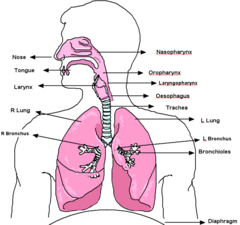
larynx
forms the entrance to the lower respiratory system (aka voice box)
primary function: prevent food or fluid from entering the lower respiratory system during swallowing

trachea
rigid tube that is located a the opening of the bronchial tree

alveoli
functional units of the respiratory system

350 million
approx how many alveoli per lung
gas diffusion (high to low)
The enormous number of alveoli provides a very large surface area for
true
T or F:
The diffusion rate is further increased by the fact that each alveolus is only one layer thick and the blood capillaries are also one layer thick
alveoli capillaries into pulmonary capillaries
In the lungs, oxygen diffuses form ___________ into the __________
ventilation
movement of air through the respiratory passageways into the alveoli of the lungs, followed by a reversal of air movement out of the lungs
1. Inspiration (inhaling)
2. Expiration (exhaling)
2 phases of ventilation
Insipiration (inhaling)
diaphragm lowers, air pressure within the lungs is less/lower than the atmospheric pressure, so air moves in
↓ diaphragm = ↓ pressure = air IN
Expiration (exhaling)
diaphragm raises, air pressure within the lungs is greater/higher atmospheric pressure, so air moves out
↑ diaphragm = ↑ pressure = air OUT
diaphragm
main muscle of respiration

medulla
Where is the respiratory center of the brain?
lung capacity
viability of passages
muscle function
elasticity
total ventilation depends on (4)
Surfactant
chemical produced in the lungs to maintain the surface tension of the alveoli and keep them from collapsing
Alveolar PCO2
Plasma PO2
Oxygen saturation (SO2)
Fraction of inspired O2 (FIO2)
Respiratory quotient
Lung capacity to transfer oxygen (oxygenation) is measured by devices that utilize calculations internally, such as (5)
Alveolar PCO2
Measurement of Lung capacity to transfer O2:
Partial pressure of CO2 gas found in alveoli
- breath into device; non-invasive

Plasma PO2
Measurement of Lung capacity to transfer O2:
Partial pressure of dissolved O2 in plasma (not attached to hgb); relates directly to oxygen status
- arterial sample (blood stick); invasive
- typically determines hypoxia
hypoxia
decreased oxygen supply to tissues
Oxygen saturation (sO2)
Measurement of Lung capacity to transfer O2:
Ratio of O2 that is bound to hgb, compared with total amount of hgb capable of binding O2
- use Pulse Onyx

Fraction of Inspired Oxygen (FIO2)
Measurement of Lung capacity to transfer O2:
Amount of O2 available for pt to breath
- % of O2 in the ambient air
20.93%
percentage of oxygen in ambient air
**lower in places with high elevation, pollution, wildfires
Respiratory quotient
Measurement of Lung capacity to transfer O2:
The ratio of CO2 being produced to the amount of O2 being consumed
- non-invasive
PCO2
Ventilation is inversely proportional to
true
T or F:
The control of ventilation is one of the most important of all brain function
The rhythm of the muscles that contract must be consistent and automatic as well as be able to accommodate changing metabolic demands
For normal ventilation to occur, what events need to take place?
control the diaphragm
Respiratory-related neurons in the medulla generate signals that are distributed to neurons within the respiratory muscle
The most important of these neurons are those that
phrenic nerve
responsible for the increase in ventilation activity to accommodate an increase in body activity; directly controls the diaphragm
tonic drive
the continuous, repetitive motion of inspiration and expiration
central and peripheral neurons/chemoreceptors that monitor O2, CO2, and pH
The tonic drive develops from main sources, but the most important are
apnea
absence of ventilation
dyspnea
difficult breathing
eupnea
normal breathing (at rest or light exercise)
external convection system
the exchange of O2 for CO2 between the alveoli and pulmonary capillaries in the lungs
internal convection system
the exchange of O2 for CO2 between the blood vessels and tissues
Conditions needed for adequate tissue oxygenation
- Available atmospheric oxygen
- Gas exchange between lungs and arterial blood
- Loading of oxygen onto hemoglobin (each hgb carries 4 oxygen molecules)
- Adequate transport (cardiac output)
- Release of oxygen (perfusion) to the tissues
4 O2
Each hemoglobin molecule can bind ____ O2 molecules
bound to hemoglobin
Most of the oxygen transported by the blood to the tissues is
ferrous (Fe2+)
reversible
Hemoglobin can only bind to oxygen in the (ferric / ferrous) state
Binding of O2 is (reversible / irreversible)
histidine
the most important amino acid involved in the binding of hgb to O2 (it binds Fe2+)
oxyhemoglobin
Hgb with O2
deoxyhemoglobin
Hgb without O2
perfusion
the process of blood delivery to a capillary bed in the tissues and the subsequent transfer of oxygen
oxygen status and hemoglobin's ability to deliver oxygen to the tissues
Oxygen transport is based on
1.34ml
One gram of hgb can hold about ________ of oxygen when 100% saturated
1.34mL x hemoglobin (g/dL)
Formular for Oxygen-Carrying Capacity
97-98% saturated
Under normal conditions the hemoglobin is _________% saturated
75%
In the tissues where capillaries and veins exchange gases, mixed venous oxygen saturation is generally ________%
pH
PCO2
temperature
2,3-DPG
Four factors that affect the perfusion rate of oxygen
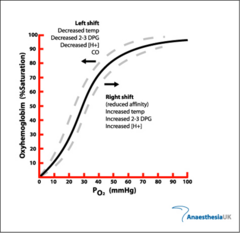
O2 Saturation Curve
Hgb-Oxygen Dissociation Curve is also known as
curve is positive and sigmoid (S-shaped)
high O2 demand
being warm
produce large amounts of CO2
being acidic
Metabolically active tissues have the following characteristics (4)
**hint: what happens when you work out
high temperatures
_________ temperatures decrease O2 affinity of hgb & O2 is released
Bohr effect
the effect pH has on the relationship between hgb and oxygen
Haldane Effect
removal of oxygen from Hgb increases Hgb's affinity for CO2 (adds CO2 to get rid of from body)
hypercapnia
increased carbon dioxide in the blood
hypocapnia
decreased carbon dioxide in the blood
2,3-Diphosphoglycerate
aka 2,3-DPG
2,3-DPG
a phosphate compound found in RBCs
destabilizes the bond of hgb-O2, releasing O2
decreased O2 affinity
increased levels of 2,3-DPG leads to __________ O2 affinity
hypoxic states
high 2,3-DPG can be observed in what type of state?
glycolysis increases, leading to increased levels of 2,3-DPG and decrease in O2 affinity
increased O2 affinity
decreased levels of 2,3-DPG leads to __________ O2 affinity
left shift
increased pH (acidic)
decreased PCO2
decreased temp
decreased 2,3-DPG
presence of carboxyhemoglobin (decrease in bound O2)
right shift
decreased pH (alkaline)
increased PCO2
increased temp
increased 2,3-DPG
increased affinity of hgb for O2
A left shift on the ODC indicates
decreased affinity of hgb for O2
A right shift on the ODC indicates
left shift
Fetal hgb (HgbF) and other variants cause (right / left) shift
Bicarbonate (HCO3-)
Carbamino (CO2+Hgb) Compounds
Dissolved Carbon Dioxide (dCO2)
Carbonate (CO3-)
Carbonic acid (H2CO3)
five forms that constitutes the total CO2 content (tCO2)
Bicarbonate, Carbamino compounds, Dissolved CO2
three main transporters of CO2 in the body
HCO3- (bicarb)
CO2 is transported in the blood primarily as
~70%
Bicarbonate makes up _______% of tCO2 in plasma
3 ways HCO3- can form
- H2CO3 can dissociated into HCO3- and H+
- HCO3- forms when carbonate (CO3-) combines with H+
- CO2 can combine directly with hydroxyl ions (OH-) to form HCO3-
5-7%
Dissolved CO2 makes up _______% of tCO2 in plasma
15-25%
Carbamino (CO2+Hgb) Compounds makes up _______% of tCO2 in plasma