chapter five: chemical bonding
 Call Kai
 Learn
 Practice Test
 Spaced Repetition
 Match
 Flashcards
 Knowt Play
1/134

There's no tags or description
Looks like no tags are added yet.
135 Terms
What is electronegativity?
The ability of an atom to attract electrons to itself in a chemical bond.
How does electronegativity change across the periodic table?
It generally increases left → right and decreases down a group.
Which element is the most electronegative?
Fluorine.
What is a pure covalent bond?
A bond in which electrons are shared essentially equally.
What is a polar covalent bond?
A bond in which electrons are shared unequally because one atom attracts them more strongly.
What determines how polar a bond is?
The electronegativity difference (ΔEN) between the bonded atoms.
What does δ⁺ mean?
A partial positive charge.
What does δ⁻ mean?
A partial negative charge.
In a polar bond, which atom gets δ⁻?
The more electronegative atom.
What is a dipole moment?
A measure of the separation of positive and negative charge.
What is the equation for dipole moment?
μ = qr, where q is separated charge and r is the distance between charges.
What unit is commonly used for dipole moments?
Debye (D).
What happens to percent ionic character as ΔEN increases?
It generally increases.
What is the basic Lewis-structure electron-counting rule for a negative ion?
Add one electron for each negative charge.
What is the rule for a positive polyatomic ion?
Subtract one electron for each positive charge.
What is a skeletal structure?
The arrangement showing which atoms are connected, before completing electron placement.
Why is hydrogen usually terminal in a Lewis structure?
Hydrogen forms only one bond.

What is resonance?
Two or more valid Lewis structures with the same atom arrangement but different electron arrangements.
(Resonance Arrows indicate two equivalent representations)

What is a resonance hybrid?
The actual structure, which is an average/intermediate of its resonance structures.
Do resonance structures always contribute equally?
No; some contributors are more important than others.
When are resonance structures equivalent?
When they have the same energy and equivalent atom/electron arrangements.
What is formal charge used for?
To compare possible Lewis structures and identify the more favorable one.
What is the formal-charge equation?
Formal charge = valence electrons − nonbonding electrons − ½(bonding electrons).
What should the total formal charge equal?
The overall charge of the molecule or ion.
What makes a Lewis structure generally more favorable?
Smaller formal charges, with negative charge preferably on more electronegative atoms.
What is an odd-electron species?
A species with an odd total number of valence electrons, so not every atom can have an octet.
What is a free radical?
A species containing an unpaired electron.
(Relevant to exceptions of the octet rule)
What is an incomplete octet?
An atom having fewer than eight electrons around it.

Which elements commonly forms incomplete octets?
Boron & Aluminum
ALWAYS CHECK FORMAL CHARGES!!!
What is an expanded octet?
More than eight electrons around a central atom.
Which atoms can commonly have expanded octets?
Elements in period 3 and beyond can commonly expand their octets.
What are the three major octet-rule exceptions?
Odd-electron species, incomplete octets, and expanded octets.
What is bond energy?
The energy required to break a chemical bond.
How are bond strength and bond length related?
Stronger bonds are generally shorter.
Which is strongest: single, double, or triple bonds?
Triple bonds.
Which is shortest: single, double, or triple bonds?
Triple bonds.
What is Valence-Shell Electron-Pair Repulsion (VSEPR)?
a chemical model used to predict the three-dimensional shapes of molecules based on the repulsion between electron pairs surrounding a central atom
What determines molecular geometry in VSEPR?
Repulsions between electron groups around the central atom.
What is an electron group?
A bonding region or a lone pair around the central atom.
What is the difference between electron and molecular geometry?
Electron geometry includes lone pairs; molecular geometry describes atom positions only.

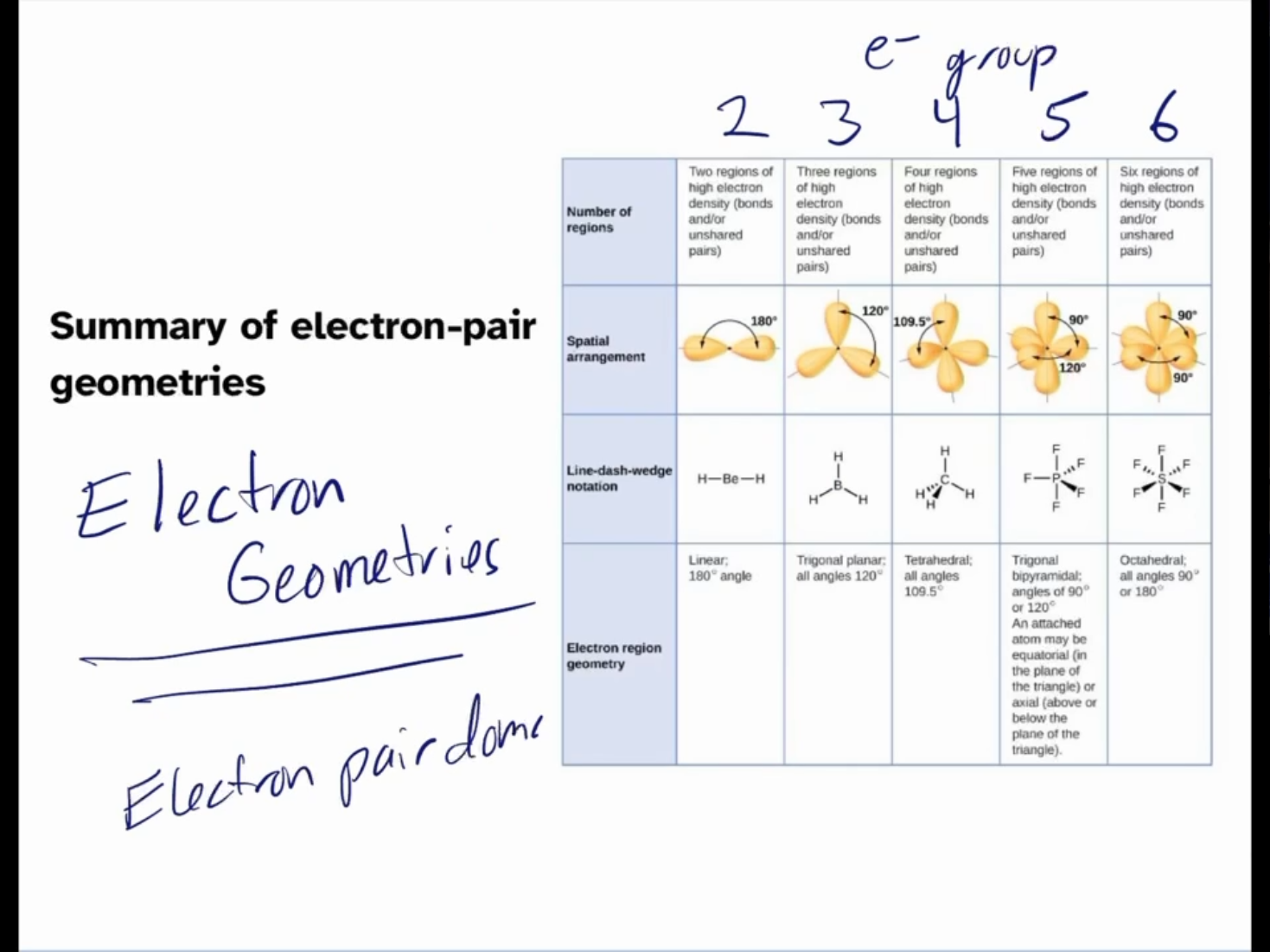
What are the five basic electron geometries?
Linear, trigonal planar, tetrahedral, trigonal bipyramidal, octahedral.

What is the electron geometry for 2 electron groups?
Linear, 180°.
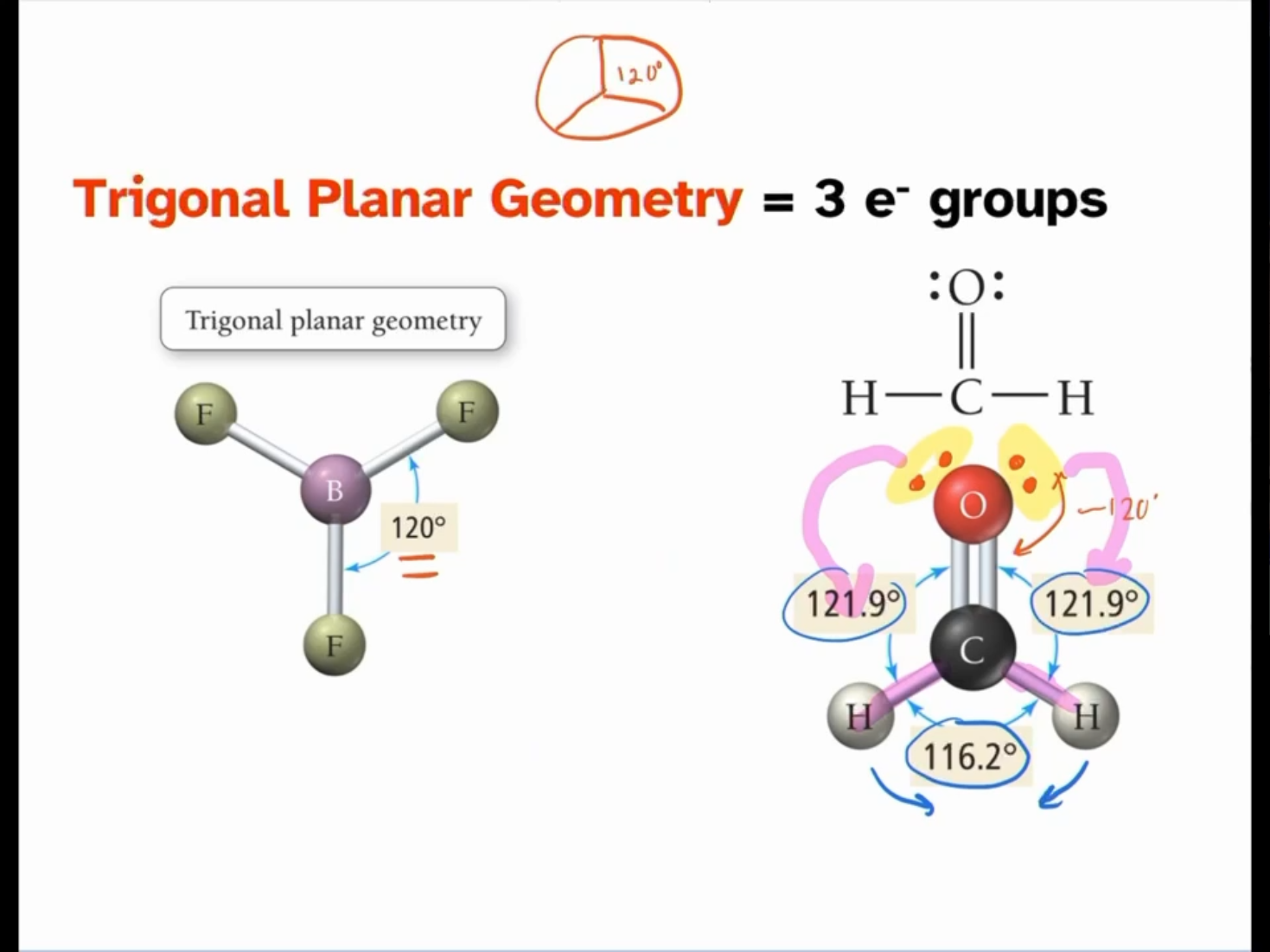
What is the electron geometry for 3 electron groups?
Trigonal planar, 120°.
(In image: the additional electrons on Oxygen push the angles further, but the important thing to know is they’re all around 120).
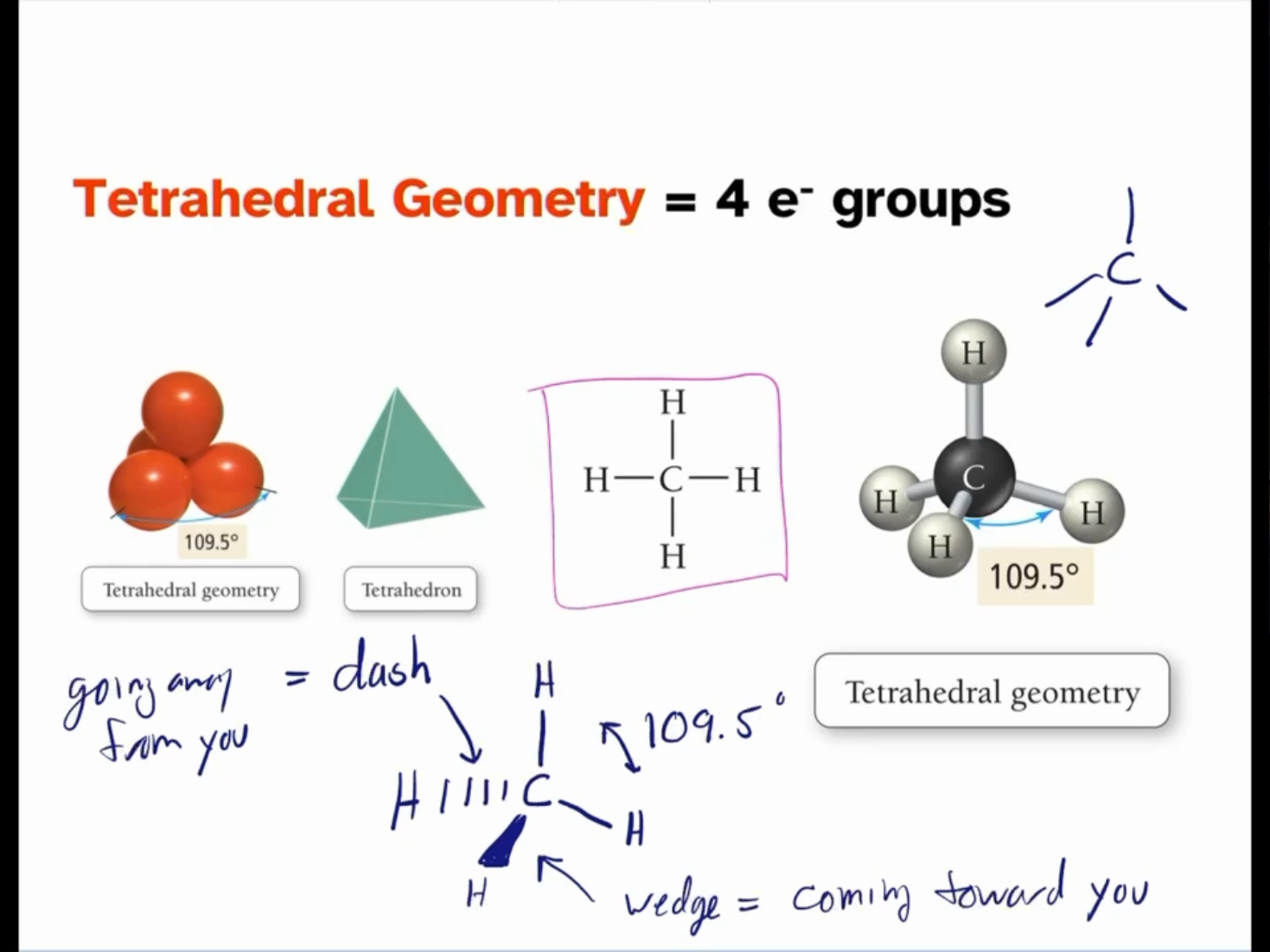
What is the electron geometry for 4 electron groups?
Tetrahedral, 109.5°.
What is the electron geometry for 5 electron groups?
Trigonal bipyramidal, with 90°, 120°, and 180° angles.

What is the electron geometry for 6 electron groups?
Octahedral, with 90° and 180 angles.
Which repulsions are strongest?
Lone pair–lone pair > lone pair–bonding pair > bonding pair–bonding pair.
Where do lone pairs prefer to go in trigonal bipyramidal geometry? Why?
Equatorial positions.
In an axial position, a lone pair experiences three strong 90° repulsive interactions with the equatorial bond pairs. (pushing on three bonds)
In an equatorial position, a lone pair experiences only two 90° repulsive interactions (with the axial bond pairs) (pushing on two bonds)
What molecular geometry results from 4 electron groups and 3 bonding groups?
Trigonal pyramidal.
What molecular geometry results from 4 electron groups and 2 bonding groups?
Bent.

What molecular geometry results from 5 electron groups and 4 bonding groups?
Seesaw.

What molecular geometry results from 5 electron groups and 3 bonding groups?
T-shaped.

What molecular geometry results from 6 electron groups and 5 bonding groups?
Square pyramidal

What molecular geometry results from 6 electron groups and 4 bonding groups?
Square planar.
What determines whether an entire molecule is polar?
Polar bonds plus the molecule's 3D geometry and whether bond dipoles cancel.

Why can a molecule with polar bonds still be nonpolar?
Its bond dipoles can cancel because of its symmetrical geometry.
Equal and opposite directions
What is the polarity of CO₂?
Nonpolar; its linear bond dipoles cancel.
What is the polarity of CCl₄?
Nonpolar; its tetrahedral bond dipoles cancel.
What is the polarity of CH₃F?
Polar; its tetrahedral bond dipoles do not cancel.
What is the polarity of H₂O?
Polar; its bent geometry prevents cancellation.
Practice: Classify Ba–O, I–I, C–S, C–F, N–O, B–N, Li–Br, and O–O.
Ba–O ionic; I–I nonpolar; C–S nonpolar; C–F polar; N–O polar; B–N polar; Li–Br ionic; O–O nonpolar.
Practice: How do you determine electron and molecular geometry?
Count electron groups, identify electron geometry, then ignore lone pairs to determine molecular geometry.
Practice: How do you determine molecular polarity?
Combine bond polarity with 3D geometry and determine whether the bond dipoles cancel.
Practice: Draw Lewis structures for PH₃, SCl₂, HI, CH₄, NF₃, HBr, SBr₂, CCl₄, SF₂, and SiH₄.
Use total valence electrons, connect atoms, complete terminal octets, place remaining electrons, and form multiple bonds if needed.
Practice: Draw Lewis structures for HCOOH, CH₃SH, CH₂O, C₂Cl₄, Cl₂CO, CH₃OH, and CH₃OCH₃.
Use the molecular connectivity, count valence electrons, complete octets, and add multiple bonds when needed.
Practice: Which species require resonance/formal-charge analysis?
Examples include CO₃²⁻, NO₂⁻, NO₃⁻, SO₃²⁻, SO₄²⁻, ClO₃⁻, ClO₄⁻, and related polyatomic ions.
Practice: How do you choose between competing Lewis structures?
Calculate formal charges and prefer structures with smaller charges and appropriate charge placement.
Practice: What are the important resonance structures of acetate, CH₃COO⁻?
Two equivalent structures with the C=O bond alternating between the two oxygens.
Practice: What is the best resonance structure for phosgene, Cl₂CO?
The structure with C=O and single C–Cl bonds is favored.
Practice: Which species illustrate incomplete or expanded octets?
Examples include BH₃/BF₃ for incomplete octets and PF₅, SF₄, I₃⁻, ClF₅, and IF₅ for expanded octets.
Practice: Rank H₃C–CH₃, H₂C=CH₂, and HC≡CH by increasing C–C bond strength.
H₃C–CH₃ < H₂C=CH₂ < HC≡CH.
Practice: Rank H₃C–CH₃, H₂C=CH₂, and HC≡CH by decreasing C–C bond length.
H₃C–CH₃ > H₂C=CH₂ > HC≡CH.
Practice: Which has the stronger and shorter N–N bond: H₂NNH₂ or HNNH?
HNNH; it has the higher N–N bond order.
Practice: AB₃ has trigonal planar geometry. How many electron groups are on A?
3 electron groups.
Practice: AB₂ is linear. How many electron groups can A have?
2 electron groups or 5 electron groups; XeF₂ is an example of 5-group linear geometry.
Practice: Determine the geometry of CI₄, NCl₃, OF₂, and H₂S.
CI₄ tetrahedral; NCl₃ trigonal pyramidal; OF₂ bent; H₂S bent.
Practice: Determine the geometry of CS₂, SCl₂, CHF₃, and PF₃.
CS₂ linear; SCl₂ bent; CHF₃ tetrahedral; PF₃ trigonal pyramidal.
Practice: Which has the smaller bond angle, H₃O⁺ or H₂O?
H₂O; it has two lone pairs compared with one in H₃O⁺.
Practice: Which has the smaller bond angle, ClO₄⁻ or ClO₃⁻?
ClO₃⁻; its lone pair compresses the bond angles.
Practice: Determine the geometry of IF₄⁺, SBr₆, PCl₅, and BrF₅.
Square planar; octahedral; trigonal bipyramidal; square pyramidal.
Practice: Determine the geometry of IBr₄⁻, SCl₄, ClF₃, and IF₂⁻.
Square planar; seesaw; T-shaped; linear.
Practice: Determine geometry around the interior atoms in CH₃OH, CH₃OCH₃, and H₂O₂.
C is tetrahedral; O is bent in the alcohol/ether; each O in H₂O₂ is bent.
Practice: Why are CO₂ and CCl₄ nonpolar despite having polar bonds?
Their symmetrical geometries cause the bond dipoles to cancel.
(note its the same element around the central atom).
Practice: Why is CH₃F polar?
Its bond dipoles do not cancel because the atoms attached to carbon are not all equivalent.
Practice: Determine the polarity of CH₂F₂, SiCl₄, and SeCl₆.
CH₂F₂ is polar; SiCl₄ and SeCl₆ are nonpolar.
Practice: Determine the polarity of IF₅, SCl₂, and SCl₄.
All are polar because their geometries do not allow complete dipole cancellation.
Practice: What do compounds such as BaCO₃, Ca(OH)₂, KNO₃, NH₄Cl, KOH, and Sr(CN)₂ have in common?
They contain ionic interactions between ions and covalent bonds within polyatomic ions.
Practice: Why can soap remove nonpolar grease using polar water?
Soap has a nonpolar region that interacts with grease and a polar/ionic region that interacts with water.
Practice: What should you determine for the azide ion, N₃⁻?
Draw its three important contributing resonance structures and compare formal charges.
Practice: What does the acetamide problem demonstrate?
Resonance gives the C–N bond partial double-bond character, helping explain why the nitrogen is nearly planar.
Practice: What does methyl azide, CH₃N₃, test?
VSEPR geometry and bond-angle/bond-length comparisons around its interior atoms.
Practice: What are the strengths and limitations of the Lewis model?
It is useful for electron counting and bonding patterns but oversimplifies real electron distribution and bonding.
Practice: What is the fundamental idea behind VSEPR?
Electron groups repel and arrange to maximize separation and lower potential energy.
Practice: Why are methane's bond angles 109.5° instead of 90°?
Four electron groups arrange tetrahedrally in 3D to maximize separation.
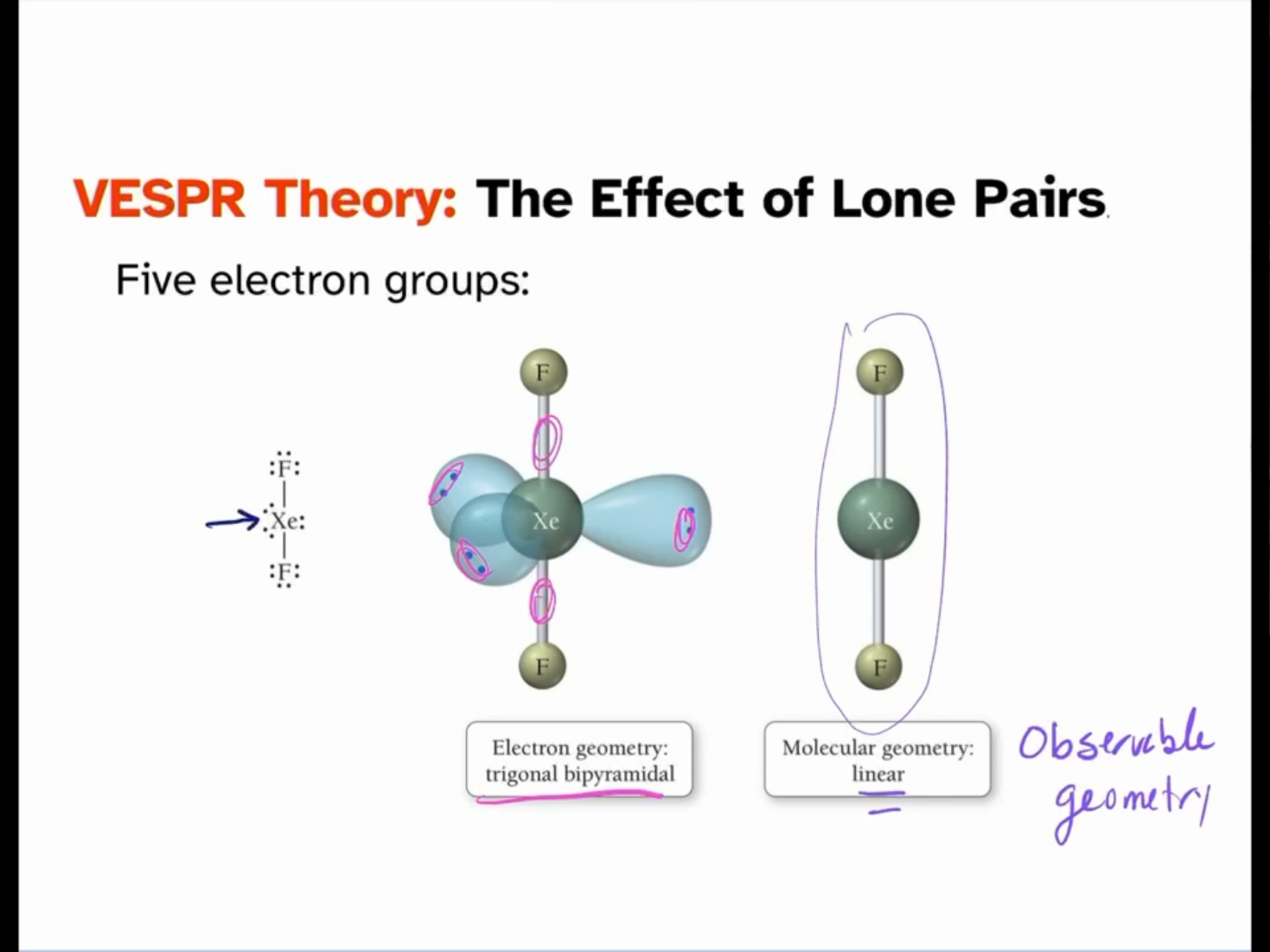
Practice: What two electron-group counts can produce a linear molecule?
2 groups: 2 bonds and 0 lone pairs; 5 groups: 2 bonds and 3 lone pairs, such as XeF₂.
XeF₂ is OBSERVED to be linear bc the lone pair groups even out (see image).
Practice: What formula forms from Al and O?
Al₂O₃.
Practice: What is the complete Lewis-structure workflow?
Count electrons → draw the skeletal structure → distribute electrons → check octets → add multiple bonds → calculate formal charges → add resonance structures if needed.
Practice: What should you determine for CS₂, NCl₃, CF₄, and CH₂F₂?
Lewis structure, molecular geometry, polar bonds, and overall molecular polarity.
Practice: What does the vitamin-solubility exercise demonstrate?
Mostly polar molecules tend to be water-soluble, while mostly nonpolar molecules tend to be fat-soluble.
Practice: What does the P₄ problem show?
P₄ has four equivalent P atoms arranged in a tetrahedral structure with single P–P bonds.