Week 3: Spatial Diffusion of Disease
 Call Kai
 Learn
Learn Practice Test
 Spaced Repetition
 Match
Match Flashcards
 Knowt Play
1/29

There's no tags or description
Looks like no tags are added yet.
Name | Mastery | Learn | Test | Matching | Spaced | Call with Kai | Chat |
|---|
No analytics yet
Send a link to your students to track their progress
30 Terms
Diffuse
To disperse/diverge from a central point; to spread widely, disseminate
In Geographic al contexts, the term diffusion, has distinct applications:
Expansion diffusion
Relocation diffusion
Combined diffusion: (Expansion + Relocation)
These 3 known methods are the ways disease spreads through populations and regions.
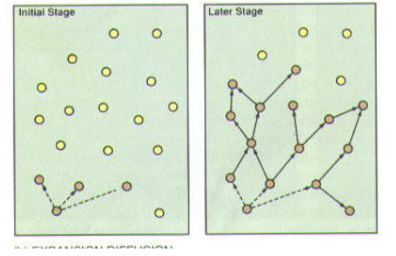
Expansion diffusion
The process whereby a phenomenon of interest (e.g information, a material artifact, a disease), spreads from one place to another.
In this expansion process, the item being diffused remains, and often intensifies, in the originating region, but new areas are also occupied by the item in subsequent time periods.
t1, t2, t3 denotes time 1, 2 and 3 respectively
Relocation Diffusion
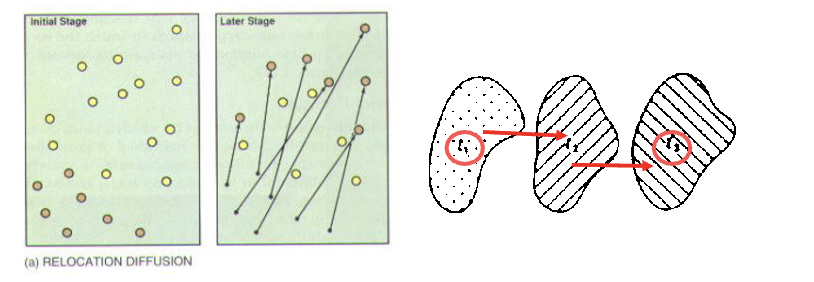
Is a spatial spread process, but the items being diffused leave the areas where they originated as they move to new areas
Cannot be in the same space at the same time
eg. a thief has to move from house to house and cannot be in all houses at once
Combined Diffusion: Expansion + Relocation
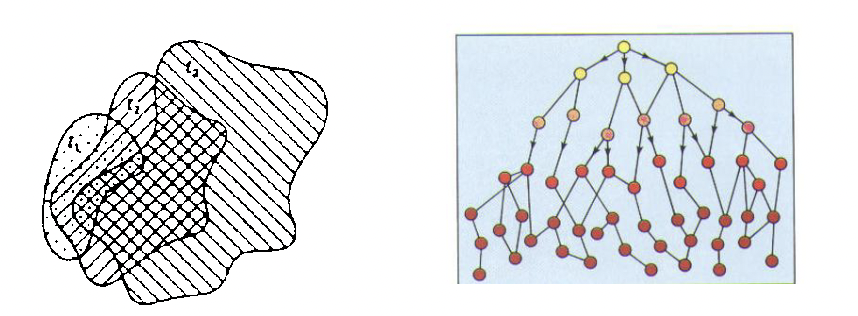
The diagram below how the two processes of expansion and relocation may be combined
the vector/ means in which the disease travels is important (intensity of virus)
level of immunity is also important
space vs place
space: A blank space, lacking meaning
place: A place with assigned meaning and culture
All 3 types of spatial diffusion
Expansion diffusion, relocation diffusion, and their combined processes:
t1, t2, t3 denotes time 1, 2 and 3 respectively
Examples of combined diffusion
The spread of the E1 Tor cholera epidemic, 1960-71
began in Sulawesi (Indonesia) in 1961 and spread throughout
→ Asia
→ Middle East
→ Africa,
→ → Europe
Expansion diffusion occurs in 2 ways:
Contagious spread
Transmission of disease through organisms
Hierarchical spread
Constructed patterns in the spread
eg. from larger to smaller network
or richer to poorer
Cascade diffusion
contagious spread
depends on direct contact.
strongly influenced by distance because nearby individuals or regions have a much higher probability of contact than remote individuals or regions.
Therefore, contagious spread tends to occur in a centrifugal manner from the source region outward.
Hierarchal spread
transmits through an ordered sequence of classes or places. example from large metropolitan centers to remote villages.
For example, within socially structured populations, innovations may be adopted first on the upper level of the social hierarchy and then trickle down to the lower levels
Cascade diffusion (subtype of hierarchical spread)
Refers to processes that always defaults to a downward spread,
from larger to smaller centers.
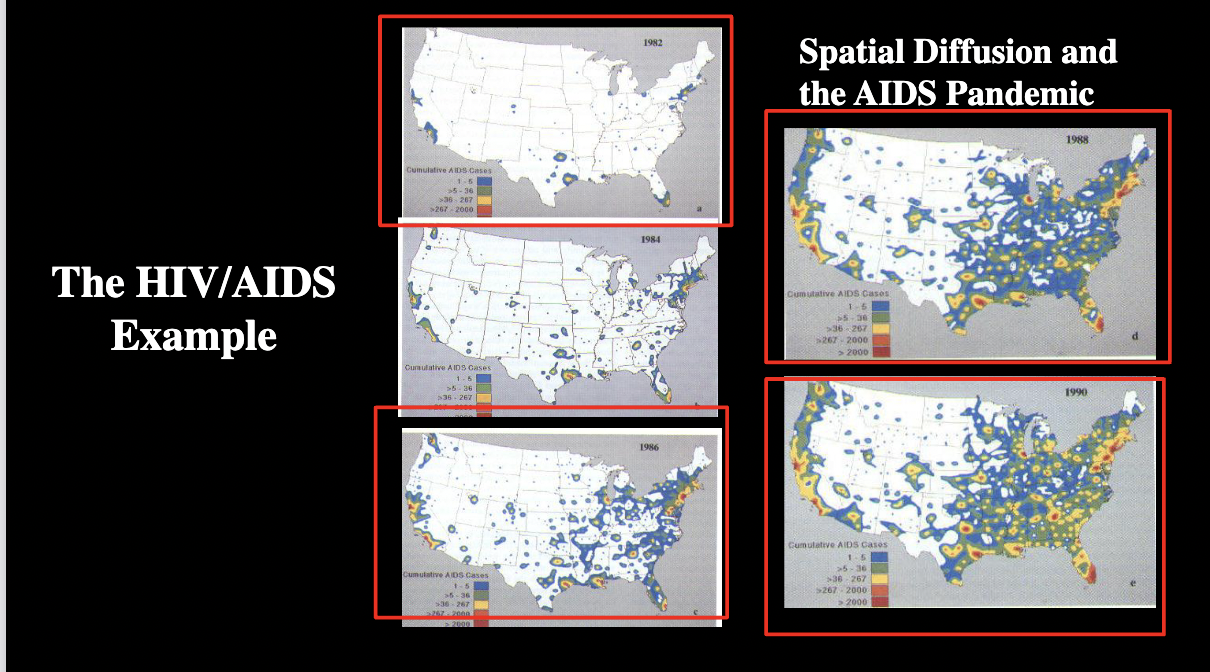
HIV/AIDS example
example of expansion
when considering social factors, obviously some aspect of hierarchy is involved
consider cities, airports, highly populated areas
Inter-spatial vs Intra-spatial
Inter-spatial: In-between spaces
Intra-spatial: inside spaces
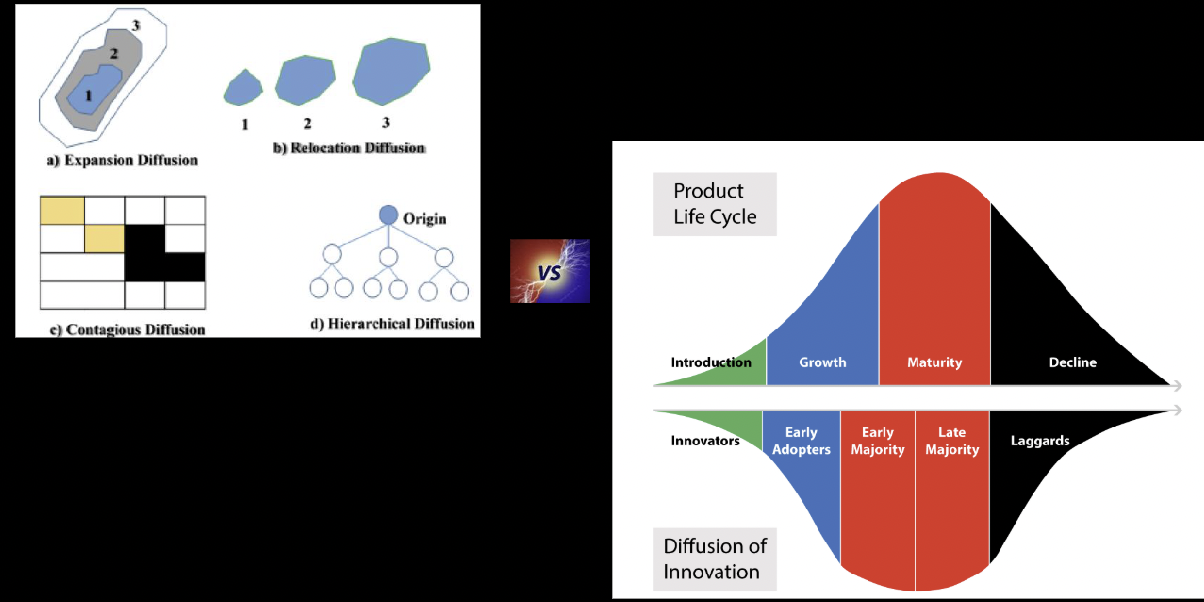
Torsten Hägerstand (1953) identified four (4) distinct stages in the passage of an innovation through an area
Primary stage
Diffusion stage
Condensing stage
Saturation stage
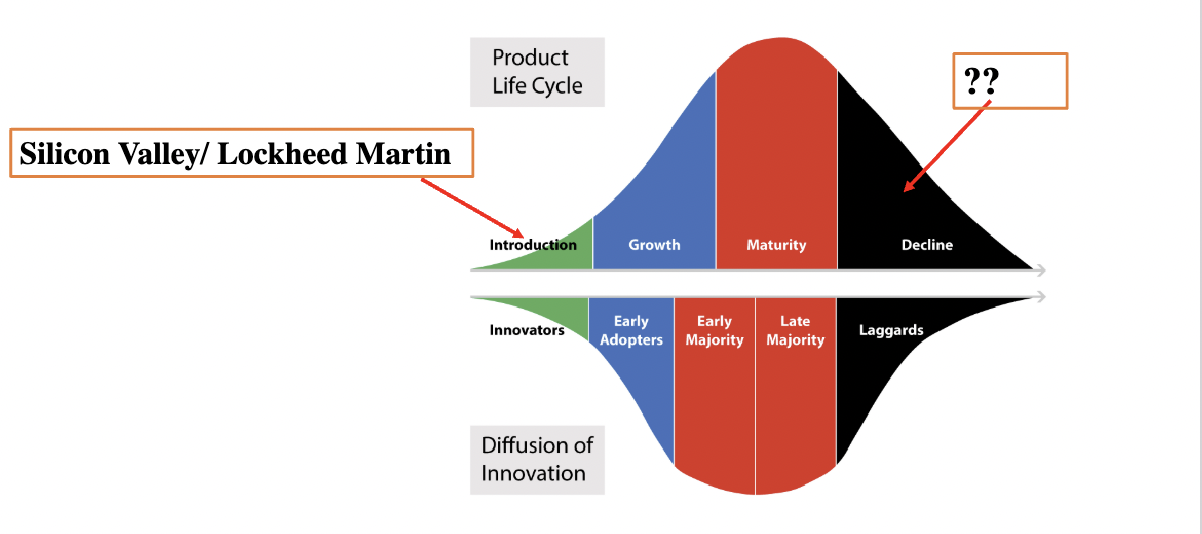
Technical Adoption
example:
Introduction: Silicon Valley (San Francisco)
Decline: when a phone stops working and the parts are not being made anymore
Primary Stage
Birthplace: marks the beginning of the diffusion process.
Patient zero
A centre of adoption is established at the origin.
There is a strong contrast in the level of adoption between this centre and remote areas which is reflected in the steep decline of the level of adoption curve beyond the origin.
Diffusion stage
The diffusion stage signals the start of the actual spread process
Patient 2, 3, 4
There is a powerful centrifugal effect, resulting in the rapid growth of acceptance in areas distant from the origin and by a reduction in the strong regional contrasts typical of the primary stage.
This results in a flattening of the slope of the proportion of adopters curve.
expansion spread, specifically contagious spread
Condensing stage
In the condensing stage, the relative increase in the numbers accepting an item is equal in all locations, regardless of their distance from the original innovation centre
The acceptance curve moves in a parallel fashion.
example of paradigm shift
Saturation stage
The final saturation stage is marked by a slowing and eventual cessation of the diffusion process, which produces a further flattening of the acceptance curve.
In this stage, the item being diffused has been adopted throughout the country, so that there is very little regional variation.
The shape of a changing diffusion profile
The shape of the changing diffusion profile in time and space has been formally modeled.
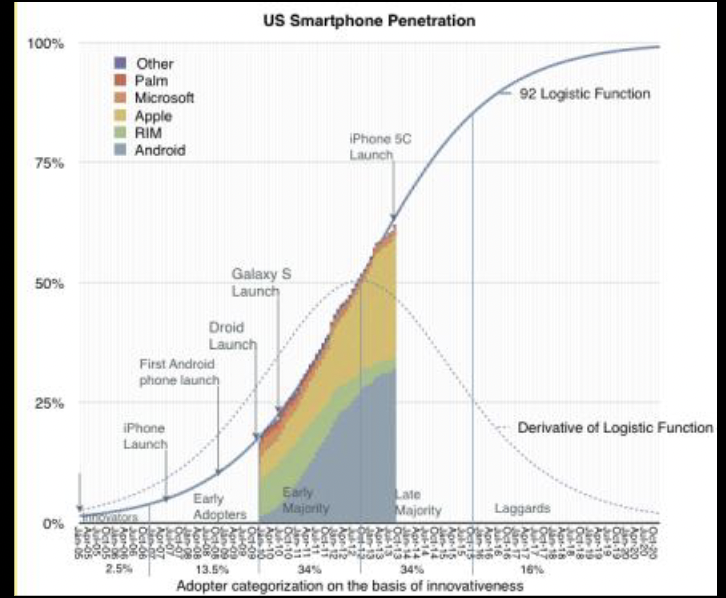
The temporal build-up in the number of adopters of an innovation follows an S-shaped curve when plotted against time, with a logistic curve as the mathematical form most commonly adopted.
S-shaped curve
Red line: levels of diffusion
Blue line: levels of interest
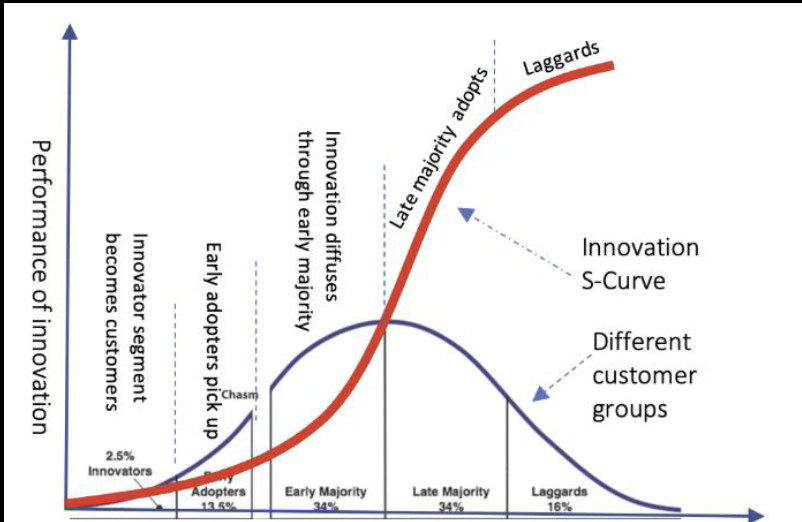
technology example
Condensation stage
Everyone has a phone, lots of kinds of phones exist
Epidemic: Oxford Dictionary definition
‘a disease prevalent among a people or community at a special time, and produced by some special causes generally not present in the affected locality’
Epidemic: Beneson definition
“The occurrence in a community or region of cases of an illness (or an outbreak) clearly in excess of expectancy. The number of cases indicating presence of an epidemic will vary according to the infectious agent, size and type of population exposed, previous experience or lack of exposure to the diseases, and time and place of occurrence; epidemicity is thus relative to usual frequency of disease in the same area, among the specified population, at the same season of the year.”
Beneson analysis
Occurrence and not quantity
goes on to stress that what constitutes an epidemic does not necessarily depend on large numbers of cases or deaths.
A single case of a communicable disease long absent from a population, or the first invasion by a disease not previously recognized in that area, requires immediate reporting and epidemiological investigation.
Two cases of such a disease associated in time and place are taken to be sufficient evidence of transmission for an epidemic to be declared
Disease vs epidemic
every epidemic is a disease, but not every disease is an epidemic
an epidemic causes unexpected chaos
Epidemics of communicable diseases are of two main types:
Propagated epidemic
Common-vehicle epidemic
Propagated Epidemic
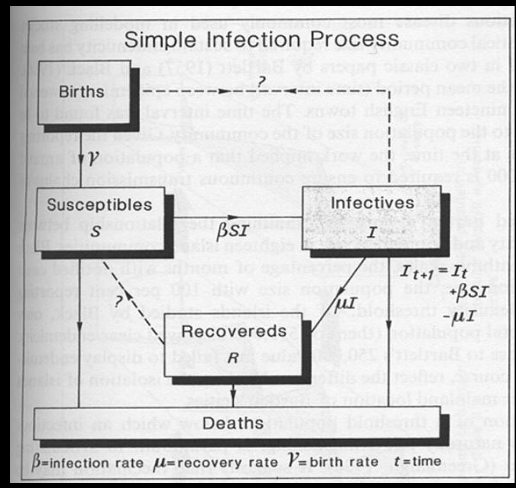
Results from the chain transmission of some infectious agent.
May be directly from person-to-person as in a measles outbreak, or indirectly via some intermediate vector (malaria) or a microparasite.
In some cases, indirect transmission may occur via humans (e.g., a mosquito-man-mosquito chain with malaria).
In others, the survival of the parasite is independent of man (thus, Pasteurella pestis, the cause of bubonic plague is continually propagated through rodents and the infection of man by an infected flea is in this respect an accidental diversion).
Common-vehicle epidemic
Results from the dissemination of a causative agent.
In this case, the epidemic may result from a group of people being infected... from a common medium (typically, water, milk, or food) which has been contaminated by a disease causing organism.
....E.g., cholera and typhoid